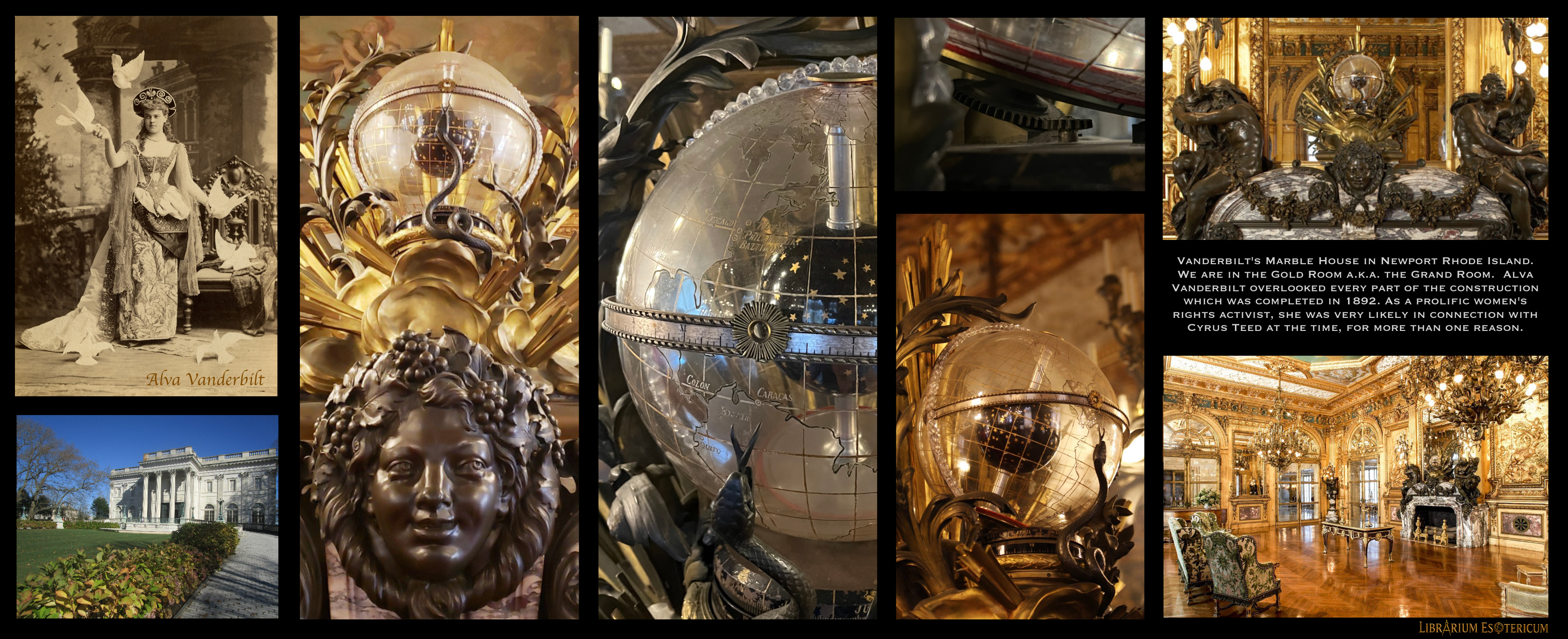
The connection presented here is built from three converging layers: Alva Vanderbilt Belmont as patron and symbolic architect of Marble House; Cyrus Teed’s Koreshan cosmology and its stationary enclosed-earth model; and the Gold Room globe-clock, where the earth, the heavens, the calendar, the city-time scale, and classical mythology are fused into one mechanical object.
1. Cyrus Teed and the period overlap
Cyrus R. Teed (1839–1908), who later took the name Koresh, founded the Koreshan movement and developed Cellular Cosmogony. In that system, the earth is understood as a stationary enclosing shell and the heavens are contained within. The late 1880s were crucial for the public emergence of the Koreshan movement: Teed's Chicago organization and publishing work were taking shape in precisely the same cultural moment in which Marble House was being built and furnished for William K. and Alva Vanderbilt.
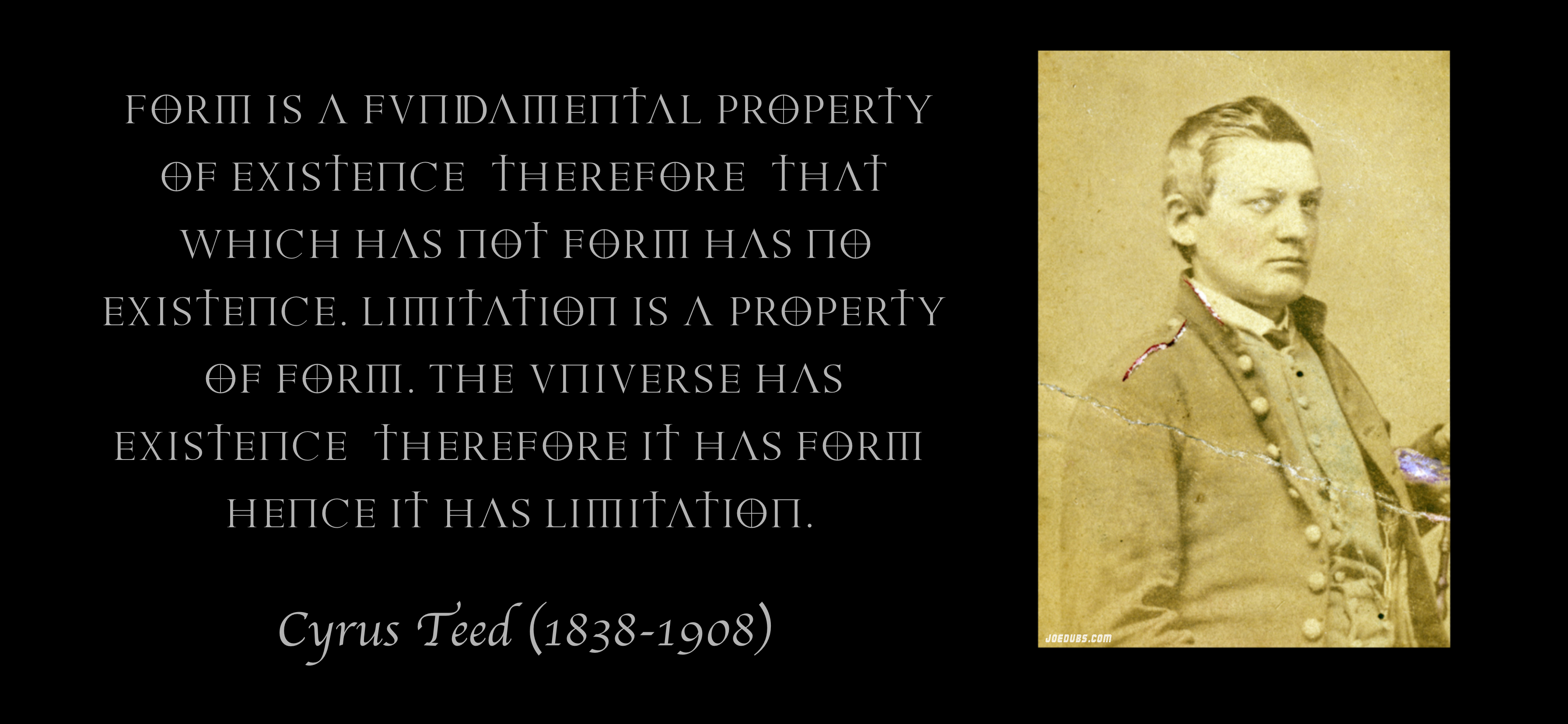
The overlap is not merely chronological. Both Marble House and Koreshanity are Gilded Age projects of cosmic order. Marble House expresses cosmic order through Beaux-Arts architecture, mythological program, mechanical clocks, mirrors, gilding, and a symbolic earth-and-universe globe. Koreshanity expresses cosmic order through religious science, the enclosed universe, and the doctrine of a stationary earth containing the heavens.
2. Alva Vanderbilt Belmont as patron
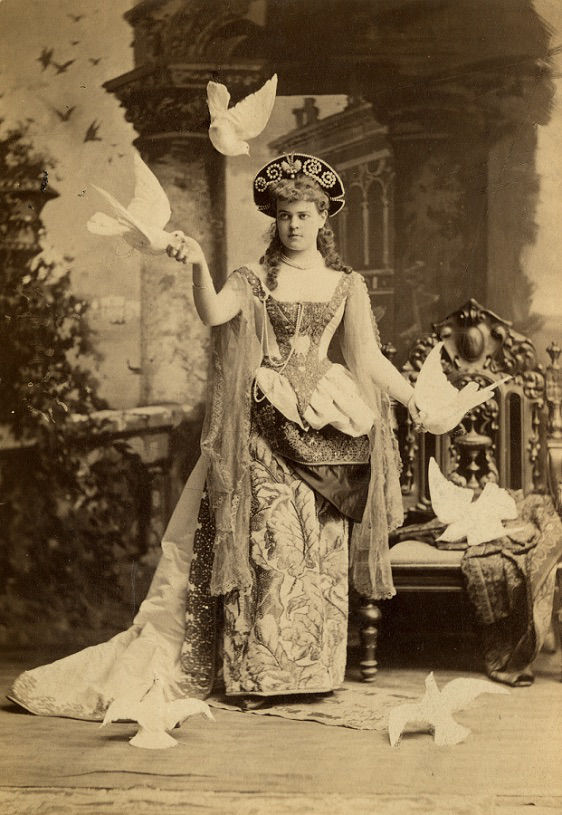
The National Historic Landmark nomination names Mrs. William K. Vanderbilt—later Mrs. Alva Belmont—as a significant person connected with Marble House and describes her collaboration with Richard Morris Hunt as a major act of cultural patronage. She understood the power of architecture and the arts in creating a dynastic image. The nomination also preserves her own comparison of Vanderbilt patronage with the Medici model: private wealth transformed into public art, beauty, and symbolic power. This is the setting in which the Gold Room should be read: not as random ornament, but as a programmatic chamber designed under Alva’s aesthetic and social ambition.
The later Alva Belmont also intersects the Koreshan record through reform and suffrage. In 1911, the Koreshan periodical The Flaming Sword directly discussed Mrs. O. H. P. Belmont’s model farm and also moved within the New York woman-suffrage environment. That does not require reducing Alva to a formal Koreshan member; the stronger point is that the Belmont world and the Koreshan world touched through reform culture, print culture, and a shared symbolic vocabulary of transformation.
3. The Marble House mantel globe: construction, materials, and form
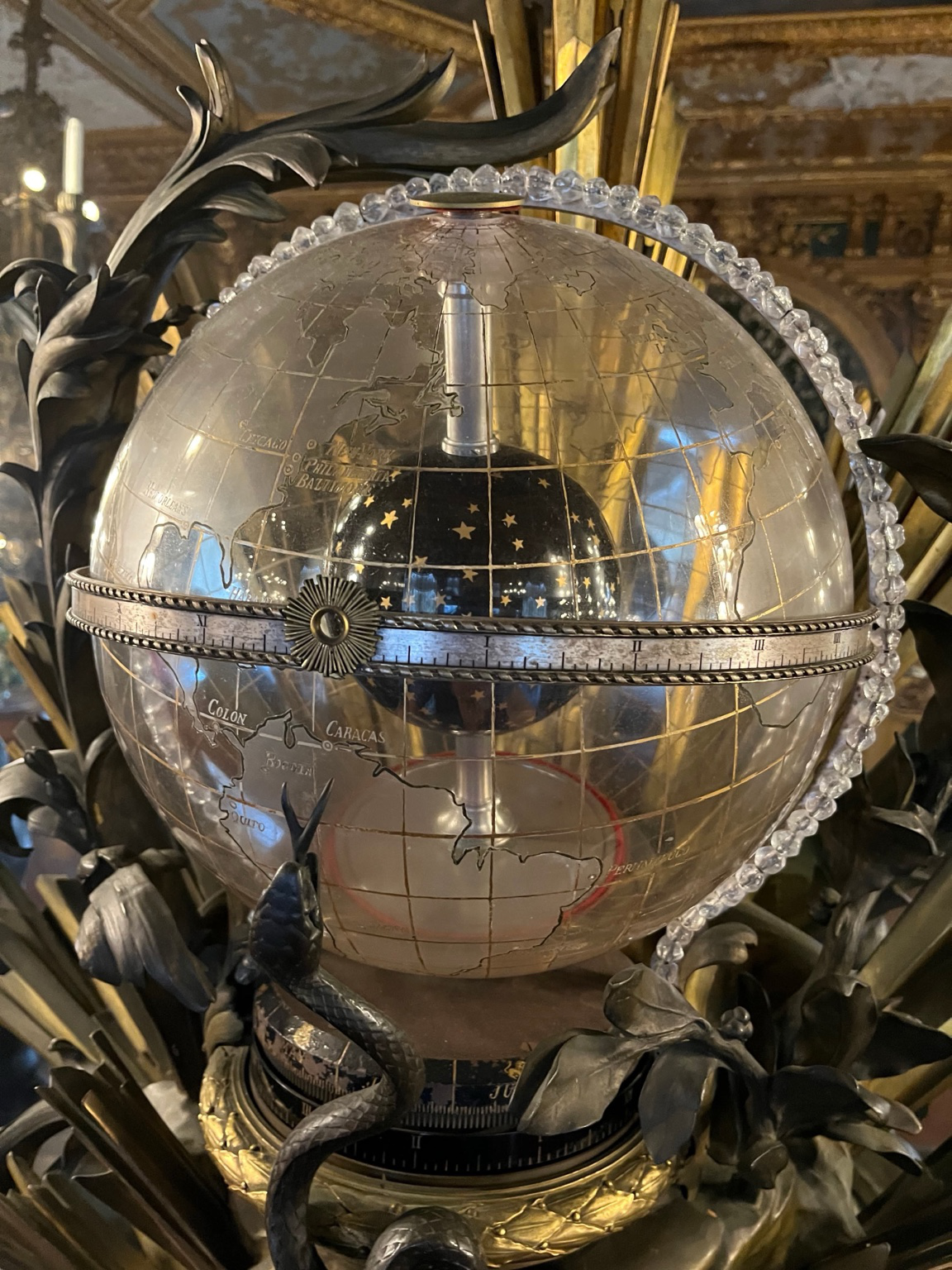
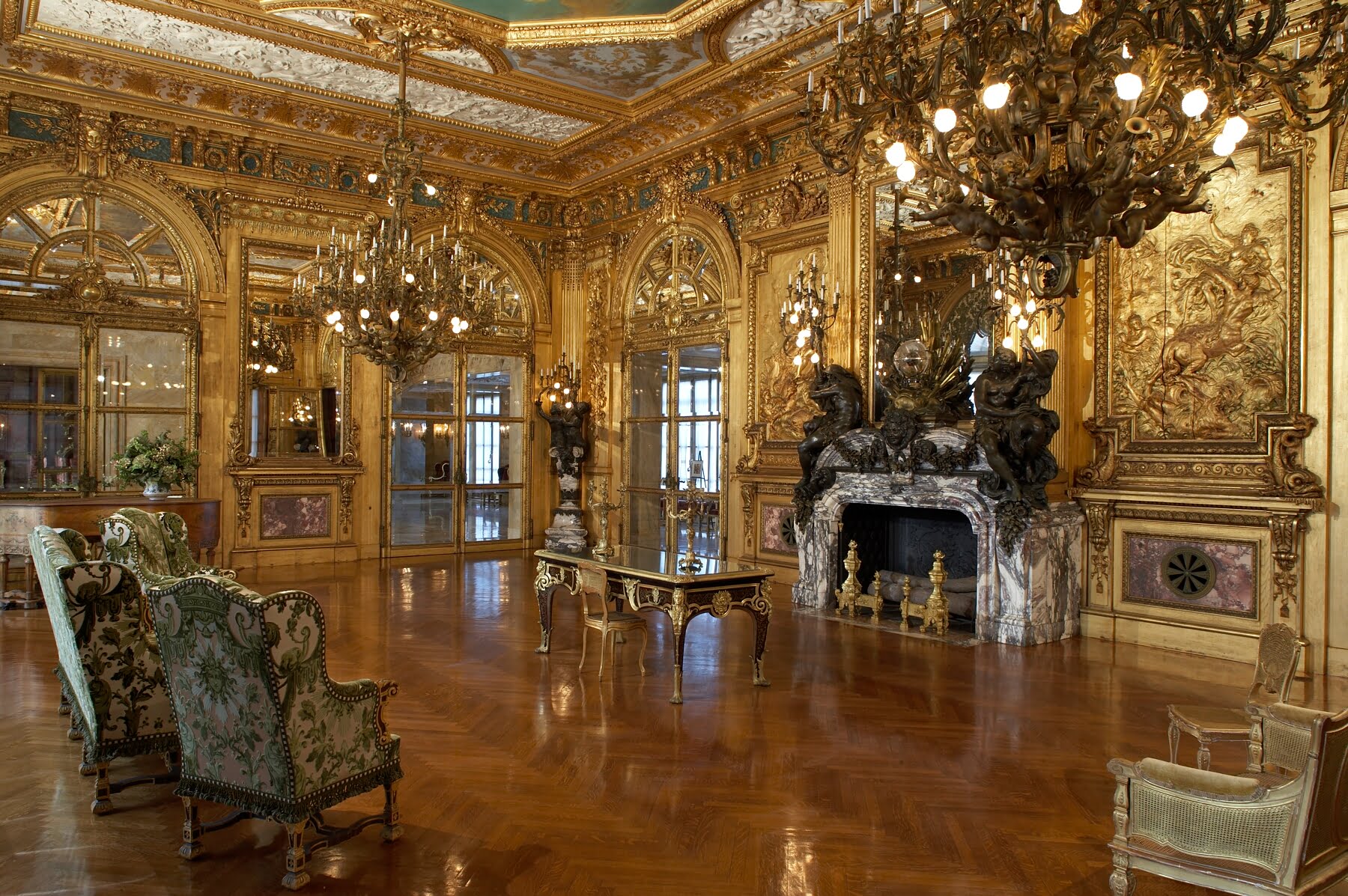
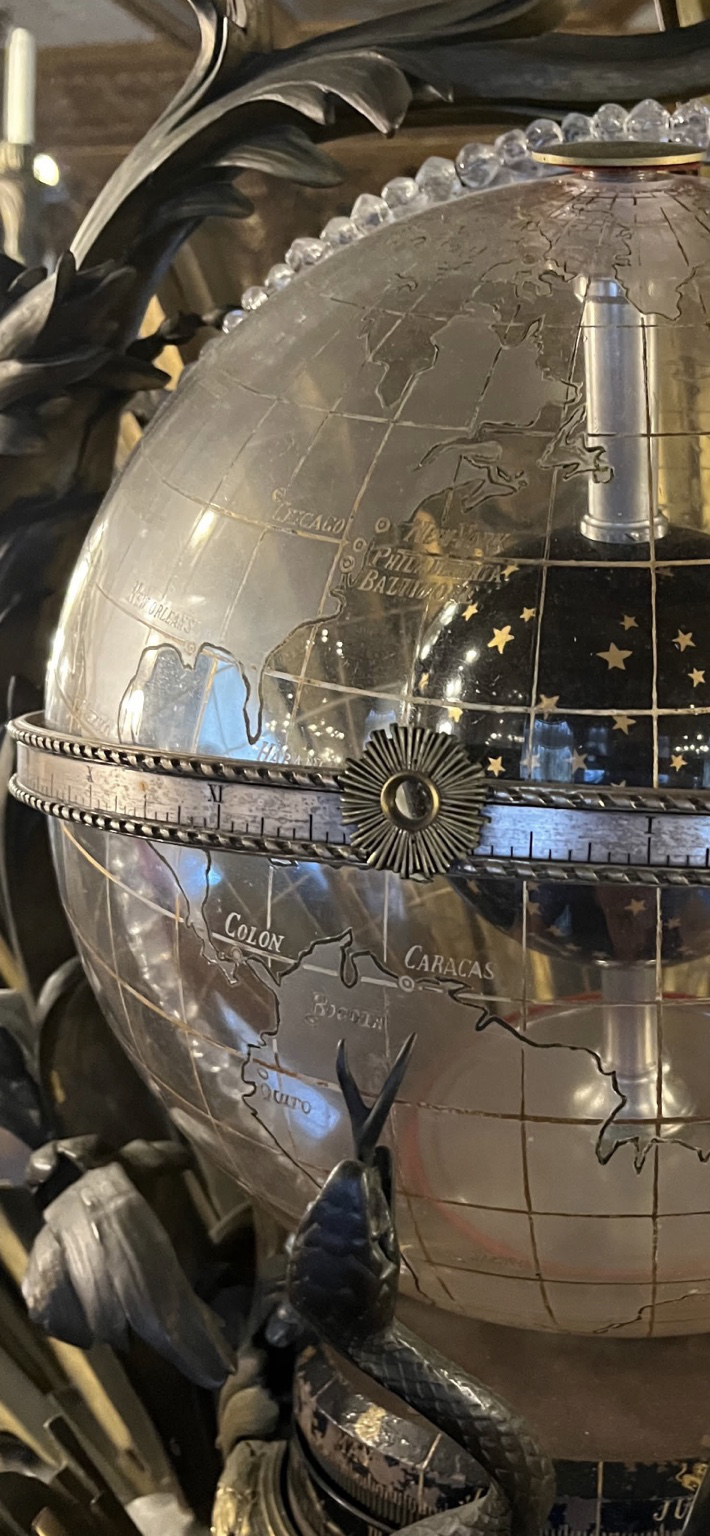
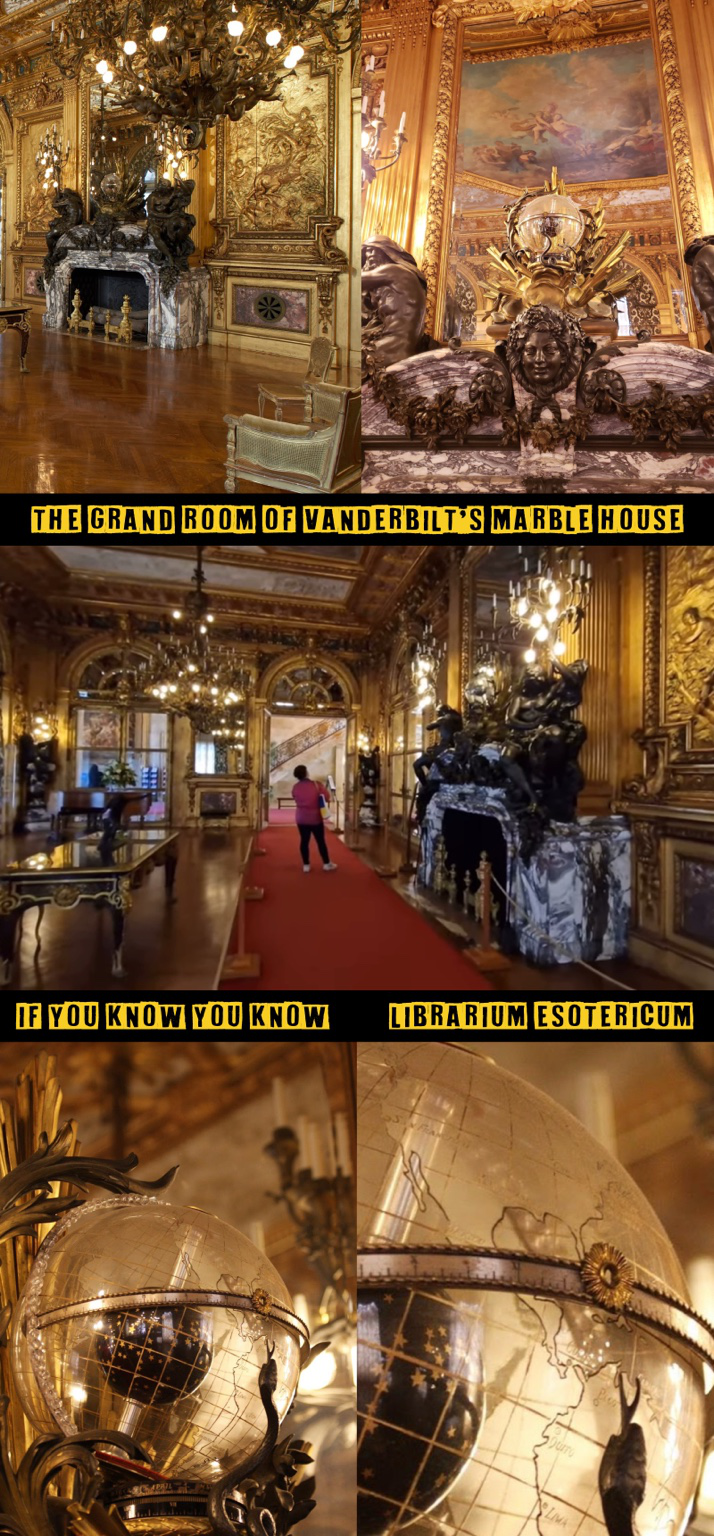
The National Historic Landmark nomination describes the Grand Salon fireplace as carved from French Fleur-de-Pêche marble. In the center of the mantel is a mask of Bacchus, God of Wine. Above that mantel is the clock in the shape of a globe. The official description says the outer globe represents the earth and that it revolved around a sphere representing the universe, while the clock displayed the month, day, and time in several cities simultaneously.
The photographs show how this description appears materially: a transparent outer terrestrial globe engraved or etched with continents, city names, and graticule lines; a dark inner star sphere; a metal equatorial band with numerals and scale divisions; a lower calendar ring; and a surrounding sculptural assembly of foliate bronze, crystal-like beads, gilded supports, and a serpent. The likely build combines engraved glass or crystal, silvered and gilded metal, painted or lacquered celestial surfaces, bronze/ormolu ornament, and precision clockwork.
4. The mechanism: stationary earth and rotating celestial center
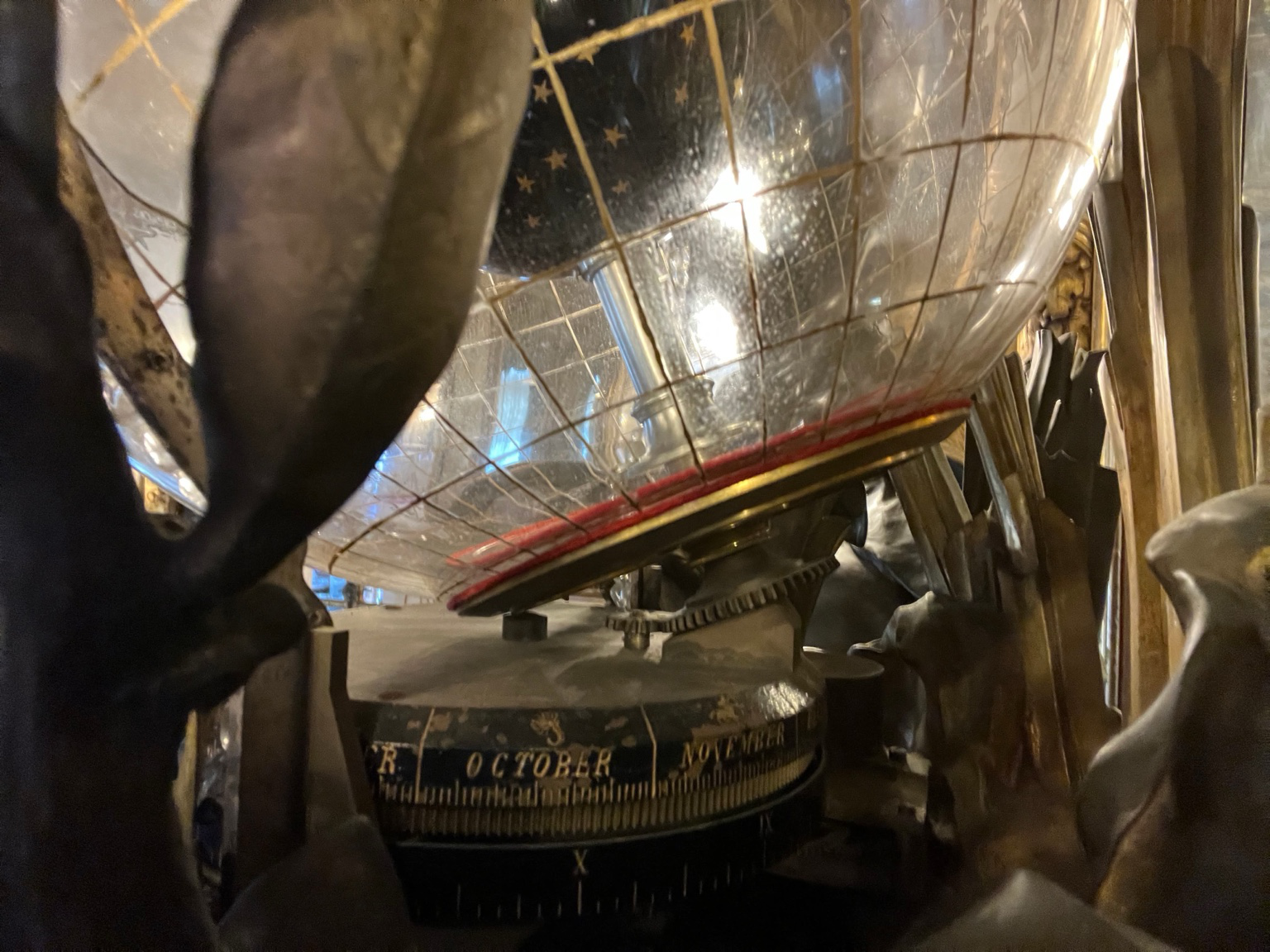
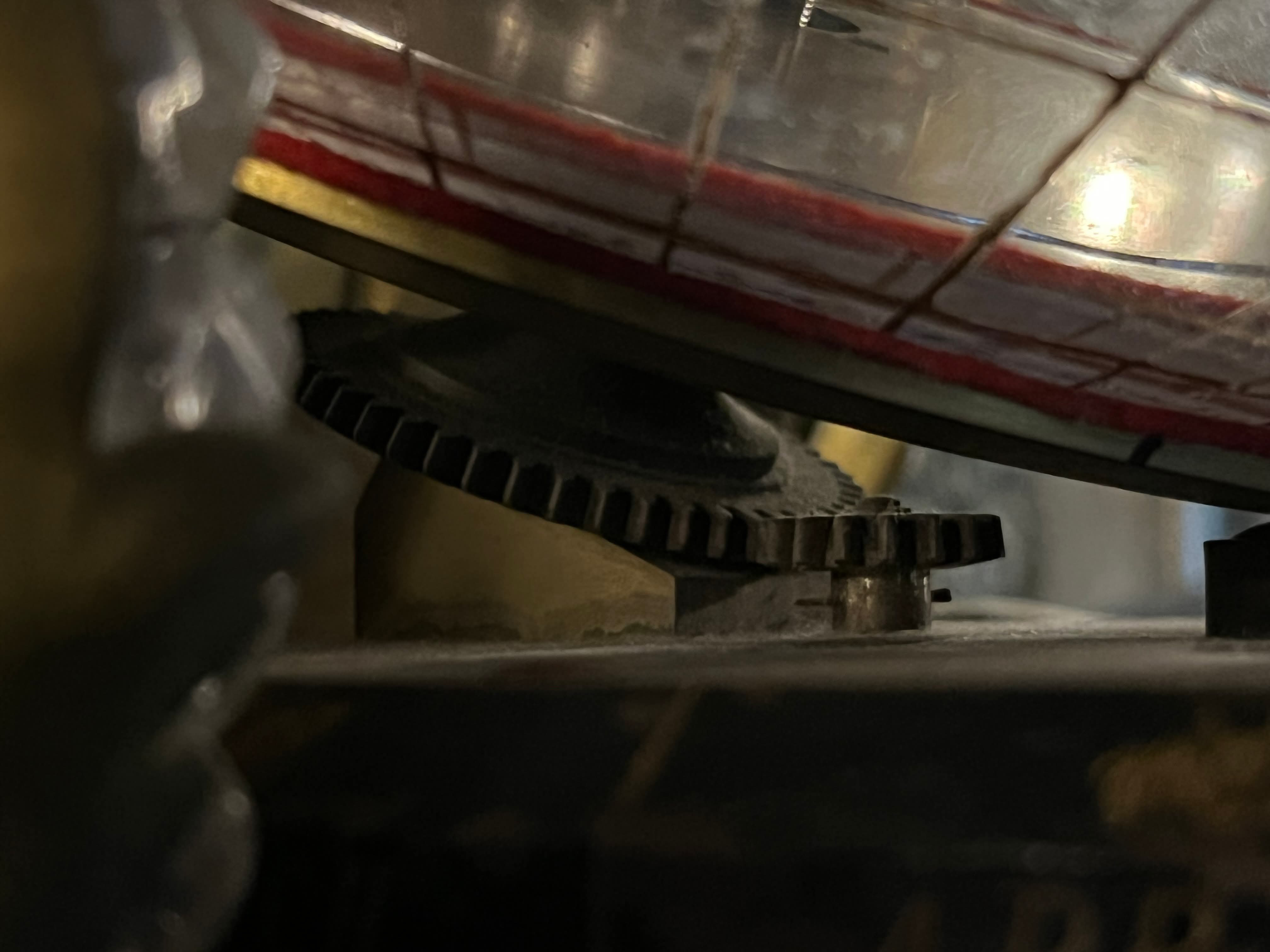
The underside photographs reveal the object as an operating mechanism rather than a static sculpture. The toothed gears, support shaft, and lower month ring show how the globe-clock could be driven and indexed through time. The month ring visible below the globe includes October and November, tying the mechanical assembly to calendrical motion. These details support the reported tradition that the mechanism was once operated by a key, and that the key was lost in the 1980s.
For the interpretive reading used in this brief, the terrestrial globe functions as the fixed earth-shell while the inner celestial sphere represents the moving heavens. This creates a striking visual parallel to Koreshan Cellular Cosmogony: a stationary earth containing a central cosmic mechanism. The National Register description establishes the official earth/universe relationship of the clock; the local key tradition and visible gearing add the mechanical layer, showing how the cosmic model was meant to move.
5. Why the globe resonates with Koreshan cosmology
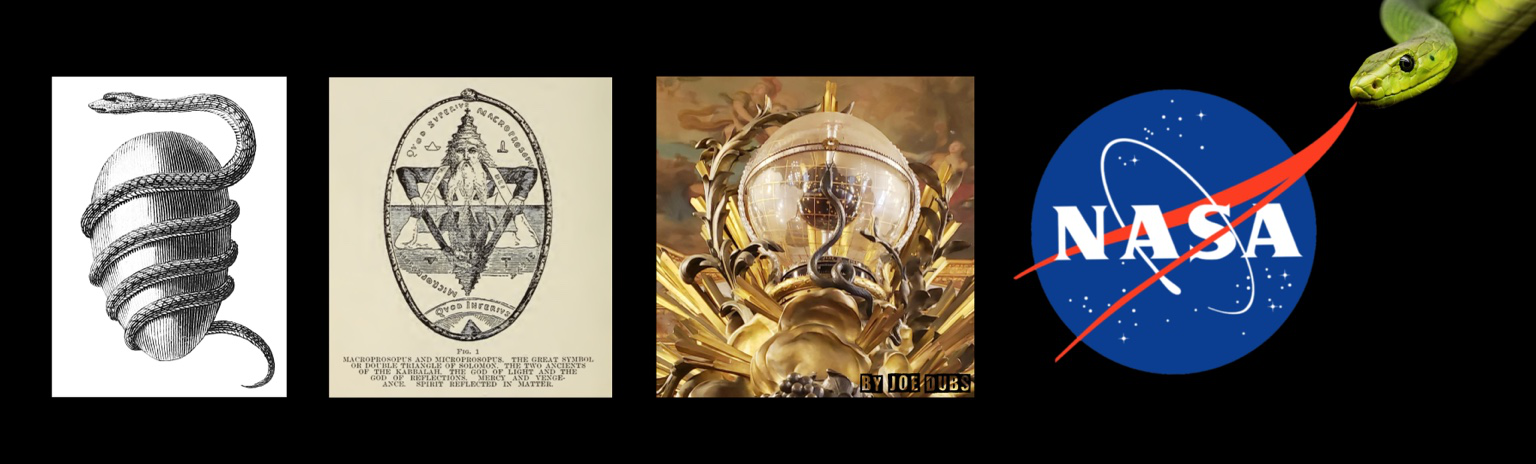
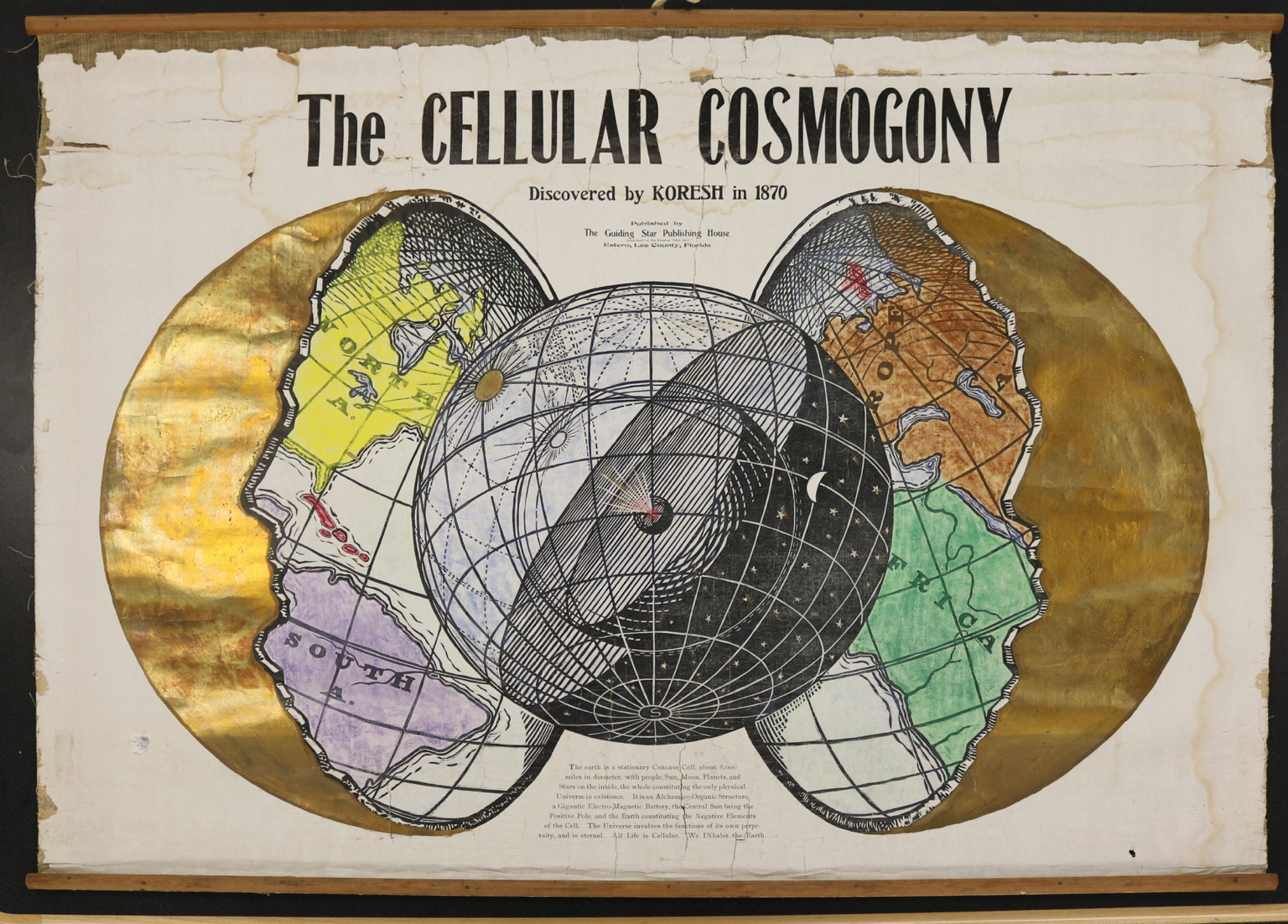
The Koreshan comparison depends on structure. Teed’s cosmology imagines the world as an enclosing shell, not a planet traveling through infinite space. The Marble House clock similarly stages the earth and universe as nested, enclosed, mechanically ordered spheres. It is a luxury Beaux-Arts object, but its symbolic grammar is cosmic: terrestrial geography outside, celestial stars inside, time measured below, and a serpent-wrapped ornamental body surrounding the whole.
That makes the clock more than decorative. It is a compressed cosmogram. Its imagery links earth, heaven, time, motion, fire, serpent, and royal/classical myth. Placed above the Bacchus mask in the Gold Room, the object becomes a symbolic axis: the lower fireplace and smoke below, the earth/universe sphere above, and the room’s mythological program around it.
In this framework, the Alva–Koreshan connection is not a single thin claim. It is a layered pattern: same time period, shared reform-era circulation, direct Koreshan print references to Alva Belmont’s world, and a Marble House cosmological object that strongly echoes the stationary enclosed-world idea at the heart of Teed’s teaching.
6. The Mythology of the Gold Room
Official National Historic Landmark text
The Grand Salon, decorated in the Louis XIV style, served as a reception and ballroom. The green silk cut velvet upholstery and draperies bear the Louis XIV motif of Apollo in a sun burst. The original draperies and upholstery fabric were made by Prelle & Co. in Lyon, France. Reproduction fabric was re-woven using the original nineteenth-century hand-loom weaving process, at Prelle & Co. In 2003 reproduction draperies were installed, and the room’s original Louis XIV style suite of furniture was re-upholstered.
The ceiling painting is attributed as eighteenth-century French, modeled after the work of the Italian artist Pietro da Cortona. The painting depicts Minerva (the Goddess of Wisdom and War) snatching a youth from his love. The painting is framed by a surround adapted from the ceiling of the Queen’s Bedroom at Versailles. The room’s two chandeliers were based on originals at the Château Maisons-Lafitte near Paris. They were originally piped for gas as well as wired for electricity. They are suspended from decorative masks representing Apollo.
The fireplace is carved from Fleur-de-Pêche marble from France. In the center of the mantel is a mask of Bacchus, the God of Wine. The clock above is in the shape of a globe. The outer globe represents the earth. This revolved around a sphere representing the universe. The clock displays the month, day, and time in several cities simultaneously. Immense bronze figures perched on the corners of the mantel depict Youth and Old Age. These were jointly inspired by Michelangelo’s allegorical figures of Night and Day in the Medici Chapel in Florence, as well as sculptures in the Salon of War at Versailles.
The room’s walls are dominated by four large-scale carved wood and 22-karat gold gilt panels representing scenes from classical mythology. The panels were made by Allard and Sons. Each is framed by a border of the Vanderbilt family emblems of acorns and oak leaves (symbolizing strength and longevity). The panels and the trophies above were inspired by panels in the Gallery of Apollo at the Louvre. The panel to the left of the fireplace depicts Poseidon (God of the Sea) with Thetis. To the right is Hercules aiming an arrow at Nessus (a Centaur seizing Hercules’ wife Deianira). Left of the center window is Demeter (Goddess of the Harvest) with Pan (God of Shepherds and Flocks). Right of the window there is a carving of Aphrodite (Goddess of Beauty) seen rising from the sea.
Mythological reading
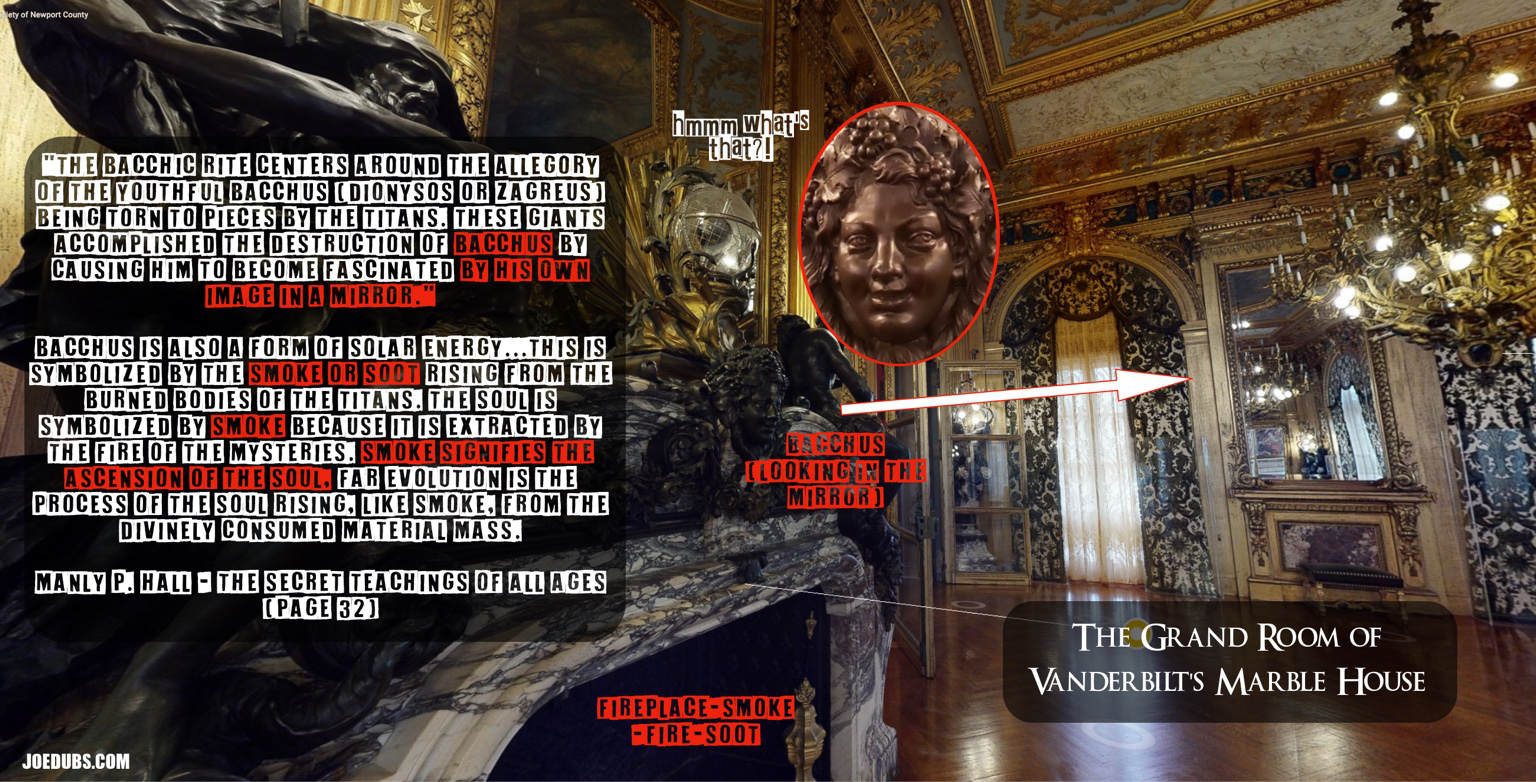
The official description gives the Gold Room an explicitly mythological frame. It names Apollo, Minerva, Bacchus, Youth and Old Age, Poseidon and Thetis, Hercules and Nessus, Demeter and Pan, and Aphrodite rising from the sea. These are not decorative accidents. They form a mythic field around the fireplace and globe-clock.
Bacchus introduces ecstasy, fire, wine, transformation, and rebirth. Demeter and Pan open the Eleusinian current of harvest, fertility, descent, and return. Apollo brings solar kingship and illumination. Minerva brings wisdom and war. Cronus brings time. Aphrodite rises from the sea. Poseidon rules the waters. Youth and Old Age guard the mantel as a pair of temporal powers.
The globe-clock sits above all of this as the cosmic diagram: earth below heaven, heaven within earth, time turning through the year.
Source Notes
- National Historic Landmark Nomination / NPS Form 10-900 for Marble House: construction and design, pp. 4–6; statement of significance and Alva Vanderbilt Belmont, pp. 10–13.
- Koreshan background: Florida Memory Koreshan Unity materials; The Flaming Sword, especially 1911 references to Mrs. O. H. P. Belmont and New York suffrage activity.
- User-supplied photographs and interpretive images are used as Figures 1–9 in this article.