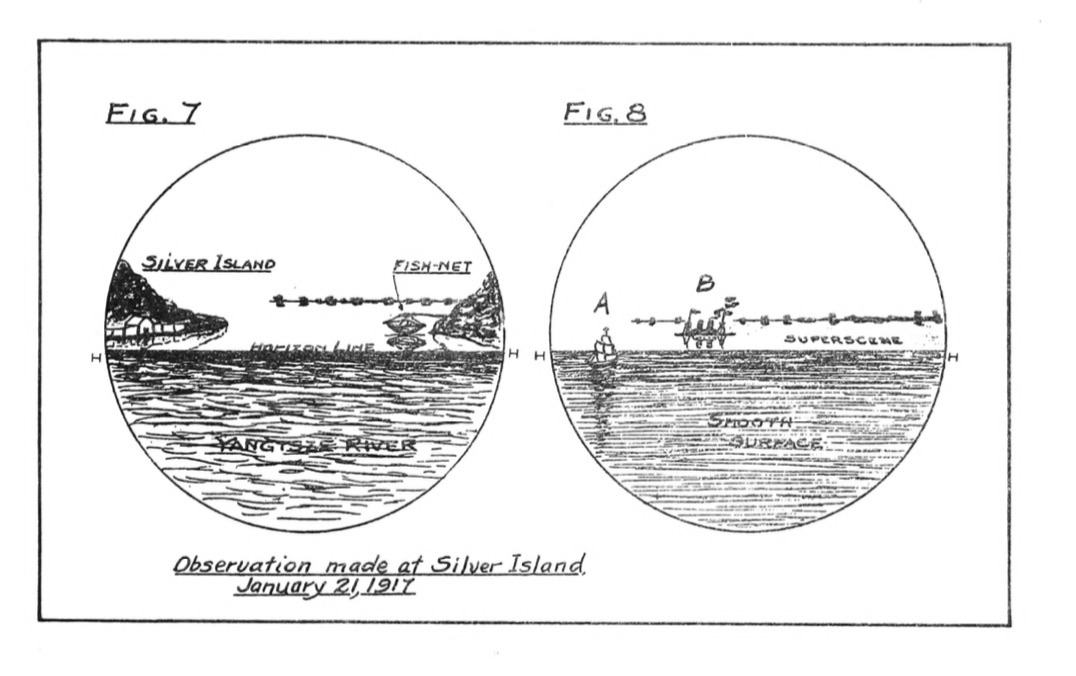
The observer should find a body of water having an uninterrupted surface view for at least two or three miles. It is better to have a distant shore line for a background. The preliminary observation may be made with the eye say 3 feet above the water. If no distinct horizon line appears between the opposite shore and the observation point, the eye should be lowered until the horizon line does appear. Beyond and above this line the mirror-like superscene will be observed in which all objects are reflected as in a mirror. The scene may be studied until the observer is completely satisfied that he is not being deceived by an optical illusion. Moving objects like the oars of a row-boat, or a curved object like a fish-net, will show symmetrical reflections, perfect and unmistakable.
On water whose surface is more or less smooth, the ordinary reflections as shown beneath the boat A, Fig. 8, should not be confused with those of the boat B, or with those of the trees on the distant shore. On a rough surface the first kind are seldom seen, but those in the superscene are always seen in fine weather. I have found by experience, however, that they are not distinct if the sun is shining on the water directly in front of the observer; the bright reflected light of the sun obscures the reflections. Also, in stormy weather, or when the air is cloudy or "heavy" and the waves are high, the reflections are obscured. ---
← Chapter 6 — A Study in Reflections | Chapter 8 — Disappearance of Vessels →
- -- Source: O. F. Barcus, A New World Discovered (1917).