The prominent English scientist and writer, Dr. R. A. Proctor, tells, in his "Mythis and Marvels of Astronomy" under a chapter, entitled "Some Astronomical Paradoxes," of an ingenious person who under the assumed name of Parallax travelled about England 50 years ago trying to convince people that the earth is not round like a globe, but flat. The experimental evidence put forth by Parallax to prove his assertion was this:—"Having betaken himself to the Bedford Canal where there is a long uninterrupted stretch of water for six miles, he tested the surface for curvature and (as he said) found none." Proctor goes on in a derisive manner deploring the fact that "if writers of modern textbooks had treated their subjects more fully and carefully, such aberration from the truth by otherwise intelligent persons could not have taken place."
In another place he introduces the conception of a concave, first on record, as far as I have been able to ascertain. He records the universal experience of aeronauts going up in a balloon, who "saw the earth presenting the appearance of a great hollow basin or the concave side of a well-curved shield." After almost exhausting his supply of ironical remarks on the flat-earth theory of Parallax, he suggests that: "Indeed, to be strictly logical, the followers of Parallax ought to adopt the faith that the earth is not flat, but basin-shaped, which hitherto they have not been ready to do." He still keeps the fundamental assertion of Parallax in mind, however, for at the close of his discussion he says: "Of course, if that statement had been true—if he had, with his eye a few inches from the surface of the water of the Bedford Canal, seen an object close to the surface six miles from him—there manifestly would have been something wrong in the accepted theory about the earth's rotundity.
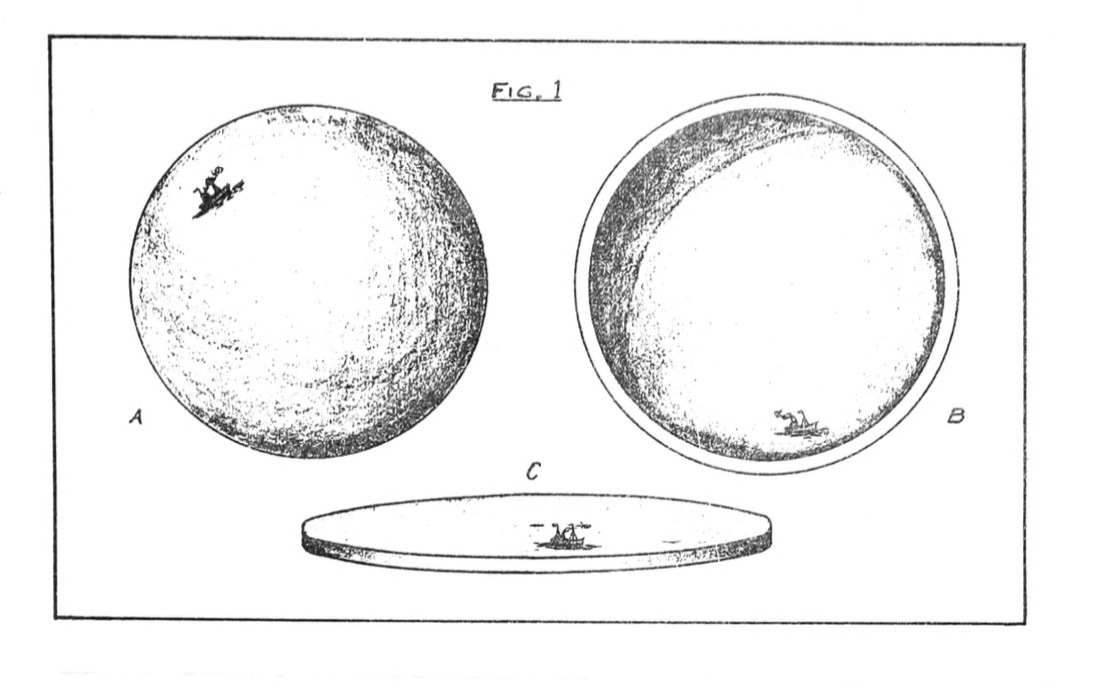
For a six mile straight-edge along water would be as severe a blow to the belief in a round earth (or a convex earth, he might have said) as a Straight line on a sea-surface from Queenstown to New York." (This was written nearly 50 years ago.) I hope to show by a few illustrations that Parallax was right in his contention that the water's surface shows no curvature downward, but that he was ridiculously misled in his belief that the earth is flat; and that Proctor was mistaken in his contention that the water's surface is convex, notwithstanding all present belief to the contrary. I propose to show that the earth's surface is neither flat nor convex, but concave. Fig. 1A, 1B, and 1C, illustrate the three conceivable forms of the earth: A, a convex or solid sphere; B, a concave or hollow sphere; and C, a flat disc. In his consideration of the earth's form Proctor's argument against Parallax's flat-earth idea has about as much weight as that of the geometrician who, in comparing the lengths of two straight lines, would use some such argument as follows:—Line A is not equal to Line B, therefore it is shorter; leaving out of consideration altogether the possibility of its being longer. The earth is not flat, therefore it is convex!
Since Magellan circumnavigated the earth—and from a number of other considerations—we are certain that the earth's surface is not flat, as many of the ancients believed. It remains, then, to ascertain whether it is convex or concave. The present theory would have us believe that it is convex, but in spite of the apparently enormous weight of evidence accumulated by scientists, I make bold to announce my convictions that it is not convex, but concave. During the past several weeks I have made upwards of 50 observations in different places along the Yangtsze River and the Grand Canal, in China, and in each case I discovered phenomena which show conclusively that the water's surface has a distinct curve upwards. My purpose now is to illustrate to the reader the nature of these phenomena and to suggest how they may be successfully observed. ---
← Chapter 1 — Introduction | Chapter 3 — Distant Objects Over Water →
- -- Source: O. F. Barcus, A New World Discovered (1917).
See diagrams enclosed.