The following subjects are treated in the large edition now being prepared for publication under the above title. The synopsis here given will be more or less followed:
1. A general survey of the Philosophy of Discovery, following Dr. Whewell's treatise on this subject, is presented in an endeavor to show how the new conception has hitherto been overlooked by scientific thinkers.
2. The usual tangible and theoretical "proofs" maintained in support of the convex theory are presented and fully discussed in an endeavor to show their incompatibility with the observed phenomena at the earth's surface. (See Appendix B for a list of these "proofs.")
3. The tangible evidence, determined by actual experiments in support of the concave conception, is presented and discussed.
4. There is presented a general survey of the research work done by the writer for several months past into all the various branches of science relating to the subject; these include Astronomy, Geography, Geology, Physics, Chemistry, Religious Literature and many others.
5. A vast amount of theoretical evidence is derived from the above-mentioned sources, from which is deduced a theory of the "new heavens" in their relation to the "new earth," arriving finally at a comprehensive conception of the probable structure of the physical world, or universe as a whole.
The reader will find in Appendix C a list of 75 questions all of which will be presented and discussed in the "Introduction to the New Cosmology." A sample of the material presented in this book is given in the following article under "Present Problems of Astronomy."
Martin, in "Triumphs and Wonders of Modern Chemistry," (1915) says: — "We have still to face the problem of the continual radiation of heat and light into space. This has always seemed a great waste to many scientists, who could hardly bring themselves to believe that it was really lost. This objection has been well put by Newcomb. "What," says he, "becomes of the great flood of heat and light which the stars radiate into empty space with a velocity of 180,000 miles a second? Only a very small fraction (1/100,000,000) of this can be received by the planets or by other stars, because these are mere points compared with their distance from us. Taking the teaching of our science just as it stands we should say that all this heat continued to move on through infinite space forever. In a few thousand years it reaches the confines of our great universe. But we know of no reason why it should stop here. During the hundreds of millions of years since all our stars began to shine has the first ray of light and heat kept on through space at the rate of one hundred and eighty thousand miles a second? and will it continue to go on for ages to come? If so, think of its distance now, and think of it still going on to be forever wasted!
Rather say, that the problem what becomes of it is as yet unsolved."
The foregoing is one of the unsolved problems of modern science. The Copernican system has many such problems. The hollow earth conception, however, settles the "solar waste" problem at once; for the sun, being a comparatively small body, is enclosed in, and situated at or near the center of, the hollow earth, whence radiate its energies in heat, light, and electricity to all parts of the earth's internal surface, without waste. Thus the economical superiority of the new conception over the Copernican theory must be recognised.
Figs. 16 and 17 illustrate the vast difference between the old and the new conceptions. In Fig. 16, the earth is seen to be nothing more than a black speck, "no larger than a dust mote glistening in the beams of a giant sun," —as one writer puts it. In Fig. 17, the earth and its majestic luminary are represented in a proportion more in keeping with that which we might expect from the Great Designer, who, as the sacred writer declares, "created the world not a waste (or in vain), but formed it to be inhabited." (Isa. 45,18). The earth is simply an enormous electric cell, having the sun at the center as the great positive electrode and the earth's shell as the negative electrode. The constant flow of the currents of energy between these two great poles is the generative source of all solar and terrestrial phenomena: such as sun-spots, the corona (seen at the time of solar eclipses) and solar prominences, terrestrial magnetism, aurora borealis, zodiacal light, gravitation, etc.
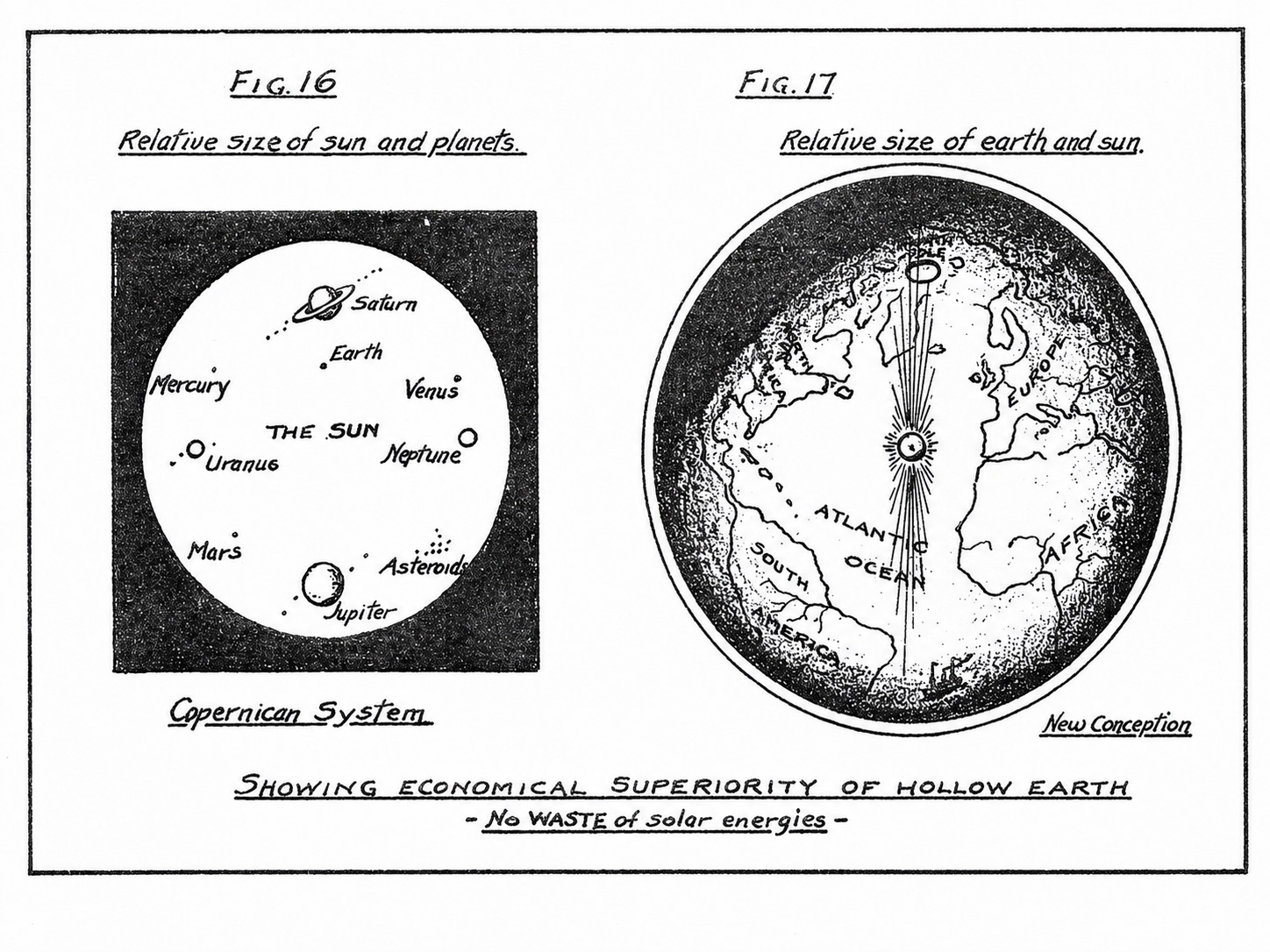
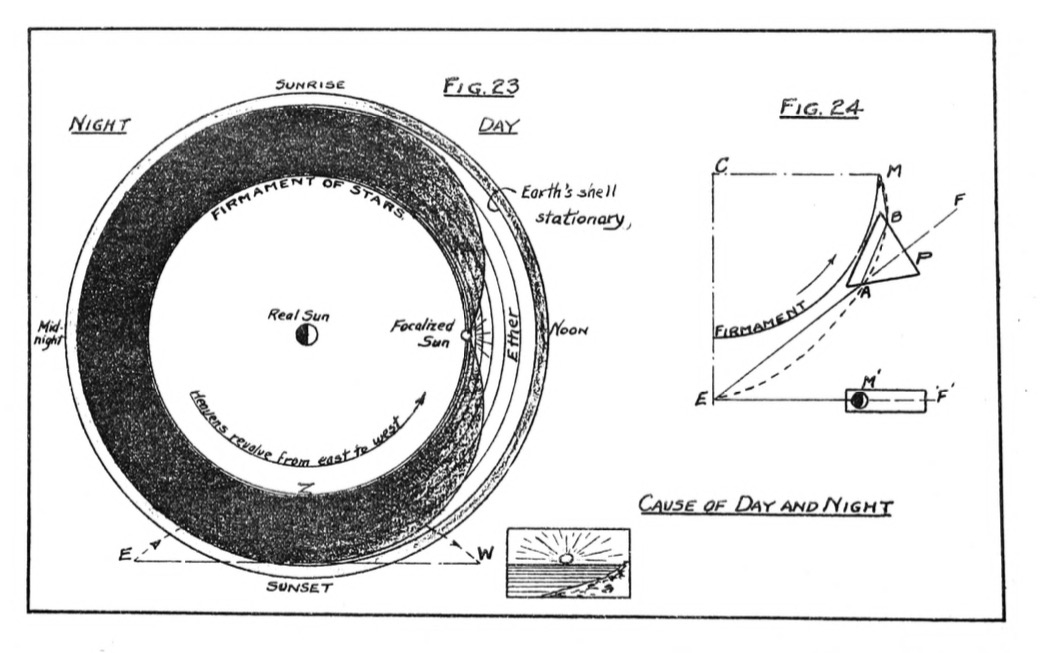
Let not the reader get the impression from Fig. 17 that the whole internal surface of the earth is exposed to the solar radiations at one time. The diagram is drawn in this way to show the relative sizes of the earth and sun; just as the planets, in Fig. 16, are all represented as being enclosed within the actual limits of the sun's disc—which we know are not their true positions. The revolving heavens themselves intervene between us and the real central sun. The probable arrangement is illustrated in Fig. 23, Appendix A.
Another, and by no means unimportant, consideration is the mechanical superiority of a hollow earth over a solid one, as illustrated in Figs. 18,19,20 and 21. Engineers are acquainted with the fact that of two beams, having the same area of cross-section, as A and B, Fig. 18, the one with a rectangular section, of a length four times its breadth, as B, is twice as strong as the one whose cross-section is a square, as A, for the reason that the supporting strength of a beam depends on the product of its cross-section by the distance of its center of gravity, g, from the point, d, where the weight is supported. The distance, dg, in B is seen to be twice that in A, hence the supporting strength of B is twice that of A. Similarly, the relative distances, dg, in the two kinds of spheres in Fig. 19 show that the hollow sphere has a decided superiority over the solid one, although there is the same amount of material in both cases. Fig. 20 illustrates the comparative bending strength of a solid and a hollow rubber cylinder. The hollow one sags much less than the solid one.
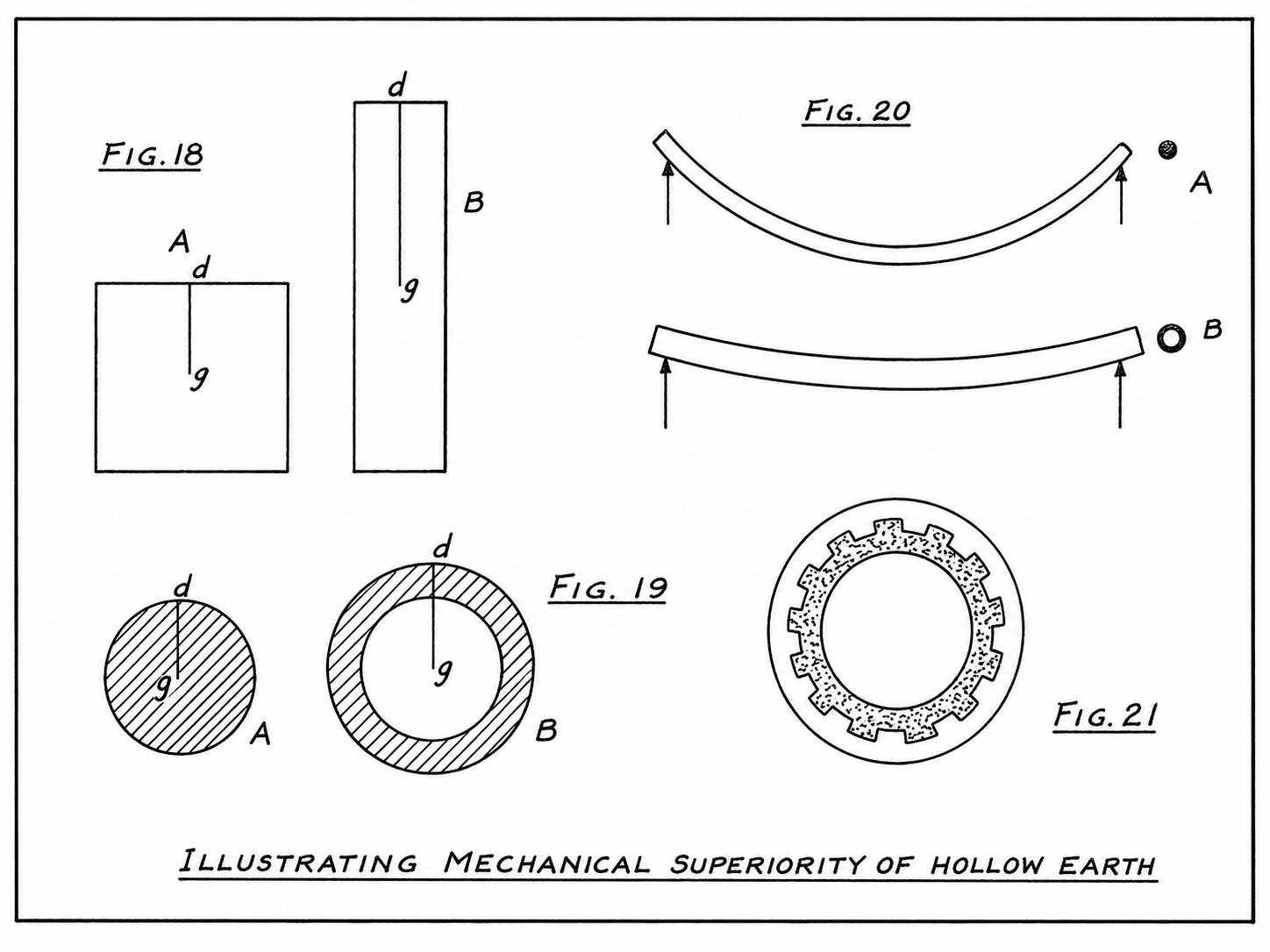
All nature speaks to us of the superiority of hollow supports over solid ones. Fig. 21 shows a section of pipe grass, the member of a large family, of which the bamboo, so much used by the Chinese in structural work, is the leading type. And so might go on with illustrations and examples enough to fill several pages to show merely from the theoretical point of view, that the conception of a hollow earth has everything in its favor, since it explains not only the very important phenomena occurring at the earth's surface, but also the many celestial phenomena that the Copernican system is helpless to comprehend. At the same time it opens up to the world of science for coming generations, entirely new fields of exploration in a number of common everyday phenomena, such as Day and Night, eclipses, etc., which must be investigated from the new viewpoint with all the care and precision hitherto bestowed by hosts of brilliant minds on the hypothetical conceptions of Copernicus. ---
← Chapter 9 — Other Phenomena | Chapter 11 — Conclusion →
- -- Source: O. F. Barcus, A New World Discovered (1917).