The Lockman Hole and the Moving North
Modern science divides the world in two. The Earth is one thing, a globe of rock, water, air, and a hidden iron engine. The sky is another, an expanding space filled with galaxies, radiation, dark matter, and dark energy. The line between them is supposed to be clean.
The measurements are not so clean.
Astronomers have found a window in the northern sky where the Milky Way's neutral hydrogen thins enough for instruments to see farther. Surveyors and satellites have mapped an Earth whose gravity does not settle into a neat geometric body. Compasses keep pointing north, but the north they follow keeps moving. The standard cosmological model can calculate the motion of distant galaxies with spectacular precision, then divides the unseen bulk of the universe into dark matter and dark energy. Its two principal ways of measuring expansion still return different numbers.
These are not small problems sitting around the edge of the picture. They concern the picture's architecture: the medium between us and the stars, the shape of the Earth, the direction of north, the origin of magnetic force, and the scale and age of the universe.
The most useful place to begin is a patch of sky called the Lockman Hole.
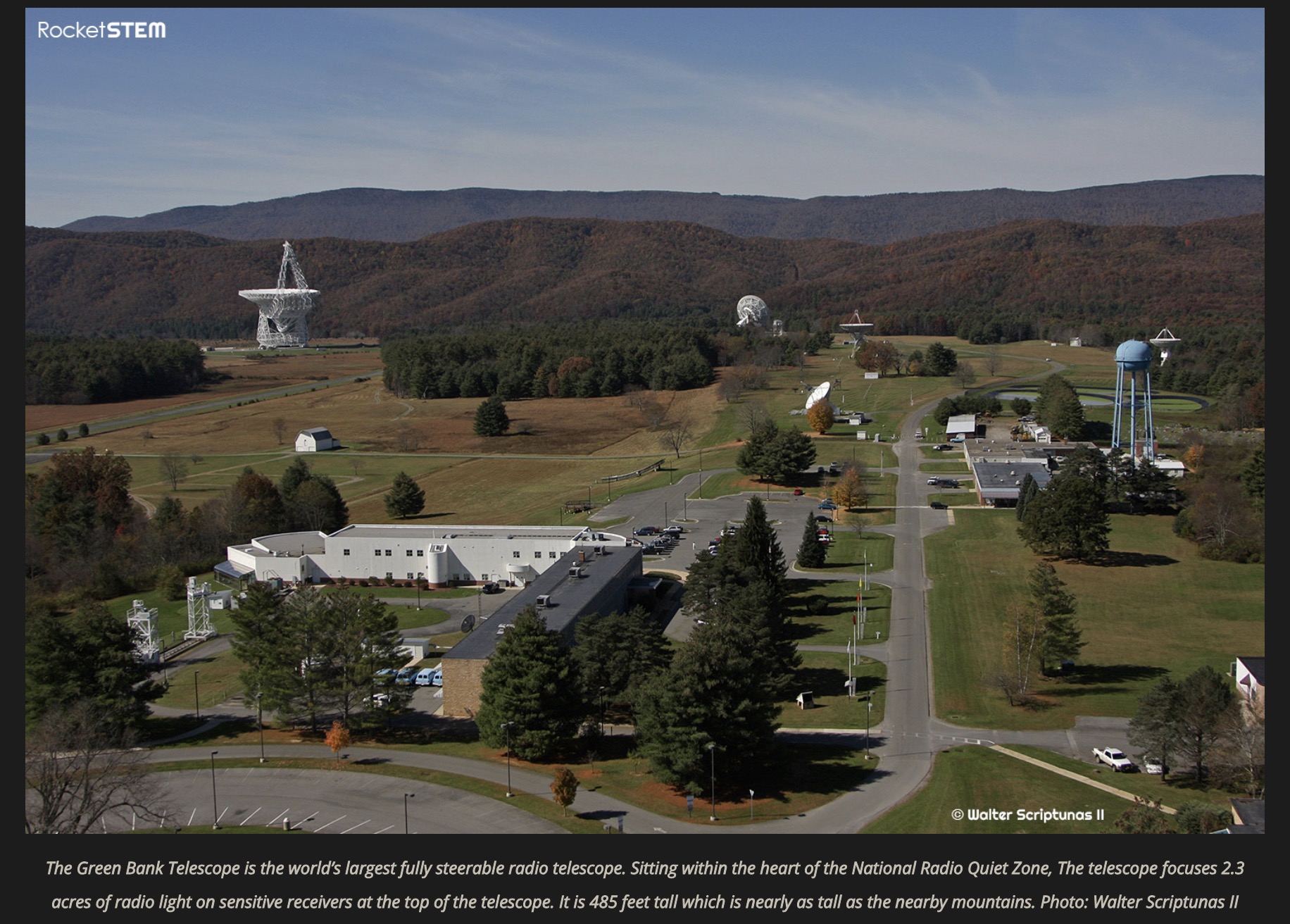
Radio astronomy began with an opening in the northern sky.
The Window
The Lockman Hole is not an empty hole in space. It is a region in Ursa Major where the foreground screen of neutral hydrogen is unusually thin. That matters because neutral hydrogen absorbs and scatters radiation. Less H I in the way means a cleaner line of sight beyond the Milky Way.
In 1986, Felix J. Lockman, Keith Jahoda, and David McCammon published a detailed 21-centimeter survey of low-column-density H I directions in the northern sky. Their main field, around right ascension 10h45m and declination +57°20′, reached a minimum neutral-hydrogen column density of 4.5 × 10¹⁹ atoms per square centimeter.[1] The number is technical. The consequence is plain: astronomers found a place where the curtain was thinner.
The field became a deep-survey workhorse. Chandra called it a region “almost free of absorption by neutral hydrogen gas” and used it to identify hundreds of X-ray sources, including supermassive black holes across enormous distances.[2] Other observatories followed it into radio, infrared, optical, and X-ray work. An opening in the local sky became one of the places through which the modern universe is assembled.
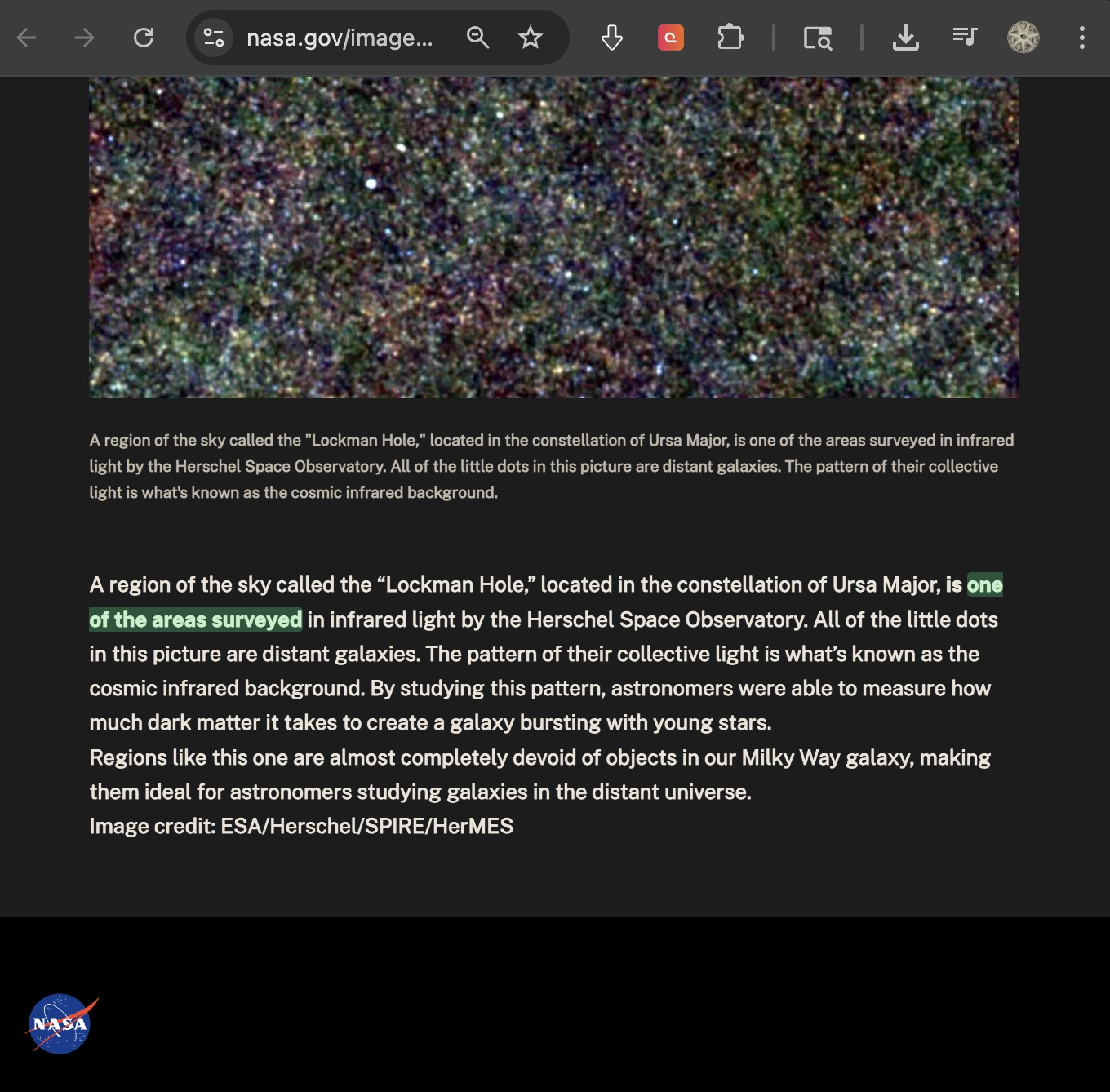
The Lockman field became a deep-survey window because less neutral hydrogen lies in the foreground.
That fact is usually presented as a convenience. The Galaxy has uneven gas. This line of sight happens to be unusually transparent. Telescopes use it. End of story.
But the location is not an anonymous coordinate. It lies in Ursa Major, the northern constellation built around the Big Dipper. Merak and Dubhe, the two stars on the Dipper's bowl, have served as pointer stars to Polaris for centuries. The region belongs to the old machinery of the northern sky: pointer, pole, circle, axis.
The old cosmologies did not divide the heavens into inert scenery and abstract coordinates. They treated the northern pivot as the moving center of a mechanism. In Hamlet's Mill, Giorgio de Santillana and Hertha von Dechend followed the image of the world mill through Scandinavian, Indian, Finnish, Greek, and other traditions. The mill turns around an axis. Its handle, they argued, belongs to Ursa Major. When the axle shifts or the handle breaks, an age turns over.[3]
Modern astronomy has selected a low-absorption window in the same northern field where older sky traditions put the pointers, the turning stars, and the axis of the visible heavens. The telescope and the old navigator look toward the same quarter of the sky, though they are asking it different questions.
The modern account calls the Lockman Hole a foreground minimum. The older language calls the northern sky a machine. That older geometry keeps the location in view: an opening beside the pointers and the axis, not a coordinate that happens to have been named.
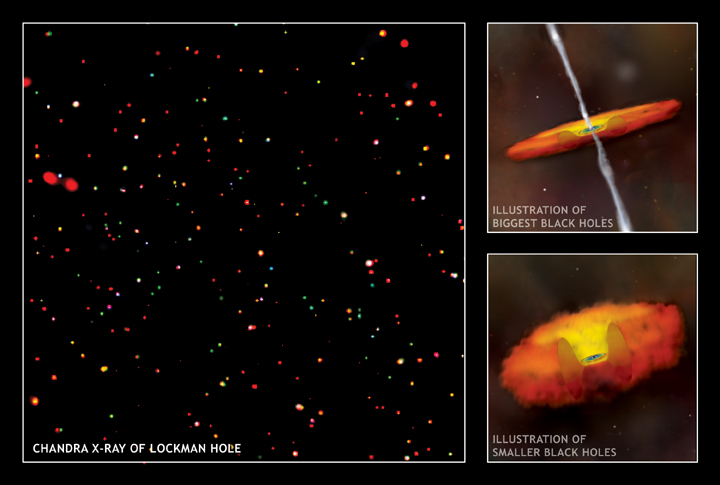
Chandra's Lockman Hole mosaic identified hundreds of X-ray sources through the low-absorption field.[2]
The Sphere Below
The Earth is usually introduced as the settled half of the story. Its dimensions are known. Its gravity is measured. Satellites circle it, maps close, and navigation systems converge on a coordinate grid. This is true as far as it goes. It does not go as far as the classroom globe implies.
The practical Earth is a geodetic construction. Latitude, elevation, mean sea level, local gravity, satellite orbit, and map projection have to be reconciled. The result is not a perfect ball but a reference ellipsoid corrected by a geoid: a gravitational surface that rises and falls according to uneven mass distribution.
NASA's GRACE mission made the point visible. The twin satellites measured tiny changes in their separation as they passed above stronger and weaker gravitational regions. The resulting maps record a planet whose gravity field varies across mountains, trenches, ice sheets, aquifers, and structures deep below the crust.[4] The beautiful colored gravity maps are often presented as a technical triumph. They are also a reminder that the smooth globe is a first approximation laid over a far more irregular field.
A gravity anomaly is not an embarrassment to gravity. It is the word used when measured gravity departs from the reference value expected at a location. The anomaly sends the investigator looking for density, depth, water, rock, temperature, and movement. The whole practical picture depends on the difference between the clean geometrical Earth and the Earth that instruments actually return.
That is the terrestrial version of the Lockman Hole. In the sky, the foreground is not uniform. Underfoot, the field is not uniform. The basic shapes remain useful, but useful is not the same thing as complete.
The issue becomes sharper when the instrument is not a satellite but a compass.
The Pole That Will Not Stay Put
A compass gives a direction. The direction does not stay fixed.
Magnetic north is not true north. True north is the geographic direction toward the rotational pole. Magnetic north is the direction a magnetic needle follows, and that direction varies by place and changes over time. It changes enough that navigation, defense, aviation, survey work, and consumer devices rely on continuously revised magnetic models.
NOAA's World Magnetic Model, the standard field model used for navigation and heading systems, is released in five-year versions. It computes annual secular variation in declination, inclination, and field strength because the values do not hold still.[5] NOAA's pole record traces the North Magnetic Dip Pole from northern Canada across the Arctic; a recent survey placed its motion at roughly 55 kilometers a year toward the north-northwest.[5] The model's practical job is to tell navigators where their compasses will point now, not where a tidy textbook says they ought to point forever.
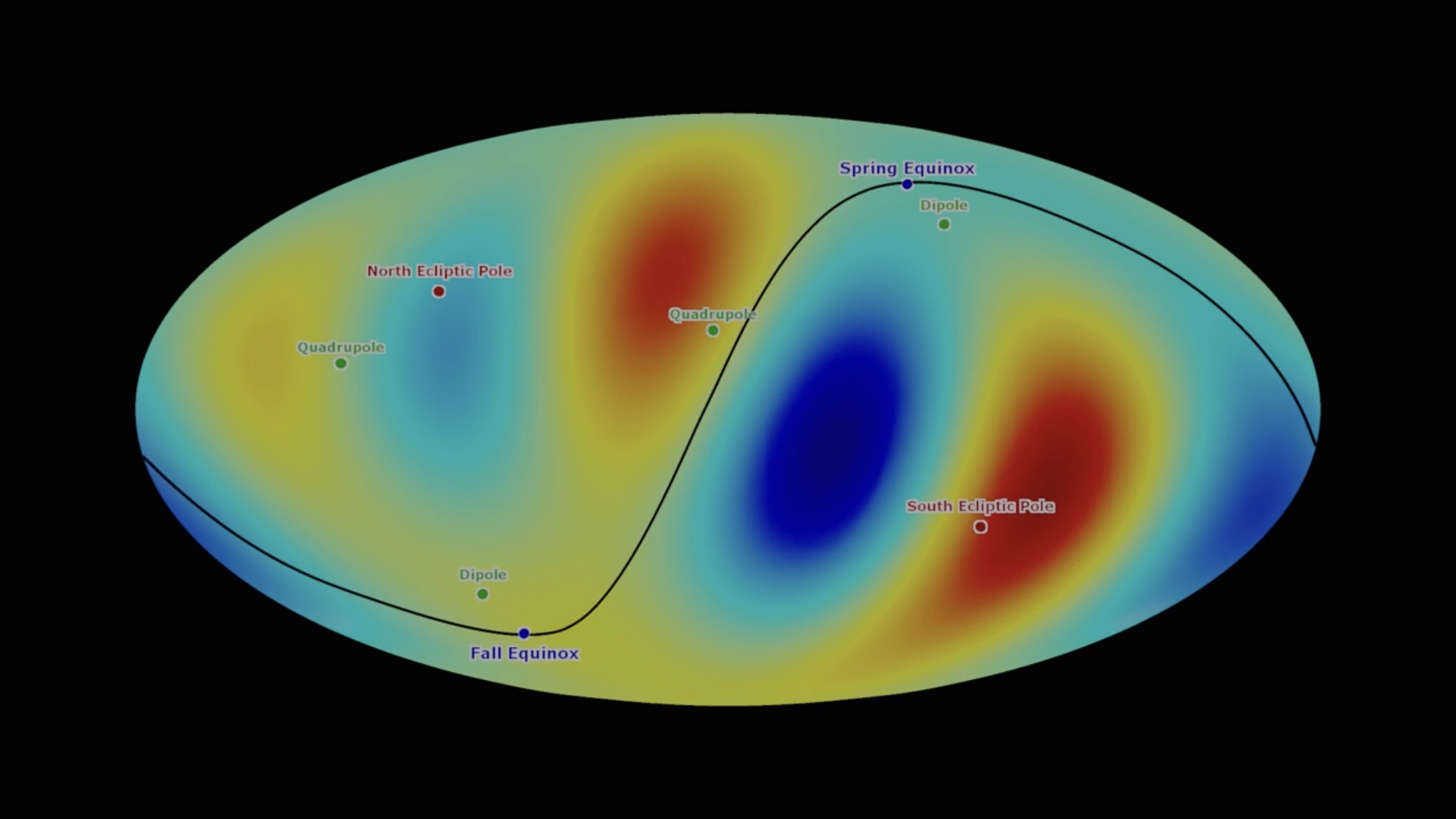
A compass gives a direction. The direction does not stay fixed.
The official explanation sends the source downward. NASA describes Earth's intrinsic field as generated by convective motion in electrically conducting molten iron far below the surface, in the outer core.[6] This is the dynamo model. It is powerful, mathematically developed, and treated as the mechanism behind secular magnetic variation.
It is still an inferred engine. No one observes a molten core circulating in real time. The field is measured at the surface, from ships, aircraft, observatories, and satellites. The interior motion is reconstructed from the field and from the physical properties assigned to deep matter. The direct observation is a moving magnetic direction. The deep-Earth machine is the model built to account for it.
Above the observer, meanwhile, there is no magnetic stillness. The Sun throws out a charged solar wind. That stream presses against the sun-facing side of the magnetosphere, reshapes the outer field, and drives interactions through the magnetosphere and ionosphere.[6] Aurorae are the visible signature of part of this traffic. Space weather changes. Solar magnetic activity changes. The field around the Earth is openly dynamic.
The usual model divides these facts into bins. The slow main field belongs to the core. External solar and ionospheric effects belong to a smaller, temporary disturbance system. The division may be useful for calculation. It is still a division imposed on one observed field environment.
The concave-Earth model takes a different path. It does not begin with a magnetic pole wandering through a hidden globe. It begins with an inhabited inner surface facing a central celestial field. A compass needle aligns with the larger geometry overhead. Magnetic north then moves because the field arrangement at the center of the sphere moves. The sky changes, the field changes, and the terrestrial direction follows.
Inside that geometry, the wandering pole is no longer an awkward feature requiring an invisible engine far below the observer. It is what a changing celestial system should produce. The Earth is the mother. The cosmos is the womb. The compass points inward toward the living field between them.
Edmund Halley saw the moving magnetic poles as a serious enough problem to propose nested magnetic spheres within the Earth. Later hollow-Earth writers returned to the same difficulty. They disagreed about the structure, but not about the fact that a supposedly stable terrestrial magnet should not casually rearrange its directions across history. The record begins with the needle, not the theory.
A Cosmology Built Around Tensions
The same pressure appears once the article leaves the local sky and turns toward the cosmological one.
The expansion rate of the universe should be a foundational quantity. Instead, different routes to it have produced a durable mismatch. Adam Riess and the SH0ES team reported a local Hubble-constant measurement that differed from the value predicted from Planck's early-universe data under the standard ΛCDM model at roughly five sigma.[7] The disagreement is not a YouTube quarrel over decimal points. It sits between two of the central measuring systems in modern cosmology.
The cosmic microwave background carries another set of residues. Planck's 2018 analysis found the broad statistical picture compatible with the standard model while also confirming several named anomalies on large angular scales.[8] The cold spot, the large-angle power deficit, hemispherical asymmetry, alignments, and other features have survived enough scrutiny to remain in the literature as anomalies rather than disappearing into a footnote.
Then there is the inventory itself. The standard model assigns most of the cosmic budget to dark matter and dark energy: entities inferred from gravitational and expansion behavior rather than identified as ordinary matter or ordinary light. The model works because the equations can be made to work. Its hidden components and corrections are not peripheral additions. They are the supporting beams.
That is why the Lockman Hole matters here. It is a direct reminder that seeing farther is never a simple act of pointing a telescope outward. The observation depends on what lies between the instrument and the reported universe. A transparent window through local hydrogen becomes the place through which distant black holes, galaxies, and evolutionary histories are counted. The world picture arrives through apertures.
The same is true below. A gravity map arrives through reference ellipsoids, orbital measurements, density assumptions, and corrections. A magnetic north arrives through a needle responding to a field that changes across time. A cosmic age and expansion rate arrive through distance ladders, standard candles, background radiation, and a model connecting the measurements.
Measurement earns its force only when the apparatus stays visible.
The Lockman Hole remains in the northern sky. A dish turns toward it. The radio data comes back through a place where the hydrogen thins. Below the dish, the compass points north, and north keeps moving. Science names the window, maps the drift, and builds an engine beneath the ground to account for it. The older geometry offers another arrangement: an inner Earth, a central sky, and a field that changes where the observer can see it.
The window is still open. The needle is still turning.
Sources
- F. J. Lockman, K. Jahoda, and D. McCammon, “The Structure of Galactic H I in Directions of Low Total Column Density,” The Astrophysical Journal 302 (1986): 432–449. NASA Technical Reports Server.
- Chandra X-ray Center, “Lockman Hole: Weight Limits for the Biggest Black Holes,” February 15, 2005. Chandra.
- Giorgio de Santillana and Hertha von Dechend, Hamlet’s Mill: An Essay on Myth and the Frame of Time (Boston: David R. Godine, 1969).
- NASA Earth Observatory, “GRACE Fact Sheet,” March 30, 2004. NASA.
- NOAA National Centers for Environmental Information, “World Magnetic Model” and “Wandering of the Geomagnetic Poles.” World Magnetic Model; pole record.
- NASA Science, “Magnetospheres,” July 5, 2023. NASA.
- Adam G. Riess et al., “A Comprehensive Measurement of the Local Value of the Hubble Constant,” The Astrophysical Journal Letters 934, no. 1 (2022): L7. DOI.
- Planck Collaboration, “Planck 2018 Results. VII. Isotropy and Statistics of the CMB,” Astronomy & Astrophysics 641 (2020): A7. DOI.