Table I, taken from "The Sailor's Pocket Book," by Bedford (1890), gives the distance of the horizon corresponding to various elevations of the observer's eye above sea level. The usual correction for atmospheric refraction is included in these values. For any distance of horizon in miles, the theoretical elevation, in inches, of the observer's eye may be found by squaring the number of miles and multiplying by 8 (See Fig. 2). Thus, suppose the distance of horizon is 11 miles. Squaring and multiplying by 8, we get 968 inches, or 80 feet. According to the Table, the elevation, corrected for atmospheric refraction, for this same distance of horizon, is only 70 feet. This means that the actual distance of the horizon (or supposedly upper limit of the earth's convex surface) as seen from an elevation of 70 feet, is practically the same as the theoretical distance (that is, refraction neglected) at an elevation of 80 feet.
In other words, the idea is that atmospheric refraction has a tendency to "elevate" distant objects. The amount allowed in this correction is about one-sixth the theoretical value.
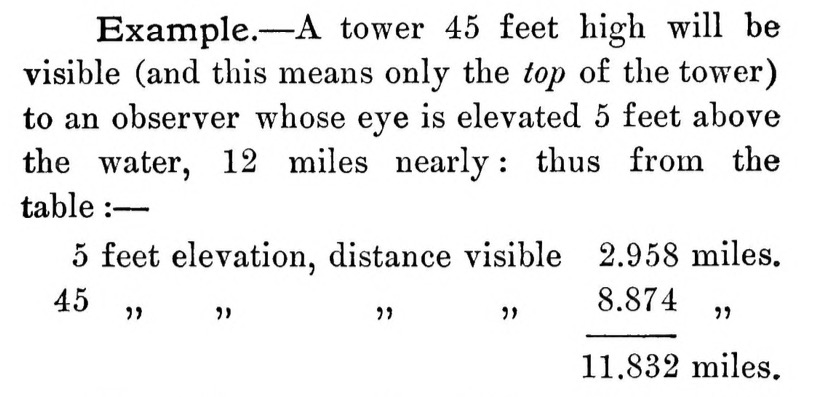
The following is an example illustrating the methods employed in actual practice determining elevations and distances at sea. Example, —A tower 45 feet high will be visible (and this means only the top of the tower) to an observer whose eye is elevated 5 feet above the water, 12 miles nearly: thus from the table:— 5 feet elevation, distance visible 2.958 miles; 45 feet, distance visible 8.874; total 11.832 miles.
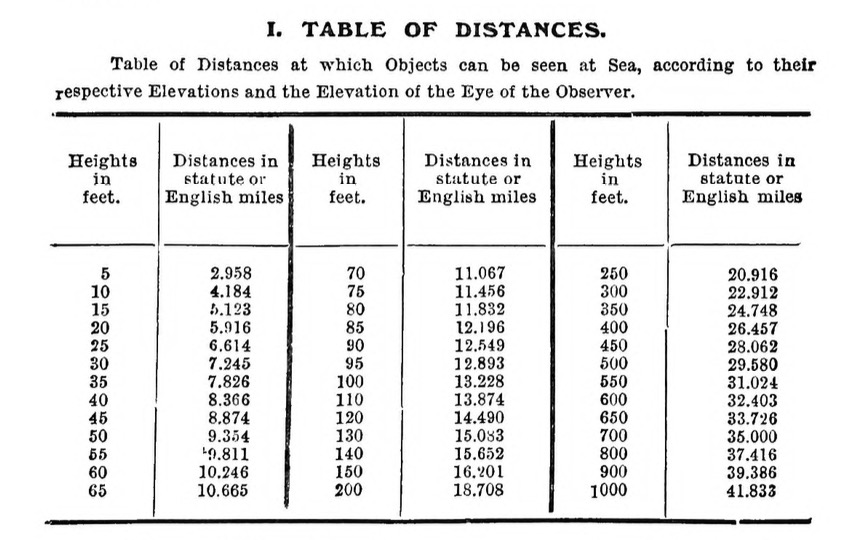
Fig. 3 shows a section of the earth's surface across the Yangtsze River from Woosung, near Shanghai, China, to Tsung Ming Island, a distance of 11 miles, as given on the authentic British Admiralty Chart (1915).
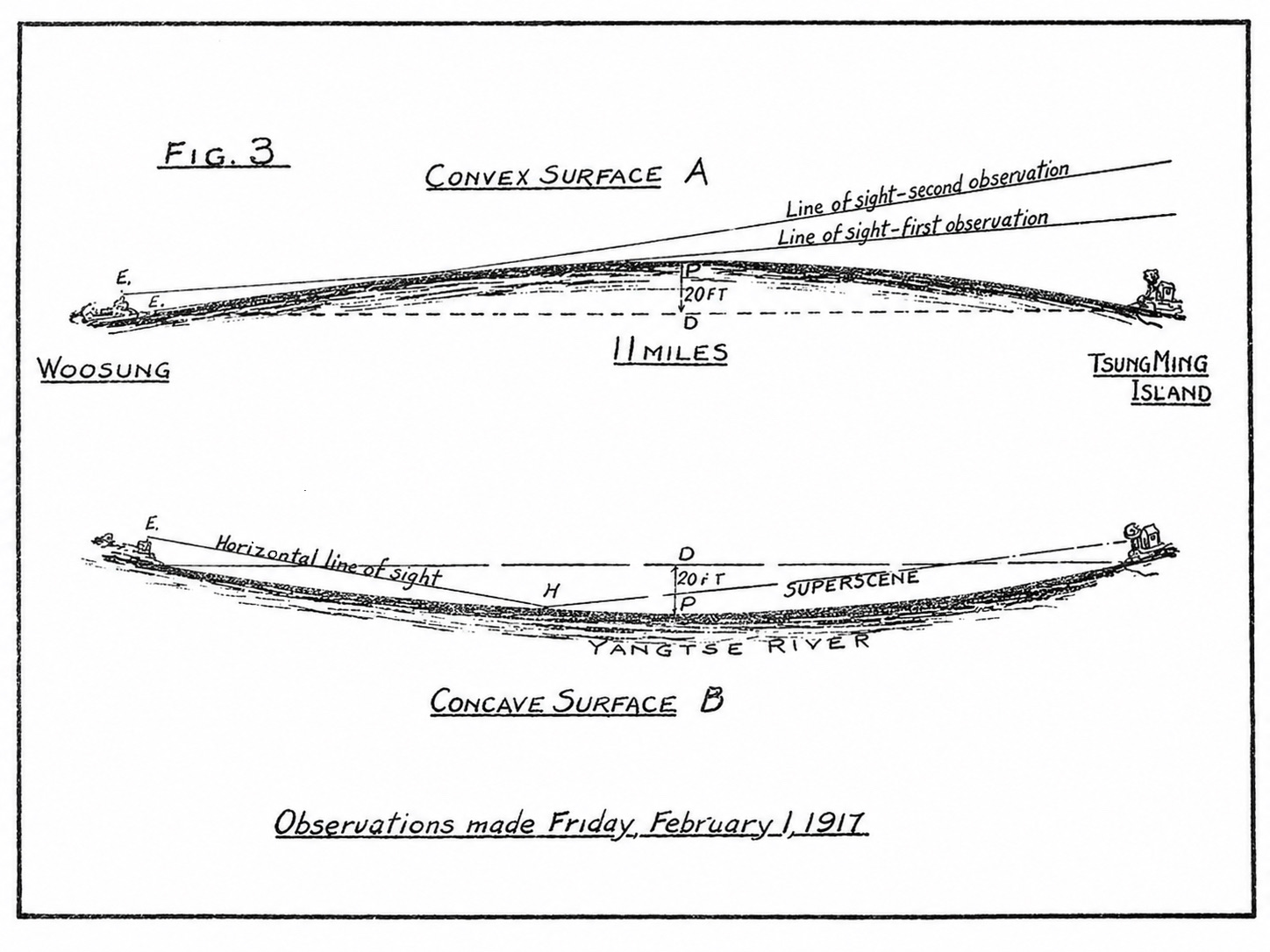
The maximum height of the supposedly convex bulge of this section, PD, Fig. 3, is practically 20 feet. We have here, then, the equivalent of an absolutely opaque wall of water through which objects on the Tsung Ming island shore are supposed to be seen (or rather, not seen), by an observer whose eye is but a few feet above sea level at Woosung.
On February 1,1917, I made this observation under ideal conditions. The atmosphere was very clear and free from fog of any kind. It was about 3.30 p.m. and the sun behind me shone full upon the objects to the northeast on Tsung Ming island 11 miles away. The first observation was made with my eye 15 feet above sea level, as determined from a permanent tide staff only a few feet away. Through prismatic field glasses (8x) I viewed the entire shore line of the island, not only that part which lay nearest me to the northeast, but also a long stretch 12 miles or more away, to the north. The vegetation anywhere on the island is scarcely more than 20 feet above sea level. I could see also along the shore, not far above the water's edge, several white-painted Chinese houses which reflected the brilliant light of the western sun.
A study of Fig. 3A and of Table I will show the impossibility of observing such a phenomenon on a convex surface. Of course, the ready critic will come forward with the usual explanation that what I saw was nothing but a mirage; but such persons can be convinced only by making the observations themselves. It is impossible to account for the phenomenon in this way.
Let the mathematical reader calculate how much the objects 11 miles away would have to be "lifted" by atmospheric refraction in order to be seen above the convex bulge 20 feet thick; it is several times the maximum value allowed by surveyors.
But I have not finished with this. Having in mind, for the moment, the possibility of a mirage effect, 1 decided to try a lower elevation and accordingly descended to a point where with my eye only 10 inches (!) above the water I still saw the vegetation along the island, none of which, as I have mentioned, is over 20 feet high. From the Table we can see that for objects to be visible (and only their tops at that), from such a low elevation, they would have to be about 70 feet high!
Now, why not conceive the water's surface to be concave, like a large basin, as Proctor suggested, as illustrated in Fig. 3B? This conception explains the phenomenon, and delivers us from innumerable difficulties confronting us in a number of other phenomena, only a few of which I can touch upon in an introductory work of this kind.
I invite the reader to verify this experiment at the first opportunity. ---
← Chapter 2 — Flat, Convex, or Concave? | Chapter 4 — The Wireless Phenomenon →
- -- Source: O. F. Barcus, A New World Discovered (1917).