Part V: The Light Bends
creatumejortu.com/tierra-concava-v-la-luz-se-curva
There is experimental evidence that visible light traveling parallel to the Earth bends, and does so at varying angles throughout the 24-hour cycle; and always upwards, just as it would on a concave Earth.
In Riedern (Klettgau, Germany) on 24 May 2001, between 11 and 12 o'clock in the morning, the engineer Wilhelm Martin (who died in 2009) undertook an experiment (in the presence of Rolf Keppler [1]) with a theodolite he called "Dumpy". Wilhelm Martin also performed the same experiment during the night hours, in this case using the Carl Zeiss fog level NI 2 no. 87523, which is an optical levelling device with a built-in plumb line, widely used in surveying and construction.
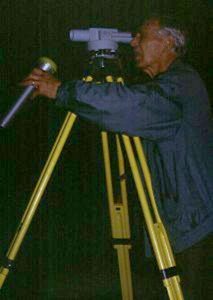
Two measuring rods were placed 1,000 m apart; the "Dumpy" level was placed between these two poles, at a distance of 500 m from each other. The built-in plumb line and spirit level were then used to ensure that the device was absolutely level to within 1 arcsecond, giving an accuracy of 0.5 cm at 1 km. Wilhelm Martin then looked through the telescope and, using the cursors, pointed to the "zero" mark on one of the measuring rods; he then rotated the theodolite 180° and did the same for the other rod. These marks would be used as a control for future measurements in the experiment.
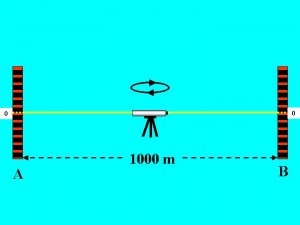
Wilhelm then placed his "Dumpy" theodolite just 4 m from the left survey rod, adjusting the height of the theodolite so that it was level with the zero mark made previously, when the theodolite was positioned between the two posts. The level was then rotated 180°, and the theodolite's cross-tracks were used to find its position on the right rod, located 996 m away.
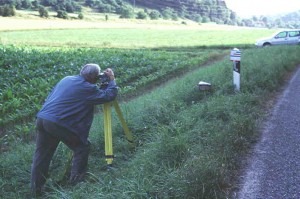
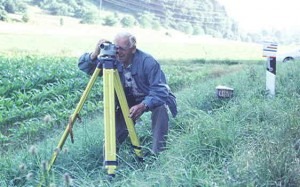
The trackers were now 12 to 14 cm higher than the zero mark made during the original check. The exact same procedure was then carried out, but this time moving the theodolite 4 m from the right post, using the zero mark as a reference, rotating the theodolite 180°, and observing the position now on the left post, located 996 m away. The result was almost the same as with the other post, marking a deviation from the original zero mark of more than 14 cm above.
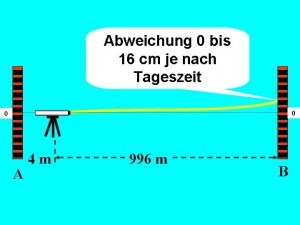
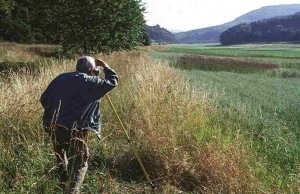
This experiment was repeated at different times of day, sometimes on different days of the year, in the same location, with results always between 0 and 18 cm above the zero mark. These results are listed below:
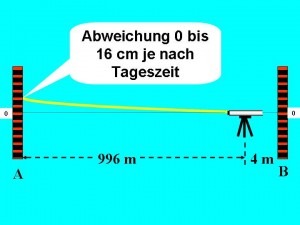
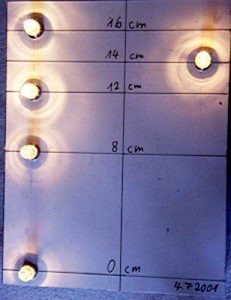
May 24, 2001: 11am-12pm No. 2 12-14cm, No. 3 more than 14cm above. April 7, 2001: 6:00 PM No. 2 and No. 3 about 16 cm higher. May 7, 2001: 00:00 to 2:00 a.m. No. 2 8cm taller, No. 3 0cm (no difference). May 7, 2001: 8-9am No. 2 8cm, No. 3 12cm taller. July 5, 2001: 5-6pm No. 2 16cm, No. 3 18cm taller.
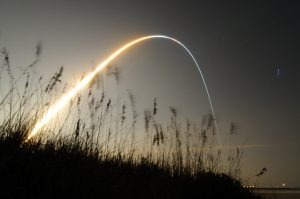
This experiment destroys modern astronomy and the Copernicanism to which it is ascribed, because it is based on the erroneous assumption that light travels in straight lines. It completely calls into question where objects are in the sky and how far away they are. Where is the comet as it slowly streaks across the night sky? Where are the stars, the planets, the Moon? Not where it appears, that's for sure. Where is "up"? Above our heads, yes... And where is that in relation to the universe?
Where is the comet and in which direction is it actually travelling? If the Earth is concave, which we have already seen to be very likely due to Cyrus Teed’s Rectilineator experiment [2], then light always bends upwards by 6 to 18 cm between 500 m and 1 km depending on the time of day. If light bends this much at this distance, how far can it travel before it doubles up? We don’t have data for 2 km, 4 km or more, so we don’t know how much more light bends past 1,000 m; however, following the concave model of the Earth, we can say that the light returns towards the antisolar point of the Celestial Sphere, with an opposite charge and with much less energy. This upward bending light explains why when we look up at the sky, even though the Earth is concave, we do not see the other side: the light bends more than the Earth's surface itself, being drawn back towards the Celestial Sphere.

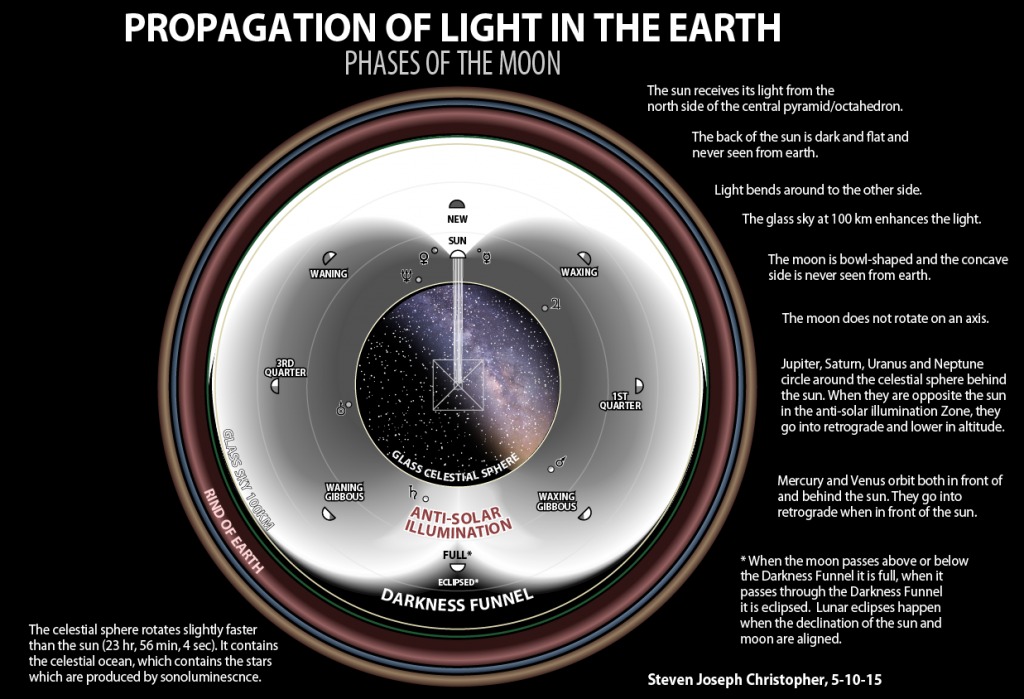
The deviation between 11 am and 12 pm was 12 to 14 cm for procedure #2 and more than 14 cm higher than the zero mark for procedure #3.
The midnight test was carried out using light bulbs fixed to the measuring poles.
Refraction and bending of light generate severe optical aberrations over long distances.
Gegenschein: the antisolar point where light converges after hitting the Earth's surface.
Light bends more than the Earth's surface, converging in the antisolar zone (Gegenschein).
As for the effect that refraction could have on the results of this experiment, it must be said that differences in air density do not usually exceed 6 cm [3], and yet in this experiment a variation of 0 to 18 cm of light bending is shown, and always upwards, never downwards as would happen if the Earth's surface were convex. Furthermore, during the day, the air temperature should be between 1 and 2º warmer near the ground (where Wilhelm Martin measured), and the light always moves towards warmer and therefore less dense air, so it should always affect by lowering the bending of the light, never accentuating it and taking it higher.
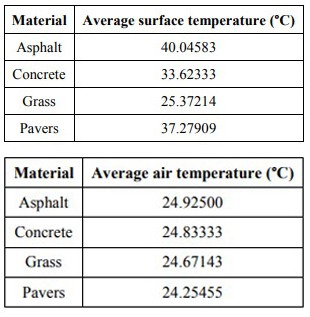
However, there are opinions such as that the air near the ground could be colder than the air higher up during the day, and warmer at night; even in that case Wilhelm Martin's tests would be reliable, since they were carried out one meter above the ground, so there should not be much difference between the air temperature near the ground and the air temperature one meter above the surface [4]. In fact, there is a study [5] carried out on grass in San Francisco, in winter, between 2 and 4 in the afternoon, which detected an average temperature difference of only 0.7° between the grass and the air at 1.5 m height. Even the air over the asphalt (the warmest surface) was only 0.25° warmer than the air over the grass (the coolest surface), as can be seen on pages 7 and 8 of the study, which concludes: “Although there were significant differences in surface temperatures, variations in the air temperatures directly above were not significant … The air temperatures above the different materials did not mimic the trend shown in the surface temperatures.” This shows how little ground heat affects daytime air temperatures.
During the night, the ground can experience temperature differences of up to 2° at a height of 1 m. The book "Essentials of Meteorology: An Invitation to the Atmosphere" [6] says: "This average increase in air temperature just above the ground is known as a 'radiation inversion', because it is formed mainly by radiative cooling from the surface. Because radiation inversions occur on the clearest, calmest nights, they are also called 'night inversions'. A strong radiation inversion occurs when the air near the ground is much cooler than the air higher up. Ideal conditions for a strong inversion, and thus very low nighttime temperatures, exist when the air is calm, the night is long, and the air is fairly dry and cloud-free." This would explain why the light bent significantly less during the nighttime measurements in the experiment.
A study [7] found that most of the urban area tends to act as a heat sink during the day, making the air slightly cooler above urban areas. The same applies to vegetation [8]. This makes the air slightly cooler near the ground in the morning and at midday, warmer in the afternoon and just after sunset, and cooler near the ground again at night due to the air insulation effect or "night inversion".
Another field study [9] was carried out during the winter/spring months on a road in Sweden (covered with snow): the graph below shows the maximum air temperature difference between 1 and 2.5 m at 0.2° around midnight (several hours after sunset). One reading even showed a very slight temperature inversion. This experiment would have been carried out at approximately the height at which Wilhelm Martin measured the bending of light.
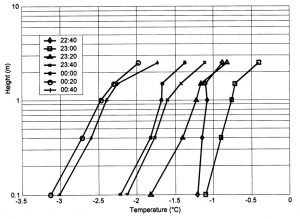
In Wilhelm Martin's experiment, it is possible that the light could have moved upwards by rising into warmer air surrounding the measuring pole during the night, or if vegetation acted as a heat sink by cooling the air directly above it; but there would have to have been cooler air near the ground not only during the night, but at all the dates and times measured by Wilhelm, including 9 a.m., 12 p.m., 2 p.m., 6 p.m., midnight, and 6 a.m., in all cases the light traveled upwards. Furthermore, if the light were bent solely by temperature changes, the differences in the daytime results would also have to be up to 6 times greater than the nighttime results, but neither happened and the measurements were consistent with light bending along a concave surface of the Earth.
Because even assuming the Earth had a downward or convex curvature, a nighttime inversion with cold air below and warm air above should cause light to refract downward. However, in the early evening and early morning, light was bent by 6 to 14 cm on a concave Earth.
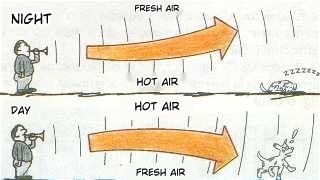
The phenomenon of thermal inversion must be considered during the experiment.
The light blue line is the path of light without marked refraction, and the violet line is that of light with a higher refractive index: refraction is always upwards, as demonstrated by the results of W. Martin's experiment.
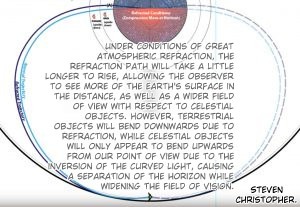
Indeed, light bends upward at a greater angle than the Earth's surface, so with suitable equipment, we would be able to observe how buildings and geographical features would appear higher the greater their distance from us. In fact, we have this photograph taken by the US Army, which shows how objects at a greater distance appear to have a higher elevation than those at a closer distance.
The same publication comments on this photo: "The US Army's Optical Research Division has just tested a new camera, specifically designed to take photos at distances of up to 50 km. The lens has a focal length of 254 cm and is 1 m long, with a diameter of 24.13 cm; it has been retouched to be able to be used with infrared film."
By studying the complete photograph we can determine the following:
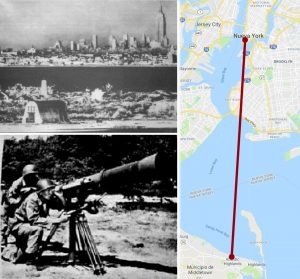
1) The camera is located on the beach of the Atlantic Highlands approximately 1 m above ground level.
2) The camera, as well as the built-in telescope, are pointing upwards, which shows that the photo was not taken from any high point, and that any object behind the horizon must be located higher up.
3) An island is shown 6 km away in its entirety (looking down): the sea entrance behind it, 14 km wide, as well as the Coney Island harbor docks, which are shown uncovered.
4) That's not all: the photo allows a view of the rooftops of the port city behind it, includes the Brooklyn peninsula and another inlet to the sea, and clearly shows the skyscrapers of Manhattan. The photo is from an issue of Foto-Magazin No. 11/1954 (1954), which demonstrates how the horizon is nothing more than an optical illusion. In the article, Dr. Fritz Neugass comments: "A new telephoto lens of the U.S. Army."
In short, if the Earth were a solid convex ball, and light rays travelled perfectly in a straight line, all of this should be 100 m below the horizon, but this is not the case at all, since, as Wilhelm Martin's experiment proves, light always and in all cases bends upwards, probably because the Earth is concave and we live in its stable and welcoming interior.
Watch Video At: https://youtu.be/YCwBArEldGY
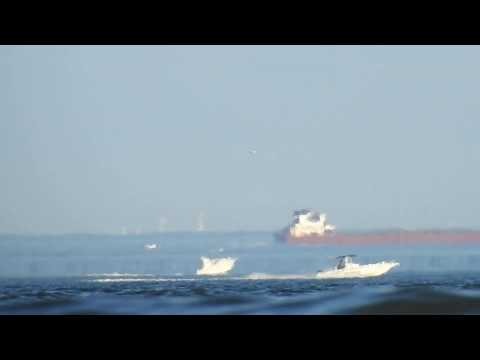
As we can see in this short video, as we manage to see beyond the first horizon, more horizons appear, one on top of the other, a phenomenon that is only consistent on a concave Earth.
Watch Video At: https://youtu.be/0eVVm1noJLM
The same thing happens when the camera is static on a tripod; as you move forward in space, the horizon gets higher and higher, until it is outside the viewfinder.
Source: http://www.wildheretic.com/concave-earth-theory/9/
Part 1: https://creatumejortu.com/la-tierra-es-concava-el-rectilineador
Part 2: https://creatumejortu.com/la-tierra-es-concava-ii-las-plomadas-de-las-minas-tamarack
Part 3: https://creatumejortu.com/la-tierra-es-concava-iii-la-tierra-no-se-mueve
Part 4: https://creatumejortu.com/airys-failure-el-fallo-de-airy
Part 6: https://creatumejortu.com/tierra-concava-vi-la-imposible-tierra-plana