The first observation that led me to doubt seriously the convex theory of the earth was made on Saturday afternoon, November 11, 1916. I was returning with a friend from a trip across the Yangtsze River at Chinkiang, China. About 4 miles down the river (as afterwards ascertained from a British Admiralty Chart) near a bluff called Hsiang Shan, I observed a white gate, the top of which I afterwards ascertained to be about 12 feet above sea level. Being in a very small shallow-bottom Chinese boat, I was able to make the observations with my eye only about 30 inches above the surface of the water. What I saw is accurately portrayed in Fig. 4:A; what I should have expected to see, according to the convex theory, is indicated by Fig. 4:B. The diagrams require but little elucidation. If the earth's surface is convex, one should expect to see nothing above the horizon HH, except that part of the object actually extending above the observer's horizon line. Everything beyond and below this line, one must necessarily conclude, should be entirely invisible. But I saw distinctly the water's surface all the way down to the shore directly in front of the white gate; I saw all the white gate itself; and, what is more remarkable, I saw its reflections in the mirror-like space beyond and above the apparent horizon.
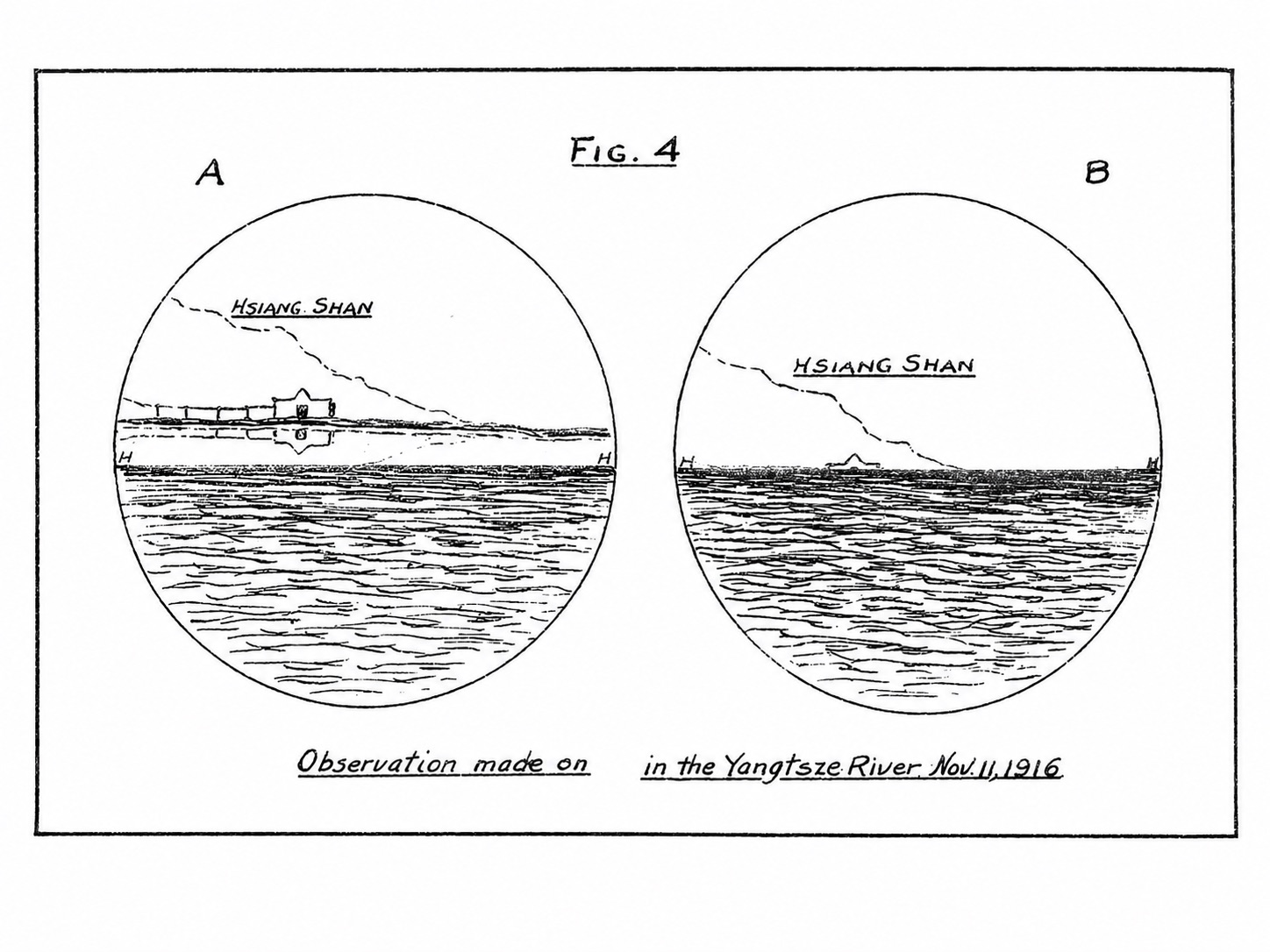
Since that day I have made a great number of observations of similar reflections, and in each case I have found the phenomenon precisely the same as in this first one. I have observed the phenomenon when the surface of the water was rough, as it usually is on the great Yangtsze River, and I have observed it when the surface was as smooth as glass, as on the Grand Canal. In all cases, in every direction, throughout the entire circle of my horizon, I have found this mirror-like space extending beyond and above what is supposed to be the limit of the earth's convex surface. In this mirror-like space, —which, for want of a proper term, I have named the Superscene, —all objects are perfectly reflected.
It is as if one were looking at objects placed on an immense circular mirror inclined, at a very small angle, upward and away from the apparent horizon. Indeed, I have arranged such an apparatus on a small scale, using an ordinary plane mirror, by which I was able to reproduce the same phenomenon. This very simple apparatus is illustrated in Fig. 5A. The mirror, on which are placed small paper images, P, of boats, trees, etc., is inclined at a very small angle upward, and observed from a point E, a few feet away.
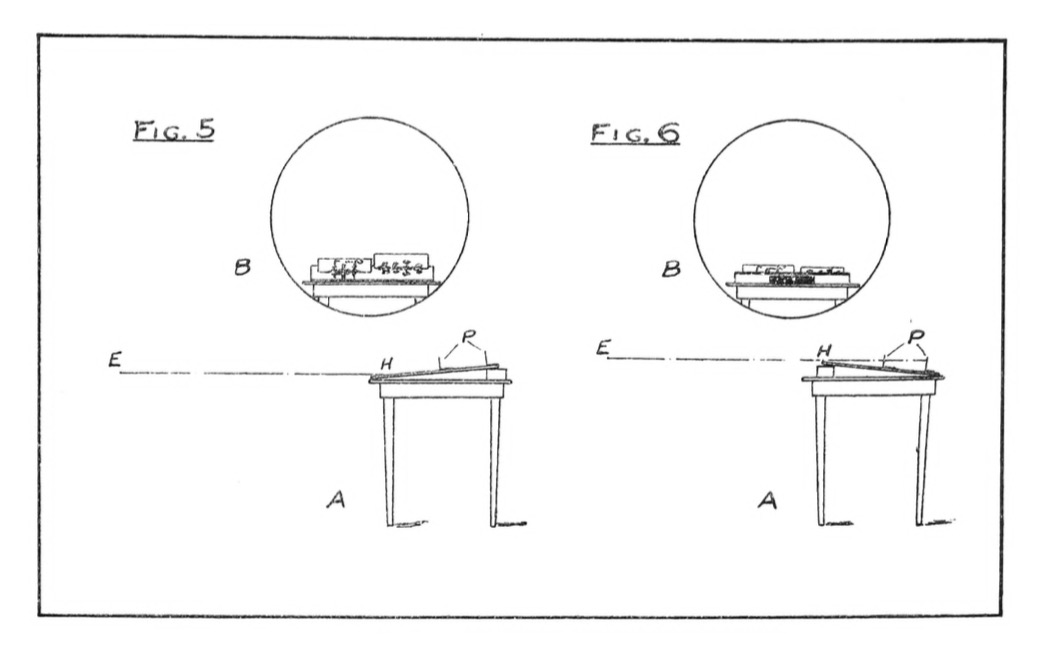
The objects and their reflections are seen as in Fig. 5B. Now suppose the mirror to be inclined downwards, as in Fig. 6A. The upper portion of some of the objects could be seen over the near edge of the mirror, as in Fig. 6B; but it would be utterly impossible to see their reflections.
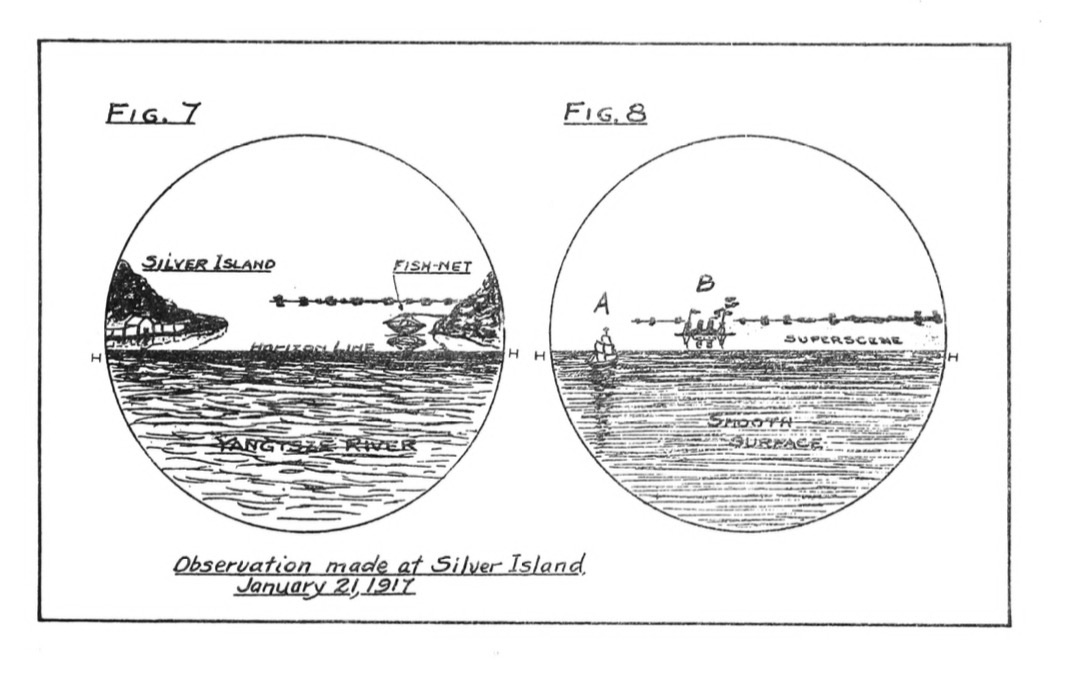
The best observations I have made were on the Yangtsze River at Silver Island, near Chinkiang, China, during the month of January, 1917. Up till that time I had not been altogether certain that what I saw beneath the objects in the superscene was their true reflections, or simply an optical illusion due to atmospheric refraction. At Silver Island, however, my doubts were completely dispelled. It was an ordinary Chinese fish-net that did it. Figure 7 illustrates what I saw. The net is shown extending out horizontally from the bank of the river opposite Silver Island. It was beyond the horizon line, HH, but its reflection was distinct and unmistakable. The downward curve of the net was beautifully reflected in an upward curve, as shown in the illustration (only the drawing is a very crude representation of the actual scene; here is where the art of telephotography must perform a great service in the future, in the study of reflections in this superscene). The observation was made through prismatic field glasses (8x). My eye was about 3 feet above the surface of the water; and the distance of the horizon line, HH, was about 2 miles. At the same time, I observed the vegetation on the shore line far beyond (5 or 6 miles) Silver Island. This is also shown in the illustration and appears some distance above the horizon line.
I must describe briefly the last observations I made, Saturday, February 3, 1917, before writing this article. I was traveling from Hangchow to Mokanshan. A large part of my journey was made in a small Chinese foot-boat (a boat operated by the feet) on the Grand Canal—that most wonderful of all Chinese waterways. For several miles, the canal being comparatively straight over long stretches, I was able with my eye scarcely 15 inches above the water to observe the smooth surface of the canal both before and behind me as the boat glided swiftly along.
It is difficult for me to describe what I saw, and still more difficult to describe my sensations as I reflected on the significance of the scenes I was witnessing. All I could think of was the impossible fairy tales in the Arabian Nights Entertainment, where human beings are allowed to penetrate the mysteries of another world. But here was no fairy tale; although, to me, it was just as remarkable because of its vivid reality. There, both before and behind me, was that wonderful mirror-like space above the horizon, constantly changing with the onward movement of the boat. On its surface there was a continual panorama of moving objects so characteristic of life on a Chinese water-way. Here were fisherman, some with nets, others with cormorants flitting about; there were slow-going junks, house-boats, sampans, small gun-boats and rapid mail-boats—all perfectly reproduced on the surface of this superscene. My belief in the old convex theory of the earth was entirely shattered. We have been taught that there is nothing to be seen (except the tops of objects, as I have mentioned) beyond the horizon; that what is called the observer's horizon is the upper limit of the earth's surface; but such ideas are incompatible with the observed phenomena. ---
← Chapter 5 — The Mirage | Chapter 7 — How and What to Observe →
- -- Source: O. F. Barcus, A New World Discovered (1917).