To A Very Dear Friend whose Christian life and character inspired me to embark on this wonderful Voyage of Discovery
“There is a place for speculation and imagination in the scientific method, but it is a place apart, which must be shut off; for if speculations are not kept in strict quarantine, they are certain to infect our conceptions with their own fatal vagueness.” —Mill, Realm of Nature
“It is probable that in the future, as in the past, the greatest discoveries—those which will suddenly reveal totally unknown regions and open up entirely new horizons—will be made by a few scholars of genius who will carry on their patient labor in solitary meditation, and who, in order to verify their boldest conceptions, will no doubt content themselves with the simplest and least costly experimental apparatus.” —Poincaré, The New Physics (1915)
“The governing passion in the life of the man of science is his passion for beauty. The soul of science, for the extension and embellishment of which scientific men live their lives, is scientific theory. They do not live to invent aeroplanes, to discover wireless telegraphy, to build Zeppelins, or to concoct poisons, but to see the universe as a more comprehensive and harmonious whole. Their reward is the acute aesthetic pleasure which the discovery of such harmony entails.” —Scientific American, December 30, 1916
“There are certain periods in the history of scientific progress when a discovery, or group of discoveries, changes the whole trend of thought. Startling as the new facts and phenomena may be, they are overshadowed by the important and far-reaching character of the ideas they suggest, and by the influence these exert in modifying views that have become almost as irrevocable as the laws of the Medes and Persians. Old mental pictures, fruitful in indicating the direction of further experiment and reasoning, are wiped out; and for a time, scientific men are busy painting, with tentative and hesitant strokes, a new picture of the physical universe.” —Cressy, Discoveries and Inventions (1914)
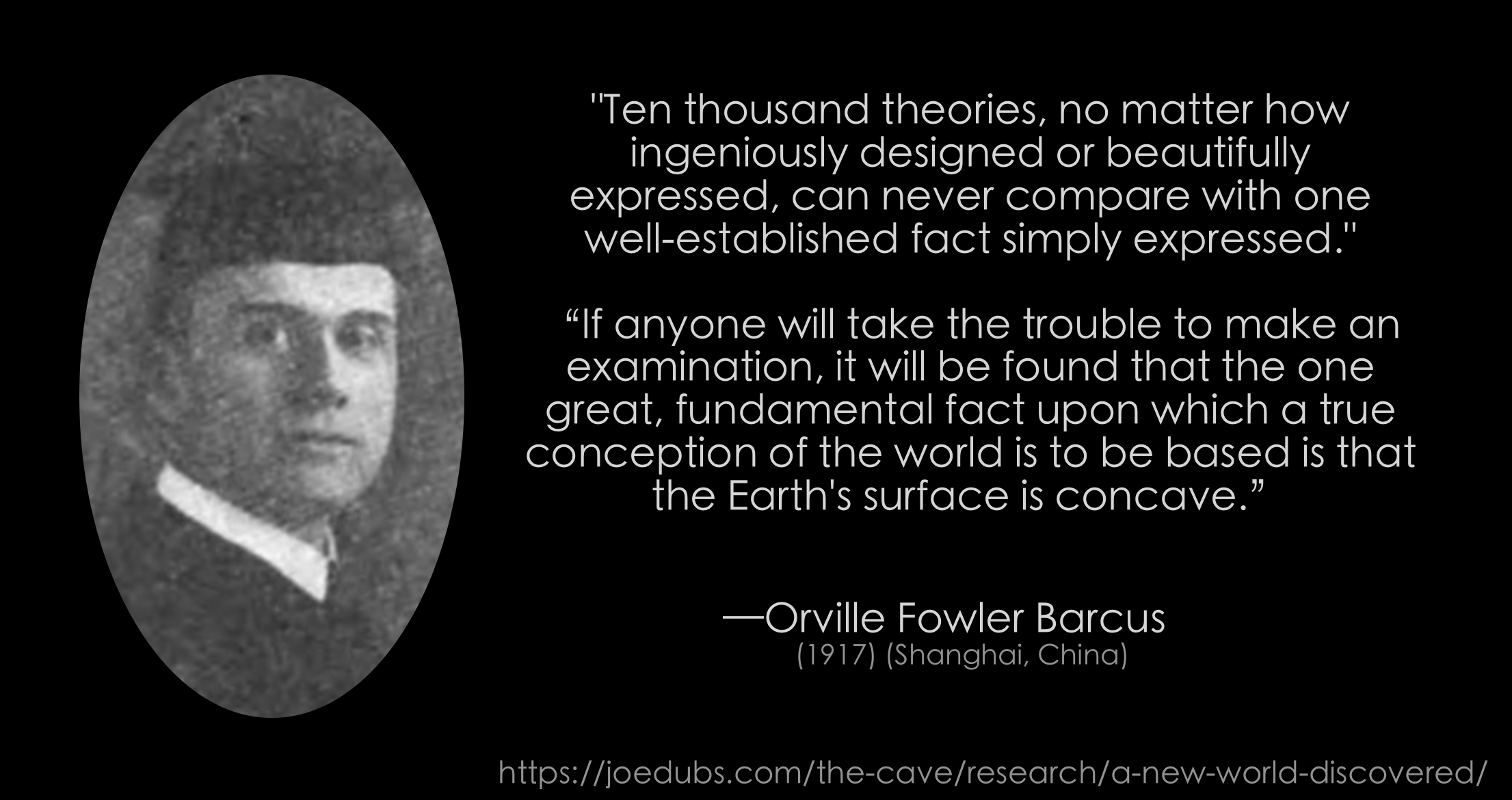
“If anyone will take the trouble to make an examination, it will be found that the one great, fundamental fact upon which a true conception of the world is to be based is that the Earth’s surface is concave.” —The Author
This little work is put before the public as a brief introduction to what must ultimately prove to be one of the most revolutionary discoveries in the history of the human race.
In presenting this discovery I make no claims to any special revelation of Truth hitherto withheld, but I do maintain that for some unaccountable reason there has been in the world of science an astonishing "marvel of oversight," in that scientific thinkers have never subjected the surface of our earth to a rigid, rational and thorough examination in order to ascertain its true contour.
Thousands upon thousands of careful and painstaking observations of the heavenly bodies and of their movements have been made with powerful telescopes, ingenious spectroscopes, and with many other instruments, —the best and most accurate that human ingenuity could devise; yet, when we come to look for records of equally careful and painstaking examinations of the earth's surface, we fail to find any, for the simple reason that no such examinations have ever been made—or, if they have, the scientific world, and hence the public in general, has never had the benefits of them.
I have done what any normally intelligent person would have done, had the thought occurred to him: refusing to accept for granted all the teaching of our modern scientific text-books concerning the nature of the universe, I have made a series of observations of various phenomena at the earth's surface itself, more especially over bodies of water where a better study of the phenomena may be carried on. The results of these observations are briefly set forth in this volume.
The edition is necessarily a limited one, since I am preparing a fuller treatment of the whole subject matter for publication within the next year. An outline of the work presented in this larger edition is given on page 64.
Meanwhile I am preparing an article to be published in one of the leading scientific magazines, and am therefore very desirous of multiplying my own personal evidence by that of others, who, being sufficiently persuaded that the idea is something more than farcical, or ephemeral (like so many others that have gone before), are willing to make the observations herein suggested and furnish me with a record of same. Each reader therefore is given an opportunity of sharing in the presentation of this new conception of our earth, by making personal observations of the phenomena, —or of some of them, at least, —and forwarding to me the records on the accompanying blank duly filled in and signed.
All such records will be gratefully received, and will be used as so much additional evidence in the presenting of the wonderful Truth which they reveal.
- --
Preface II — The New Heavens →
- -- Source: O. F. Barcus, A New World Discovered (1917).