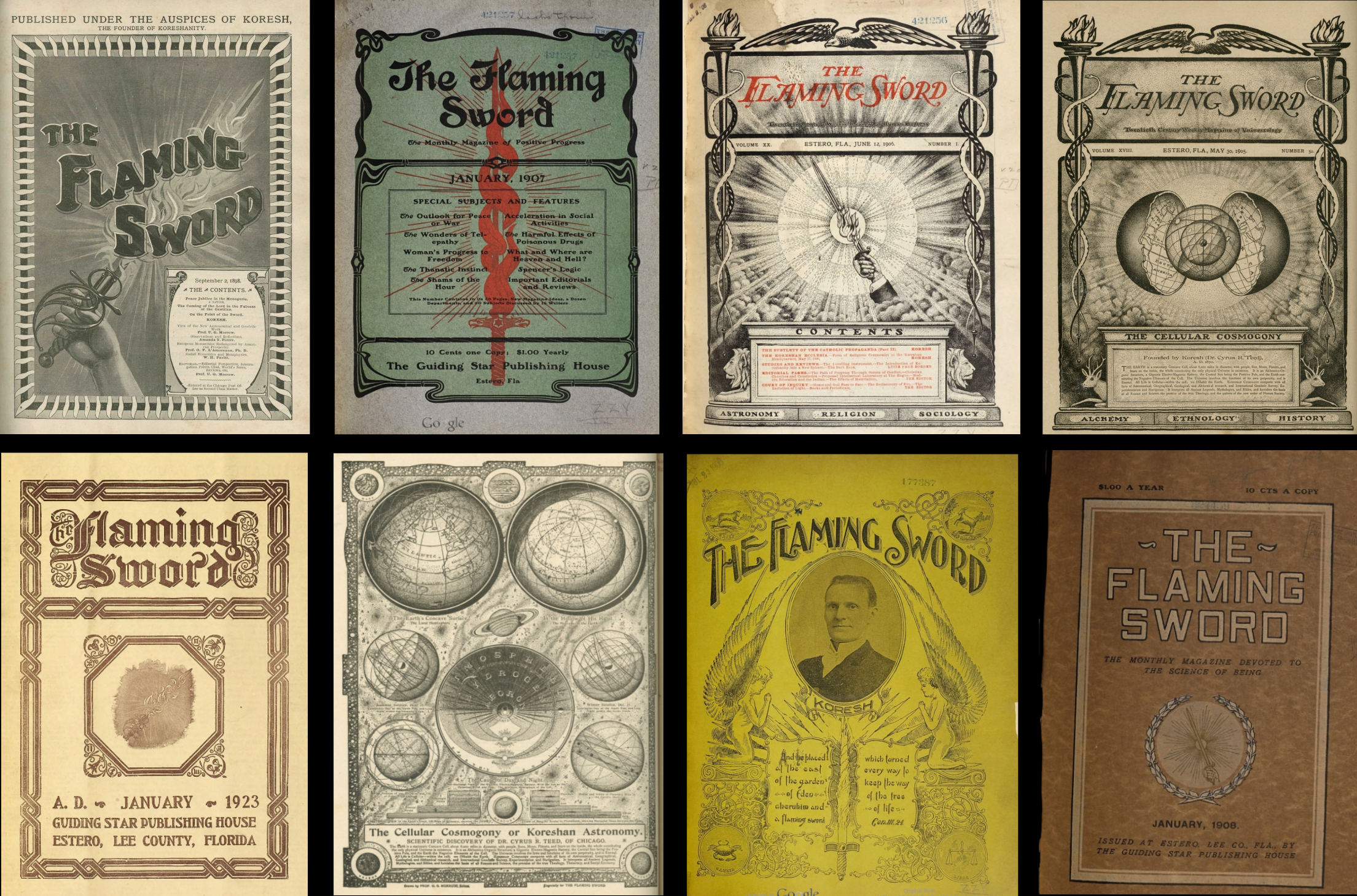
Vol. 6, No. 2 · July 1893
A long-form treatment of the moon’s form and function in Koreshan cosmogony, connecting lunar phenomena to the paper’s wider theory of universal structure.
PDF p. 6
Vol. 6, No. 2 · July 1893
The paper reinterprets solar and lunar eclipses through its concave-earth cosmology and its theory of returning solar radiations.
PDF p. 6
Vol. 6, No. 2 · July 1893
An account of how the sun’s motion was thought to act on the earth shell’s metallic layers, producing electro-magnetic and levic forces.
PDF p. 7
Vol. 7, No. 6 · Mar 24, 1894
A philosophical essay distinguishing knowledge (comprehension of facts through observation and reason) from belief (acceptance of unproven concepts). Argues that absolute knowledge requires experiencing all facts of the universe through cycles of embodiment, and that the Christ exemplified this perfection. Modern scientists are portrayed as rejecting the appointed Way of Christ while seeking truth through antichrist channels.
PDF pp. 4-5
Vol. 7, No. 7 · Mar 31, 1894
Miscellany page consisting of two parts. First: 'Random Notes from Various Lectures' — a collection of Koreshan aphorisms touching on chemistry, the sun and moon symbolism, gender in nature, the Anglo-Saxon and German nations, money, Gog and Magog, the fall of man, and cycles of the zodiac. Second: a 'Correspondence' letter from Estero (New Jerusalem), Feb 22–Mar 13, 1894, describing the Koreshan pioneers' life — digging sweet potatoes, fishing, alligators, climate, honey extraction, and the plans for building the Great City.
PDF pp. 9-10
Vol. 7, No. 10 · Apr 21, 1894
Koreshan lecture aphorisms, the poem Unalterable Law, and a humorous funeral anecdote titled As Funny as Any.
PDF p. 9
Vol. 8, No. 3 · Sep 1894
An early Koreshan critique of Zetetic (flat earth) astronomy as promoted by 'Parallax' (Samuel Rowbotham) and The Herald of Glad Tidings. The editor argues that while Zetetics have proven the earth is not convex, they have not proven it is flat. Presents the concave theory as the correct alternative, with geometrical arguments from the cube-sphere analogy, a rail-and-tube experiment showing perspective foreshortening, and a proposed canal experiment to demonstrate concavity.
PDF p. 5
Vol. 9, No. 8 · Aug 1895
A poetic-theological meditation on Elijah/Koresh as the 'man with the plumb line' who confronts the cross of Calvary at the end of the Christian dispensation. Portrays Elijah as the restorer of true cosmic knowledge — the firmament, the sun, moon, and stars in their right places — and as the divider of the world, the cross of Christ that will turn the world upside down and make all things new.
PDF pp. 5-6
Vol. 10, No. 4 · Apr 1896
Two-part miscellany. First: O.F. L'Amoreaux describes watching sail vessels off Estero Island vanish from unaided view but reappear through a telescope — a practical test against the convex-earth theory. Second: 'The Holy Ghost Then and Now' examines the primitive Christian communal life under Acts 2, contrasts it with modern revivalism, and argues that true conversion requires the full ripening of the divine seed through cycles of embodiment.
PDF pp. 19-20
Vol. 10, No. 11 ·
A Disclosure of a Few of the Factors of Conclusion in the Modern Astronomical System.
PDF pp. 21-22
Vol. 10, No. 11 · Nov 1896
A compilation of evidence against convexity from the visible distances between mountain peaks, the U.S. Army Signal Corps heliograph experiment transmitting messages 183 miles between peaks in Colorado and Utah, and authoritative lighthouse visibility records showing lights visible far beyond the calculated convex horizon. Includes the classic example of Holyhead and Poolbeg lights across St. George's Channel (60 miles) and the English trigonometrical survey.
PDF p. 20
Vol. 11, No. 2 · Feb 1897
A Koreshan survey of alternative astronomical systems current in the 1890s. Examines the Copernican system's debt to Ptolemy, the Electric Theory of planetary currents, Vail's Annular/ring theory (with its $1,000 challenge), the Gillespian geocentric system, and Captain Wolff's cone-shaped earth theory — all critiqued from the Koreshan standpoint as lacking a demonstrated premise.
PDF pp. 17-18
Vol. 12, No. 16 · Mar 4, 1898
Source-led article repair of Some Real Things Beyond the Power of the Telescope; historical claims remain attributed to The Flaming Sword.
PDF p. 8
Vol. 12, No. 25 · May 6, 1898
This Vol. 12, No. 25 item takes up Genuine Science the Panacea for Human Ills within the paper's account of celestial phenomena and its enclosed-universe model.
PDF pp. 5-8
Vol. 12, No. 26 · May 1898
A reader’s challenge about planets between Mars and Jupiter receives a short editorial answer situating primary, secondary, and tertiary planets in the Koreshan system.
PDF p. 11
Vol. 12, No. 28 · May 1898
Part IV explains a cellular-cosmogony diagram, relating the eastern hemisphere and visible heavens to the paper’s enclosed-universe model.
PDF pp. 6-7
Vol. 12, No. 36 ·
I agree that we cannot always be sure of a fact from the visual appearance. To illustrate, I will relate what came under my observation repeatedly in Colorado.
PDF pp. 10-11
Vol. 12, No. 44 · Sep 1898
A reader asks how a sun conventionally described as larger than the earth could exist inside a hollow globe; the reply directs readers to Koreshan literature and rejects conventional solar-parallax calculations.
PDF p. 10
Vol. 12, No. 48 · Oct 1898
A reader asks whether a hollow or solid globe could belong to a larger planetary system; the editorial reply argues for a single enclosed universe and its layered earth shell.
PDF p. 10
Vol. 13, No. 14 · February 1899
Lucie Page Borden argues that Koreshan Universology offers a rational, systematic account of cosmic order, social organization, and the concave-earth model.
PDF pp. 7–8
Vol. 13, No. 26 · 19 May 1899
An account of the fixed stars within the Koreshan cosmic shell, explaining their apparent positions through the paper’s concave-earth cosmology.
PDF pp. 10-11
Vol. 13, No. 27 · May 26, 1899
A correspondent calling himself 'an astronomer in the hollow globe' presses four questions about planetary motion, tides, and Kepler's laws, then argues that the Koreshan optical proofs and rectilineator evidence fail to demonstrate concavity — and that the 'optical illusion' explanation for celestial appearances is less probable than an unreliable instrument.
PDF p. 12
Vol. 13, No. 31 · 23 Jun 1899
A report on the reception of Koreshan astronomy in Georgia, placing the movement’s cosmological claims in a contemporary public setting.
PDF p. 12
Vol. 13, No. 37 ·
This Vol. 13, No. 37 item takes up Koreshan Cosmogony and Zeteticism within the paper's account of celestial phenomena and its enclosed-universe model.
PDF p. 11
Vol. 13, No. 52 · 17 Nov 1899
A systematic presentation of the premises the paper considered necessary for Koreshan Universology and its account of the universe.
PDF pp. 3-5
Vol. 14, No. 14 · Feb 1900
Source-led targeted existing-body seam repair repair of Fallacious Modern Astronomy.; historical claims remain attributed to The Flaming Sword.
PDF pp. 11–12
Vol. 14, No. 22 · April 1900
An editorial considers fundamental questions of being and origins, presenting the Koreshan cosmology as its answer to the mystery of existence.
PDF p. 12
Vol. 14, No. 27 · May 25, 1900
Editor Flaming Sword: — I see the astronomers are making great preparations for observing and photographing the sun's eclipse on the 28th inst.
PDF p. 8
Vol. 14, No. 29 · Jun 8, 1900
A Koreshan explanation of the Zodiacal belt within the earth's shell, the planetary disci whose reflections appear as visible planets, the Gegenschein as the reflex of the concave daylight hemisphere, and the precession of the equinoxes explained through the anthropostic movement of the divine Sun through the human constellations. Includes lunar science: the visible moon as a gravospheric X-ray image of the earth's shell, the dark mercurial discus that causes lunar eclipses by cutting the electromagnetic circuit.
PDF p. 12
Vol. 14, No. 30 · 15 Jun 1900
An argument for a religion grounded in the paper’s claimed scientific principles, with Koreshan cosmology offered as its foundation.
PDF p. 11
Vol. 14, No. 38 · Aug 10, 1900
THE SAME OBJECT viewed from two different points of sight, differs both in aspect and position.
PDF pp. 6-7
Vol. 14, No. 51 · Nov 9, 1900
This Vol. 14, No. 51 item takes up Swedenborg and the Cellular Cosmogony within the paper's account of celestial phenomena and its enclosed-universe model.
PDF p. 5
Vol. 14, No. 52 · Nov 1900
Source-led targeted existing-body seam repair repair of Phenomenal Refutation of Modern Astronomy.; historical claims remain attributed to The Flaming Sword.
PDF pp. 5–7
Vol. 15, No. 1 · Nov 1900
An Open Court exchange addresses why stars appear in the same constellations to distant observers, advancing the paper’s account of curved light and a stellar sphere.
PDF pp. 11–12
Vol. 15, No. 3 ·
Editor Flaming Sword:—Take your own diagram—the one showing Chicago as the lowest point—and explain how it is that the region of stars that never set extends right and left, above and below, with the .
PDF p. 12
Vol. 15, No. 16 · Mar 8, 1901
The Flaming Sword editor responds to Edward A. Osse's critique in the Baltimore American. Rebuts claims about the Lake Michigan telescope experiment, describes a practical optics demonstration with a telescope, fence, board, and string that proves the telescope sees through barriers, includes a Lighthouse and Target diagram discussion, and addresses refraction arguments. Dr. O. J. Ruth provides background on Osse, revealing the pseudonym 'Edward A. Osse' probably originated as 'O. E.' from the Odorless Excavating industry.
PDF pp. 11-13
Vol. 15, No. 18 · March 1901
An editorial on advancing Koreshan cosmogony, framed as a response to the paper’s claimed weaknesses in modern scientific explanation.
PDF p. 5
Vol. 15, No. 19 · March 1901
A polemical editorial attacks the assumptions of contemporary science, especially Copernican astronomy, and sets out the paper’s case for Koreshan alternatives.
PDF pp. 3-6
Vol. 15, No. 40 · Aug 23, 1901
The paper contrasts Koreshan alchemy with contemporary accounts of solar heat, radiation, and the transformation of matter and energy.
PDF pp. 6-7
Vol. 15, No. 46 · 4 Oct 1901
A critique of what the paper presents as unresolved anomalies and contradictions in modern physics.
PDF pp. 4-6
Vol. 15, No. 48 · Oct 18, 1901
This Vol. 15, No. 48 item takes up La Cosmogonie Cellulaire Ou La Terre Une Sphere Concave within the paper's account of celestial phenomena and its enclosed-universe model.
PDF p. 14
Vol. 16, No. 6 · 27 Dec. 1901
This Vol. 16, No. 6 item takes up The Earth and the Solar System within the paper's account of celestial phenomena and its enclosed-universe model.
PDF pp. 5-6
Vol. 16, No. 15 · Feb 28, 1902
Editor Flaming Sword:— How do you explain the fact that mathematicians determined the location of the planet Neptune before it was observed by astronomers? The calculations, you know, were made upon t.
PDF p. 24
Vol. 16, No. 16 · 7 Mar 1902
The paper treats the apparent dome overhead as an optical effect and uses it to argue for its enclosed, concave-earth model of the heavens.
PDF pp. 12-13
Vol. 16, No. 18 · Mar 21, 1902
Editor Flaming Sword:— I have taken up the study of astrology; but as the computations by the heliocentric and geocentric methods are not at all satisfactory to me, I want to know if the Cellular Cosm.
PDF pp. 12-13
Vol. 16, No. 19 · Mar 28, 1902
Editor Flaming Sword:— Will you please explain why the rays of the rising sun touch the top of a mountain before the base; and why the rays of the setting sun leave the top of the mountain last? Accor.
PDF p. 12
Vol. 16, No. 23 · Apr 25, 1902
Editor Flaming Sword:—Permit me to recommend for your careful perusal, an article in the February (1902) number of the Popular Science Monthly, entitled "Stellar Evolution in the Light of Recent Resea.
PDF pp. 12-13
Vol. 16, No. 33 · Jul 4, 1902
Editor Flaming Sword:— Why does not a ship as it passes out to sea, become smaller and smaller until it entirely disappears from sight as a whole, as does the rising balloon, instead of disappearing h.
PDF p. 12
Vol. 16, No. 34 · 11 Jul 1902
The paper presents space as a bounded, cellular phenomenon rather than an infinite void, explaining the idea within its Koreshan system.
PDF p. 12
Vol. 16, No. 46 · 3 Oct 1902
An explanation of a total lunar eclipse through the Koreshan system, set against the standard account of the moon and its shadow.
PDF p. 10
Vol. 16, No. 49 · 24 Oct 1902
The paper offers a Koreshan explanation of a lunar eclipse and contrasts it with the conventional astronomical account.
PDF p. 10
Vol. 16, No. 50 · 31 Oct 1902
An editorial critique of modern astronomy’s methods and assumptions, written from the paper’s Koreshan perspective.
PDF pp. 10-11
Vol. 16, No. 50 · 31 Oct 1902
An editorial criticizes modern astronomy for what it describes as unsupported assumptions and failures to explain celestial phenomena coherently.
PDF p. 8
Vol. 17, No. 3 · 5 Dec 1902
A technical discussion of astronomical triangulation, criticizing the assumptions used to infer distance and celestial position.
PDF p. 10
Vol. 17, No. 4 ·
Editor Flaming Sword:—A friend who is interested in the new theory known as the Cellular Cosmogony, has been explaining to me as best he can, the points upon which the assertion that the earth is holl.
PDF pp. 10-11
Vol. 17, No. 14 · Feb 20, 1903
Source-led exclusive full article repair of Science in Sunday Schools; historical claims remain attributed to The Flaming Sword.
PDF p. 6
Vol. 17, No. 15 · Feb 27, 1903
Editor Flaming Sword:— In a recent letter I asked you to show why astronomical triangulations have heretofore been incorrect.
PDF p. 10
Vol. 17, No. 29 · 5 Jun 1903
A discussion of cosmic force and mechanical energy, using the language of ‘horse-power’ to describe the universe in Koreshan terms.
PDF pp. 10-11
Vol. 17, No. 40 · Aug 21, 1903
Lucie Page Borden urges universities to investigate Koreshan cosmogony, arguing that the form of the universe must underlie scientific research.
PDF p. 6
Vol. 17, No. 45 · Sep 25, 1903
Source-led exclusive full article repair of Are the Solar Rays Electrical?; historical claims remain attributed to The Flaming Sword.
PDF pp. 10–11
Vol. 18, No. 28 · Dec 20, 1904
The paper interprets Uranus’s seven-year passage through zodiacal constellations in relation to Koreshan history and anticipated religious, political, and social changes.
PDF pp. 7-8
Vol. 18, No. 35 · Feb 7, 1905
Two astronomy Q&As from the Open Court. First, a reader asks how the Koreshan System explains seasons without an orbiting, rotating earth. The editor explains the sun's spiral motion — the central sun's revolution carrying the projected sun in a spiral path between the tropics, the lantern-and-lens analogy, and the annual Zodiacal sweep. Second, a reader asks about precession changing the months' relation to seasons; the editor explains the difference between the tropical and sidereal year and why the Gregorian calendar maintains seasonal alignment.
PDF p. 12
Vol. 18, No. 42 · March 28, 1905
"Will you please explain as clearly and thoroughly as space in the Inquiry Department of The Flaming Sword will admit, the phenomena manifest in the rising and setting of the sun? The first impression.
PDF pp. 12-13
Vol. 18, No. 51 ·
This Vol. 18, No. 51 item takes up Progress in Koreshan Study within the paper's account of celestial phenomena and its enclosed-universe model.
PDF p. 12
Vol. 19, No. 6 · Jul 18, 1905
Source-led article repair of The Obliquity of the Ecliptic; historical claims remain attributed to The Flaming Sword.
PDF p. 12
Vol. 19, No. 10 · Aug 15, 1905
Extracts from Garrett P. Serviss describe solar and stellar photography, spectroscopy, and unresolved questions about the Milky Way.
PDF p. 23
Vol. 19, No. 11 · Aug 1905
J. S. Sargent answers a reader’s question about gravity by arguing that a concave earth would draw a falling body toward its circumference rather than an imagined central sun.
PDF pp. 8–9
Vol. 19, No. 26 · 5 Dec 1905
"Science now computes the distance to the sun to be all the way from 90,000,000 to 95,000,000 miles from the earth.
PDF p. 12
Vol. 19, No. 28 · Dec 19, 1905
An Open Court of Inquiry response explains the periodical's account of sunrise and sunset through perspective, visual curvilineation, and the concave-earth premise.
PDF p. 12
Vol. 20, No. 2 · 19 Jun 1906
A later discussion of the sky’s apparent vault, setting familiar visual experience against the paper’s cellular model of the universe.
PDF p. 12
Vol. 21, No. 10 · Oct 1907
Otto T. Frincke defends Cellular Cosmogony as the divine order of the universe while criticizing astronomical claims about distant suns and worlds.
PDF pp. 20–21
Vol. 22, No. 2 · Feb 15, 1908
Source-led exclusive full article repair of Outline of the Koreshan System; historical claims remain attributed to The Flaming Sword.
PDF pp. 14–16
Vol. 24, No. 5 · May 1910
An installment of the paper’s introductory cosmogony series for younger readers, presenting its universe model in instructional form.
PDF p. 20
Vol. 24, No. 6 · Jun 1910
A discussion of cometary phenomena and the role assigned to them within the Koreshan account of the cosmos.
PDF p. 18
Vol. 25, No. 2 · Feb 1911
A 1911 editorial rejects reports of a newly formed sun in a nebula and contrasts astronomical conjecture with the paper’s Cellular Cosmogony.
PDF p. 15
Vol. 25, No. 9 · Sep 1911
A later installment of the paper’s instructional cosmogony series for younger readers, continuing its account of the Koreshan universe.
PDF pp. 18-19
Vol. 43 ·
IN THIS AGE of scientific marvels we are wont to look upon the ideas and efforts of the people of earlier times as out of date and lacking somewhat in real sagacity.
PDF p. 101