I began this work with the intention of saying very little about the probable structure of "the new heavens" as related to "the new earth"; since the rigid principle upon which I base my arguments for a hollow earth requires that all evidence, of whatsoever kind, obtained from observations of celestial phenomena shall be considered as secondary—decidedly so—to the one great fundamental fact, namely: that the earth's surface is concave.
Our previous conception of the probable structure of the heavens must undergo such a revolutionary change, when viewed in the light of this new fact, that it would require many more pages of illustrations and explanations to satisfy the host of critical minds in the vast number of questions that would arise. It required years and years of patient labor on the part of hundreds of brilliant minds to arrive at the present conception of the universe, based primarily on the one apparently simple assumption of Copernicus that the earth is not fixed but has a rotational and orbital motion. It would be folly, therefore, on my part to presume, at once, a final explanation of the entire universe, or even of some of the most common celestial phenomena, such as Day and Night, change of Seasons, etc., based on the one simple discovered fact that the earth is a hollow sphere. There are so many possibilities involved in such a new conception that it will require the service of all the brilliant minds in science for the next hundred years or more to work out, on the new and true basis, a final conception of the universe as a whole; and even then we can never be absolutely sure of its conclusiveness for the very nature of celestial phenomena, in contradistinction to phenomena at the earth's surface, forbids absolute penetration, by the most sagacious of mortal minds, into the mysteries of the upper regions.
There are at least two conclusions, however, that must necessarily follow from the fact of the earth's concavity, viz:—
(1) That the human family is living on the inside of a hollow earth, having an internal diameter (as far as we know at present) of approximately 8,000 miles.
(2) That the heavenly bodies being visible, as they are from every part of the earth's internal surface, are therefore all enclosed in the hollow earth.
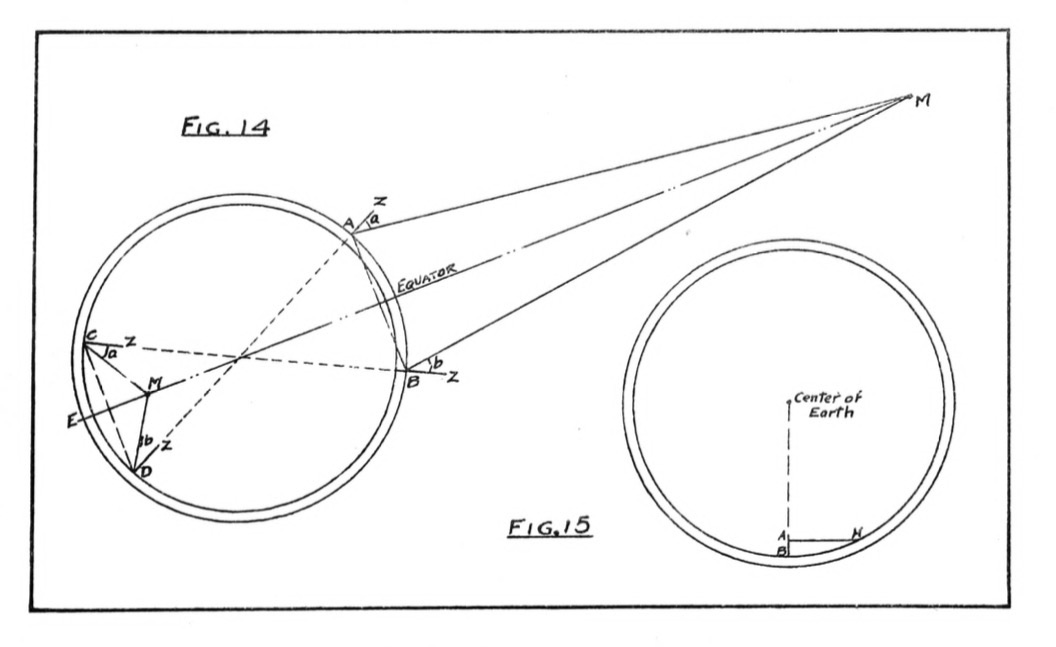
At the present stage of inquiry, therefore, it would be decidedly unscientific for any one to expect an immediate and decisive answer to such questions as: What is the cause of Day and Night? What is the cause of eclipses? What are the Stars? etc.,—for the explanation of these phenomena must always be based on observations containing certain elements of assumption. In order to satisfy in some degree, however, any unreasonable sceptics who will read this book, I have appended a brief description of what I myself consider to be the cause of Day and Night. My suggestions need be received only in so far as they are examined and verified by the recognized scientific authorities. My one present great desire is that this brief introductory work, if it doesn't win very many immediate converts to the new conception, will at least stimulate scientific investigators in every field of labor to stop their work long enough to make a rigid and thorough examination of the earth's surface on which we live. ---
← Preface I — "The New Earth" | Chapter 1 — Introduction →
- -- Source: O. F. Barcus, A New World Discovered (1917).