by Leonello Boni (1971) "If you do not expect the unexpected, you will not find the truth."
In the July 1931 issue of the American magazine "Geographic Magazine," on page 635, there was an infrared photograph of Mount Aconcagua, taken that same year from an airplane at a distance of about 460 kilometers. Under it, it was written: "The first photo taken to finally show the convex curvature of the Earth."
Even more recent photos, taken by the Germans in 1944 with V-2 missiles from an altitude of 165 km and, subsequently, by the Americans with "Aerobee" rockets from an altitude of 400 km, show the sphericity of our planet and its convexity, about which there should no longer have been any doubt. Whoever might have thought, then, that the very photo from 1931 and those taken later by American or Russian missiles and spacecraft could in the future serve to show instead the CONCAVE curvature of the Earth, would have smiled with pity or, at the very least, with disbelief.
Well then, on the basis of a recent and ingenious conception by Prof. Amico-Roxas, a professor of mathematical analysis at the University of Rome, it would seem instead that the second hypothesis is actually the right one: that is, the Earth is CONCAVE and we live INSIDE it, on the inner surface of a hollow sphere. Already with the "new optics - science of vision" of Prof. Vasco Ronchi, a first great revolution in the field of physics had emerged and is operating in depth; now, therefore, the conception of the world also presents itself with a new face, and all the knowledge of human sensations and perceptions is being re-examined: thus also the sphericity and "convexity" of the Earth.
Every conception of the world is necessarily founded on certain hypotheses regarding the nature of space and, in particular, on the hypothesis of a specific law of light propagation. Until Einstein, cosmic space was considered Euclidean; that is, the propagation of light was assumed to be rectilinear (in the Euclidean sense), space homogeneous, and motions rigid: on this premise, the Exospheric Theory of the world was founded in its various variants (Ptolemaic and Copernican systems). Einstein, with his theory of gravitation, departs from Newton's theory: the propagation of light is not rectilinear, motions are not rigid, the real Universe is not Euclidean. However, the curvatures of light rays in Einstein's Theory are so slight that the relativistic world still fits within an exospheric model.
The new Endospheric Theory (Paolo Emilio Amico-Roxas: "THE PROBLEM OF SPACE AND THE CONCEPTION OF THE WORLD", Libreria Editrice Universitaria D'Isa - Rome), like Einstein's, was born from a gradual evolution of ideas, from gradual developments of thought, conducted with absolute logical and scientific rigor; it is founded on the concept of a "field" but, in addition to the gravitational field, it also considers the electric field, whose sources are the Sun and the "stellar center", that is, the central region (with respect to the CONCAVE surface of the Earth, considering the latter as a hollow sphere containing the entire Universe) of the system of all stars.
More specifically, the center of this region would be the negative pole of the aforementioned field and of all the multiple fields each having, as a positive pole, a star.
Qualitatively, the new Theory it does not differ from that of Einstein; the difference is purely quantitative, the curvatures of "light" would be more pronounced, non-rigid motions would involve more sensitive deformations, and the Universe would have a more radically non-Euclidean nature. Based on the hypothesis of rectilinear or quasi-rectilinear propagation of light, admitted respectively in the classical Theory and Einstein's, the world is assumed to be exospheric; conversely, based on the hypothesis of curvilinear propagation of light (the geodesics traveled by electromagnetic radiation would be the lines of force of the aforementioned field or fields), the world would be configured INSIDE the terrestrial sphere considered HOLLOW, with geometric rigor (transformation by reciprocal radius vectors), surrounded by the concave surface of the Earth.
And there would be full equivalence and correspondence between classical space and endospheric space: all relationships valid in the former are also valid in the latter; all celestial phenomena explained and predicted through calculation in the former are explained and predicted, with equal exactness and logical rigor, in the latter. By attributing to the quantities and variables appearing in Newton's law and in all the relationships of Celestial Mechanics the meaning that pertains to them in the NON-Euclidean space of the Endospheric Theory, that law and those formulas retain their full validity: in them, however, the quantities depend on the local intensity of the field. Thus, the Euclidean and Einsteinian worlds would become abstract worlds, while the endospheric one would be the concrete and real one; equivalent to each other, but not identical, in fact deeply different and linked by a vector reciprocity. Space, characterized by the laws of the field, through the application of transformations by reciprocal radius vectors, changes into the classical space of Euclid.
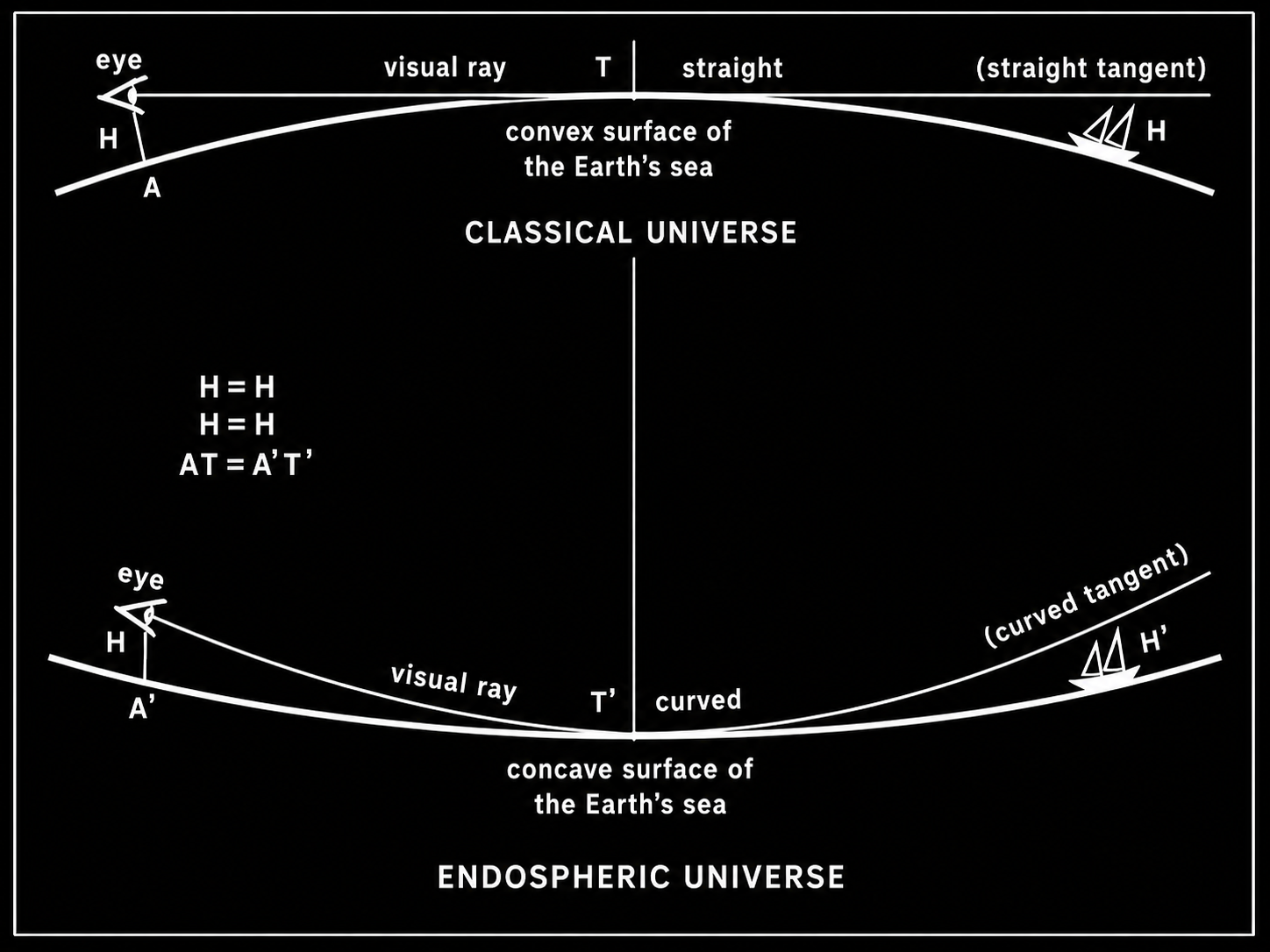
The hypothesis of the rectilinear propagation of light arose from the fact that we mentally extend the rays that reach the back of the eye; as a result, every object or light source appears to be located in the direction from which the rays of light, coming from the object or source, penetrate the eye or the camera obscura of a camera along the tangent to the curve. For this reason, for millennia we believed that space—which is actually curved—was instead Euclidean. According to the endospheric theory, however, electromagnetic waves (so-called light) travel along curvilinear geodesics whose curvature is very slight near the Earth's surface, so that they appear rectilinear, while in fact it gradually increases until it becomes infinite in the depths of space.
The circular transformation by reciprocal vectors that links the real endospheric space with the exospheric space of the classical hypothesis implies that every relation valid in one of them is also valid for the other. Therefore, the same formulas, relations, and equations remain valid but acquire different meanings depending on the meaning we attribute to the magnitudes or variables that appear in them.
The new theory would then clarify several facts that instead find no satisfactory explanation in the classical conception: this is also where its validity and acceptability would reside. With the new Endospheric Theory, therefore, the Earth would not be a planet, but the periphery of the world; thus, quite rightly, this hypothesis can be called the boldest and most revolutionary conception of the world to have appeared so far, so much so that, at first glance, it is spontaneous to reject it as absurd. But, given the scientific rigor and seriousness with which the well-known author has treated the subject, and the meticulousness of the elaboration, including the mathematical aspects, it deserves to be examined carefully because it makes one think, for those who have no prejudices of any kind and are not conditioned by the classical conception of the world, how all this "could be", as the very famous Prof. Francesco Severi stated after having carefully examined it. In any case, this theory must be considered a bold and fertile new working hypothesis.
The study of the Theory nonetheless requires an effort regarding one's mental attitude, and the greatest difficulty is perhaps psychological in nature, since it is not easy to mentally "see" a world in which spatial INFINITY, in non-Euclidean terms, is INSIDE the hollow sphere of the Earth, and the FINITE (again in non-Euclidean terms) is instead OUTSIDE. Which seems decidedly contradictory, if one does not take into account that we are expressing ourselves in non-Euclidean terms.
But then, what could there possibly be "outside" the hollow sphere that would contain the entire Universe? The depth of the CONCAVE Earth, measured no longer toward the center of the sphere but radially outward, would not differ numerically from the already known length of the Earth's radius. However, since the Universe is conceived here as a "field" where the maximum concentration of energy is found at the center (the stellar center or the negative pole of the universal field), as one moves away from that center, the energy density decreases: therefore, a "very short" kilometer near that center would become "very long" at the periphery, as quantities are functions of the local field intensity.
Thus, outside the "HOLLOW-EARTH", non-Euclidean kilometers would correspond to unequal lengths increasing to infinity, and matter would attenuate, tending toward zero. Therefore, the depth of the Earth, while still expressed by the number 6370 kilometers (Earth's radius), evaluated with increasing kilometers in the endospheric world, would have no end and an "outside" would not exist (a Euclidean concept rooted in us but which here would not make sense), because outside there would be the entire infinity of the Earth, expressible however with a finite number of non-Euclidean kilometers.
The fact that photographs taken from hundreds of kilometers high, from aboard rockets or spaceships, show the Earth to be spherical and convex - where we inhabit it OUTSIDE, on the surface - should prove, beyond any doubt, that the Earth cannot be concave, because "it does not look like one." This assertion, however, immediately falls apart if one considers that, if light rays have a curvature (Einstein has proven it), they can only show us the Earth as convex even if it is not, even in photographs. Therefore, the very photographs that make us see the Earth as convex can also serve to prove the opposite, under the hypothesis that light rays have a significant curvature.
In which case the Earth would actually be concave, and we would inhabit it FROM WITHIN (that is, with our heads pointing towards the center of the hollow sphere and our feet on the surface), and it would encompass the entire Universe which, in non-Euclidean terms, would be infinite.
The Universe would therefore have a density that increases the closer one gets to the sources of the field, namely the Sun (positive pole) and the "Stellar Center" (negative pole), and moving away from these, the aforementioned field would attenuate until it vanished. And celestial bodies would be "singular points," just as in Einstein's language they are great concentrations of energy. Even the Earth - not a planet - would be a "singular zone" of the field, and its surface could be called an equipotential surface at the edge of the Universe. "Gravity" would be provided by solar repulsion forces; the hollow Earth would expand as a consequence of the universal force of expansion or repulsion, with the consequent fractures and displacement of the Continents (Wegener's theories of continental drift and displacement). Light would travel along the geodesics of the new non-Euclidean space (field) while still respecting the laws of observation. All velocities and magnitudes of the Stars would have to be referred to local units of length. Therefore, the existence of giant stars and millions of other Suns which, with diameters as large as universes and near-zero density (and which would travel at prodigious speeds), would no longer be conceivable because all celestial bodies would be denser than the Earth, and their density would be a function of the intensity of the local field, that is, denser the closer they are to the "stellar center." While the Earth - not a planet, but the boundary of the Universe - would have a lower density than all of them.
However, one should not conclude that the Endospheric Theory annihilates or in any way diminishes the hitherto intuited infinity of the Universe, even if it is 'enclosed' here by a 'hollow' Earth. The concept of an infinite Universe, in non-Euclidean terms, remains intact because we must not confuse the 'psychological' infinite with that of mathematicians and physicists, for whom it is merely a limit and not a conceivable magnitude: the infinite is indeed not traversable even conceptually, and remains only a poetic fantasy.
After a comparison between the two conceptions of the world, the classical one and the endospheric one, science has evolved, highlighting the important circumstance that the Endospheric Theory admits the General Theory of Relativity as a 'special case', just as General Relativity admits Special Relativity as a 'special case', which in turn admits Newton's Theory as a 'special case'.
END OF ARTICLE