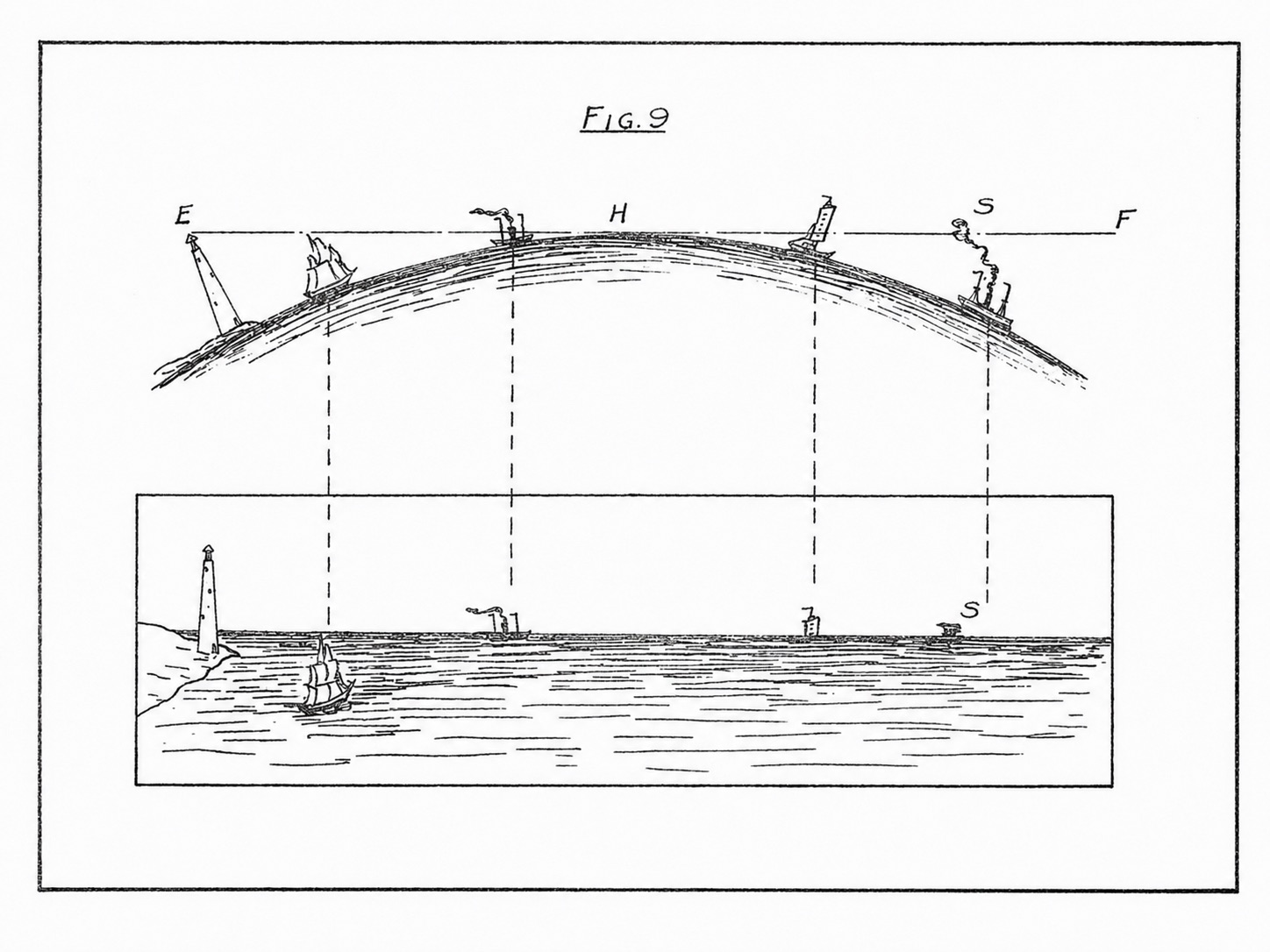
We are ready now to treat the evidence furnished by the phenomenon of vessels disappearing beyond the horizon. Figure 9 is a reproduction of the usual diagram illustrating the phenomenon. The observer is situated on the tower at E, his line of sight is EF, and his horizon at H. The vessels are all moving away from the shore, and one by one they apparently disappear gradually as they pass beyond the point IJ. The smoke of the boat S is visible above the horizon; the boat itself is entirely out of sight. The other boats appear to pass through the various phases: first, the entire outline of the boat is visible until it reaches the horizon at H, then the hull gradually disappears, next the sails, and finally the masts pass from view. This is the theoretical account of the matter, and, it must be admitted, a very plausible one, conclusive evidence, one would think, of the earth's convexity, as we have been taught in our text-books. But when one comes to make an actual and careful observation of the phenomenon, he finds that vessels do not disappear in this way at all! The reader has already noticed, no doubt, in some of the illustrations, that only the upper portions of some of the vessels are shown in the superscene. The conditions are accurately portrayed; for it is a fact that the lower parts of all objects, of any distinguishable size, when seen beyond the apparent horizon, appear to be cut off by a certain horizontal line, and a distinct space is seen between this line and the apparent horizon. It presents the appearance of horizontal slots having been cut in the superscene, into which the various objects are inserted, as it were, the upper parts only being visible because they are outside. How is this to be explained? I present my explanation in Fig. 10.
Before a clear conception can be had of this illustration, however, it will be necessary to consider briefly the principle of Perspective Foreshortening, a principle hitherto overlooked or disregarded in a study of this subject. The human eye has its limits of vision; two objects seen beyond a certain point, called the vanishing point, are not distinguishable as separate objects, but appear as one point. For example, an object one foot high, AH, Fig. 11A, placed at a distance of about 3,500 feet from the eye, is seen as a mere point at H, the line EH being the horizontal line of sight. In other words the point A is "brought down," so to speak, by perspective foreshortening, and appears to coincide with the point H. Likewise, a point C, Fig. 11B, one foot below the horizontal line EH, and placed about 3,500 feet from E, will appear to coincide with the point H. In this case the point C is "brought up" by perspective foreshortening. Applying this principle to objects receding from view, we have a simple explanation of the gradual disappearance of vessels.
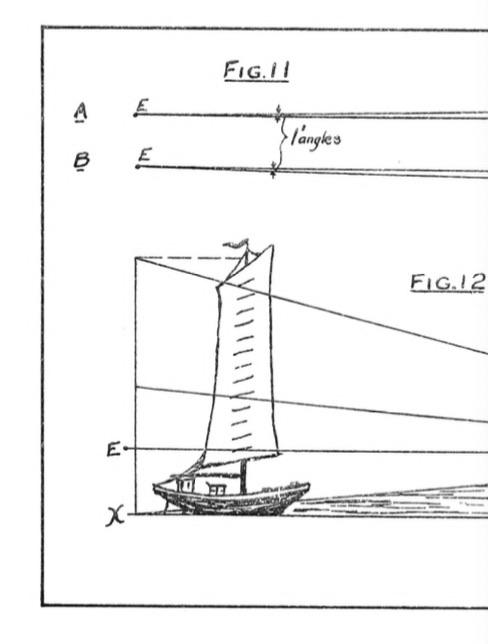
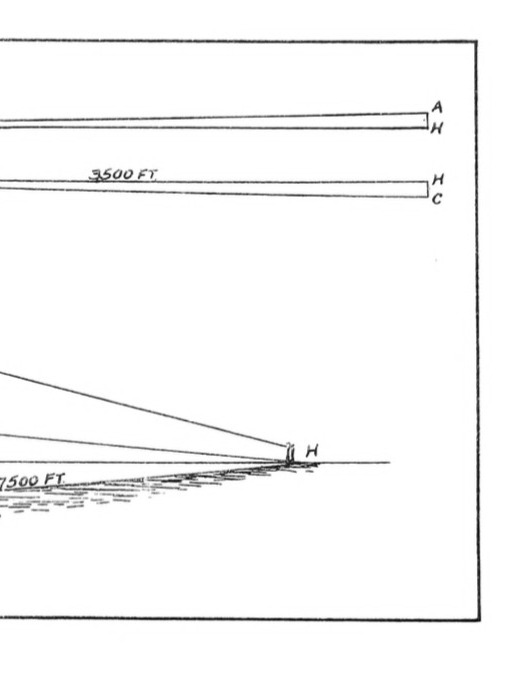
It must be observed, however, that this phenomenon is no proof as to whether the earth's surface is flat, convex or concave; it may take place on any one of these surfaces and we could not decide which it was by a superficial observation. A study of Figure 12 will make this clear. The hull of the vessel is included in the space below the horizontal line of sight EH. The entire height of the vessel is 20 feet. Receding from the eye at E, the hull becomes a mere point when it reaches the vanishing point H, 17,500 feet (5 x 3,500) from E; but the sails being much higher than the hull and therefore subtending a larger angle at E, continue to be visible for some distance beyond H.
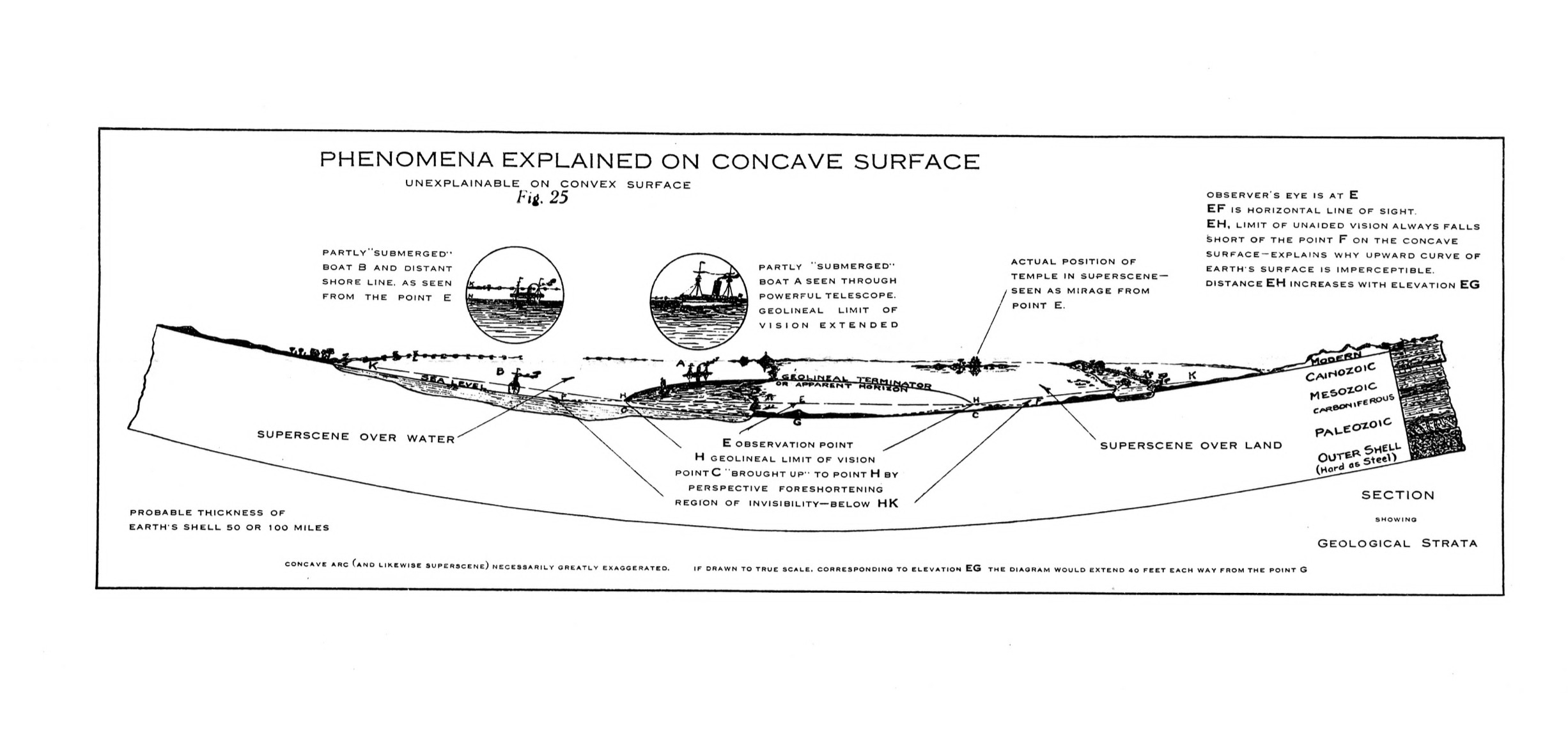
This is not the only feature of the phenomenon entering into our considerations. Returning to Fig. 10 we shall see just how the phenomenon takes place on a concave surface. The vessel A, it will be observed, has not reached the vanishing point H, hence its entire outline is visible from E. But the vessel B has passed beyond H, therefore only its upper part is visible, and appears as though inserted in a horizontal slot in the superscene. The important point to be noted here is that all objects, or parts of objects, entirely below the line of sight EH, when they have once passed beyond the vanishing point H, are "shut out," so to speak, from the observer's view at E, by the water, or geolinear, surface which at the point C is "brought up" by perspective foreshortening to coincide with the point H.
The lower part of boat B up to the upper limit HK of the superscene is thus completely cut off from visibility. These conditions are plainly shown in the large illustration. The superscene itself is explained as that portion of the water's surface HK extending beyond and above the limit of vision H and is itself visible only when there are objects large enough to be visibly reflected on its surface. The reader is reminded that this phenomenon of the superscene is observed over land as well as over water, as described in the chapter on the mirage.*
The fact that the upward curve of the earth's surface always extends beyond the limit of vision answers the question why such an upward rise is imperceptible to the unaided eye. The superscene usually extends over such an area at a distance of several miles from the observer that the upward inclination of its surface, even when viewed through moderately strong field glasses, appears exceedingly small.
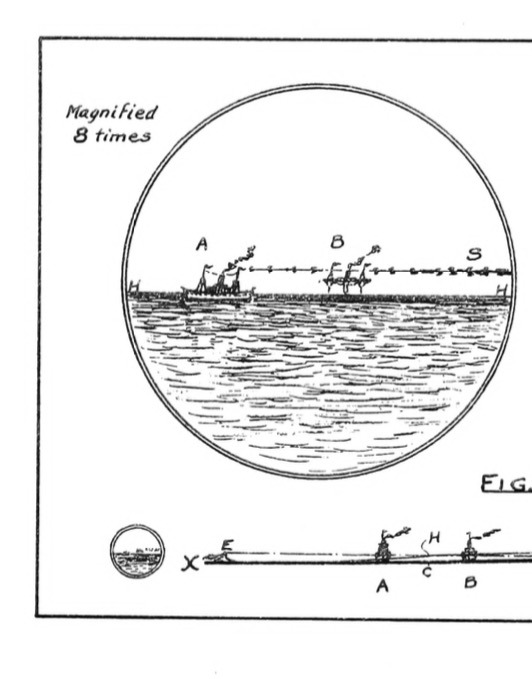
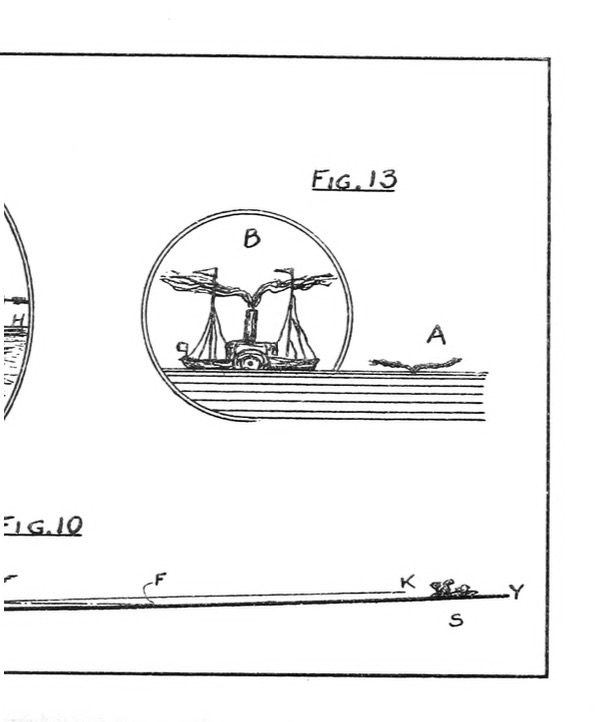
One rigid test remains now to be made of the phenomenon of disappearing vessels. Suppose a telescope were used to extend the limit of vision beyond the second vessel B, Fig. 10. Would the whole vessel be brought again into view? If not, then we must conclude after all that there is a convex bulge of the earth's surface, or its equivalent, rising up between the vessel and the observer. If so, then we must conclude that there is no such convexity, and consequently prepare our minds to accept the inevitable and revolutionary results of such conditions. Now as a matter of fact, repeated experiments have shown that distant objects, entirely invisible to the unaided eye, can be brought into view again by a powerful telescope. Lack of space prevents my giving an account of these experiments conducted on Lake Michigan a few years ago by the Koreshan scientists; but in the book I am preparing for publication next year a full account of these and many other experiments will be given. Ordinary field glasses are not strong enough to extend the vanishing point very far beyond that of the unaided eye, but a powerful telescope as used by the Koreshan experimenters brought whole vessels into view that were entirely invisible to the naked eye. Fig. 13 illustrates the results. Only the smoke of the vessel was visible to the unaided eye, as at A, but the telescope brought the whole vessel into view, as at B. It requires no elucidation for the reader to realize that such a phenomenon could not possibly take place on a convex surface. After the vessel had once passed beyond the convex bulge of the earth's surface no telescope ever made could make it visible again.
Let astronomers cease from their fruitless efforts with larger and larger telescopes to fathom the "limitless depths of space"; and let them direct their instruments to this wonderful region beyond the so-called apparent horizon where they will find awaiting them more revelations of Truth than were ever dreamed of in their philosophy. ---
← Chapter 7 — How and What to Observe | Chapter 9 — Other Phenomena →
- -- Source: O. F. Barcus, A New World Discovered (1917).
Fig. 25 clearly illustrates these phenomena.