The outer ring of the alchemical emblem spells it out: LAPIDEM VISITA INTERIORA TERRAE RECTIFICANDO INVENIES OCCULTUM. Visit the interior of the earth, and by rectifying you will find the hidden stone.
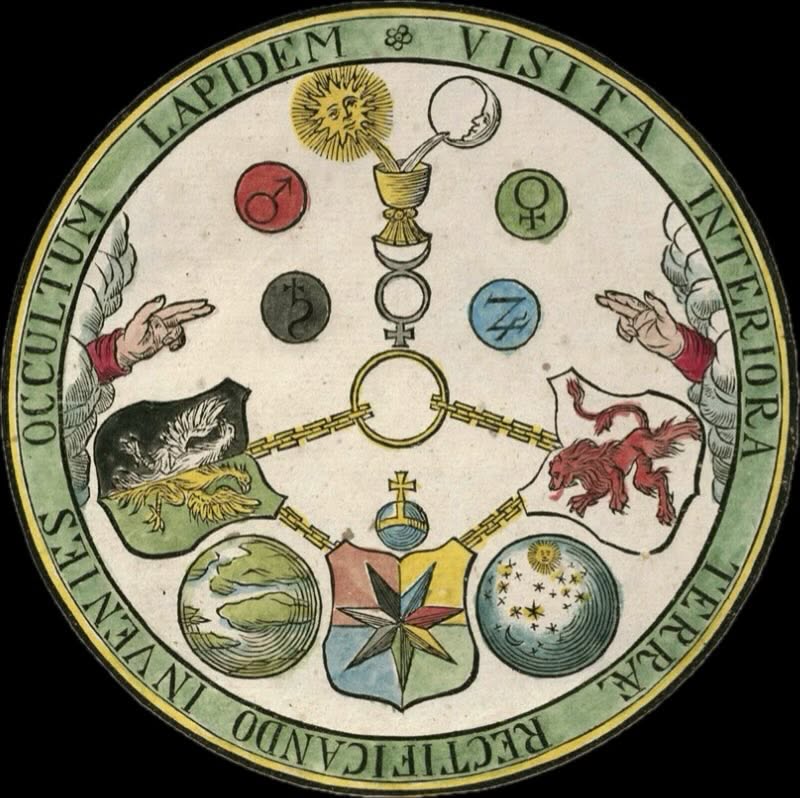
Read literally, it's a recipe for a mineral process. Read differently, it's a diagram of a cosmology — a cosmology you couldn't publish directly in the 17th century without drawing the wrong kind of attention. The sun and moon feeding a central vessel. The planetary forces arranged around it. The earth suspended in chain-linked tension with the moon below. If you needed to encode a non-standard model of the world in 1617, this is what that encoding looked like.
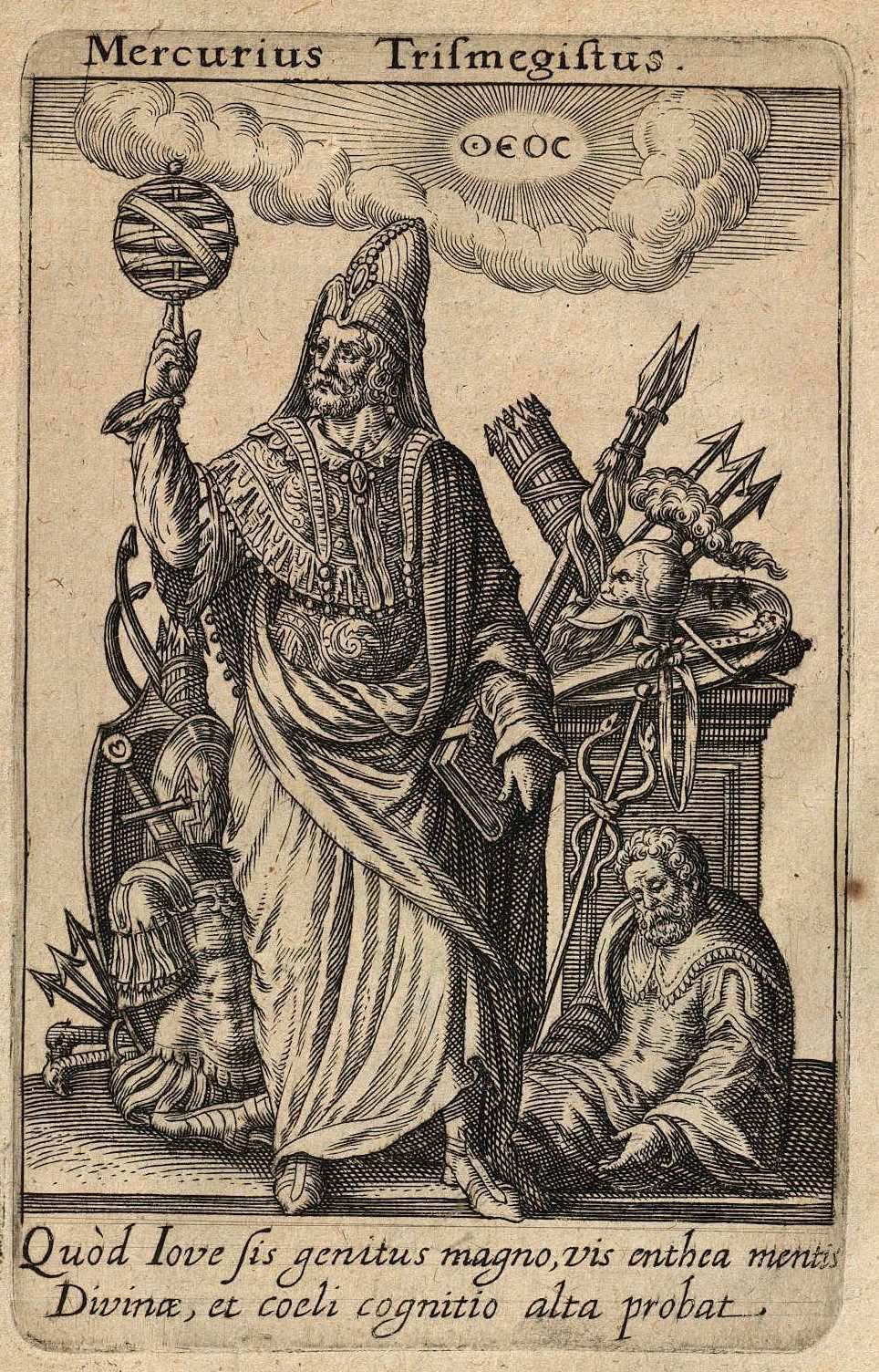
The Latin verse beneath the Hermes engraving is blunt: Because you are born of great Jove, the divine force of mind and high knowledge of heaven proves it. Divine knowledge, not earthly argument. The armillary sphere in his hand — a model of the celestial mechanics — is the proof. The discarded weapons at his feet make the point: this isn't settled by force. It's settled by whoever controls the model.
The clever ones encoded metaphysical truths into art, poetry, and mythology because they knew these truths ran against the accepted paradigm. After centuries or millennia of official thought, deep truths become occulted. Only sanctioned models are allowed to surface, while aberrant ideas are shelved, dismissed, or forgotten. What we inherit then is not always the most accurate or evidence-based version of history and science, but the most popular one.
The question is how the encoding works in practice. Not "did they?" — that part is well documented across every hermetic, alchemical, and mystery tradition that left paper behind. The question is what the method tells us about how ideas survive, and whose ideas get to survive at all.
The emblem book as delivery system. Michael Maier's Atalanta Fugiens (1617) is an alchemical emblem book: fifty engravings, each paired with a musical fugue and a Latin epigram. To the casual reader it is a book about transforming metals. To someone who knows what they're looking at, it is a spiritual and cosmological manual encoded in picture, music, and verse. Triple-locked. If you lose one key, the other two don't help much.
Maier was a physician to Emperor Rudolf II in Prague, a court that sheltered John Dee, Johannes Kepler, and half the esoteric minds of the period. These people knew exactly how dangerous certain ideas were. The church had burned Giordano Bruno in 1600 for cosmological heresy. You didn't publish a treatise saying the official model was wrong. You published an emblem book about transforming lead into gold and let the people who needed to understand it find their way in.
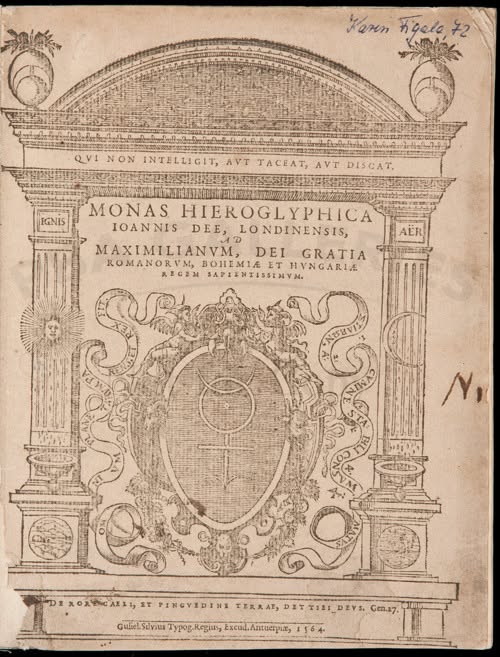
Dee went further. His Monas Hieroglyphica (1564) isn't a book of emblems — it's a single symbol, the Monas, a composite glyph built from the astronomical signs for the sun, moon, elements, and Aries. Dee claimed the entire structure of the cosmos could be derived from this one figure. The title page warns the reader up front: Qui non intelligit, aut taceat, aut discat. He who does not understand, let him be silent or let him learn.
The book was dedicated to Emperor Maximilian II. Dee wasn't hiding in a garret — he was presenting encoded cosmology to the most powerful court in Europe. The encoding wasn't cowardice. It was a filter. If you couldn't read the symbol, the symbol wasn't for you.
The map that was right, until it wasn't. Johann Baptist Homann's planisphere, published in Nuremberg in the early 1700s, was state of the art. It compiled the best French and Dutch cartography, displayed both celestial hemispheres alongside the terrestrial ones, and was taken seriously as geographic truth.
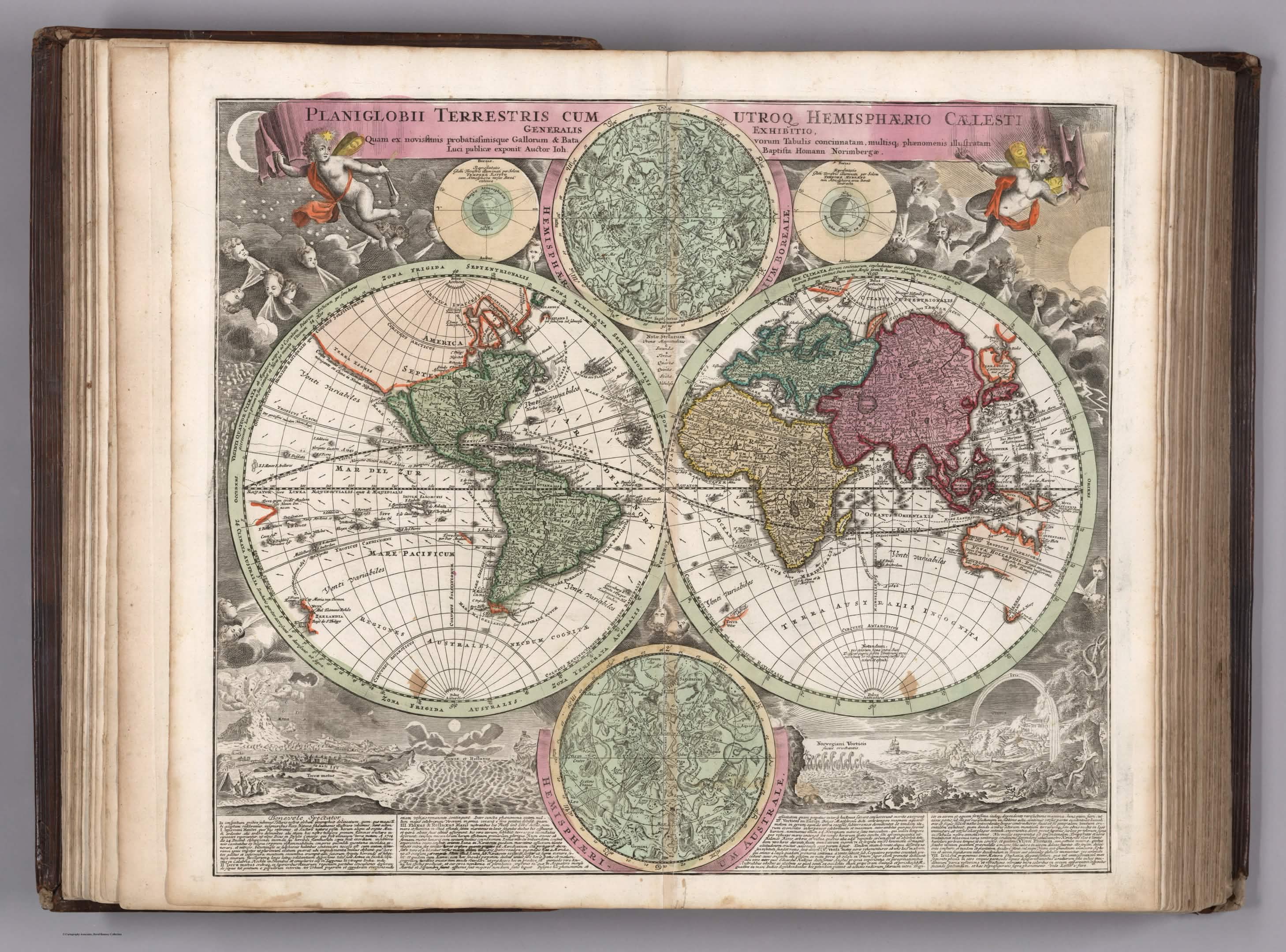
California appears as an island. Terra Australis Incognita — the Unknown Southern Land — sprawls across the bottom of both hemispheres, filling in a continent nobody had mapped because nobody had been there. In 1700 this wasn't fringe speculation. It was the sanctioned model, reproduced by the leading cartographic publisher in the Holy Roman Empire. If you disagreed with it, you were the crank.
The map is now an artifact. The model it represented didn't survive contact with better data. But while it was the official picture, alternatives were dismissed by default — not because they were wrong, but because Homann was the authority and the authority defined what counted as a map.
The cosmology in the state park. The orrery at the Koreshan Unity settlement in Estero, Florida, is still there. You can visit it. The interpretive sign calls it "The Celestial Cosmogony." The model suspended in the wooden frame shows the earth as a concave shell with the sun, moon, and planets inside it — a cellular cosmogony, as Cyrus Teed called it, where the universe is contained within the earth rather than the earth floating in an external void.
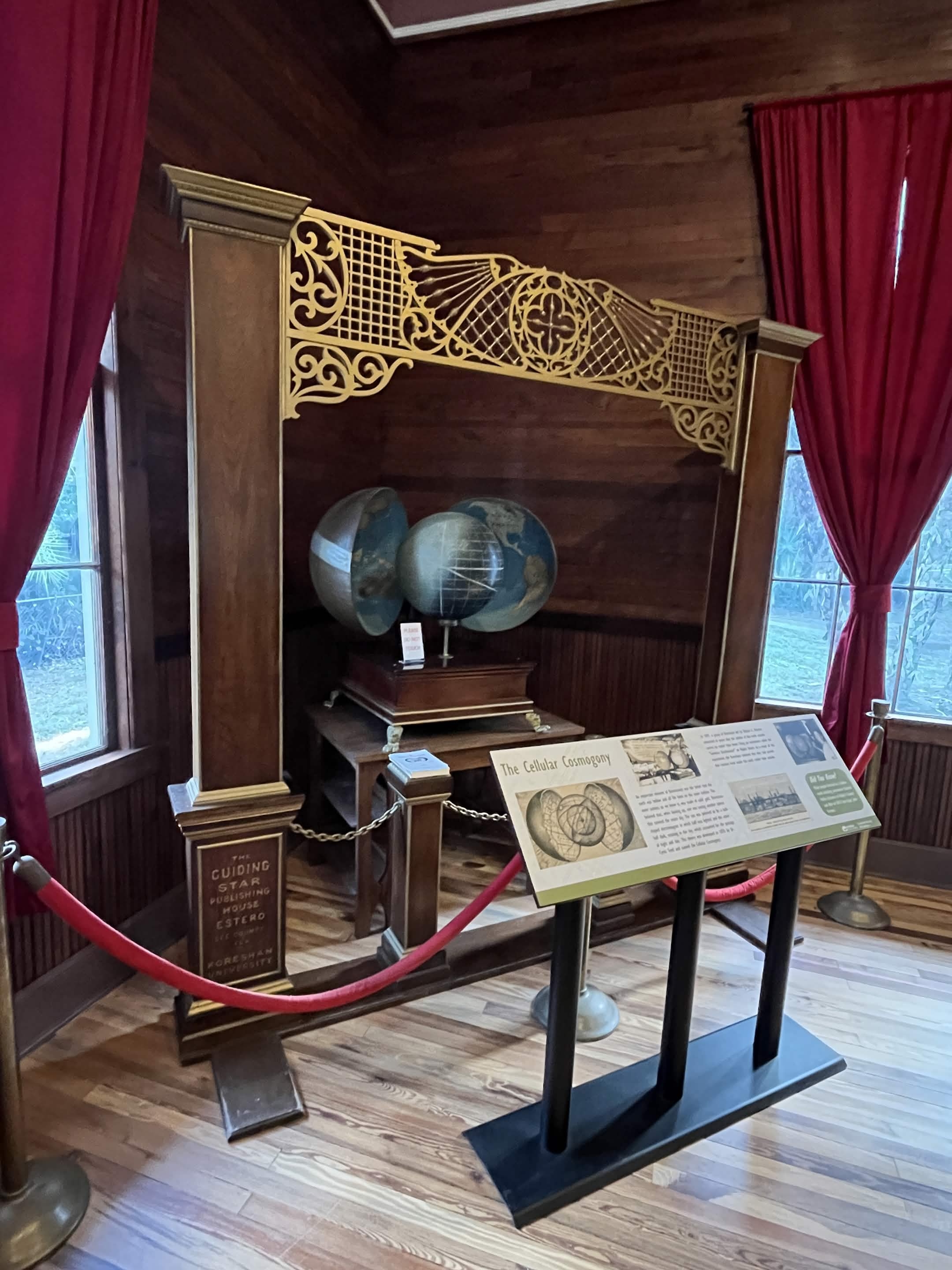
The Koreshans built a town around this idea in the 1890s. They ran a publishing house, a university, an art hall. They conducted experiments they believed proved the earth curved upward. Their cosmology had its own internal coherence — Teed derived it from a vision he had in 1869, then spent the rest of his life building the physics around it.
Nobody burned their books. Nobody had to. The official model absorbed them by category: not science, but religion. Not astronomy, but utopianism. The orrery is behind velvet ropes now, preserved as historical curiosity. The model it demonstrates hasn't been refuted so much as routed around.
The medieval universe that stuck. The Ptolemaic earth-centered universe wasn't just bad science that the church liked. It was a cosmology that happened to align with institutional power. When the evidence started dragging the model toward heliocentrism, the response was suppression — Galileo's trial, the Index of Forbidden Books, Bruno's execution. None of this was ancient history to the people writing emblem books in 1617. They'd watched the machinery up close.
What gets taught as "the medieval worldview" is often the worldview that had institutional backing. The alternatives were present. The Stoics had an infinite universe. The atomists had void and multiple worlds. The Hermetic texts described a cosmos where earth was a reflection of heaven and heaven a reflection of earth — microcosm and macrocosm, not center and periphery. These were available. They weren't adopted. Popularity and backing are not the same as accuracy.
What survives and why. Emblem books, Homann's map, the Koreshan orrery — each encodes a different relationship between knowledge and power. The alchemical engraving hid its cosmology inside a mineral allegory and survived because nobody took it as cosmology. Homann's map was the official view and survived until evidence forced it out. The Koreshan orrery was dismissed before it could be refuted and survived as an exhibit, not as a living challenge.
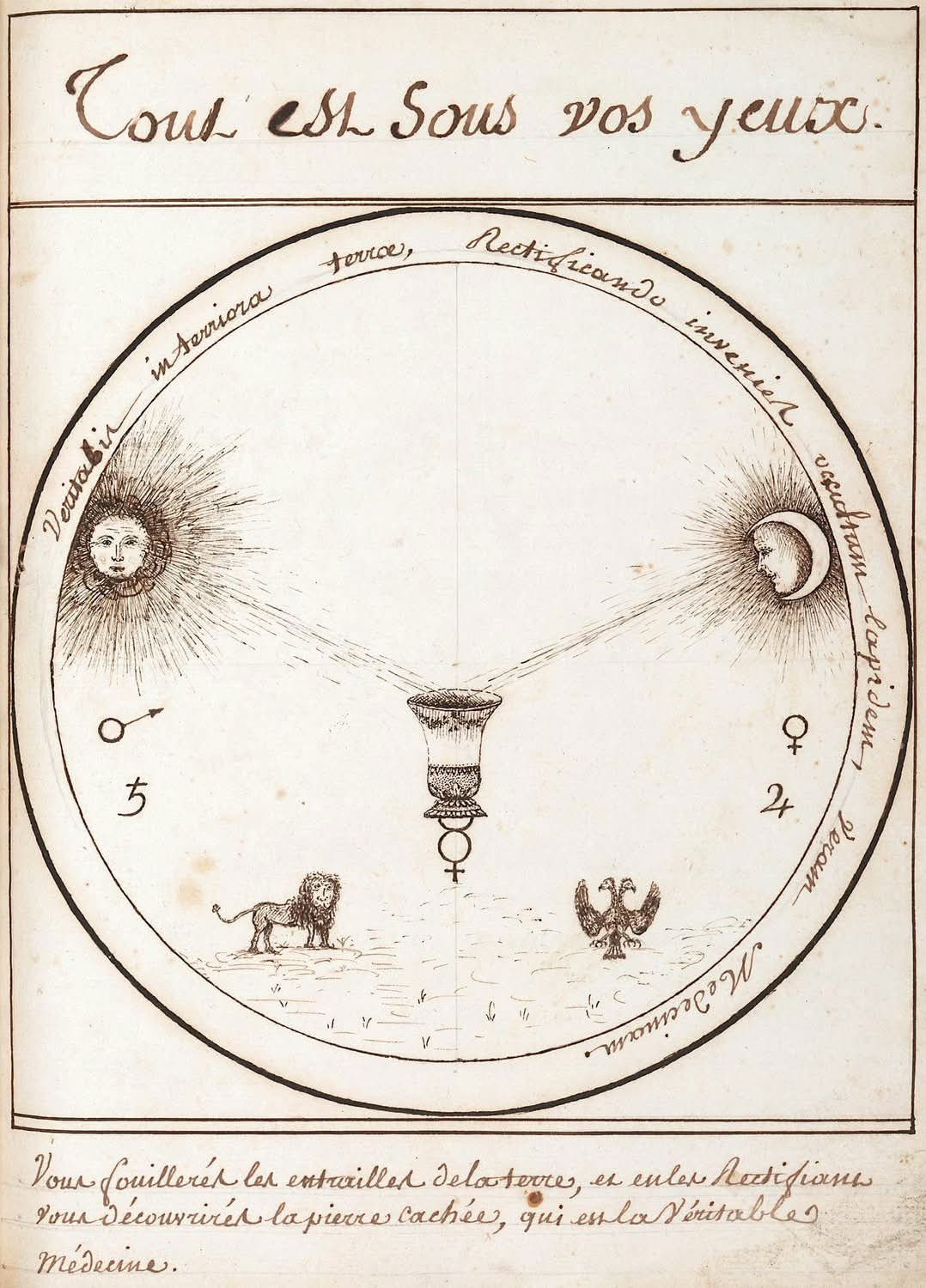
The same instructions appear in French, in ink, in an unknown hand, a century or two after the Latin emblem was engraved. Everything is under your eyes. Not hidden somewhere else. Not locked in a vault. Right there, if you know how to look. The sun and moon feed the chalice. The lion and eagle flank the bottom. The same diagram, the same promise, recopied by someone who understood what they were transmitting.
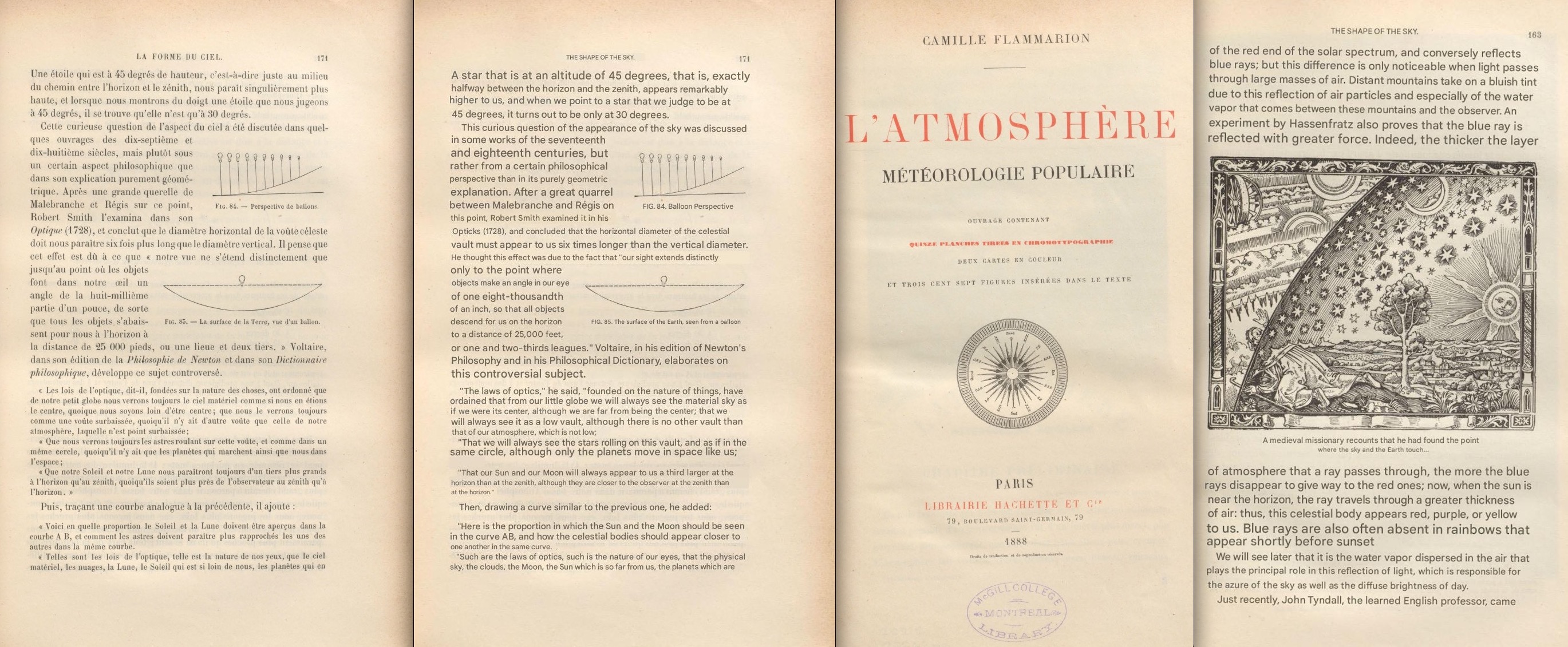
The Flammarion engraving shows a man at the boundary. He isn't breaking through it. He's looking. The machinery of the cosmos — wheels, clouds, fire — is already running on the other side. The only thing that changed is that he stopped taking the painted sky at face value.
The Latin on the emblem says rectificando invenies occultum — by rectifying, you will find what is hidden. The method and the instruction are the same thing.