Around the time of the Bolshevik Revolution, a French Protestant missionary was living in Shanghai, China. His name was O. F. Barcus. In 1917, he wrote A New World Discovered, a book about the concave earth.
Near the end of the book, Barcus included Appendix C, "Seventy-five Vital Questions." The questions are presented below in their original five-part arrangement, with the OCR cleaned for readability. Where a question is addressed by an article in the Flaming Sword archive, a linked arrow follows the question.
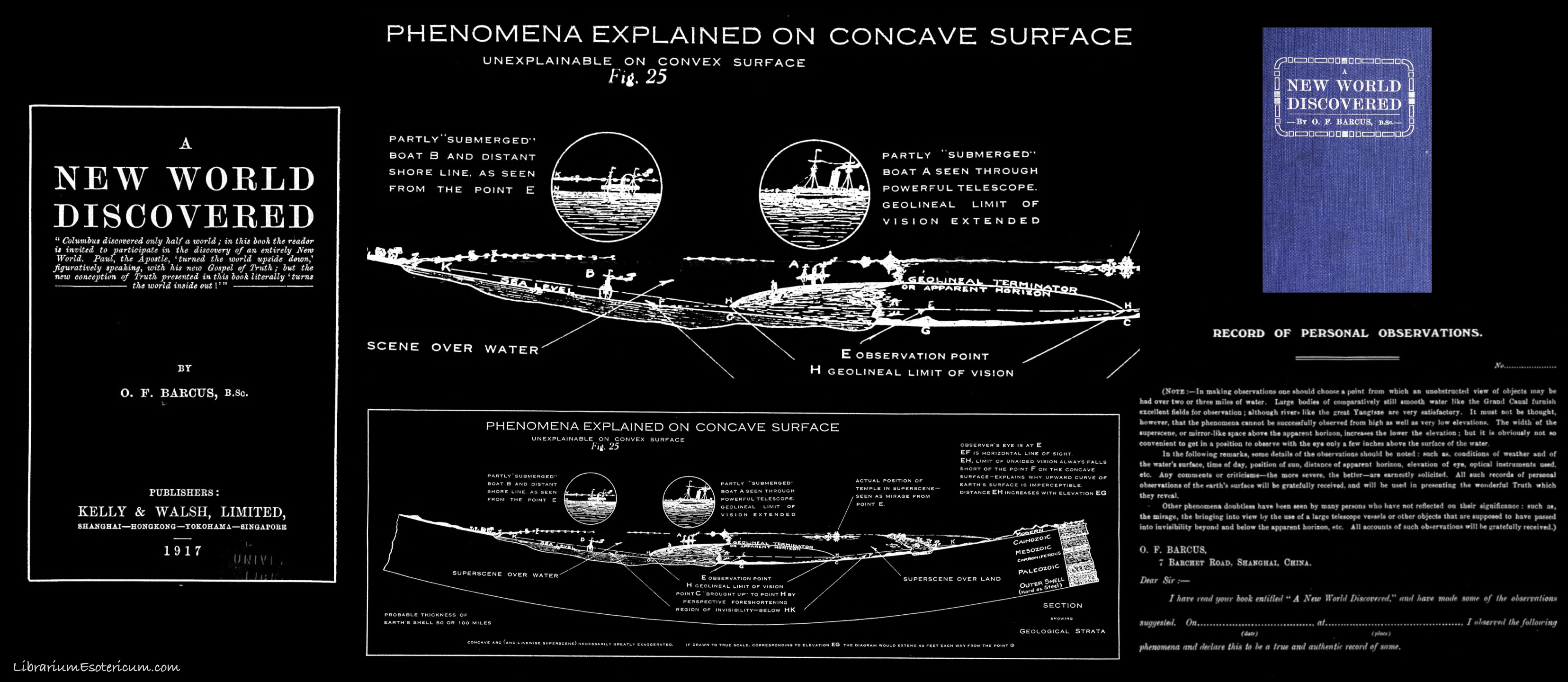
Barcus's cover, observation form, and Fig. 25, assembled in one diagram.
Part I. On the History of Cosmology
- When and by whom was the modern theory of the universe originated?
- On what observed facts did Copernicus base his theory?
- What theory was in vogue before the time of Copernicus?
- What was the form of the universe according to the teaching of Ptolemy?
- What was the objection to the Ptolemaic theory?
- What other theories were there besides the Ptolemaic and the Copernican? →
- What was the Tychonic system?
- Why was the Copernican system finally adopted?
- What personal conception did Copernicus himself have of the actual form of the universe?
- What was Kepler's conception?
- What is the conception of modern scientific teachers as to the actual form and extent of the universe?
- What did the Chinese, Egyptians, and other ancient peoples have to say about the origin and nature of the universe?
- What records of cosmology do we possess in Christian literature?
Part II. On the Origin and Nature of the Hollow Globe Conception
- When and by whom was the idea of a hollow earth originated?
- If such a conception were possible, why have scientists never considered it? →
- What is the teaching of Koreshanity? →
- On what observed facts does "Koresh" base his theory? →
- If the Copernican theory is false and the Koreshan theory true, why have scientists not discarded the old belief for the new one? →
Part III. On the Evidence in Support of the Copernican Theory
- What tangible evidence do the followers of Copernicus produce in support of the convex theory of the Earth? →
- Does the fact that the Earth can be circumnavigated prove that it is a globular body?
- Since the weight of objects is almost uniform at the same elevation above sea level at all parts of the Earth's surface, does this indicate that the Earth is practically spherical in form?
- Does the gradual disappearance over the horizon of vessels going out to sea prove that the Earth's surface is convex? →
- Does the fact that the sea horizon, as seen from an eminence, is everywhere depressed to the same extent below the level line show that the surface is approximately spherical? →
- Does the experiment with three signals on a level line, in which the middle signal was found to be higher than the line of sight between the other two, furnish conclusive evidence of the Earth's convexity? →
- What theoretical proofs are maintained in support of the Copernican system? →
- It would seem that the shadow of the Earth, as seen upon the moon at the time of a lunar eclipse, is convincing proof that the Earth is a solid sphere. What is the objection to this evidence? →
- Is it not more reasonable to suppose that the apparent diurnal movements of the heavenly bodies are due to the rotation of the Earth about an axis, rather than to attribute to these bodies such inconceivably great velocities as would be required for them to make one revolution in twenty-four hours about a centrally fixed Earth? →
- How can the eastward deviation of bodies falling from a great height be explained if the Earth has no rotational movement?
- How can the movements of Foucault's gyroscope and swinging pendulum be explained if the Earth does not rotate about an axis?
- Do not the observed facts of deviating projectiles, trade winds, ocean currents, tides, and the deviation of plumb lines towards the equator all indicate the rotation of the Earth?
- How can the ellipsoidal form of the Earth, flattened at the poles and bulged at the equator, be accounted for if it does not rotate about an axis passing through its poles?
- How is the change of seasons explained if the Earth has no annual orbital movement about the sun? →
- Does not the observed fact of the annual parallax of the stars prove conclusively that the Earth has an annual orbital movement about the sun? →
- What about the discovery of the aberration of light? Does not this observed fact prove that the Earth has actual bodily movement through space? →
- If the spectroscope shows that the velocity of light from stars has a certain variation through a period of six months, does not this indicate that the Earth itself is approaching or receding from these stars at different times of the year? →
- How can the discrepancy between the predicted and actual times of eclipses of Jupiter's moons be accounted for if the Earth does not move round the sun in an orbit having a diameter of approximately 186,000,000 miles? →
Part IV. On the Evidence in Support of the Hollow Globe Conception
- What tangible evidence do you produce in support of the idea that the Earth is a hollow globe? →
- What observations have you made of the mirror-like space which you say is seen beyond and above the apparent horizon? →
- May not this mirror-like space be explained as an optical illusion or mirage? →
- What observations have you made to show that distant objects can be seen with the eye considerably below the elevation required by the convex theory? →
- May not the apparent "elevating" of distant objects be due to atmospheric refraction, for the same reason that the setting sun is seen for several minutes after it has actually passed below the observer's horizon? →
- What experiments have been made to show that plumb lines converge upwards and not downwards? →
- How does the Rectilineator show the concavity of the Earth's surface? →
- What experiments have been performed with the Rectilineator? →
- Why have these tangible proofs of the Earth's concavity never been investigated by scientists? →
- What theoretical proofs are maintained in support of the hollow globe conception? →
- What is the mechanical superiority of a hollow sphere over a solid one? →
- What economical advantages has the hollow globe arrangement over the old system?
- What is the general experience of aeronauts when ascending above the Earth's surface? →
- What evidence is there from solar and terrestrial phenomena to show that the sun and Earth must be more closely related than the present theoretical distance of 93 million miles will allow? →
- What evidence may we derive from sunspots? →
- What is the electron theory, and what evidence does it furnish in support of a hollow globe idea?
- How may gravitation be explained? →
- What evidence is furnished by the discovery of radium?
- Does the observed radioactivity of material substances support the hollow globe idea?
- What is the scientist's conception of the origin and constitution of matter? →
- Taking all our evidence from modern researches in physics, chemistry, geology, astronomy, and related fields, what must be the probable explanation of the universe? →
Part V. On Some Questions Involved
- If the human family lives on the inner surface of a hollow globe, having the sun at or near its center, what then is the cause of day and night? →
- If the Earth has an internal diameter of only 8,000 miles, how can it possibly enclose all the heavenly bodies which astronomers tell us are at such enormous distances from us? →
- Our comparatively near luminary, the moon, has been subjected to careful methods of triangulation and observation, and its distance of practically 240,000 miles from us has been determined with a fair degree of accuracy. How is this difficulty of putting the moon inside a hollow Earth only 8,000 miles in diameter to be met? →
- Likewise, the distance of the sun from the Earth, having always been considered the unit of all celestial measurements, has been the subject of careful investigation. How is it conceivable that astronomers have incorrectly determined this distance of 93 million miles? →
- If the sun and moon are both enclosed in a hollow Earth, what is the cause of lunar eclipses? →
- What are the stars? →
- What becomes of all the phenomenal results of spectroscopic observations of stars, double stars, nebulae, and other objects if they are comparatively insignificant luminous points of light inside the hollow Earth? →
- If the Copernican system is not true, how do you account for the exactness with which astronomers are able to predict eclipses and other celestial events? →
- If the Earth is stationary, how do you account for many terrestrial phenomena such as tides, ocean currents, Foucault's swinging pendulum, and other effects?
- If the Earth is an immense hollow globe only 8,000 miles in diameter, and we are on its inner surface, why are we not able with our powerful telescopes to see across it? →
- What is the nature of the Earth's shell? →
- What supports the Earth? →
- The Bible always speaks of "the heavens and the Earth" as being created together in the beginning; they must therefore be co-existent. In the new conception, where are the "heavens" in relation to the "Earth"?
- Are the planets inhabited?
- Are the heavens and Earth eternal?
- What is outside the Earth? →
- What problems remain to be solved by future investigators?
Source
O. F. Barcus, A New World Discovered, Kelly & Walsh, Shanghai, 1917. Appendix C, "Seventy-five Vital Questions," printed pp. 87–95.