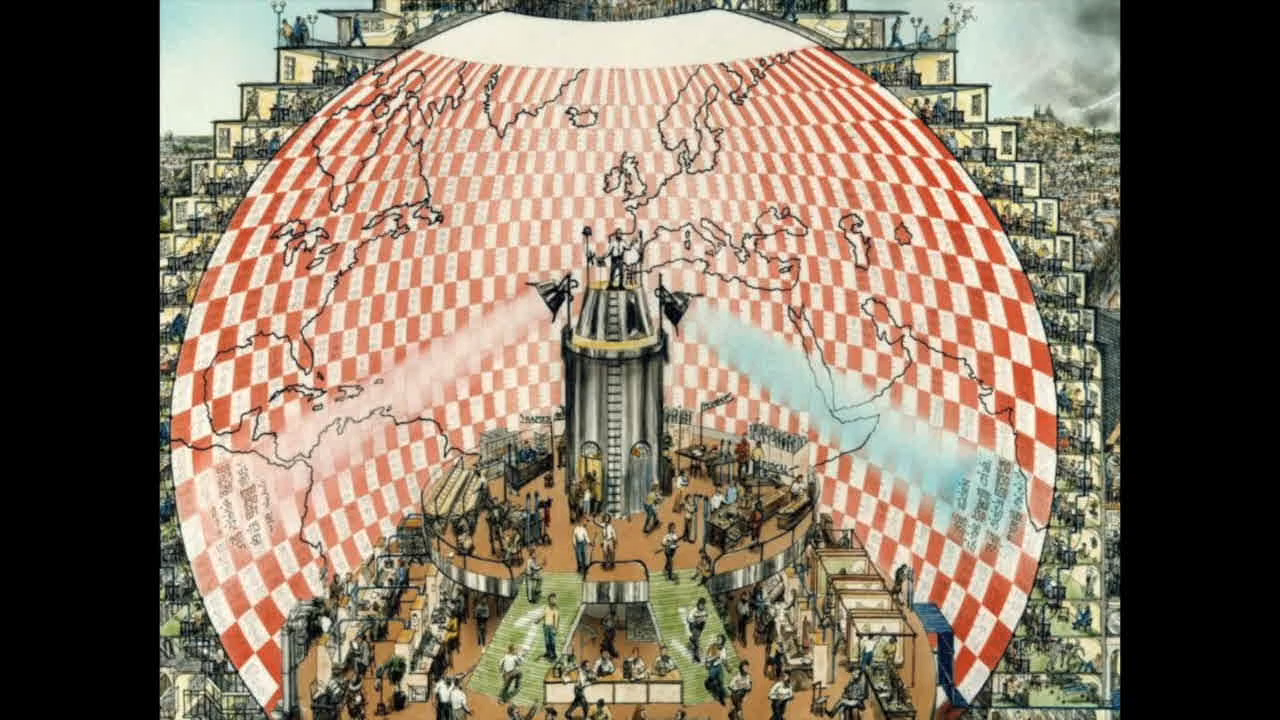
Lewis Fry Richardson's 1922 Weather Prediction by Numerical Process contains one of the strangest-looking images in the early history of computing: a vast circular theatre, its walls carrying a world map, with thousands of human calculators seated around it and a director conducting their work from a central tower.
At first glance, it looks uncannily close to an enclosed-world diagram. The viewer is inside a round chamber. The world wraps around the walls. The polar region is overhead; Antarctica is below. If you arrived through the picture rather than the book, you could reasonably pause and ask whether somebody had built weather prediction around an inner-world geometry.
The answer is no. Richardson was not proposing a concave-Earth weather model. But the distinction is useful, because his forecast factory is a clean historical example of how a model can turn a global surface into an interior visual space without changing the model's underlying geometry.
The image behind the question
Richardson was an English physicist, mathematician, and meteorological pioneer. His book proposed forecasting weather by solving atmospheric equations in repeated numerical steps—an approach that was wildly impractical with 1922 technology but became the basis of modern numerical weather prediction once electronic computers arrived.
The practical scheme divided the atmosphere into a grid. Richardson estimated that a global computation on 200-kilometre cells would require 64,000 human “computers,” each responsible for a limited calculation. He then allowed himself a break from the equations and called the following description a “fantasy.”[^1]
“Imagine a large hall like a theatre, except that the circles and galleries go right round through the space usually occupied by the stage. The walls of this chamber are painted to form a map of the globe. The ceiling represents the north polar regions, England is in the gallery, the tropics in the upper circle, Australia on the dress circle and the antarctic in the pit.”[^2]
That is the whole visual hook. A globe has been unfolded, projected, and painted around the inside of a theatre. The audience—or, in this case, the calculators—occupies the apparent interior of the world map.
What Richardson actually modeled
The fantasy is not the geometry of the weather system. It is an architectural way to organize the work.
Earlier in the book, Richardson writes his continuity equation in “spherical coordinates on a globe of radius a.”[^3] His global forecast scheme uses a coordinate grid, pressure, wind, temperature, and other atmospheric quantities distributed across cells. The theatre is a human interface for that grid: put the map around the workers so that every calculator sits beside the location whose values he or she must update.
The European Meteorological Society describes the same point plainly: Richardson divided the globe into cells and specified the dynamical variables at each cell's centre. His forecast factory was a “fantasy” in Chapter 11, not a replacement cosmology.[^4]
That means the image cannot be enlisted as evidence that a successful weather-prediction system used concave Earth. It did not. The model assumes a globe, and the circular room is a way of displaying it.
Why it still belongs in the Cave
The Cave should keep this because it clarifies a question that the usual diagrams blur: what changes when a world is represented as an inner surface?
Richardson's factory makes an ordinary globe visually behave like an enclosure. The ceiling becomes the north polar region. The pit becomes Antarctica. Locations once imagined as spread across an exterior sphere are redistributed around an inhabited interior. Nothing in the mathematics has been inverted, but the reader's visual relation to the map has.
That gap matters. A picture can be suggestive without being proof. A circular building with a map on its inner wall is not a concave-Earth model. It is, however, an unusually good comparison object for concave-Earth diagrams because it separates three things that often get mashed together:
- Representation: a globe can be projected onto the inside of a room.
- Computation: a weather model can calculate atmospheric change over a gridded globe.
- Cosmology: a concave-Earth system claims that people physically live on an inner surface and must provide different accounts of light, scale, gravity, sky, and celestial motion.
Richardson gives us the first two. Koresh, Neupert, Sexl, Abdelkader, Roxas, and later inner-world writers are making the third claim. The resemblance is visual, not technical.
Weather prediction needs a model that can lose
This is where the weather question becomes more useful than a historical curiosity. Forecasting is a hard test for any world-model because it cannot survive on a static diagram. It needs a coordinate system, measurable initial conditions, equations for atmospheric motion, a way to advance those equations through time, and predictions that can fail in public.
Modern numerical weather prediction still works through the same basic structure: observations are used to define an initial atmospheric state; a computer advances that state through short time steps; the output becomes the next input.[^5] A changed cosmology would have to do more than redraw the map inward. It would need an equally explicit working system: its coordinates, its atmospheric layers, its force rules, its light and pressure relations, and a forecast record comparable against observations.
That is not a dismissal of concave-Earth theory. It is the standard that separates a cosmological picture from a predictive physical model. A new geometry earns its keep when it calculates something better, not merely when it makes an old image look newly strange.
The right use of the forecast factory
File Richardson's forecast factory under models and diagrams, not under concavity experiments or weather evidence.
It is a strong visual companion to the Cave because it demonstrates an important and easily missed fact: the same mapped world can be seen from the outside or from within, depending on the representation. But it also guards against a lazy conclusion. Richardson's own equations and prose are explicit. His theatre wraps a conventional globe around the workers; it does not place humanity inside a physical world-shell.
That makes the article better than a forced connection. The real discovery is not that 1922 meteorology secretly ran on concave Earth. It is that a pioneer of computation independently built the closest thing imaginable to a weather room inside the world—and left the text clear enough that we do not have to pretend it says more than it does.
Source Trail
- Lewis Fry Richardson, Weather Prediction by Numerical Process (Cambridge University Press, 1922), especially Chapter 4/2 and Chapter 11/2–4, pp. 24 and 219–220. Digitized by the Internet Archive: <https://archive.org/details/weatherpredictio00richrich>
- Peter Lynch, “Richardson's Fantastic Forecast Factory,” European Meteorological Society. Includes the Chapter 11 fantasy and historical context: <https://www.emetsoc.org/resources/rff/>
- UK Met Office, “Celebrating Lewis Fry Richardson and his legacy.” Useful overview of the hand-calculated forecast and 64,000-computer estimate: <https://www.metoffice.gov.uk/about-us/who-we-are/our-history/celebrating-100-years-of-scientific-forecasting>
- NOAA JetStream, “Weather Models.” Short explanation of initialization, grid points, time steps, and iterative numerical forecasting: <https://www.noaa.gov/jetstream/upper-air-charts/weather-models>
- Joe Dubs, “Lewis Fry Richardson's Weather Prediction Model & Concave Earth” (YouTube, 25 March 2025): <https://youtu.be/NubmZqTH61w>
[^1]: Richardson, Weather Prediction by Numerical Process (1922), p. 219: he estimates 32 × 2,000 = 64,000 computers for the global calculation. [^2]: Ibid., p. 219. [^3]: Ibid., p. 24, Chapter 4/2, “The Indestructibility of Mass.” [^4]: Lynch, “Richardson's Fantastic Forecast Factory,” European Meteorological Society. [^5]: NOAA JetStream, “Weather Models.”