Part IV: Airy's Failure
If a telescope is pointed at a star and both are stationary, then obviously the light hits the telescope directly. However, in 1729, James Bradley discovered that he had to tilt his telescope forward very slightly to see a star in the center of his telescope; at the time, it was assumed that this was due to the Earth's motion around the Sun. However, think about it: this slight tilt could be made necessary by the Earth's motion, as well as by the motion of the stars around a stationary Earth .
As we see here, in both cases the light would arrive at the same angle, requiring the telescope to be tilted a few degrees; so tilting the telescope does not determine whether the stars are moving or the Earth is moving .
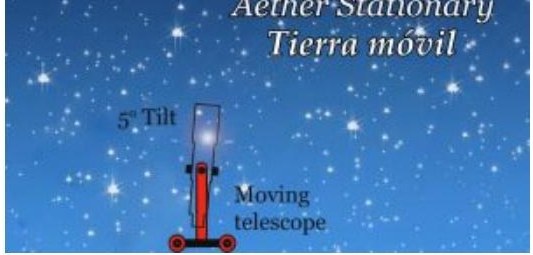
If the Ether were stationary and the Earth moved.
If the Ether were moving and the Earth were stationary.
There is a simple experiment that can determine whether it was the Earth that was moving or the stars: all that had to be done was to record the inclination required for any particular star, then fill the telescope with water, which slows down the speed of light in the telescope, and record its inclination again. In the following slides we see the mobile telescope filled with water at a five-degree inclination, and you can see that the light from the star now does not reach the eyepiece at the bottom; this is because starlight moves much more slowly when passing through water .
Therefore the telescope would have to be tilted more (say ten degrees more), so that the star would be visible again in the eyepiece, because the light would now be slower when passing through the telescope, since the light will be affected not only by the movement of the Earth, but also by the water in the telescope, which moves together with it and the Earth (double effect) .
In Airy's experiment, if the Aether were stationary and the Earth were moving, the water-filled telescope would have to be tilted further to see the same star.
However, if the telescope with the Earth and the water inside are stationary, and it is only the star that moves, then the telescope should hardly have to be tilted any further , since it is the same light that is slowed down when passing through the water, without the water in the telescope being too affected by any other movement.

In Airy's experiment, if the Aether were moving and the Earth were stationary, the telescope with water wouldn't have to move. And this is how it happened.
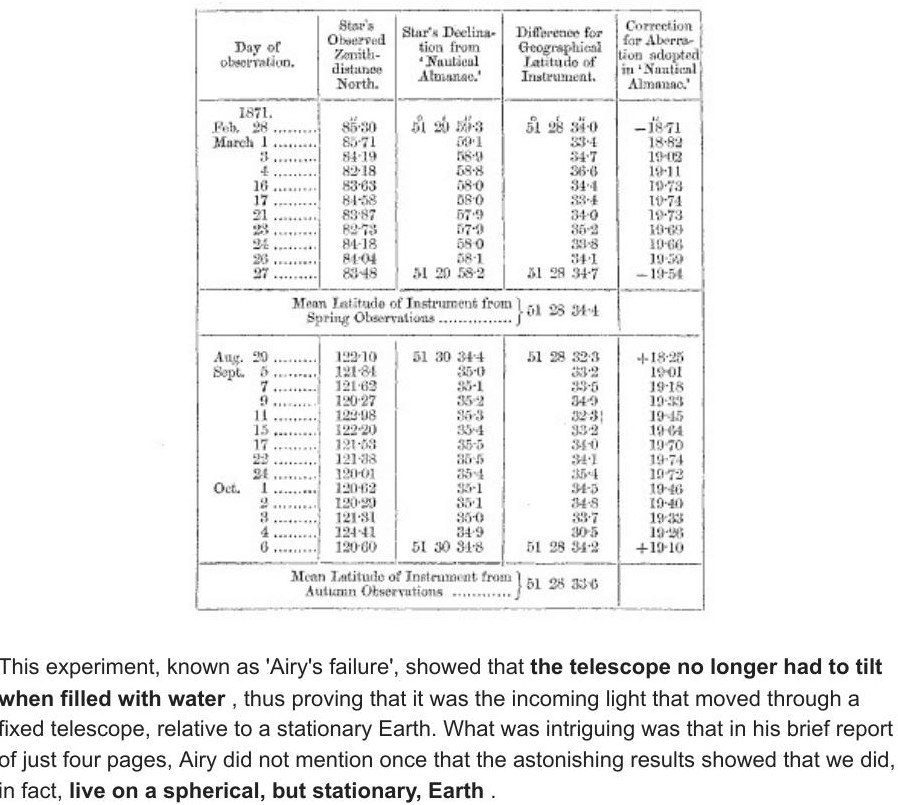
In 1871, George Biddell Airy, the Astronomer Royal at the time, performed this experiment. This is a copy of his original report: you can see how the two readings are virtually identical. If the telescope had been moving, Airy expected a figure of 30 arcseconds of tilt, but in fact, he only managed to read a difference of 0.8 arcseconds .
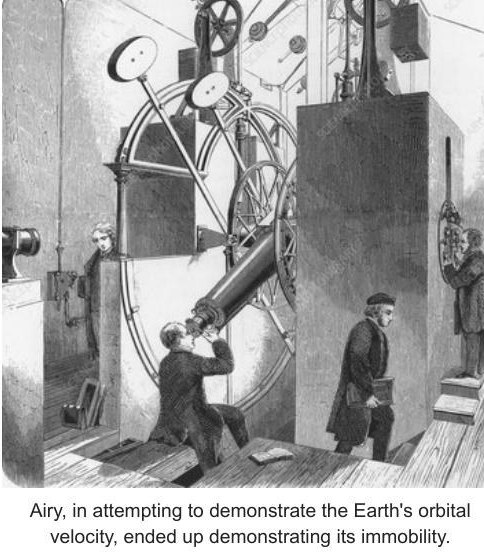
Airy, in attempting to demonstrate the Earth's orbital velocity, ended up demonstrating its immobility.
This experiment, known as 'Airy's failure', showed that the telescope no longer had to tilt when filled with water , thus proving that it was the incoming light that moved through a fixed telescope, relative to a stationary Earth. What was intriguing was that in his brief report of just four pages, Airy did not mention once that the astonishing results showed that we did, in fact, live on a spherical, but stationary, Earth .
Watch Video At: https://youtu.be/2n72Luv0iIU
References:
https://www.jstor.org/stable/113096?seq=1#metadata_info_tab_contents
https://www.thenauticalalmanac.com/
Part 1: https://creatumejortu.com/la-tierra-es-concava-el-rectilineador
Part 2: https://creatumejortu.com/la-tierra-es-concava-ii-las-plomadas-de-las-minas-tamarack
Part 3: https://creatumejortu.com/la-tierra-es-concava-iii-la-tierra-no-se-mueve Part 5: https://creatumejortu.com/tierra-concava-v-la-luz-se-curva
Part 6: https://creatumejortu.com/tierra-concava-vi-la-imposible-tierra-plana