Research Library

How Radio Waves Actually Work

Night AM reception is not a bounce off an invisible ceiling. The signal path changes with the air, then opens across much more land.

At noon, an AM station can sound weak a hundred miles away. After dark, the same station can take over a radio hundreds of miles from its tower. A distant receiver can go from a faint murmur to a signal people describe as twenty times stronger.

That is the fact to start with. Radio does not behave the same way all day. The path changes when the air above the ground changes.

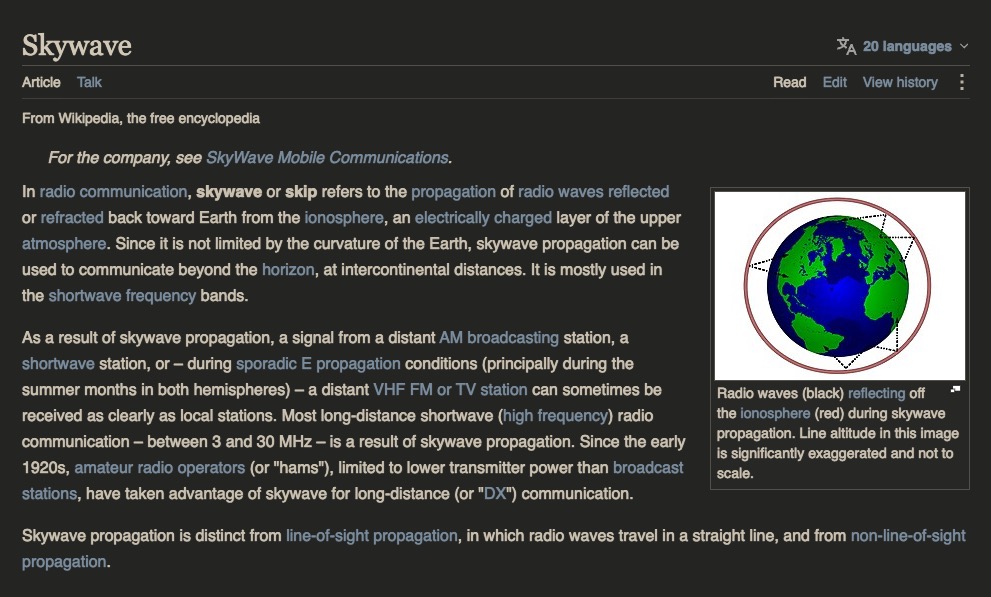
The official explanation says the signal goes up, strikes a charged layer called the ionosphere, and comes back down. The usual diagram looks like a ball tossed against a ceiling. In the daytime, one layer absorbs the signal. At night, that layer weakens and the F region is supposed to send the signal back to Earth. That is the story behind AM skywave, skip distance, clear-channel stations, and the rules that force many stations to cut power after sunset.[1]

The rules are real. So are the distant stations. The question is what route those signals are actually taking.

Early Marconi wireless tower array

An early Marconi wireless tower array. U.S. National Park Service / Marconi Company Ltd.

The first thing to clear up is the word bounce. Nobody has watched an AM signal leave a tower, hit the F2 region, and ricochet back to a receiver. Engineers transmit, receive, compare arrival times and signal strengths, then calculate a path that fits the result. That calculation may be useful, but it is still a calculation. Calling it a bounce makes the result sound more direct than it is.

The FCC's own records show how much has to be calculated. Its AM rules use field-strength curves built from years of measurements. The calculations change with latitude, season, solar activity, time of night, and the chance that a distant signal will interfere with another station.[2] This is not a simple, clean reflection. It is a moving target.

That moving target gets enormous after sunset. A local daytime station becomes a regional station. A regional station becomes a problem for another station on the same frequency. The FCC has to make stations reduce power, use directional antennas, or go off the air because nighttime signals reach places they do not reach during the day.[1]

That is much more than a radio becoming a little clearer. Something has opened up a longer route.

The Night Signal

AM uses long waves. They spread outward from the tower and weaken with distance, but they do not simply fire straight into empty space like a flashlight beam. The atmosphere around them has layers. Its temperature and density are never fixed. The air near the ground cools after sunset. The temperature profile changes mile by mile above it. A path that was short and broken during the day can become longer and smoother at night.

That is the point of the twenty-times-stronger signal. Treat twenty as a picture of the size of the change, not as one magic number that applies to every station. Signal strength depends on the station, the receiver, the ground, the season, solar conditions, and the route. But the nightly jump is large enough that it has shaped American broadcast law for generations.

The standard diagram says this happens because a wave goes hundreds of miles upward, reaches an invisible electrical layer, and returns at the correct angle. Then it may do it again. The signal must land beyond the first horizon, cross a skip zone, and still arrive where listeners are waiting.

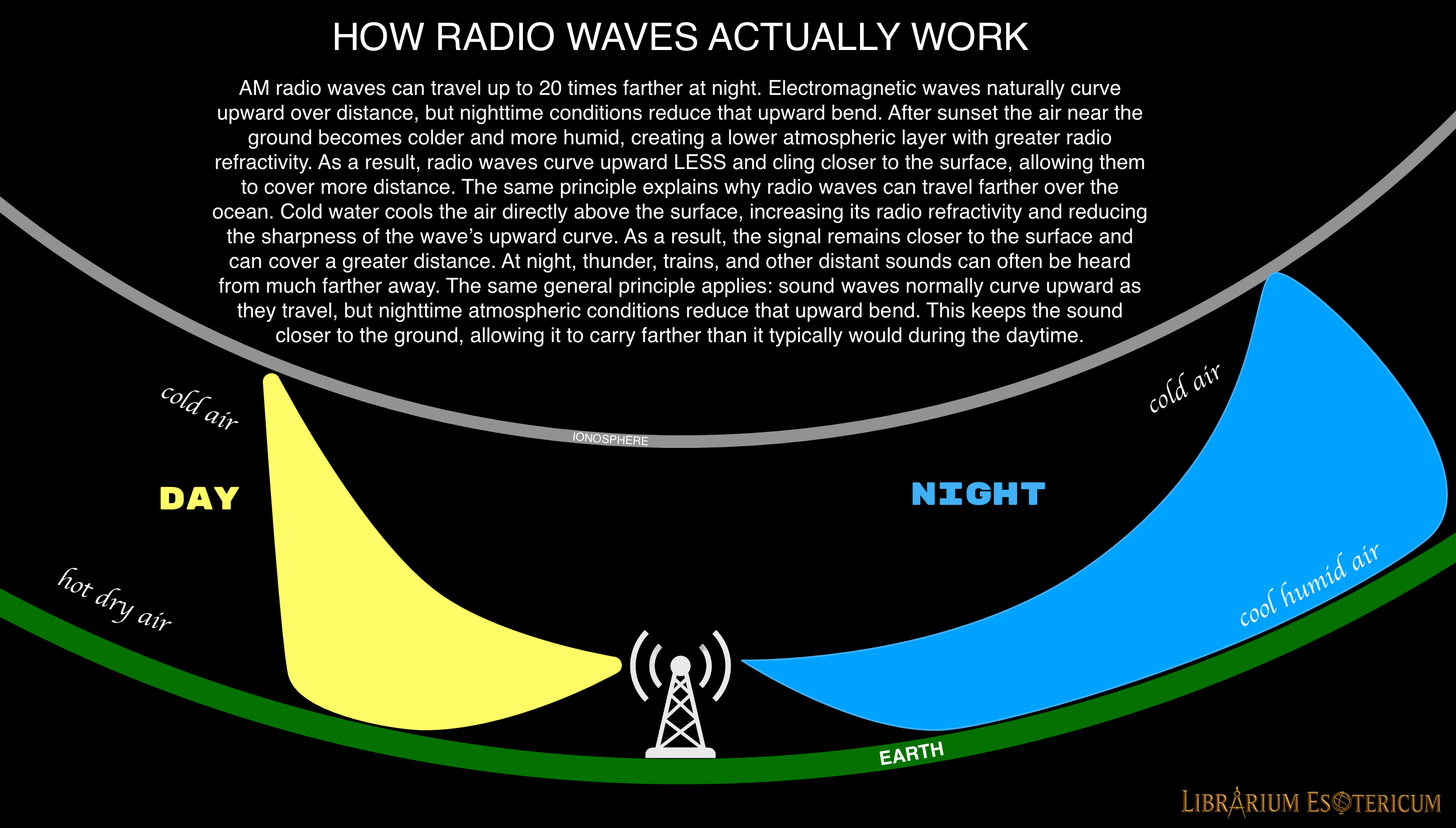
Diagram of standard daytime and nighttime AM coverage

The standard AM explanation draws a daytime groundwave and a nighttime return path from the ionosphere. The route is an interpretation of reception data, not a photographed bounce.

There is another way to read the same observation. The signal curves through the atmosphere instead of striking a ceiling. As the nighttime air cools and rearranges, the curve lengthens. It stays available to more land.

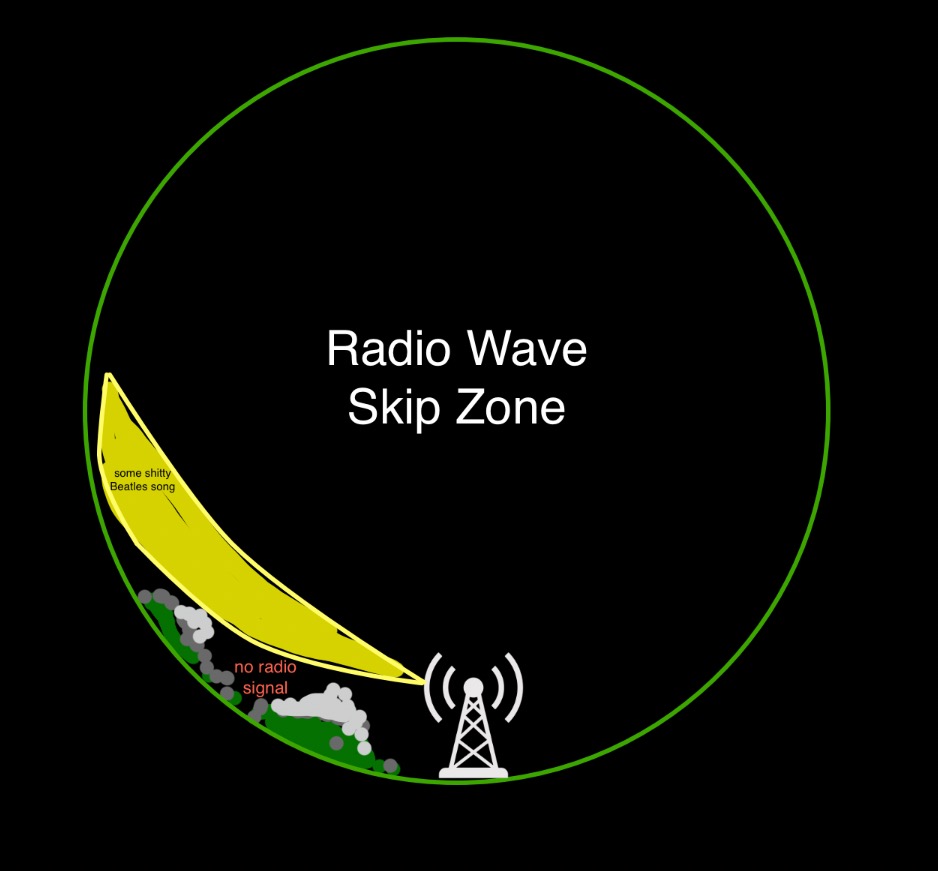
This is easier to picture inside a concave Earth. Stand inside a huge bowl and point a line slightly upward. The line rises away from the ground at first, but it is still traveling within the bowl. It can continue toward country far beyond the local horizon without needing to hit an upper mirror and come back down. The curve has room to run.

That is what the nighttime AM record looks like: a route opening outward across the land, not a ball making repeated jumps off an unseen ceiling.

Why FM Matters

FM is useful because it gives the same problem a different shape. FM signals normally have shorter range and are treated as line-of-sight broadcasts. Yet in 1942, Chicago station W31C reported daily reception in Monterrey, Mexico, about 1,100 airline miles away, from a 50,000-watt transmitter on the Field Building.[3] The report appeared in FM Magazine, not in an advertisement. The distance was strange enough to be mentioned in the radio trade press.

William Paul Babishoff collected that report with later examples of long FM reception along the California coast.[3] The standard answer gives FM its own special vocabulary: tropospheric ducting, sporadic E, and F2 skip. Each term describes a condition that may bend or carry a signal farther than its normal range.

The names do not remove the basic question. If the signal has to leave the path available near the ground and then return, where is the gap? Why do some long-distance paths stay regular? Why does the route change with the same daily cooling that changes other kinds of long-range reception?

A wave curving through changing air does not need a separate invisible mirror for each surprise. It needs an atmosphere that is doing more than sitting there.

Sound Is the Easy Example

Sound and radio are not the same kind of wave, and they do not bend for the same physical reason. That part matters. But both make the same plain point: the air is not a blank stage.

On some cool nights, distant traffic, trains, music, or industrial noise carry much farther than they do in the heat of the day. The layers of air have changed. Sound can be guided downward and carried across a much larger area. Anyone who has heard a highway from miles away on a still night already knows the atmosphere can change a route without putting a solid wall in the sky.

Radio deserves the same common-sense question. Why assume its long nighttime path must be a perfect trip to a remote reflector when the air around the path is changing all the way out?

The F2 story answers a geometry problem created by a convex Earth. The signal has to get beyond a falling surface, so it must be sent upward, returned downward, and sent upward again as many times as necessary. Once that shape is assumed, the ionospheric bounce has to carry a lot of weight.

The radio itself gives a cleaner starting point. Signals travel farther at night. Their reach changes with the atmosphere. Distant stations appear where the daytime map says they should not. The record does not begin with a bounce. It begins with a receiver picking up a station.

After sunset, a local AM dial opens into a much larger country. That is the thing in your hand. Start there.

Sources

[1] Federal Communications Commission, "Why AM Stations Must Reduce Power, Change Operations, or Cease Broadcasting at Night," https://www.fcc.gov/media/radio/am-stations-at-night

[2] Federal Communications Commission, Improved Methods for Calculating Skywave Field Strength in the AM Broadcast Band, FCC 88-324, 1988, https://docs.fcc.gov/public/attachments/FCC-88-324A1.pdf

[3] William Paul Babishoff, "AM/FM Radio Reveals the True Shape of the Earth," 2014. The cited source packet quotes FM Magazine, February 1942, p. 34.

Source trail

  • Babishoff AM/FM radio packet and AM skywave research dossier