Perhaps we who are living in this wonderful age of discoveries and inventions should not deem it so surprising that the many phenomena occurring at the earth's surface have not hitherto been more carefully observed and their true meaning ascertained. Once possessed with the obstinate belief that the human family is living on the external surface of a solid earth, blind to all other possible conceptions of the earth's form, and content to explain the many mysterious phenomena by all sorts of patched-up theories and assumptions, rational or otherwise—more often the latter, the mind of the man of science has come to be what it is to-day, molded and fashioned about a nucleus of belief that has no more substantial claims to truth than countless other beliefs that have come and gone in the ages past.
It was not until our own present generation that the most wonderful of all natural phenomena was, in a very real sense, revealed to man: namely, the invisible "ether," that marvellous "substance," or "force" or whatever it may be, which seems to pervade all space, as well as material substances visible and invisible. We know it best, perhaps, through its manifestations in the wireless telegraph; and it is the testimony of this instrument which I now propose to present as supplementary evidence to that obtained from the simple observations made by the human eye, as described in the previous chapter.
Physicists tell us that light waves, when passing through a uniform medium, radiate in straight lines from the source of illumination; and this fact may be easily demonstrated experimentally by any one. Physicists also tell us that the invisible ether waves, set in motion by the wireless telegraph transmitter, behave in the same manner: that is, they travel in straight lines radiating outward from the generating source, just as the rays of light radiate outward in all directions from a candle or a lamp. It is unnecessary for our present purpose to go any further into a detailed description or explanation of these "wireless" waves; it is only important to know that, like light waves, they are propagated in a rectilinear and not a curvilinear direction; hence, we are bound to conclude that they cannot be detected if there are obstacles intervening between the transmitting and receiving instruments, any more than rays of light from a lamp can be perceived by the eye if they are intercepted by objects between the eye and the lamp.
Here is what Cressy, in "Discoveries and Inventions" (1914), says: "In spite of a high degree of perfection in the instruments for producing electrical waves and in those used to detect them, the wave meets with many adventures on the way, and there is some uncertainty as to how it really gets there. One of the problems which, while it has been surmounted practically, still evades theoretical explanation, is the particular path pursued by the wave between the stations. When Marconi first made the attempt to put England and the American continent into communication, there were no scientific facts which pointed to success, but there were some which indicated the impossibility of surmounting the great aqueous hump of the Atlantic, 125 miles high, which lies between. An electric wave is in effect a very long light wave travelling with the same velocity—186,000 miles a second—and possessing many other similar characteristics. Now light waves show a rooted objection to turning a corner. Save for a slight bending around the edges of objects, they pursue a straight path from origin to destination. If an electrical wave were endowed with equal rectitude, and were launched on its way from Canada to Poldhu, it would arrive there something like a thousand miles above the land! Signals hovering in the heavens above and having no tangible connection with the earth below would be rather useless; from that height they could not even be collected by a kite. Fortunately, however, the waves come to earth themselves (which is very surprising), and there is some evidence to show that they travel all the way through the air. Perhaps a more striking illustration of what the curvature of the earth involves is to be found in the fact that when receiving signals at Buenos Ayres from Clifden, a distance of 6,700 English miles, Marconi was detecting waves which had been deflected from their original direction (supposedly) by 97°!... Sufficient will have been said to indicate in some measure the extraordinary progress that has been made since the birth of the invention in 1896, and to explain to some extent the simpler principles upon which that and subsequent improvements have been based. The reader will be able to see, in imagination, the powerful waves spreading out from the transmitting aerial, and, in some as yet inexplicable way, curving round the surface of the earth."
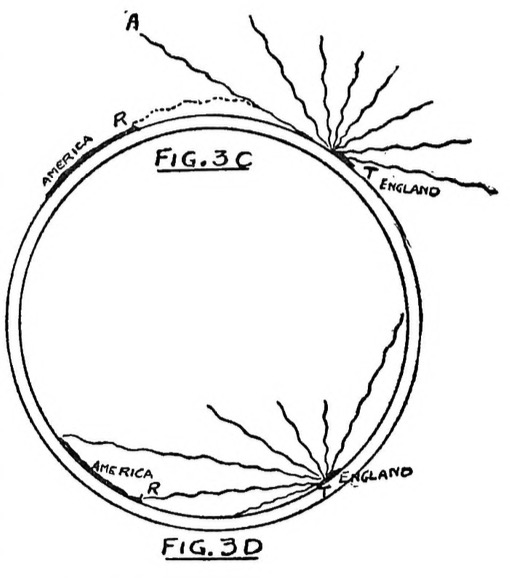
Figure 3C illustrates the conditions under which the wireless waves are supposed to operate, according to the convex theory. In order that the tangent ray, TA, may be detected by a receiving instrument at R, it is necessary to suppose that the ray is bent down as indicated by the dotted line. But such a supposition is in contradiction to the laws which physicists themselves declare to be true regarding light or electric waves. We realize the predicament here presented. As soon as we turn, however, to the conditions illustrated in Figure 3 D, all difficulties vanish at once. It requires no further elucidation for the reader to draw his own conclusion as to which of these two conceptions is more likely to be the true one and the one more reasonable to accept. ---
← Chapter 3 — Distant Objects Over Water | Chapter 5 — The Mirage →
- -- Source: O. F. Barcus, A New World Discovered (1917).