There remains now to be mentioned another class of evidence which is entirely different from that already presented, and which demonstrates the concavity of the earth's surface.
Two important experiments may be mentioned:
1. In a series of experiments in some deep mine shafts near Chicago a few years ago it was discovered that plumb lines converge upwards instead of downwards!
All sorts of explanations were put forward by scientists at the time, but to this day the phenomenon remains unexplained. This means that the center of the earth must be above our heads instead of under our feet. Fig. 14 illustrates a practical application of the consequences attending this change of conception. If the plumb lines converge downwards, as ZA and ZB, the results of trigonometrical calculations of the distance of a heavenly body, as the moon, will be different from those based on plumb lines that converge upwards, as CZ and DZ. In the first case M is found to be about 240,000 miles from the earth; while in the second, it is only a few hundred miles above the earth's internal surface. The corresponding angular measurements "a" and "b," are the same in both cases but the results are wholly different. Indeed, the distances of all the heavenly bodies must ultimately be found correspondingly less, since the present dimensions of the solar and sidereal systems are after all only relative, and if the fundamental measurement is incorrect, as the upward convergence of plumb lines indicates, it means that the entire visible heavens may be reduced to dimensions small enough to be enclosed in a hollow earth having an internal diameter of 8,000 miles.
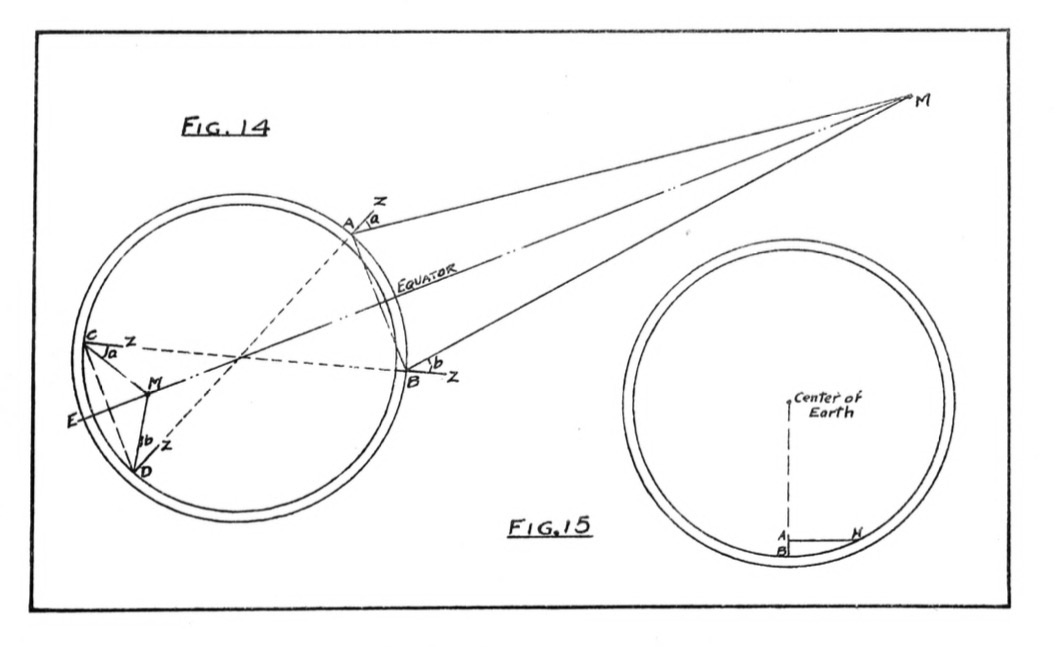
2. In another series of experiments, requiring a period of several months, a party of scientists extended, by purely mechanical means, an "air line" perpendicular to the vertical plumb line, and it came in contact with the water's surface at a distance from the starting point corresponding to that required of a concave arc whose radius of curvature is that of the earth's radius according to the convex theory, i.e., 4,000 miles. Fig. 15 illustrates how a straight line, AH, extended perpendicularly to the vertical plumb line, AB, was found to strike the earth's surface at H. The elevation of the starting point A above sea level was 128 inches, and the horizontal line came in contact with the water's surface at the point H, 4½ miles away. Careful measurements of the convergence between the extended line and the surface of the water showed the same relation that exists between a chord and the concave arc of a circle 8,000 miles in diameter. Such results would not be possible on a convex surface; for the extended line would go off at a tangent farther and farther from the convex arc. ---
← Chapter 8 — Disappearance of Vessels | Chapter 10 — The New Cosmology →
- -- Source: O. F. Barcus, A New World Discovered (1917).