"It is to be observed in the first place that this universe is spherical *; not only because that it is the most perfect of all figures, needing no fastening or junction, complete in itself; but because it is the most capacious figure, fittest to enclose and preserve all things; because the most perfect portions of the universe—the sun, moon and stars—are seen to have that shape; and lastly because, as we see in drops of water and other liquids, all things capable of assuming the figure they prefer, select the figure of a sphere. The sphere of the stars, being the outermost and chief of all the spheres, is immovable because enclosing all other spheres." —Copernicus, the founder of modern Astronomy, written in 1543.
"The sun lies farther from the fixed stars than these lie from each other. "Within the sphere of the fixed stars there is a vast concavity girt round on all sides by the stars. The sun lies within this space, so that the solar system occupies an exceptional position in the universe. The concavity enclosing the sun lies also near the center of the zone called the Milky Way. This is shown by the fact that the Milky Way appears as a great circle on the heavens, and sensibly of uniform brightness throughout. The space occupied by the stars, limited on the inside by the concavity enclosing the sun, is also limited on the outside, and thus forms an immense spherical, outside of which lies space. The sun is the chief body—THE HEART OF THE UNIVERSE—whence flow light and heat; he is also the ruler of the planets and their satellites. The stars according to this hypothesis are much smaller than the sun, but shine with their own light, the light of each having its own proper color." —Kepler, one of the earliest and greatest of the exponents of the Copernican system, written in 1620.
"I wish that some one would undertake to give a history of celestial phenomena after the method of Bacon, and describe the sky exactly as it appears at present, without introducing a single hypothesis." —Descartes, 1632.
"If asked whether science has solved, or is likely in our day to solve, the problem of the universe, I must shake my head in doubt. Behind and above and around us the real mystery lies unsolved, and, so far as we are concerned, incapable of solution." —Tyndall, in the Fortnightly Review.
"The day will arrive when, like all those which have shone before it, this seductive hypothesis will lead to more errors than discoveries. It will, however, have been improved, and it will have become a very vast and very complete edifice which some will not willingly abandon; for those who have made to themselves a comfortable dwelling place on the ruins of ancient monuments are often too loth to leave it." —Poincaré, on the Electron Theory, "The New Physics,"—1915.
"The true theory must accord, not with this fact or that, but with all the known facts. It is singular what mistaken notions are held by some on this point, who seem to think that the holder of a theory ought to be ready to concede that some facts are inconsistent with it. A true theory must accord with all known facts; that is, though we may not always be able to show how certain facts are to be explained by it, we must no longer hold a theory after we have been forced to admit that even a single fact is opposed to it or inconsistent with it." —Proctor, in "The Universe of Suns."
"Ten thousand theories, no matter how ingeniously designed or beautifully expressed, can never compare with one well-established fact simply expressed."—The Author.
"It is safe to say that nine-tenths of all that mankind believes, or thinks it believes, is destitute of any solid basis of facts. It is perhaps not so much the fault as the misfortune of humanity that this is true. "We must not forget that, much as mankind has achieved in the wresting from Nature the secret of her laws, the intellectual world is yet in its infancy."—Hudson, in "A Scientific Demonstration of the Future Life."
"Many students think that a little less mathematics and a little more Nature would be good for the physics of the present and the future. Like the people of our cities, the physics of the day must get 'back to Nature.' "We fancy that we have sought out many inventions in our time, but future generations will pity us for our ignorance and our impotence."—Salbibt, in Harmsworth's Self Educator, 1914.
"The determination of the figure of the earth is a problem of the highest importance in astronomy, inasmuch as the diameter of the earth is the unit to which all celestial distances must be referred." —Encyclopaedia Britannica, Vol. 1., p. 597.
"The world is to be discovered by the investigations of geometry and by the 'practical interrogation of Nature." —Draper, in "The Conflict Between Religion and Science."
"No theory should ever be spoken of as if it were a truth, until it is plainly proved to be such, with no possibility of mistake. So with regard to the earth's inside and what it is made of, we cannot get beyond theories; but when we speak of the earth's crust, there is not the same sort of difficulty, since here we can see, and feel, and examine for ourselves." —A. Greene, in "The World's Foundation."
"One of the greatest of modern mathematicians, referring to this subject, says that the point here contested was one which is for mankind of the highest interest, because of the rank it assigns to the globe that we inhabit. If the earth be immovable in the midst of the universe, man has a right to regard himself as the principle object of the care of Nature. But if the earth be only one of the planets revolving round the sun, an insignificant body in the solar system, she will disappear entirely in the immensity of the heavens, in which this system, vast as it may appear to us, is nothing but an insensible point." —Draper, in "The Conflict Between Religion and Science."
"When we consider that the advocates of the earth's stationary position can account for and explain the celestial phenomena as accurately, to their thinking, as we can to ours, in addition to which they have the evidence of their senses, which we have not, and Scriptures and facts in their favor, which we have not, it is not without some show of reason that they maintain the superiority of their system. Whereas, we must be content, at present, to take for granted the truth of the hypothesis of the earth's motion for one thing. "We shall never, indeed, arrive at a time when we shall be able to pronounce it absolutely proved to be true. The nature of the subject excludes such a possibility. However perfect our theory may appear, in our estimation, and however satisfactory the Newtonian hypothesis may seem to account for all celestial phenomena, yet we are here compelled to admit the astounding truth, that if our premise be disputed and our facts challenged, the whole range of astronomy does not contain the proofs of its own accuracy. Startling as this announcement may appear, it is nevertheless true; and astronomy would indeed be helpless were it not for the applied approval of those whose authority is considered a guarantee of its truth. Should this sole refuge fail us, all our arguments, all our observations, all our boasted accuracy would be useless, and the whole science of modern astronomy must fall to the ground." —Dr. Woodhouse, Cambridge, England.
It is one thing for any person to convince himself, by a series of careful observations and thoughtful considerations, that he has discovered a new and important truth that has hitherto escaped the vigilant eyes of the human race; but it is quite another matter an exceedingly difficult one—to introduce his discovery to a critical and conservative public. I fully realise—or think I do—these conditions, and am therefore endeavoring to co-opt a number of others in the collating of facts sufficient to convince the world of science that a really new discovery has been made. Scientific thinkers of to-day require—and justly so—a vast amount of evidence to convince them that the Copernican system is not true: that the earth's surface is not convex; and that we are not living on the outside of a solid globe 8,000 miles in diameter, which rotates on an axis once in every 24 hours, and revolves round the sun once in every three hundred and sixty five and one-fourth days—facts that have been taught and passively believed for more than 300 years.
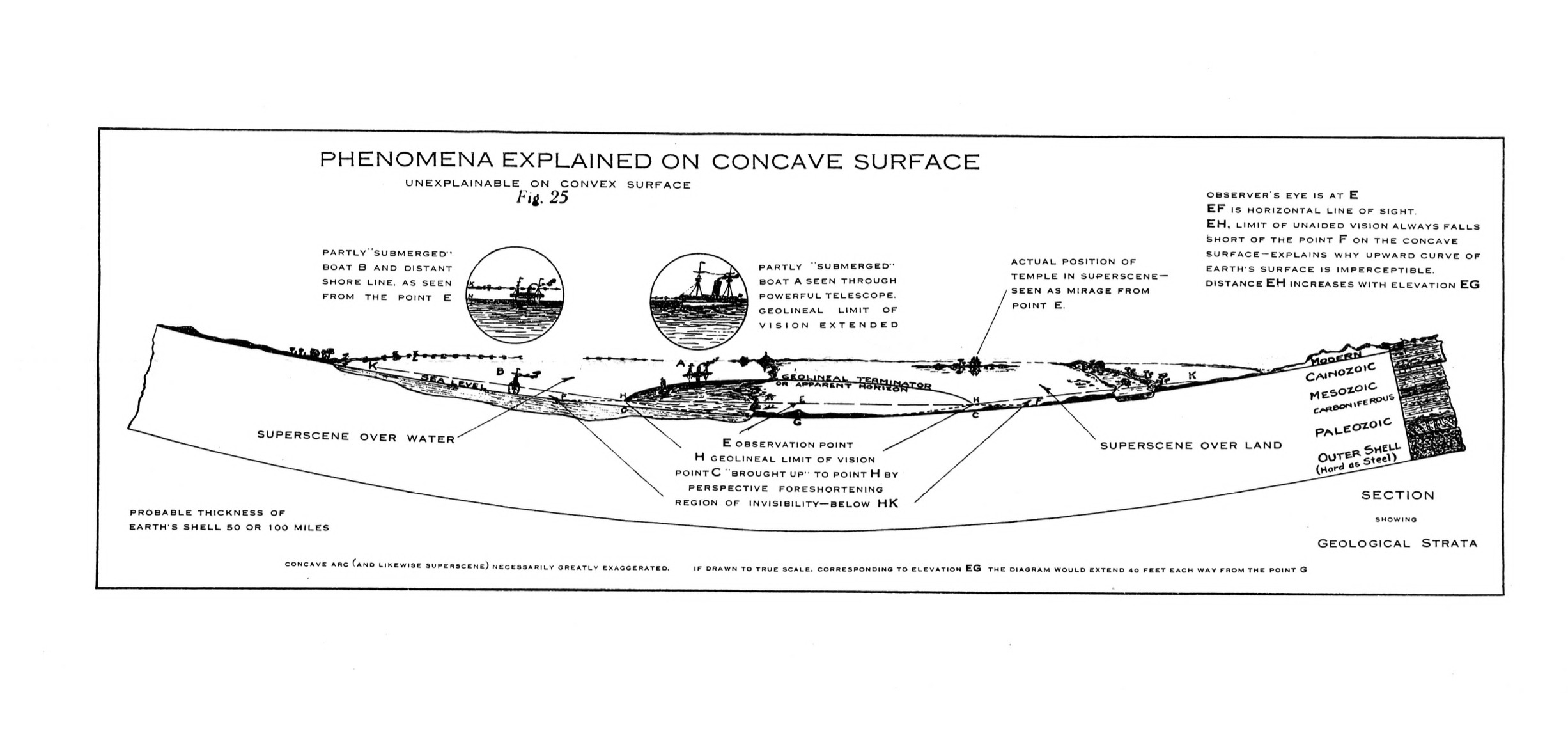
Strange as it may seem to the average reader when one takes the trouble to make a careful examination of the subject, he will find an astonishing lack of conclusive evidence put forth by science to substantiate these well-known assertions.
As to the rotation of the earth on an axis, for example, Matthew Henry, in his Commentary on Job 38 says:—"It is to this day a dispute whether the earth stands still or turns round." Another modern writer says:—"There is really nothing but probability to show us whether we are moving in one direction or the stars are moving in the opposite one. During the greater part of the life of mankind (that is, until the time of Copernicus) the latter view was universally accepted." — (Garrett Fisher, in "Astronomy," Harmsworth's Self Educator). Likewise, the tangible evidence maintained in support of the earth's convexity is very meagre and superficial—and by tangible evidence I mean that in which all assertions are based on observations of phenomena entirely accessible to, or within the reach of, our physical senses; it excludes, therefore, as inconclusive, all evidence based on points of reference situated outside the earth's atmosphere, that is, in the "heavens" themselves or in any other place inaccessible for actual personal examination.
There are, among others, three important assumptions presented in modern textbooks on Geography and Astronomy, that are supposed to furnish conclusive proof that the earth is a solid sphere, or practically so; and the supposition has always been, of course, that the human family lives on its external surface. These assumptions are as follows, viz:— (1) The earth's surface is convex as shown by the gradual disappearance of vessels going out to sea, the hull first becoming invisible, then the sails, and finally the masts; (2) The earth's shadow as seen on the moon at the time of a lunar eclipse, indicates that the earth is a sphere; and (3) The fact that as one travels northward from the earth's equator, the elevation of the pole star changes in proportion to the increase in latitude, proves the globular form of the earth (a conclusion based on the supposition that the pole star is at a comparatively infinite distance from the earth).
The first of these will be dealt with presently; the second and third are at once excluded from the class of tangible evidence, since, in the first place, it is obviously impossible for any one to prove (although people seem to think it should be taken for granted) that it is the shadow of the earth that is seen during a lunar eclipse; likewise, the pole star—as well as all the other so-called fixed stars—may or may not be at an infinite distance from the earth, for this assertion is itself based on the fundamental supposition that the earth moves in an orbit round the sun, although it is impossible, as more than one writer has declared, to furnish conclusive evidence that such a movement is going on. I lay great stress on the distinction that should be made between assertions based on points of reference lying beyond the reach of personal, tangible observations (as are practically all the assertions of modern astronomers), and those based on phenomena which occur—and which may be observed by any normally intelligent person—on the earth's surface itself. ---
← Preface II — "The New Heavens" | Chapter 2 — Flat, Convex, or Concave? →
- -- Source: O. F. Barcus, A New World Discovered (1917).
The italics in these quotations are the Author's.