Extracted text
Editorial transcription, lightly normalized from the scan. Line-break hyphenation, spacing, capitalization, and unmistakable OCR errors have been repaired; the claims remain those of The Flaming Sword.
Absurdities of Science So Called
It is claimed and maintained by the civil engineer, that there is a refraction of the atmosphere amounting to about three inches to the mile, and that this amount of allowance has to be made in running a line curvating with the surface of the earth, which he claims is convex. Assuming such to be the case, and employing that principle of mathematics which is applied to the calculation of the curvation of the earth, namely, the law of inverse ratio to the square of the distance, we find that the second mile would show a deviation of nine inches, instead of three; the third mile, twenty-seven inches; the fourth mile, eighty-one inches; and the fifth mile, two hundred and forty-three inches. If the limit of the atmosphere is ninety miles, what would be the amount of refraction for the whole distance? There is no mathematician or physicist who could answer the question.
If the earth curvates eight inches to the mile — the estimate being made on the calculation of the inverse ratio to the square of the distance — then the distance of three miles would show a curvation of seventy-two inches; while upon the same basis, the refraction would be only twenty-seven inches; which would show that the curvation of the earth at the distance of three miles would be forty-five inches in excess of the refraction. At the distance of four miles, the curvation would be one hundred and twenty-eight inches, while the refraction at the same distance would be eighty-one inches, the curvation being forty-seven inches in excess of the refraction. If this estimate were correct, the convex theory might hold good as against this objection. But the physicists have never determined and settled the question as to the depth of the atmosphere, and therefore they have not settled the absolute degree of refraction at the supposed limit of the atmosphere.
They claim that the atmosphere is about forty-five miles deep; some, ninety miles. Away back several years ago, some astronomers claimed that it was five hundred miles deep, and therefore that the variation of the angle of refraction at the supposed limit of the atmosphere would be so great that no angle of refraction could be determined. If the direction of the star cannot be determined on account of the unknown angle of incidence and refraction — the angle being unknown because the refractive density of the atmosphere at the point of incidence is unknown, and the refractive density unknown because the depth of the atmosphere is undetermined — then the location of the star is undetermined. If the location is undetermined, what foundation has the Copernican system of astronomy? Yet this is the system which is taught in our schools and colleges, and which the people, without questioning, accept as proven truth.
The Diagram
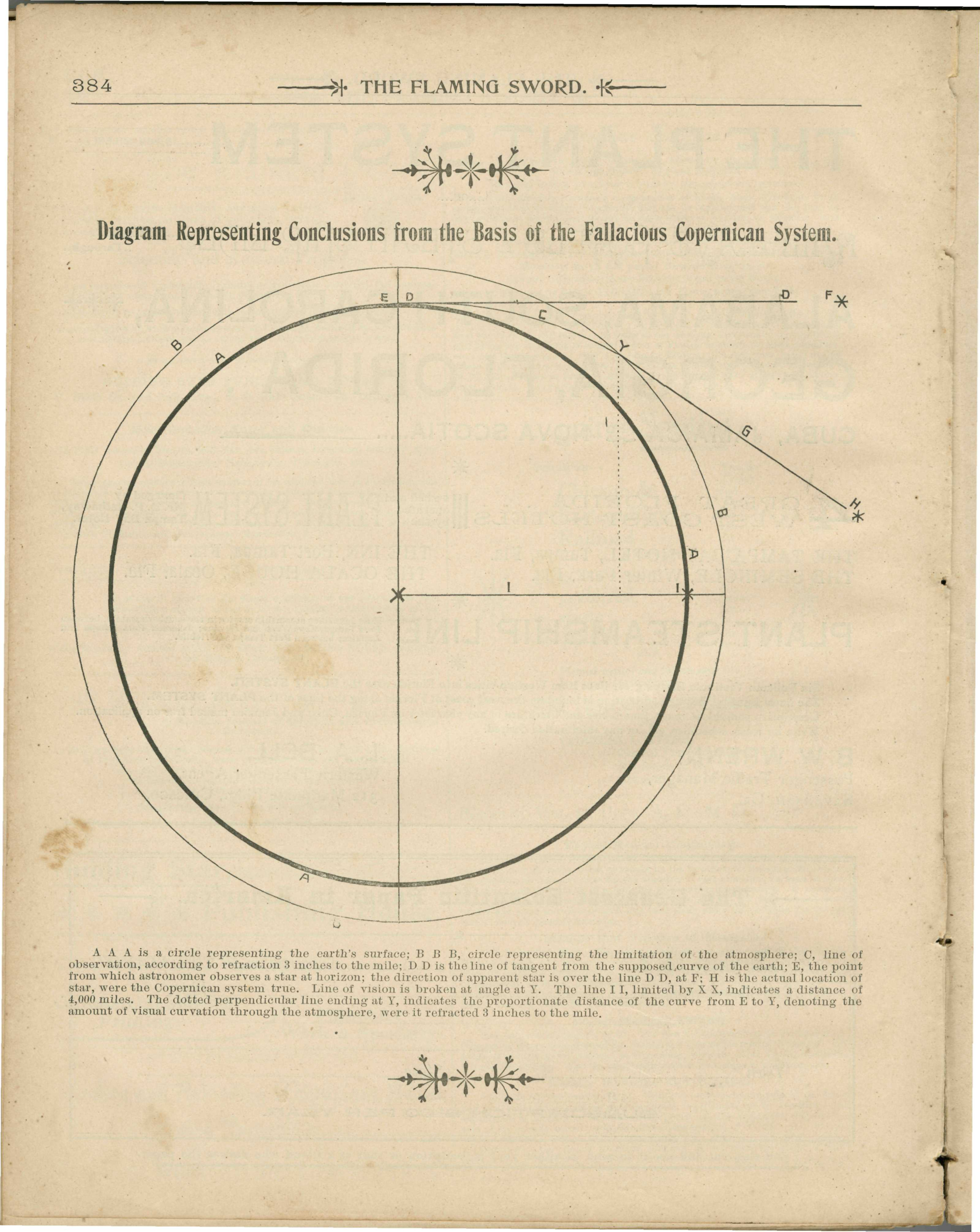
Diagram Representing Conclusions from the Basis of the Fallacious Copernican System. A A A is a circle representing the earth's surface; B B B, circle representing the limitation of the atmosphere; C, line of observation, according to refraction 3 inches to the mile; D D is the line of tangent from the supposed curve of the earth; E, the point from which astronomer observes a star at horizon; the direction of apparent star is over the line D D, at F; H is the actual location of star, were the Copernican system true. Line of vision is broken at angle at Y. The line I I, limited by X X, indicates a distance of 4,000 miles. The dotted perpendicular line ending at Y, indicates the proportionate distance of the curve from E to Y, denoting the amount of visual curvation through the atmosphere, were it refracted 3 inches to the mile.
No telescope can be made so accurate that there is not a perceptible deflection of the optical line, causing an angle of deviation at the objective point of the visual axis of the instrument. If the astronomer does not estimate this angle of deviation, and also the further deviation of the optical line by the refraction of the atmosphere, which the physicist declares to obtain, then the great distances assumed to exist would constitute insurmountable obstacles to any correct astronomical estimate.
The absurdities of the Copernican system become more palpable the more the system is subjected to rational criticism. Let us have "higher criticism" on modern physics — and criticise the critics.
- --
The source scans remain the record. This page preserves the periodical's argument and reported observations without presenting its conclusions as independently established results. The claims remain attributed to The Flaming Sword.
← Flaming Sword Archive
The Flaming Sword · Vol. 11, No. 4 · Apr. 1897 · PDF pp. 6-7