Extracted text
Editorial transcription, lightly normalized from the scan. Line-break hyphenation, spacing, capitalization, and unmistakable OCR errors have been repaired; the claims remain those of The Flaming Sword.
"It seems to me that a critical examination of two etchings in the book CELLULAR COSMOGONY, is alone sufficient to defeat your new astronomy. In etching No. 4 (page 92), three lengths of the Rectilineator show a perfect level with the horizon, and according to your own word they are level. In etching No. 7 (page 140), you also show three sections of the apparatus, which are also perfectly level; and yet do not appear to be in agreement with the horizon. How one set, the exact duplicate of another set, both perfectly level, can show differently on the horizon, is more than I can see—especially, when you use the horizon as proof of the correctness of the first etching. Certainly if the two instruments are exactly alike, both level, they both must agree with the horizon regardless of any line or anything else."
Now we have had the idea that the two etchings referred to were in direct corroboration of the scientific declaration of the earth's concavity. There is a misconception somewhere, and we are decidedly inclined to believe that it is with the inquirer. Of course, a leveled straight-edge will line up with the horizon at all times anywhere; and any two or more leveled straight-edges must agree as related to the horizon. Our inquirer makes the mistake in supposing that the Rectilineator in etching No. 7 was level. The only kind of a surface on which a straight line could be continuously level, would be a flat earth.
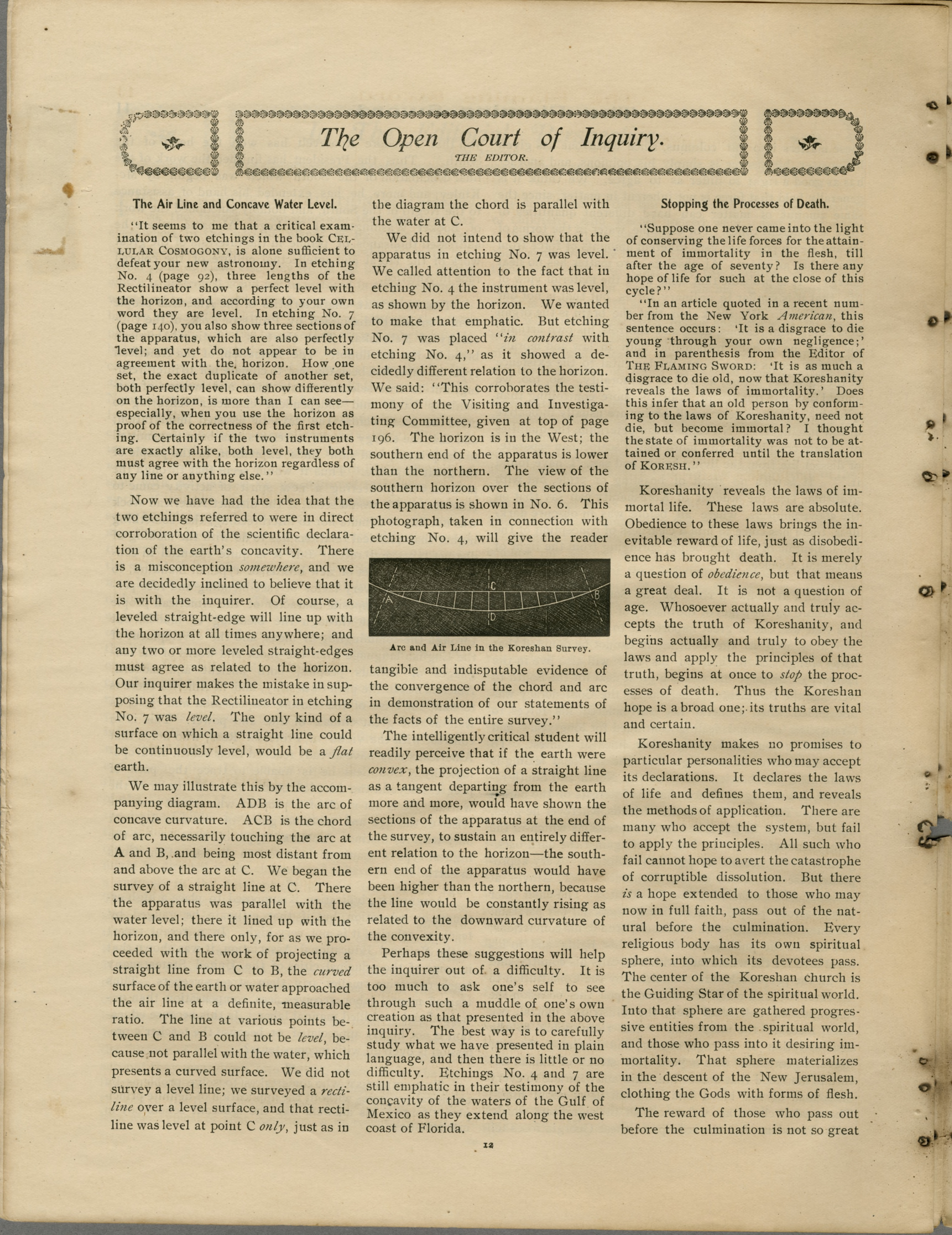
We may illustrate this by the accompanying diagram. ADB is the arc of concave curvature. ACB is the chord of arc, necessarily touching the arc at A and B, and being most distant from and above the arc at C. We began the survey of a straight line at C. There the apparatus was parallel with the water level; there it lined up with the horizon, and there only, for as we proceeded with the work of projecting a straight line from C to B, the curved surface of the earth or water approached the air line at a definite, measurable ratio. The line at various points between C and B could not be level, because not parallel with the water, which presents a curved surface. We did not survey a level line; we surveyed a rectiline over a level surface, and that rectiline was level at point C only, just as in the diagram the chord is parallel with the water at C.
We did not intend to show that the apparatus in etching No. 7 was level. We called attention to the fact that in etching No. 4 the instrument was level, as shown by the horizon. We wanted to make that emphatic. But etching No. 7 was placed "in contrast with etching No. 4," as it showed a decidedly different relation to the horizon. We said: "This corroborates the testimony of the Visiting and Investigating Committee, given at top of page 196. The horizon is in the West; the southern end of the apparatus is lower than the northern. The view of the southern horizon over the sections of the apparatus is shown in No. 6. This photograph, taken in connection with etching No. 4, will give the reader tangible and indisputable evidence of the convergence of the chord and arc in demonstration of our statements of the facts of the entire survey."
[Printed figure, second column: a diagram of the arc and chord, captioned "Arc and Air Line in the Koreshan Survey."]
The intelligently critical student will readily perceive that if the earth were convex, the projection of a straight line as a tangent departing from the earth more and more, would have shown the sections of the apparatus at the end of the survey, to sustain an entirely different relation to the horizon—the southern end of the apparatus would have been higher than the northern, because the line would be constantly rising as related to the downward curvature of the convexity.
Perhaps these suggestions will help the inquirer out of a difficulty. It is too much to ask one's self to see through such a muddle of one's own creation as that presented in the above inquiry. The best way is to carefully study what we have presented in plain language, and then there is little or no difficulty. Etchings No. 4 and 7 are still emphatic in their testimony of the concavity of the waters of the Gulf of Mexico as they extend along the west coast of Florida.
- --
The source scans remain the record. This page preserves the periodical's argument and reported observations without presenting its conclusions as independently established results. The claims remain attributed to The Flaming Sword.
← Flaming Sword Archive
The Flaming Sword · Vol. 19, No. 22 · · PDF p. 12