Extracted text
Successful Completion of the First Line of Survey on May 5, at Naples, Fla.; Descent After the First Mile.
Editorial transcription, lightly normalized from the cited scan pages. Historical claims remain those of The Flaming Sword.
A great day in the history of Koreshanity has come!—a day full of success in the completion of the first air line surveyed in the history of the world! No less successful for the Koreshan System will be the days which follow, for that day marks the beginning of a period of its rapid advancement and progress. A system of science that is capable of overthrowing the fallacies of modern times will finally make and embrace the world's history—the universe in its perfection and glory!
KORESH leads on toward the goal of universal victory, and today he points in triumph to the successful demonstration of the premise of the true Science of Cosmogony, which he has patiently taught for twenty-seven years.
Columbus, in his adventures, struck a chord that resounded throughout the world; he led the westward march of empire and the progress of civilization. The operation of the mighty forces of human development, which before were confined to the old world, was made to pivot upon the discovery of new fields of expression. Within the lifetime of that one man a great change came; where, in the earlier days of his career, his plans fell upon deaf ears, there were soon awakened in all the kingdoms of Europe mighty movements toward the new continent. He lifted the veil from the new world; that act was the turning-point in the progress of nations. Vastly more important than the discovery of the continent of America is the discovery of the true cosmic form, in which all continents lie, with the resultant demonstration—that which brings to the world a comprehensive view of the Light of Ages! The Koreshan System is founded upon a scientific and specific premise. The System pivots upon the fall of the earth's concavity; the demonstration of that fact is the pivot of its success.
The mighty forces of the impending scientific revolution, hitherto confined in their proper centers and spheres of elaboration, involved in the integral mind which has brought to us the marvelous System, and pulsating about the pivot of the demonstration of the scientific premise, will soon be manifest in the awakening of the world to the realization of the dawn of a New World—a New Era, in which humanity will be saved from the prevailing fallacies—ignorance and darkness! The testimony of the air line, the chord of arc, will vibrate the world in confirmation of the message of KORESH! That testimony is now proclaimed to the world. The tension of human thought and the voltage of mental energy involved in the work of promulgation of the Koreshan System, and the triumphant herald of the facts of the demonstration of its premise, will be felt in future years —long ages after all the fallacious systems have been buried in the ruins of the old world!
Completion of the First I,ine of Survey.
On March 18, at the beginning of the air line, the horizontal axis of the Rectilineator was 10 feet above the water level. After surveying a distance of 2½ miles, the apparatus stood, on May 5, on the beach near Gordon's Pass, with the middle line of the sections only 6 feet above the waters of the Gulf and Pass. The sections were absolutely level at the beginning of the survey; at Gordon's Pass the bubble in the spirit level had shifted toward the north end of the vial .15 of an inch, as determined by the graduated scale on the vial, while the mercurial level and the Gulf horizon exhibited a distinct angle and deviation from the level or horizontal at place of test. In the distance of 2 3/4 miles the apparatus had approached 4 feet nearer the water than at the beginning; the lower cross-arms reached almost to the ground. On this account, and on account of the Pass, this distance is as far as we could survey the air line by means of the apparatus adjustments. The exact number of adjustments made during the entire line surveyed was 1,064—each section being 12 feet in length.
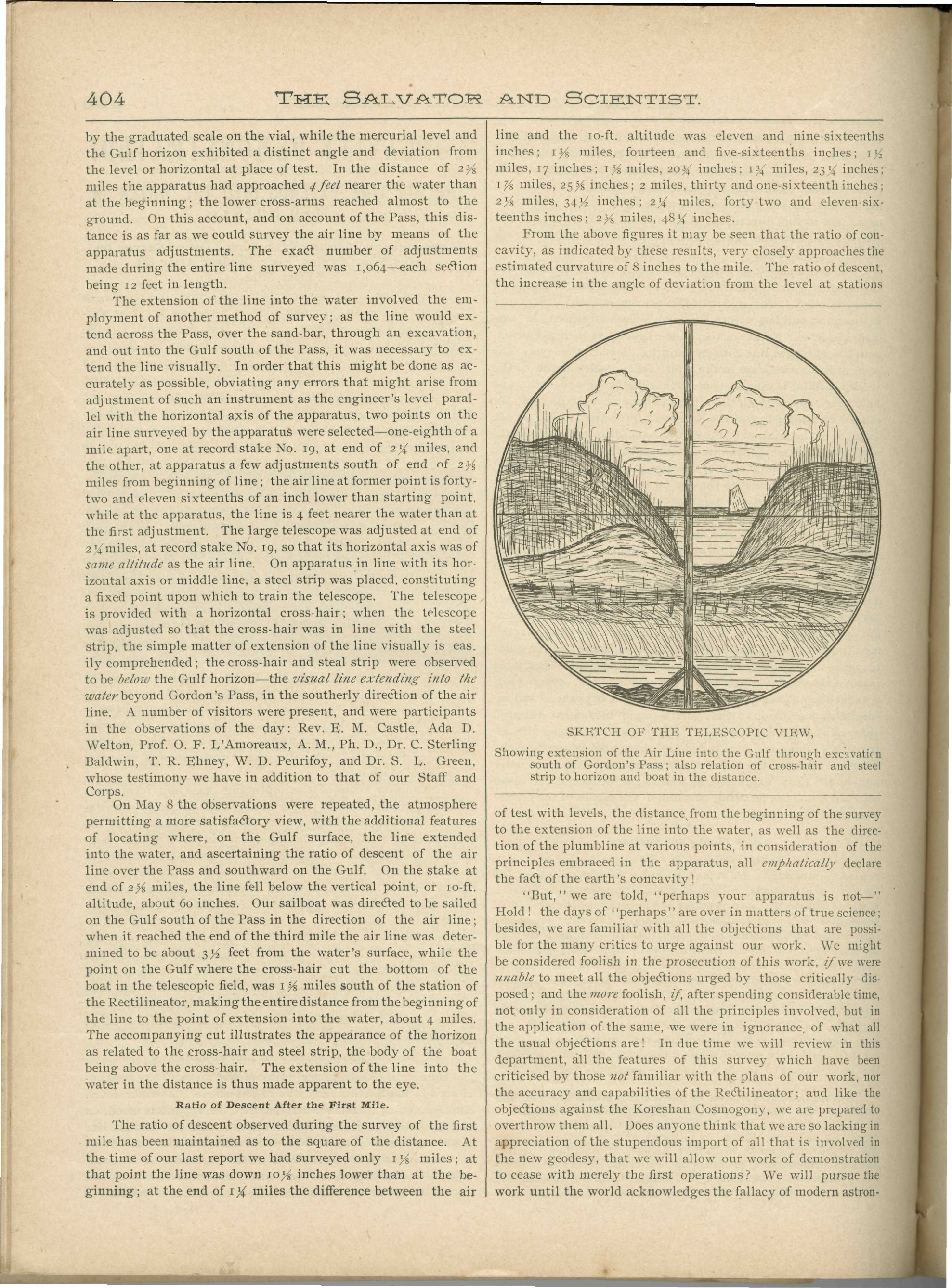
The extension of the line into the water involved the employment of another method of survey; as the line would extend across the Pass, over the sand-bar, through an excavation, and out into the Gulf south of the Pass, it was necessary to extend the line visually. In order that this might be done as accurately as possible, obviating any errors that might arise from adjustment of such an instrument as the engineer's level parallel with the horizontal axis of the apparatus, two points on the air line surveyed by the apparatus were selected—one-eighth of a mile apart, one at record stake No. 19, at end of 2 3/4 miles, and the other, at apparatus a few adjustments south of end of 2 3/4 miles from beginning of line; the air line at former point is forty-two and eleven sixteenths of an inch lower than starting point, while at the apparatus, the line is 4 feet nearer the water than at the first adjustment. The large telescope was adjusted at end of 2½ miles, at record stake No. 19, so that its horizontal axis was of same altitude as the air line. On apparatus in line with its horizontal axis or middle line, a steel strip was placed, constituting a fixed point upon which to train the telescope. The telescope is provided with a horizontal cross-hair; when the telescope was adjusted so that the cross-hair was in line with the steel strip, the simple matter of extension of the line visually is easily comprehended; the cross-hair and steel strip were observed to be below the Gulf horizon—the visual line extending into the water beyond Gordon's Pass, in the southerly direction of the air line. A number of visitors were present, and were participants in the observations of the day: Rev. E. M. Castle, Ada D. Welton, Prof. O. F. L'Amoreaux, A. M., Ph. D., Dr. C. Sterling Baldwin, T. R. Ehney, W. D. Peurifoy, and Dr. S. L. Green, whose testimony we have in addition to that of our Staff and Corps.
On May 8 the observations were repeated, the atmosphere permitting a more satisfactory view, with the additional features of locating where, on the Gulf surface, the line extended into the water, and ascertaining the ratio of descent of the air line over the Pass and southward on the Gulf. On the stake at end of 2 1/4 miles, the line fell below the vertical point, or 10-ft. altitude, about 60 inches. Our sailboat was directed to be sailed on the Gulf south of the Pass in the direction of the air line; when it reached the end of the third mile the air line was determined to be about 3 1/2 feet from the water's surface, while the point on the Gulf where the cross-hair cut the bottom of the boat in the telescopic field, was 1 1/8 miles south of the station of the Rectilineator, making the entire distance from the beginning of the line to the point of extension into the water, about 4 miles. The accompanying cut illustrates the appearance of the horizon as related to the cross-hair and steel strip, the body of the boat being above the cross-hair. The extension of the line into the water in the distance is thus made apparent to the eye.
Ratio of Descent After the First Mile.
The ratio of descent observed during the survey of the first mile has been maintained as to the square of the distance. At the time of our last report we had surveyed only 1 1/8 miles; at that point the line was down 10 1/2 inches lower than at the beginning; at the end of 1 1/4 miles the difference between the air line and the 10-foot altitude was eleven and nine-sixteenths inches; at 1 3/8 miles, fourteen and five-sixteenths inches; at 1 1/2 miles, 17 inches; at 1 5/8 miles, 20 3/8 inches; at 1 3/4 miles, 23 3/4 inches; at 1 7/8 miles, 25 1/2 inches; at 2 miles, thirty and one-sixteenth inches; at 2 1/4 miles, 34 1/2 inches; at 2 1/2 miles, forty-two and eleven-sixteenths inches; at 2 3/4 miles, 48 1/2 inches.
From the above figures it may be seen that the ratio of concavity, as indicated by these results, very closely approaches the estimated curvature of 8 inches to the mile. The ratio of descent, the increase in the angle of deviation from the level at stations of test with levels, the distance from the beginning of the survey to the extension of the line into the water, as well as the direction of the plumbline at various points, in consideration of the principles embraced in the apparatus, all emphatically declare the fact of the earth's concavity!
"But, " w e are told, "perhaps your apparatus is not—" Hold! the days of "perhaps" are over in matters of true science; besides, we are familiar with all the objections that are possible for the many critics to urge against our work. We might be considered foolish in the prosecution of this work, if we were unable to meet all the objections urged by those critically disposed; and the more foolish, if, after spending considerable time, not only in consideration of all the principles involved, but in the application of the same, we were in ignorance, of what all the usual objections are! In due time we will review in this department, all the features of this survey which have been criticised by those not familiar with the plans of our work, nor the accuracy and capabilities of the Rectilineator; and like the objections against the Koreshan Cosmogony, we are prepared to overthrow them all. Does anyone think that we are so lacking in appreciation of the stupendous import of all that is involved in the new geodesy, that we will allow our work of demonstration to cease with merely the first operations? We will pursue the work until the world acknowledges the fallacy of modern astronomy! This will involve the continuation of these operations, with apparatus embodying all possible mechanical and optical, improvements, executed by the world's best instrument makers; but in the meantime, we will show how foolish objections may be urged as a result of jumping at conclusions without logical reason therefor!
- --
The source scans remain the record. This page preserves the periodical's argument and reported observations without presenting its conclusions as independently established results. The claims remain attributed to The Flaming Sword.
← Flaming Sword Archive
The Flaming Sword · Vol. 11, No. 5 · · PDF pp. 19-21