Extracted text
Written for the Pittsburgh Dispatch An Offer to Teed.
Editorial transcription, lightly normalized from the scan. Line-end hyphenation, letter spacing, and unmistakable OCR substitutions have been repaired; the claims remain those of the correspondents and The Flaming Sword.
To the Editor of the Dispatch:—I have just finished reading about 200 pages of the lucubrations of “Koresh” (Cyrus H. Teed), in explanation and defense of his “Hollow Globe” theory. He boldly offers $100,000 to any “recognized scientist” who will disprove his theory.
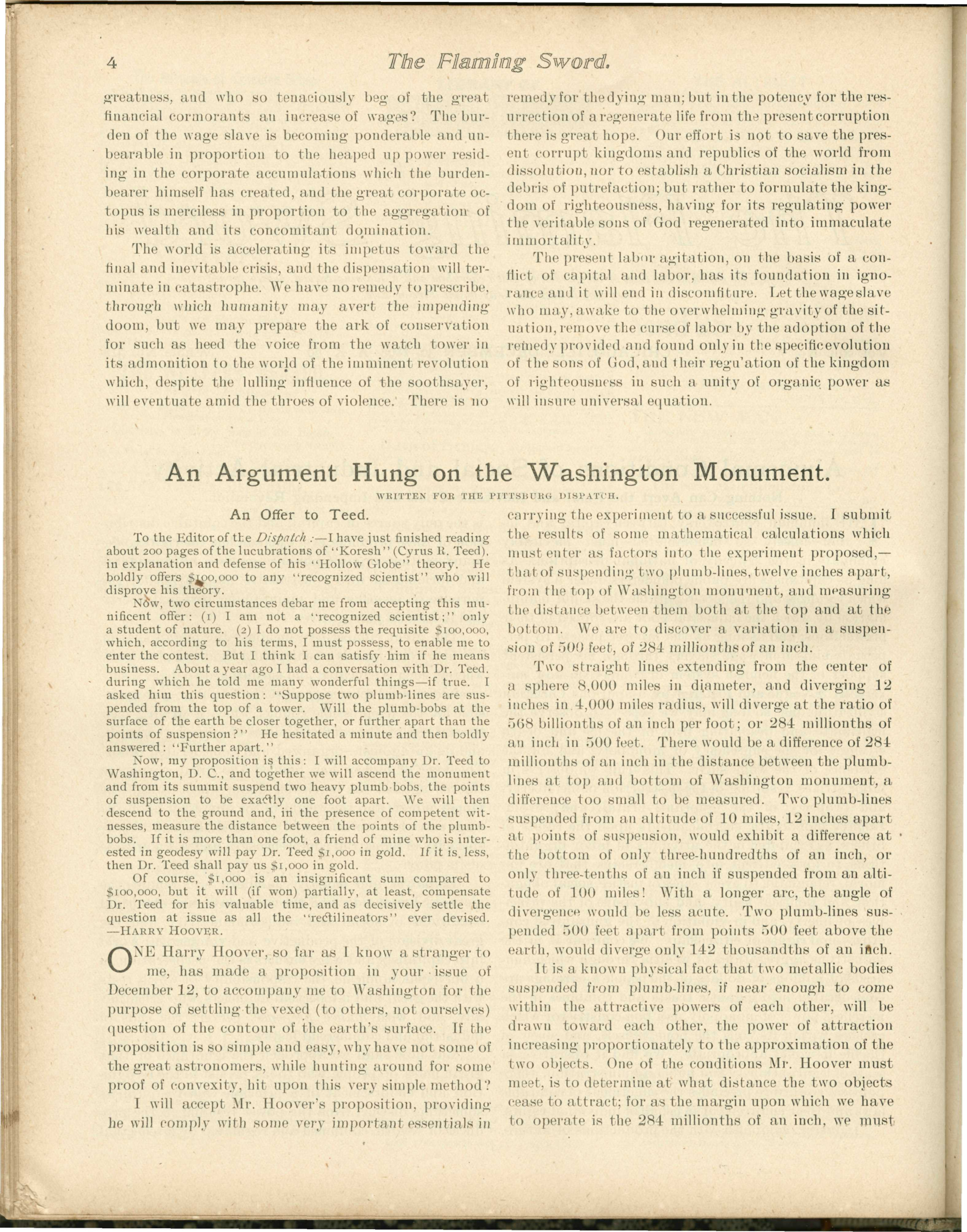
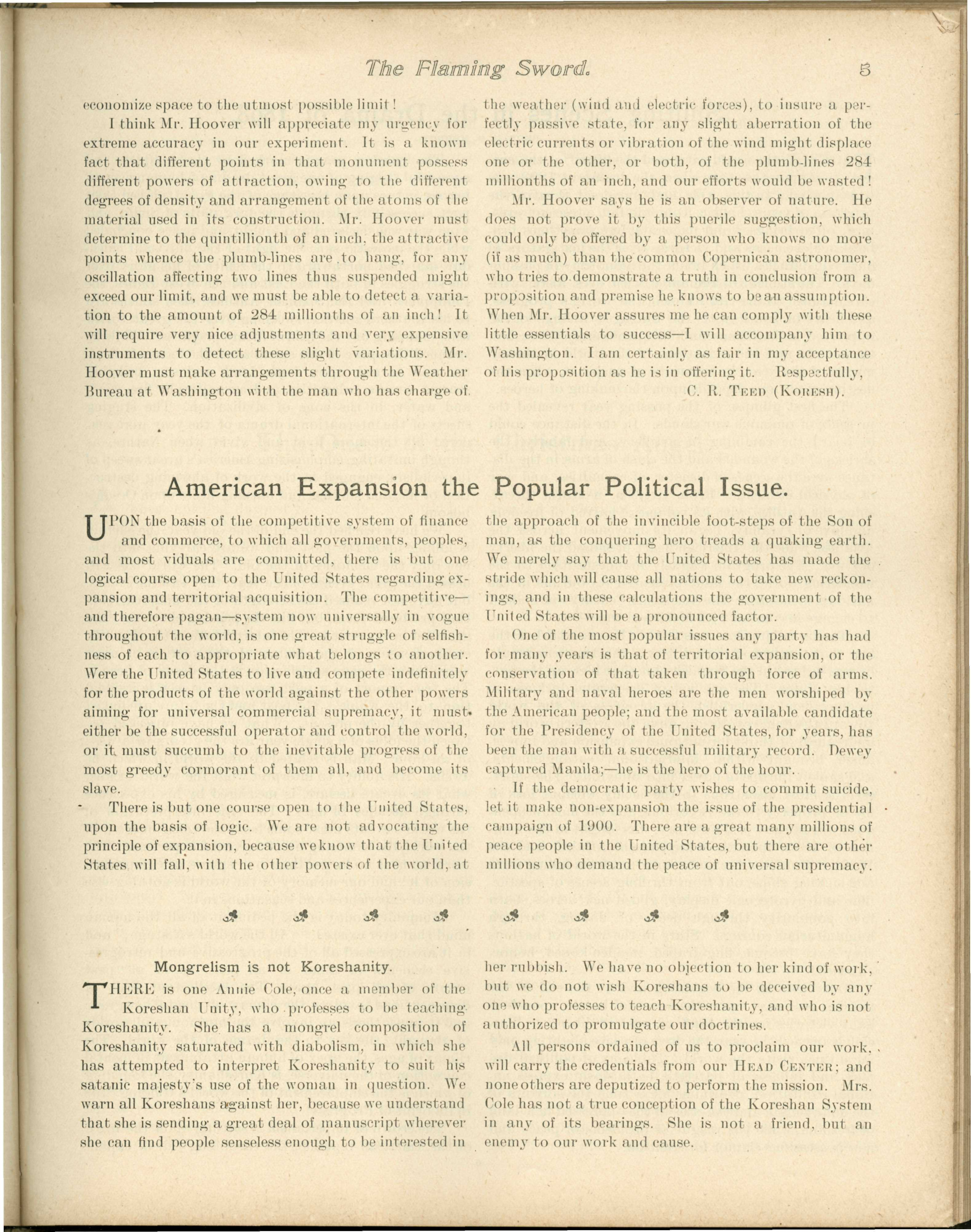
Now, two circumstances debar me from accepting this munificent offer: (1) I am not a “recognized scientist;” only a student of nature. (2) I do not possess the requisite $100,000, which, according to his terms, I must possess, to enable me to enter the contest. But I think I can satisfy him if he means business. About a year ago I had a conversation with Dr. Teed, during which he told me many wonderful things—if true. I asked him this question: “Suppose two plumb-lines are suspended from the top of a tower. Will the plumb-bobs at the surface of the earth be closer together, or further apart than the points of suspension?” He hesitated a minute and then boldly answered: “Further apart.”
Now, my proposition is this: I will accompany Dr. Teed to Washington, D. C., and together we will ascend the monument and from its summit suspend two heavy plumb-bobs, the points of suspension to be exactly one foot apart. We will then descend to the ground and, in the presence of competent witnesses, measure the distance between the points of the plumb-bobs. If it is more than one foot, a friend of mine who is interested in geodesy will pay Dr. Teed $1,000 in gold. If it is less, then Dr. Teed shall pay us $1,000 in gold.
Of course, $1,000 is an insignificant sum compared to $100,000, but it will (if won) partially, at least, compensate Dr. Teed for his valuable time, and as decisively settle the question at issue as all the “rectilineators” ever devised.
—Harry Hoover.
One Harry Hoover, so far as I know a stranger to me, has made a proposition in your issue of December 12, to accompany me to Washington for the purpose of settling the vexed (to others, not ourselves) question of the contour of the earth’s surface. If the proposition is so simple and easy, why have not some of the great astronomers, while hunting around for some proof of convexity, hit upon this very simple method?
I will accept Mr. Hoover’s proposition, providing he will comply with some very important essentials in carrying the experiment to a successful issue. I submit the results of some mathematical calculations which must enter as factors into the experiment proposed,—that of suspending two plumb-lines, twelve inches apart, from the top of Washington monument, and measuring the distance between them both at the top and at the bottom. We are to discover a variation in a suspension of 500 feet, of 284 millionths of an inch.
Two straight lines extending from the center of a sphere 8,000 miles in diameter, and diverging 12 inches in 4,000 miles radius, will diverge at the ratio of 568 billionths of an inch per foot; or 284 millionths of an inch in 500 feet. There would be a difference of 284 millionths of an inch in the distance between the plumb-lines at top and bottom of Washington monument, a difference too small to be measured. Two plumb-lines suspended from an altitude of 10 miles, 12 inches apart at points of suspension, would exhibit a difference at the bottom of only three-hundredths of an inch, or only three-tenths of an inch if suspended from an altitude of 100 miles! With a longer arc, the angle of divergence would be less acute. Two plumb-lines suspended 500 feet apart from points 500 feet above the earth, would diverge only 142 thousandths of an inch.
It is a known physical fact that two metallic bodies suspended from plumb-lines, if near enough to come within the attractive powers of each other, will be drawn toward each other, the power of attraction increasing proportionately to the approximation of the two objects. One of the conditions Mr. Hoover must meet, is to determine at what distance the two objects cease to attract; for as the margin upon which we have to operate is the 284 millionths of an inch, we must economize space to the utmost possible limit!
I think Mr. Hoover will appreciate my urgency for extreme accuracy in our experiment. It is a known fact that different points in that monument possess different powers of attraction, owing to the different degrees of density and arrangement of the atoms of the material used in its construction. Mr. Hoover must determine to the quintillionth of an inch, the attractive points whence the plumb-lines are to hang, for any oscillation affecting two lines thus suspended might exceed our limit, and we must be able to detect a variation to the amount of 284 millionths of an inch! It will require very nice adjustments and very expensive instruments to detect these slight variations. Mr. Hoover must make arrangements through the Weather Bureau at Washington with the man who has charge of the weather (wind and electric forces), to insure a perfectly passive state, for any slight aberration of the electric currents or vibration of the wind might displace one or the other, or both, of the plumb-lines 284 millionths of an inch, and our efforts would be wasted!
Mr. Hoover says he is an observer of nature. He does not prove it by this puerile suggestion, which could only be offered by a person who knows no more (if as much) than the common Copernican astronomer, who tries to demonstrate a truth in conclusion from a proposition and premise he knows to be an assumption. When Mr. Hoover assures me he can comply with these little essentials to success—I will accompany him to Washington. I am certainly as fair in my acceptance of his proposition as he is in offering it. Respectfully,
C. R. Teed (Koresh).
- --
The source scans remain the record. This page preserves the periodical’s correspondence without presenting its conclusions as independently established fact.
The Flaming Sword · Vol. 13, No. 7 · Dec 1898 · PDF pp. 4–5