Extracted text
Editorial transcription, lightly normalized from the scan. Line-break hyphenation, spacing, capitalization, and unmistakable OCR errors have been repaired; the claims remain those of The Flaming Sword.
The Apparent Dome of the Heavens.
EDITOR FLAMING SWORD:—Kindly explain why there is a difference of about 22° between the altitude of the sun at noon, June 21, and its altitude as indicated on your charts—from 42° north latitude. There is also a difference of about 8¼° between the facts of observation and the charts for altitude of the sun on March 21. If the tropics of Cancer and Capricorn are of the same diameter, the sun should move through equal spaces in equal times on both tropics. Actual measurement of the amount of space covered by the sun's diurnal motion in 20 minutes of time, on both tropics, shows the sun's movement in 20 minutes on the southern tropic to be only a hundred and twelfth part less than its movement for same time on the tropic of Cancer; so the sun at noon December 22 can be but little farther away than at noon, June 21; while the Koreshan theory requires that it be two and a half times more distant. I am greatly desirous of knowing the truth regarding the subject of astronomy. I had hoped that the Koreshan theory were true, but I cannot make the facts comport with it. I am not saying that these objections are unanswerable, but that I cannot answer them. Before the Koreshan Cosmogony can triumph it must logically meet these and similar objections, and show the error of their deduction.—Condensed from several letters received from M. S. M., South Elgin, Ill.
The greatest difficulty with which we have to contend in the promulgation of the Koreshan Cosmogony, is the failure of the modern mind to eradicate false conceptions and to reason from the basis of demonstrated premises. As long as the mind persists in the unwarranted belief that rays of light and lines of vision are straight, and undertakes to apply the same when considering the phenomena of the cellular universe, no progress whatever can be made in the study of the System.
There is but one question which can logically enter into consideration of the difference between the Koreshan and modern systems of astronomy—and that is the actual shape of the earth; and the way to determine the earth's shape is to apply tests to its own surface. If the earth is considered to be convex, all phenomena must be explained from the basis of convexity, which requires that light be propagated in straight lines, and that apparent angles and altitudes be taken as real. The earth is actually concave, as we have demonstrated by analogy, observation, and experimentation; therefore, all phenomena must be explained from the concave basis; the facts of phenomena and the laws and principles of physics and optics, as well as the basic premise of the System itself, demand forcefully and logically, that rays of light and lines of vision be considered as curves. Be assured that the Cellular Cosmogony and the Copernican system of astronomy cannot both be true, and it is absurd to undertake to mix conclusions adduced from opposite premises.
The idea of the earth's convexity originated in the false conception that the arc of the heavens is concave to the observer; the shape of the earth was made to conform in the mind, to appearances. The Koreshan method of procedure is to first determine the actual shape of the earth, as a tangible basis of conclusion concerning the direction of the curvature of the arc of the heavens. We know that the earth is concave, and that the heavens are convex to the observer; we also know it to be a fact that the heavens appear concave. Certainly, then, there are factors operative to cause a convex arc to appear concave. When the mind comprehends what these factors are, every objection against the Koreshan conception of the Cellular Universe vanishes.
The only points in the heavens which have the same real and apparent altitudes from 42° north latitude are the zenith and points on the almucantar or altitude circle of 42°. It is not surprising to us that geometrical lines and angles drawn on our charts do not agree with the apparent angles and altitudes, because rectilinear radial lines from the center of observation cannot sustain the same relation to convex and concave arcs. The apparent altitudes of the sun at noon on June 21, September 23, and December 22, from latitude 42° north, are about 71¼°, 48°, and 24¼°, respectively; but if one relates the point of observation and the convex heavens by straight lines and angles measured on paper, the altitudes would be 51°, 42°, and 40°, respectively, and all horizon points in the heavens, which appear to meet the earth, would have a geometrical altitude of about 54°.
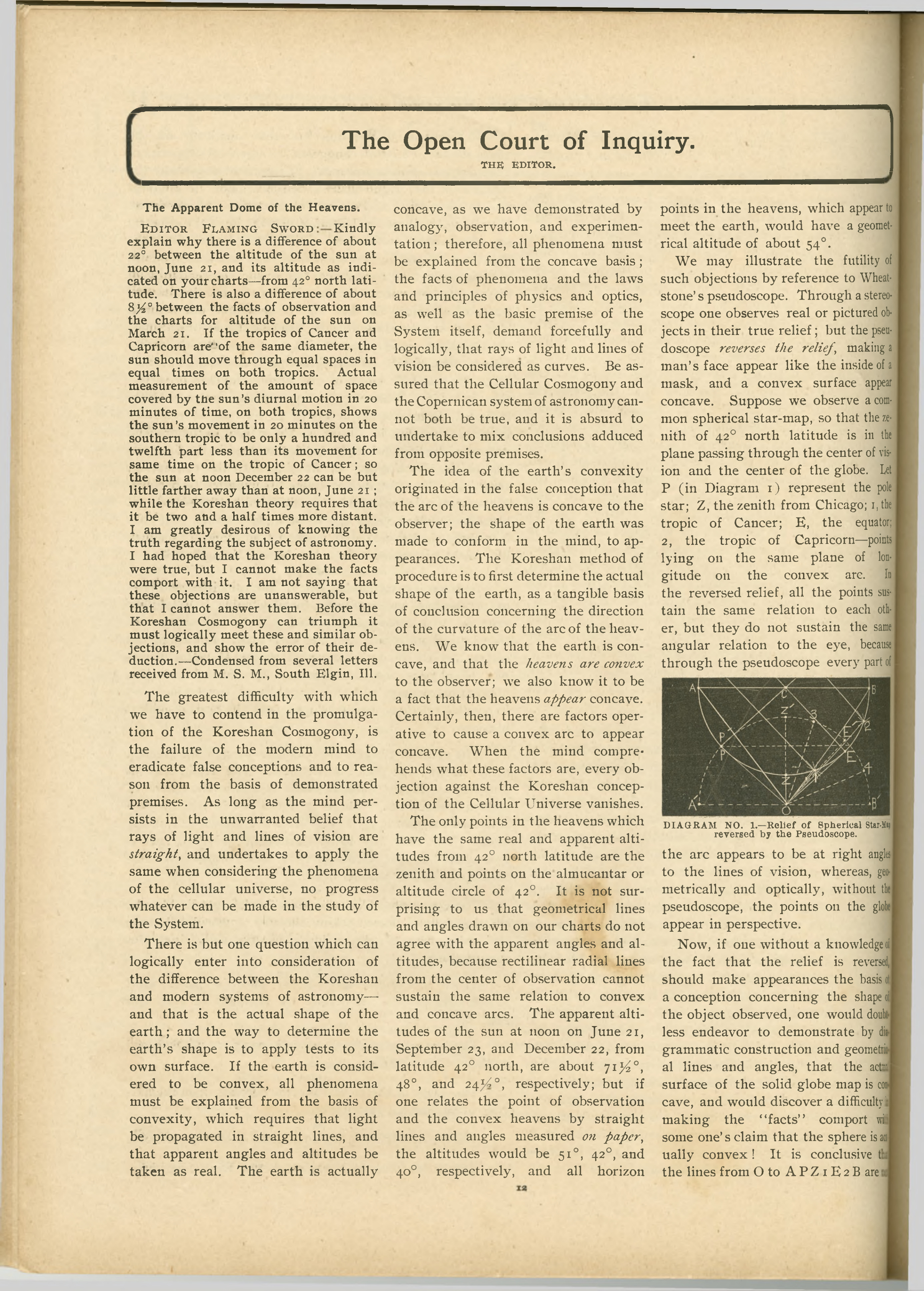
We may illustrate the futility of such objections by reference to Wheatstone's pseudoscope. Through a stereoscope one observes real or pictured objects in their true relief; but the pseudoscope reverses the relief, making a man's face appear like the inside of a mask, and a convex surface appear concave. Suppose we observe a common spherical star-map, so that the zenith of 42° north latitude is in the plane passing through the center of vision and the center of the globe. Let P (in Diagram 1) represent the pole star; Z, the zenith from Chicago; 1, the tropic of Cancer; E, the equator; 2, the tropic of Capricorn—points lying on the same plane of longitude on the convex arc. In the reversed relief, all the points sustain the same relation to each other, but they do not sustain the same angular relation to the eye, because through the pseudoscope every part of the arc appears to be at right angles to the lines of vision, whereas, geometrically and optically, without the pseudoscope, the points on the globe appear in perspective.
DIAGRAM NO. 1.—Relief of Spherical Star-Map reversed by the Pseudoscope.
Now, if one without a knowledge of the fact that the relief is reversed, should make appearances the basis of a conception concerning the shape of the object observed, one would doubtless endeavor to demonstrate by diagrammatic construction and geometrical lines and angles, that the actual surface of the solid globe map is concave, and would discover a difficulty: making the "facts" comport with some one's claim that the sphere is actually convex! It is conclusive that the lines from O to A P Z 1 E 2 B are coincidental with the dotted lines extending from O to A'P'Z' 2E' 4B', because the relief is reversed. If small intense points of light were moving equal spaces in equal time on the tropics of Cancer and Capricorn, they would appear to move equal spaces in equal times on the reversed relief, because the reversal of the relief does not change the relation of the points, degrees, and lines.
DIAGRAM NO. 2.—Sphere of the Heavens and Tilt of the Poles from Chicago.
Now, the atmosphere, ascending and descending energies, the factors of perspective and geolinear foreshortening, and the curvation of rays of light and lines of vision, constitute a "pseudoscope" which reverses the relief of the sphere of the heavens. These factors cause the curved lines of vision to sustain the same relation to the convex arc of the heavens, that radial lines from the center of observation sustain to the apparent concavity; they enable us to see every point on a hemisphere of the heavens at right angles to its surface. The limit of the visible hemisphere is apparently lowered to the earth's surface, with an even curvature from the zenith point to all points on the horizon.
Every system of astronomy employs what is termed "the horizon system;" and the best the astronomer can do is to measure angular spaces in terms of degrees, minutes, and seconds of arc. We employ the horizon system; the plane of the sensible horizon passes through the observer, while the plane of the rational horizon passes through the center of the earth—the plane of the two horizons being 4,000 miles apart, as in the convex theory. If we see a hemisphere of the heavens, we know that the apparent dome, while it is necessarily a foreshortening of the arc of the heavens, leaves the relation of all points, degrees, minutes, and seconds unchanged. From the basis of these apparent relations we can determine the actual position of the "heavenly bodies" when we know what relation the heavens sustain to the earth, but not before.
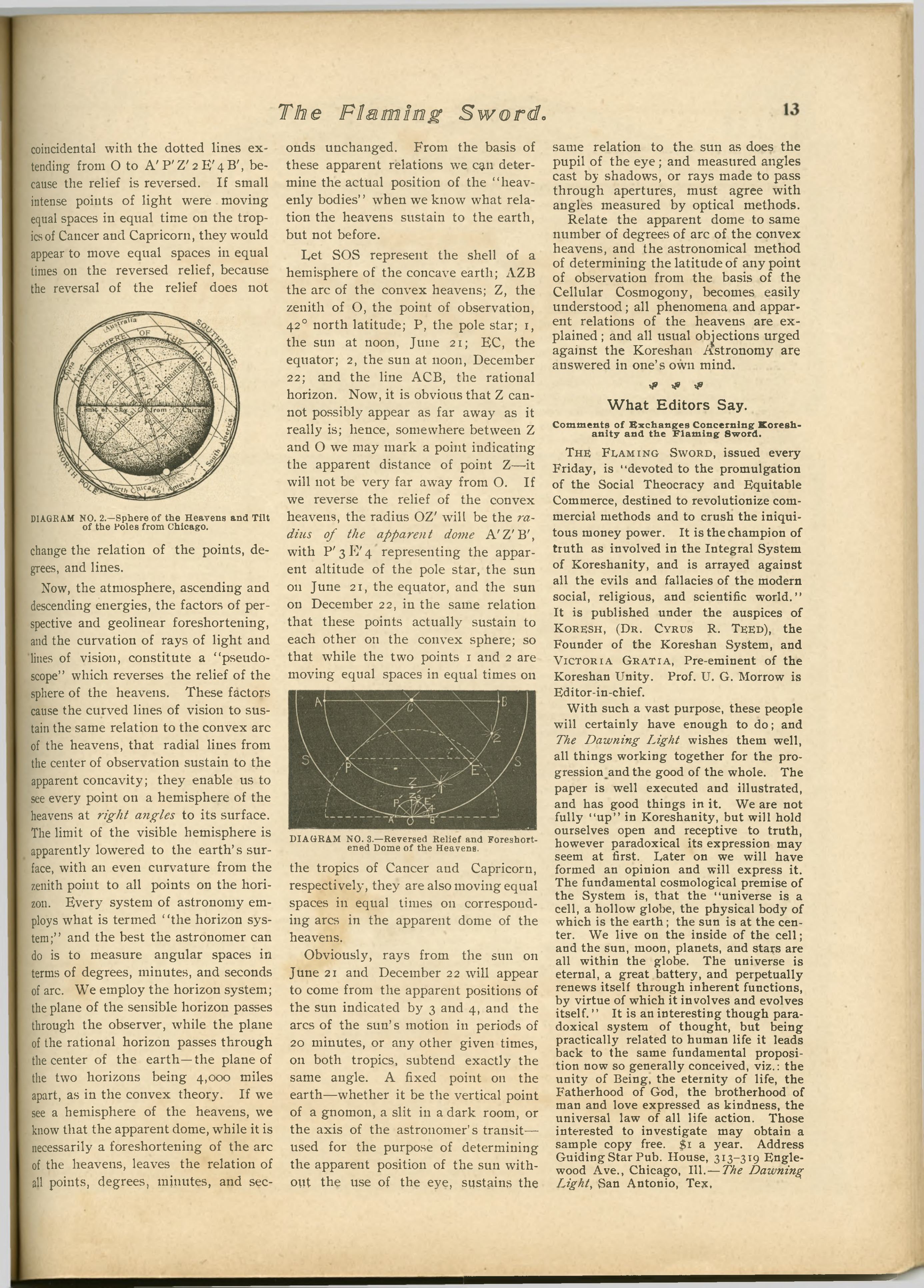
Let SOS represent the shell of a hemisphere of the concave earth; AZB the arc of the convex heavens; Z, the zenith of O, the point of observation, 42° north latitude; P, the pole star; 1, the sun at noon, June 21; EC, the equator; 2, the sun at noon, December 22; and the line ACB, the rational horizon. Now, it is obvious that Z cannot possibly appear as far away as it really is; hence, somewhere between Z and O we may mark a point indicating the apparent distance of point Z—it will not be very far away from O. If we reverse the relief of the convex heavens, the radius OZ' will be the radius of the apparent dome A'Z'B', with P' 3 E' 4 representing the apparent altitude of the pole star, the sun on June 21, the equator, and the sun on December 22, in the same relation that these points actually sustain to each other on the convex sphere; so that while the two points 1 and 2 are moving equal spaces in equal times on the tropics of Cancer and Capricorn, respectively, they are also moving equal spaces in equal times on corresponding arcs in the apparent dome of the heavens.
DIAGRAM NO. 3.—Reversed Relief and Foreshortened Dome of the Heavens.
Obviously, rays from the sun on June 21 and December 22 will appear to come from the apparent positions of the sun indicated by 3 and 4, and the arcs of the sun's motion in periods of 20 minutes, or any other given times, on both tropics, subtend exactly the same angle. A fixed point on the earth—whether it be the vertical point of a gnomon, a slit in a dark room, or the axis of the astronomer's transit—used for the purpose of determining the apparent position of the sun without the use of the eye, sustains the same relation to the sun as does the pupil of the eye; and measured angles cast by shadows, or rays made to pass through apertures, must agree with angles measured by optical methods.
Relate the apparent dome to the same number of degrees of arc of the convex heavens, and the astronomical method of determining the latitude of any point of observation from the basis of the Cellular Cosmogony, becomes easily understood; all phenomena and apparent relations of the heavens are explained; and all usual objections urged against the Koreshan Astronomy are answered in one's own mind.
- --
The source scans remain the record. This page preserves the periodical's argument and reported observations without presenting its conclusions as independently established results. The claims remain attributed to The Flaming Sword.
The Flaming Sword · Vol. 16, No. 16 · 7 Mar 1902 · PDF pp. 12-13