Extracted text
A Disclosure of a Few of the Factors of Conclusion in the Modern Astronomical System.
Editorial transcription lightly normalized from the cited scan; historical claims below are those of The Flaming Sword and are not independently verified.
Jupiter is a large planet that turns on his axis, and why do not we turn? - Airy.
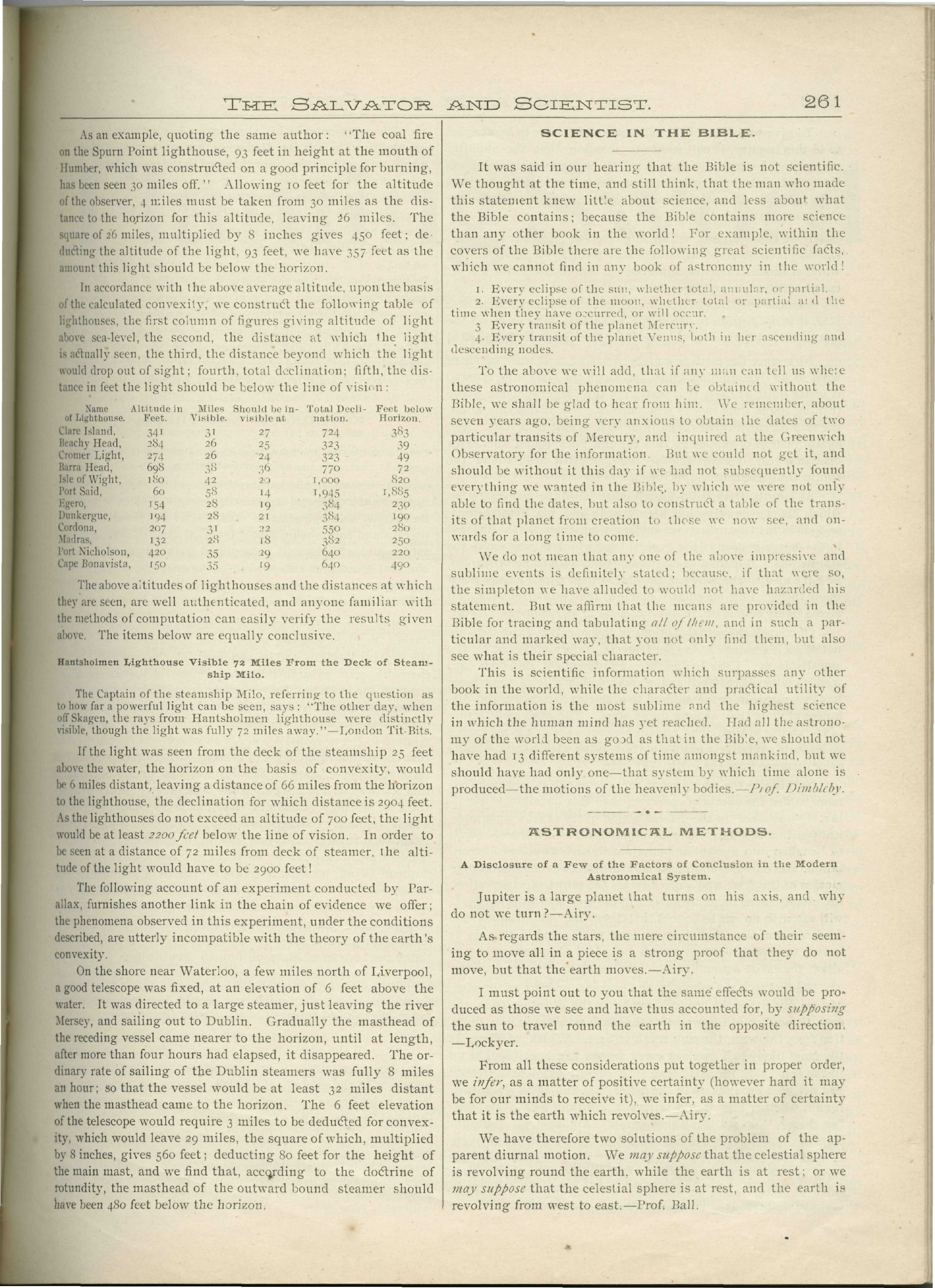
As regards the stars, the mere circumstance of their seeming to move all in a piece is a strong proof that they do not move, but that the earth moves. - Airy.
I must point out to you that the same effects would be produced as those we see and have thus accounted for, by supposing the sun to travel round the earth in the opposite direction. - Lockyer.
From all these considerations put together in proper order, we infer, as a matter of positive certainty (however hard it may be for our minds to receive it), we infer, as a matter of certainty that it is the earth which revolves. - Airy.
We have therefore two solutions of the problem of the apparent diurnal motion. We may suppose that the celestial sphere is revolving round the earth, while the earth is at rest; or we may suppose that the celestial sphere is at rest, and the earth is revolving from west to east. - Prof. Ball.
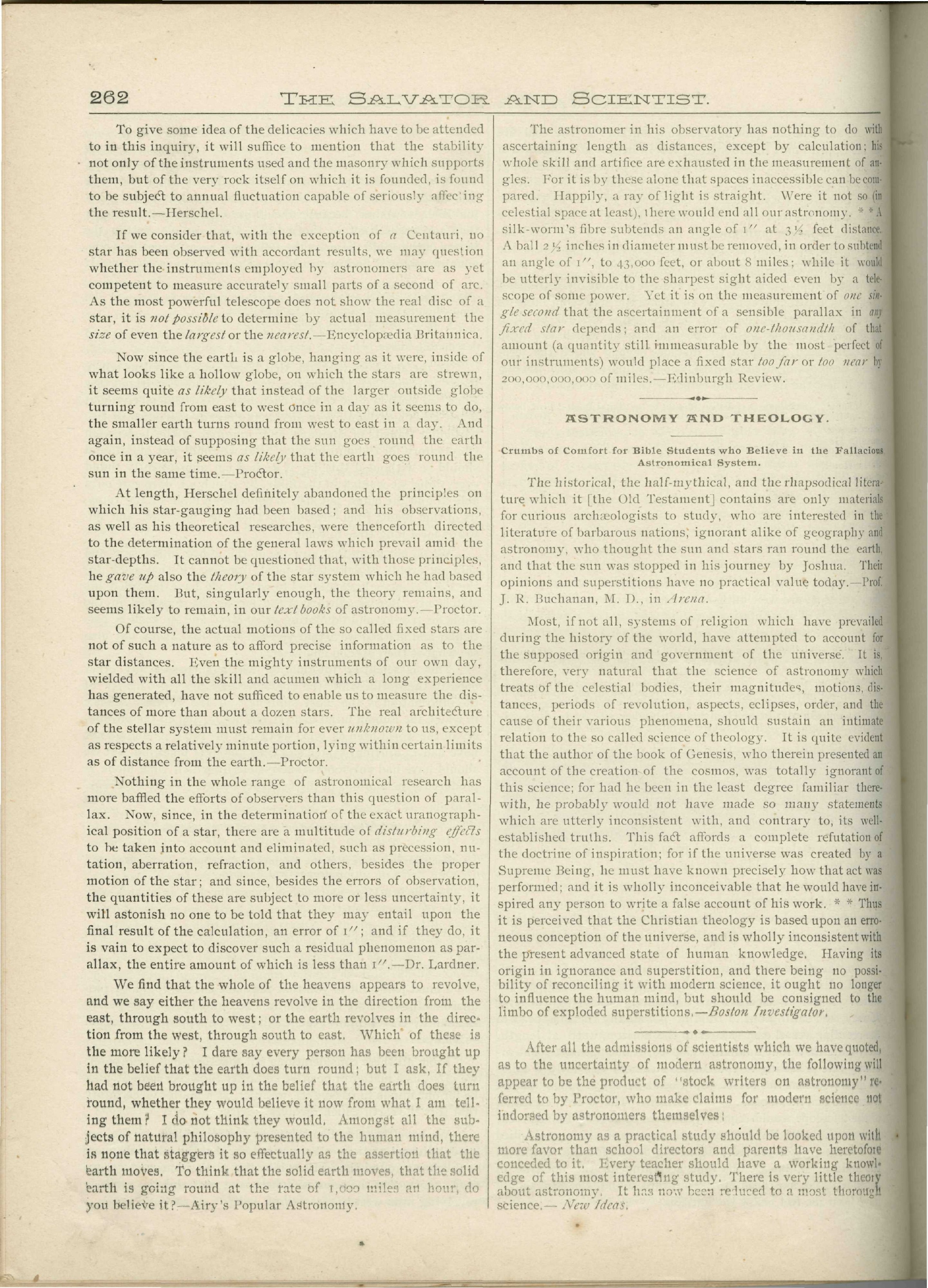
To give some idea of the delicacies which have to be attended to in this inquiry, it will suffice to mention that the stability not only of the instruments used and the masonry which supports them, but of the very rock itself on which it is founded, is found to be subject to annual fluctuation capable of seriously affecting the result. - Herschel.
If we consider that, with the exception of a Centauri, no star has been observed with accordant results, we may question whether the instruments employed by astronomers are as yet competent to measure accurately small parts of a second of arc. As the most powerful telescope does not show the real disc of a star, it is not possible to determine by actual measurement the size of even the largest or the nearest. - Encyclopaedia Britannica.
Now since the earth is a globe, hanging as it were, inside of what looks like a hollow globe, on which the stars are strewn, it seems quite as likely that instead of the larger outside globe turning round from east to west once in a day as it seems to do, the smaller earth turns round from west to east in a day. And again, instead of supposing that the sun goes round the earth once in a year, it seems as likely that the earth goes round the sun in the same time. - Proctor.
At length, Herschel definitely abandoned the principles on which his star-gauging had been based; and his observations, as well as his theoretical researches, were thenceforth directed to the determination of the general laws which prevail amid the star-depths. It cannot be questioned that, with those principles, he gave up also the theory of the star system which he had based upon them. But, singularly enough, the theory remains, and seems likely to remain, in our text books of astronomy. - Proctor.
Of course, the actual motions of the so-called fixed stars are not of such a nature as to afford precise information as to the star distances. Even the mighty instruments of our own day, wielded with all the skill and acumen which a long experience has generated, have not sufficed to enable us to measure the distances of more than about a dozen stars. The real architecture of the stellar system must remain for ever unknown to us, except as respects a relatively minute portion, lying within certain limits as of distance from the earth. - Proctor.
Nothing in the whole range of astronomical research has more baffled the efforts of observers than this question of parallax. Now, since, in the determination of the exact uranographical position of a star, there are a multitude of disturbing effects to be taken into account and eliminated, such as precession, nutation, aberration, refraction, and others, besides the proper motion of the star; and since, besides the errors of observation, the quantities of these are subject to more or less uncertainty, it will astonish no one to be told that they may entail upon the final result of the calculation an error of 1 second; and if they do, it is vain to expect to discover such a residual phenomenon as parallax, the entire amount of which is less than 1 second. - Dr. Lardner.
We find that the whole of the heavens appears to revolve, and we say either the heavens revolve in the direction from the east, through south to west; or the earth revolves in the direction from the west, through south to east. Which of these is the more likely? I dare say every person has been brought up in the belief that the earth does turn round; but I ask, if they had not been brought up in the belief that the earth does turn round, whether they would believe it now from what I am telling them? I do not think they would. Amongst all the subjects of natural philosophy presented to the human mind, there is none that staggers it so effectually as the assertion that the earth moves. To think that the solid earth moves, that the solid earth is going round at the rate of 1,000 miles an hour, do you believe it? - Airy's Popular Astronomy.
The astronomer in his observatory has nothing to do with ascertaining length as distances, except by calculation; his whole skill and artifice are exhausted in the measurement of angles. For it is by these alone that spaces inaccessible can be compared. Happily, a ray of light is straight. Were it not so (in celestial space at least), there would end all our astronomy. A silk-worm's fibre subtends an angle of 1 second at 3 1/2 feet distance. A ball 2 1/2 inches in diameter must be removed, in order to subtend an angle of 1 second, to 43,000 feet, or about 8 miles; while it would be utterly invisible to the sharpest sight aided even by a telescope of some power. Yet it is on the measurement of one single second that the ascertainment of a sensible parallax in any fixed star depends; and an error of one-thousandth of that amount (a quantity still immeasurable by the most perfect of our instruments) would place a fixed star too far or too near by 200,000,000,000 of miles. - Edinburgh Review.
- --
The source scans remain the record. This page preserves the periodical's argument and reported observations without presenting its conclusions as independently established results. The claims remain attributed to The Flaming Sword.
← Flaming Sword Archive
The Flaming Sword · Vol. 10, No. 11 · · PDF pp. 21-22