Extracted text
Editorial transcription, lightly normalized from the scan. Line-break hyphenation, spacing, capitalization, and unmistakable OCR errors have been repaired; the claims remain those of The Flaming Sword.
The Open Court of Inquiry.
THE EDITOR.
Astronomy and Astrology.
Editor Flaming Sword:— I have taken up the study of astrology; but as the computations by the heliocentric and geocentric methods are not at all satisfactory to me, I want to know if the Cellular Cosmogony or Koreshan Astronomy gives a more rational plan of calculation. Can you furnish me any literature that might give me new light on the subject?— T. B., Worth, Ky.
Scientific astrology must have for its basis a correct system of astronomy, which determines not only the forms and relations of the earth and the heavens, but also the functions performed by all the different parts of the physical cosmos. Without a knowledge of the relations and functions of the universe there can be no absolutely correct computations of solar, lunar, and planetary periods, and no true astrological forecasts nor delineations of human character. The Astrology of Koreshanity, founded upon the Cellular Cosmogony, is termed Astro-anthroposophy, or the science of the relation which the stars sustain to the world of humanity. The Koreshan Astrology covers a vastly broader field than modern astrological systems, because Koreshanity possesses the keys, the fundamental principles of the application of all sciences to the practical affairs of man.
The geocentric astrology accepts the Ptolemaic system of astronomy as its basis, making the earth the center of the universe. The heliocentric astrology has for its basis the accepted Copernican astronomy, in which the visible sun is supposed to be the center of the solar system. There is, in fact, no place for astrology in modern astronomy, for the reason that there is no actual Zodiacal circle, nor any actual constellations or grouping of stars in the system. The conflict of the two systems of astrology now employed, proves the necessity of a knowledge of the true astronomical and cosmological relations. Every one familiar with astronomy knows that the so called heliocentric and geocentric latitudes and longitudes of the planets differ quite materially. The difference of relation between the signs and the sun, in the two systems, is very marked. In the geocentric system Aries is the sign of the vernal equinox, and Libra the autumnal; in the heliocentric system, Libra is the sign of the vernal equinox, and Aries the autumnal, because the earth is supposed to be in Libra at the time of the vernal equinox, and in Aries when the sun crosses the equator in September.
It has been suggested by a number of astrologers, that there may be a basis of harmony between the geocentric and heliocentric principles; each system is admitted to have its own peculiar advantages, and there is much discussion as to the merits of each. The Cellular Cosmogony supplies this basis of harmony, because it demonstrates that the earth is stationary; that the physical heavens, with all the orbs it contains, have a diurnal motion; and that the visible heavenly bodies revolve about the central sun. Thus the constellations of the Zodiac have their heliocentric relations, and the planets their heliocentric positions. We maintain that the apparent positions of the planets on the arcs of the physical heavens are their true positions; this agrees with what is termed the geocentric view. Our basis is geo-circumferential—that is, the shell of the earth surrounds the heavens; the earth is a hollow globe instead of a convex body.
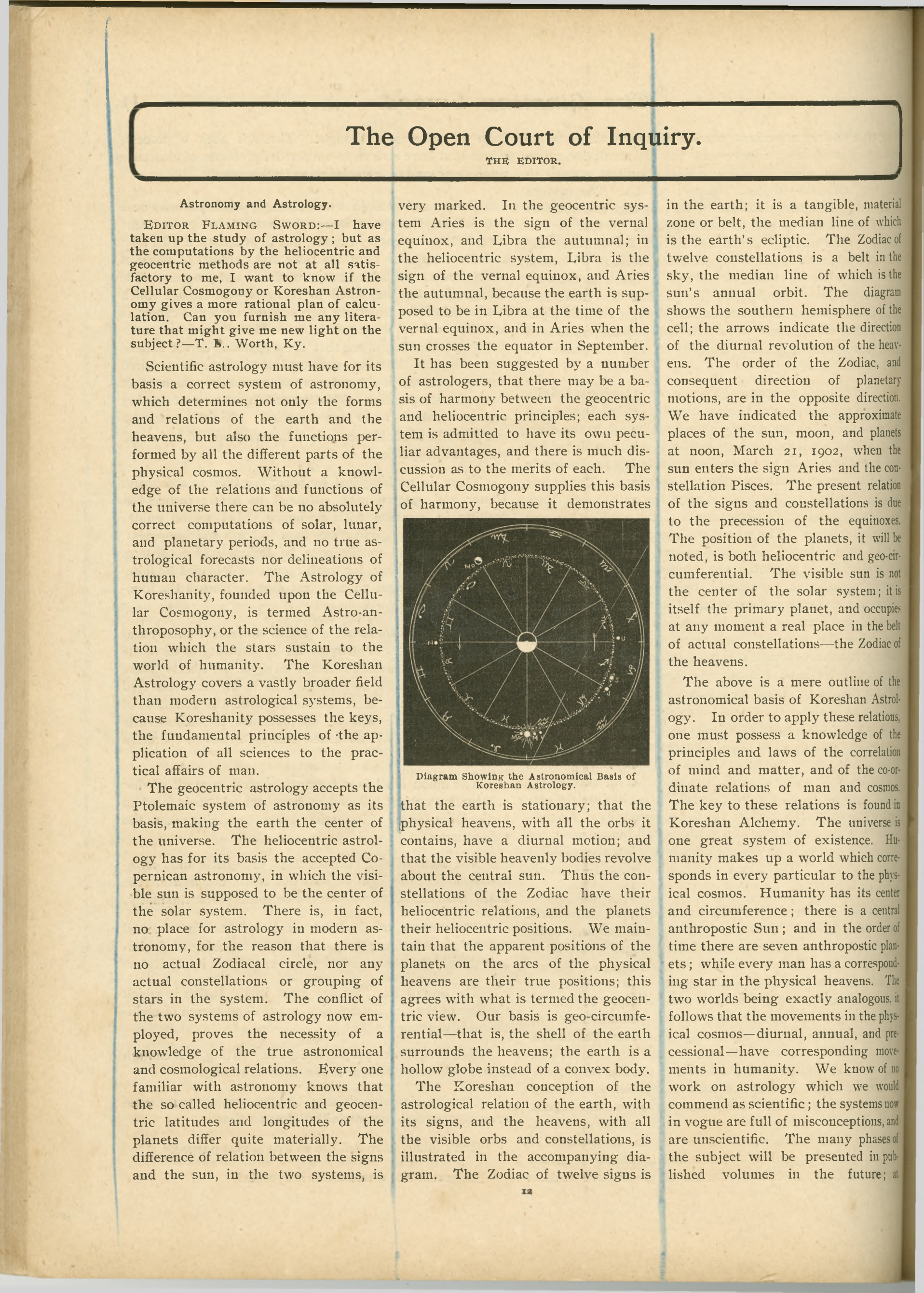
The Koreshan conception of the astrological relation of the earth, with its signs, and the heavens, with all the visible orbs and constellations, is illustrated in the accompanying diagram. The Zodiac of twelve signs is in the earth; it is a tangible, material zone or belt, the median line of which is the earth's ecliptic. The Zodiac of twelve constellations is a belt in the sky, the median line of which is the sun's annual orbit. The diagram shows the southern hemisphere of the cell; the arrows indicate the direction of the diurnal revolution of the heavens. The order of the Zodiac, and consequent direction of planetary motions, are in the opposite direction. We have indicated the approximate places of the sun, moon, and planets at noon, March 21, 1902, when the sun enters the sign Aries and the constellation Pisces. The present relation of the signs and constellations is due to the precession of the equinoxes. The position of the planets, it will be noted, is both heliocentric and geo-circumferential. The visible sun is not the center of the solar system; it is itself the primary planet, and occupies at any moment a real place in the belt of actual constellations—the Zodiac of the heavens.
The above is a mere outline of the astronomical basis of Koreshan Astrology. In order to apply these relations, one must possess a knowledge of the principles and laws of the correlation of mind and matter, and of the co-ordinate relations of man and cosmos. The key to these relations is found in Koreshan Alchemy. The universe is one great system of existence. Humanity makes up a world which corresponds in every particular to the physical cosmos. Humanity has its center and circumference; there is a central anthropostic Sun; and in the order of time there are seven anthropostic planets; while every man has a corresponding star in the physical heavens. The two worlds being exactly analogous, it follows that the movements in the physical cosmos—diurnal, annual, and precessional—have corresponding movements in humanity. We know of no work on astrology which we would commend as scientific; the systems now in vogue are full of misconceptions, and are unscientific. The many phases of the subject will be presented in published volumes in the future; at present, however, much can be learned concerning the fundamental principles of Koreshan Astro-anthroposophy through a diligent study of Koreshan Literature, including files of The Flaming Sword since the year 1890.
- --
The source scans remain the record. This page preserves the periodical's text as an editorial transcription; its claims remain those of The Flaming Sword.
The Flaming Sword · Vol. 16, No. 18 · Mar 21, 1902 · PDF pp. 12-13