Extracted text
Printed form: a signed external criticism followed by the periodical’s editorial rebuttal. The two voices are kept in sequence.
Editorial transcription, lightly normalized from the cited scan pages. Historical claims remain those of The Flaming Sword.
THE FLORIDA GEODETIC SURVEY,
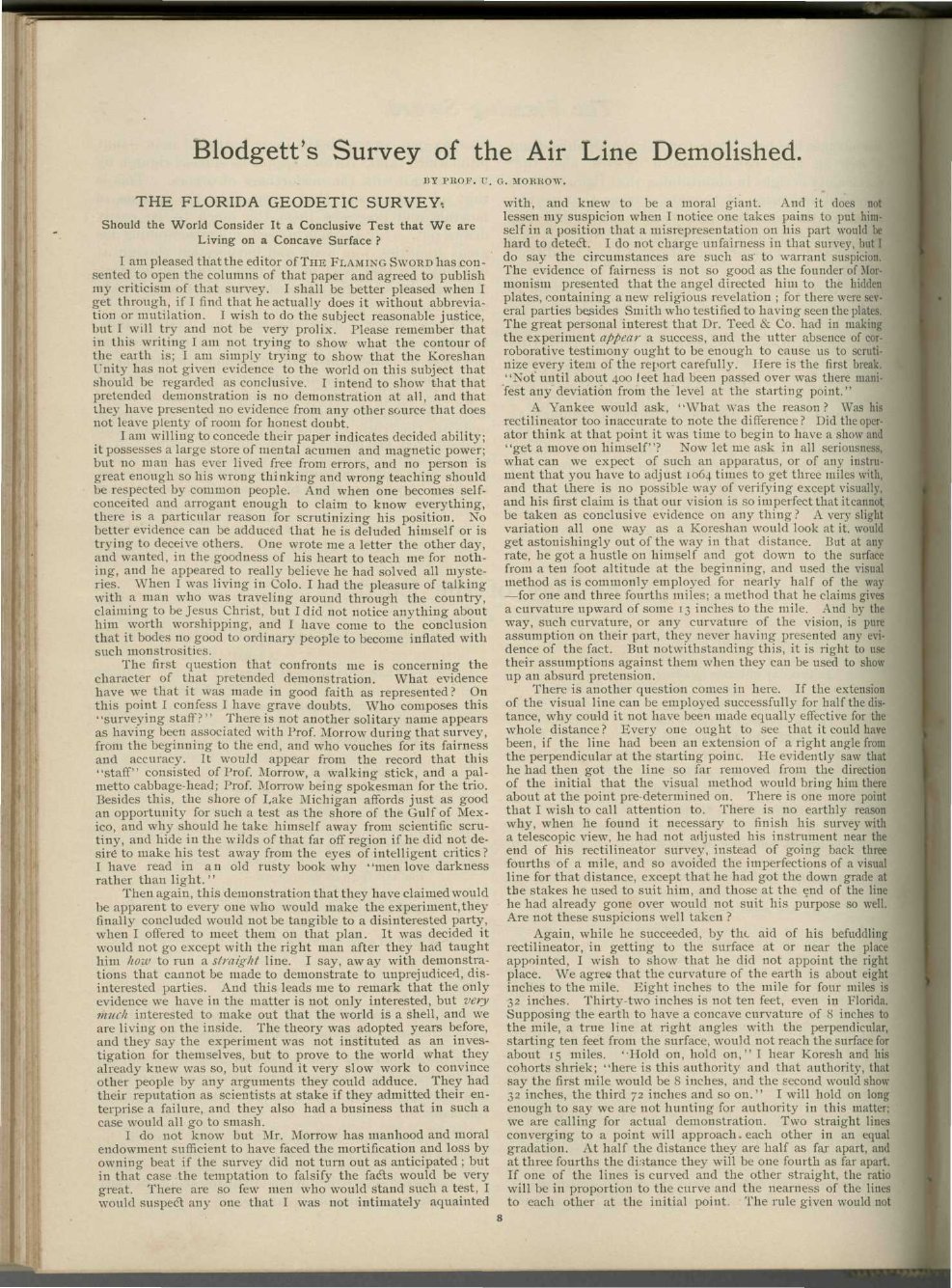
Should the World Consider It a Conclusive Test that We are Living on a Concave Surface?
I am pleased that the editor of THE FLAMING SWORD has consented to open the columns of that paper and agreed to publish my criticism of that survey. I shall be better pleased when I get through, if I find that he actually does it without abbreviation or mutilation. I wish to do the subject reasonable justice, but I will try and not be very prolix. Please remember that in this writing I am not trying to show what the contour of the earth is; I am simply trying to show that the Koreshan Unity has not given evidence to the world on this subject that should be regarded as conclusive. I intend to show that that pretended demonstration is no demonstration at all, and that they have presented no evidence from any other source that does not leave plenty of room for honest doubt. I am willing to concede their paper indicates decided ability; it possesses a large store of mental acumen and magnetic power; but no man has ever lived free from errors, and no person is great enough so his wrong thinking and wrong teaching should be respected by common people. And when one becomes self-conceited and arrogant enough to claim to know everything, there is a particular reason for scrutinizing his position. No better evidence can be adduced that he is deluded himself or is trying to deceive others. One wrote me a letter the other day, and wanted, in the goodness of his heart to teach me for nothing, and he appeared to really believe he had solved all mysteries. When I was living in Colo. I had the pleasure of talking with a man who was traveling around through the country, claiming to be Jesus Christ, but I did not notice anything about him worth worshipping, and I have come to the conclusion that it bodes no good to ordinary people to become inflated with such monstrosities.
The first question that confronts me is concerning the character of that pretended demonstration. What evidence have we that it was made in good faith as represented? On this point I confess I have grave doubts. Who composes this ''surveying staff?'' There is not another solitary name appears as having been associated with Prof. Morrow during that survey, from the beginning to the end, and who vouches for its fairness and accuracy. It would appear from the record that this "staff" consisted of Prof. Morrow, a walking stick, and a palmetto cabbage-head; Prof. Morrow being spokesman for the trio. Besides this, the shore of Lake Michigan affords just as good an opportunity for such a test as the shore of the Gulf of Mexico, and why should he take himself away from scientific scrutiny, and hide in the wilds of that far off region if he did not desire to make his test away from the eyes of intelligent critics? I have read in an old rusty book why "men love darkness rather than light. "
Then again, this demonstration that they have claimed would be apparent to every one who would make the experiment, they finally concluded would not be tangible to a disinterested party, when I offered to meet them on that plan. It was decided it would not go except with the right man after they had taught him how to run a straight line. I say, away with demonstrations that cannot be made to demonstrate to unprejudiced, disinterested parties. And this leads me to remark that the only evidence we have in the matter is not only interested, but very much interested to make out that the world is a shell, and we are living on the inside. The theory was adopted years before, and they say the experiment was not instituted as an investigation for themselves, but to prove to the world what they already knew was so, but found it very slow work to convince other people by any arguments they could adduce. They had their reputation as scientists at stake if they admitted their enterprise a failure, and they also had a business that in such a case would all go to smash.
I do not know but Mr. Morrow has manhood and moral endowment sufficient to have faced the mortification and loss by owning it if the survey did not turn out as anticipated; but in that case the temptation to falsify the facts would be very great. There are so few men who would stand such a test, I would suspect any one that I was not intimately acquainted with, and knew to be a moral giant. And it does not lessen my suspicion when I notice one takes pains to put himself in a position that a misrepresentation on his part would be hard to detect. I do not charge unfairness in that survey, but I do say the circumstances are such as to warrant suspicion.
The evidence of fairness is not so good as the founder of Mormonism presented that the angel directed him to the hidden plates, containing a new religious revelation; for there were several parties besides Smith who testified to having seen the plates. The great personal interest that Dr. Teed & Co. had in making the experiment appear a success, and the utter absence of corroborative testimony ought to be enough to cause us to scrutinize every item of the report carefully. Here is the first break. "Not until about 400 feet had been passed over was there manifest any deviation from the level at the starting point."
A Yankee would ask, "What was the reason? Was his rectilineator too inaccurate to note the difference? Did the operator think at that point it was time to begin to have a show and "get a move on himself"? Now let me ask in all seriousness, what can we expect of such an apparatus, or of any instrument that you have to adjust 1064 times to get three miles with, and that there is no possible way of verifying except visually, and his first claim is that our vision is so imperfect that it cannot be taken as conclusive evidence on anything? A very slight variation all one way as a Koreshan would look at it, would get astonishingly out of the way in that distance. But at any rate, he got a hustle on himself and got down to the surface from a ten foot altitude at the beginning, and used the visual method as is commonly employed for nearly half of the way —for one and three fourths miles; a method that he claims gives a curvature upward of some 13 inches to the mile. And by the way, such curvature, or any curvature of the vision, is pure assumption on their part, they never having presented any evidence of the fact. But notwithstanding this, it is right to use their assumptions against them when they can be used to show up an absurd pretension.
There is another question comes in here. If the extension of the visual line can be employed successfully for half the distance, why could it not have been made equally effective for the whole distance? Every one ought to see that it could have been, if the line had been an extension of a right angle from the perpendicular at the starting point. He evidently saw that he had then got the line so far removed from the direction of the initial that the visual method would bring him there about at the point predetermined on. There is one more point that I wish to call attention to. There is no earthly reason why, when he found it necessary to finish his survey with a telescopic view, he had not adjusted his instrument near the end of his rectilineator survey, instead of going back three fourths of a mile, and so avoided the imperfections of a visual line for that distance, except that he had got the down grade at the stakes he used to suit him, and those at the end of the line he had already gone over would not suit his purpose so well. Are not these suspicions well taken?
Again, while he succeeded, by the aid of his befuddling rectilineator, in getting to the surface at or near the place appointed, I wish to show that he did not appoint the right place. We agree that the curvature of the earth is about eight inches to the mile. Eight inches to the mile for four miles is 32 inches. Thirty-two inches is not ten feet, even in Florida.
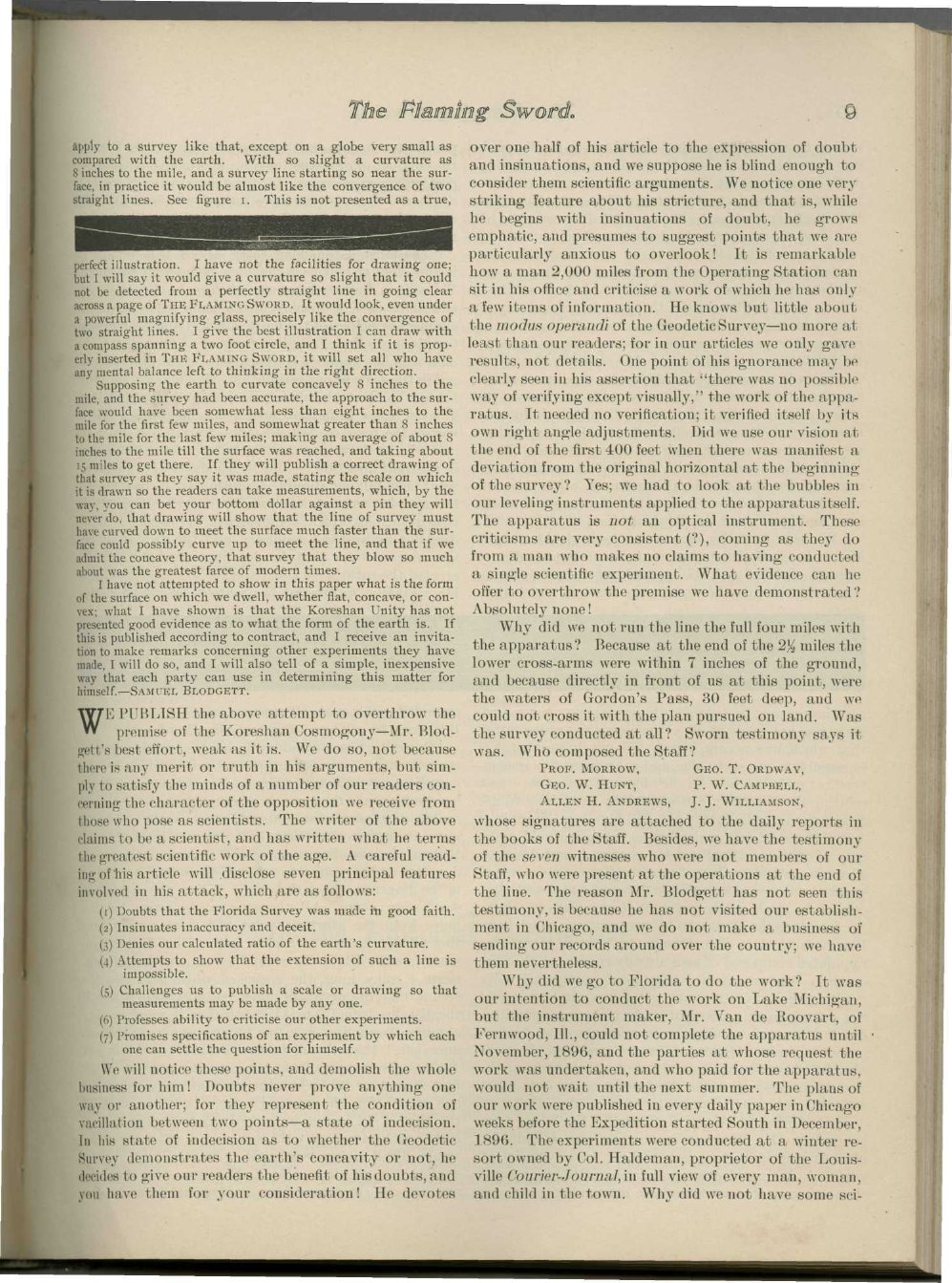
Supposing the earth to have a concave curvature of 8 inches to the mile, a true line at right angles with the perpendicular, starting ten feet from the surface, would not reach the surface for about 15 miles. "Hold on, hold on," I hear Koresh and his cohorts shriek; "here is this authority' and that authority, that say the first mile would be 8 inches, and the second would show 32 inches, the third 72 inches and so on." I will hold on long enough to say we are not hunting for authority in this matter; we are calling for actual demonstration. Two straight lines converging to a point will approach. each other in an equal gradation. At half the distance they are half as far apart, and at three fourths the distance they will be one fourth as far apart. If one of the lines is curved and the other straight, the ratio will be in proportion to the curve and the nearness of the lines to each other at the initial point. The rule given would not apply to a survey like that, except on a globe very small as compared with the earth. With so slight a curvature as 8 inches to the mile, and a survey line starting so near the surface, in practice it would be almost like the convergence of two straight lines. See figure i. This is not presented as a true, perfect illustration. I have not the facilities for drawing one; but I will say it would give a curvature so slight that it could not be detected from a perfectly straight line in going clear across a page of THE FLAMING SWORD. It would look, even under a powerful magnifying glass, precisely like the convergence of two straight lines. I give the best illustration I can draw with a compass spanning a two foot circle, and I think if it is properly inserted in THE FLAMING SWORD, it will set all who have any mental balance left to thinking in the right direction. Supposing the earth to curvate concavely 8 inches to the mile, and the survey had been accurate, the approach to the surface would have been somewhat less than eight inches to the mile for the first few miles, and somewhat greater than 8 inches to the mile for the last few miles; making an average of about 8 inches to the mile till the surface was reached, and taking about 15 miles to get there. If they will publish a correct drawing of that survey as they say it was made, stating the scale on which it is drawn so the readers can take measurements, which, by the way, you can bet your bottom dollar against a pin they will never do, that drawing will show that the line of survey must have curved down to meet the surface much faster than the surface could possibly curve up to meet the line, and that if we admit the concave theory, that survey that they blow so much about was the greatest farce of modern times.
I have not attempted to show in this paper what is the form of the surface on which we dwell, whether flat, concave, or convex; what I have shown is that the Koreshan Unity has not presented good evidence as to what the form of the earth is. If this is published according to contract, and I receive an invitation to make remarks concerning other experiments they have made, I will do so, and I will also tell of a simple, inexpensive way that each party can use in determining this matter for himself.—SAMUEL BLODGETT.
WE PUBLISH the above attempt to overthrow the premise of the Koreshan Cosmogony—Mr. Blodgett's best effort, weak as it is. We do so, not because there is any merit or truth in his arguments, but simply to satisfy the minds of a number of our readers concerning the character of the opposition we receive from those who pose as scientists.
The writer of the above claims to be a scientist, and has written what he terms the greatest scientific work of the age. A careful reading of his article will disclose seven principal features involved in his attack, which are as follows:
(1) Doubts that the Florida Survey was made in good faith. (2) Insinuates inaccuracy and deceit. (3) Denies our calculated ratio of the earth's curvature. (4) Attempts to show that the extension of such a line is impossible. (5) Challenges us to publish a scale or drawing so that measurements may be made by any one. (6) Professes ability to criticise our other experiments. (7) Promises specifications of an experiment by which each one can settle the question for himself. We will notice these points, and demolish the whole business for him! Doubts never prove anything one way or another; for they represent the condition of vacillation between two points—a state of indecision.
In his state of indecision as to whether the Geodetic Survey demonstrates the earth's concavity or not, he decides to give our readers the benefit of his doubts, and you have them for your consideration! He devotes over one half of his article to the expression of doubt and insinuations, and we suppose he is blind enough to consider them scientific arguments. We notice one very striking feature about his stricture, and that is, while he begins with insinuations of doubt, he grows emphatic, and presumes to suggest points that we are particularly anxious to overlook! It is remarkable how a man 2,000 miles from the Operating Station can sit in his office and criticise a work of which he has only a few items of information. He knows but little about the modus operandi of the Geodetic Survey—no more at least than our readers; for in our articles we only gave results, not details. One point of his ignorance may be clearly seen in his assertion that "there was no possible way of verifying except visually," the work of the apparatus. It needed no verification; it verified itself by its own right angle adjustments. Did we use our vision at the end of the first 400 feet when there was manifest a deviation from the original horizontal at the beginning of the survey? Yes; we had to look at the bubbles in our leveling instruments applied to the apparatus itself. The apparatus is not an optical instrument. These criticisms are very consistent (?), coming as they do from a man who makes no claims to having conducted a single scientific experiment. What evidence can he offer to overthrow the premise we have demonstrated'.' Absolutely none! Why did we not run the line the full four miles with the apparatus? Because at the end of the 2½ miles the lower cross-arms were within 7 inches of the ground, and because directly in front of us at this point, were the waters of Gordon's Pass, 30 feet deep, and we could not cross it with the plan pursued on land. Was the survey conducted at all? Sworn testimony says it was. Who composed the Staff? PROF. MORROW, GEO. T. ORDWAY, GEO. W. HUNT, P. W. CAMPBELL, ALLEN H. ANDREWS, J. J. WILLIAMSON, whose signatures are attached to the daily reports in the books of the Staff. Besides, we have the testimony of the seven witnesses who were not members of our Staff, who were present at the operations at the end of the line. The reason Mr. Blodgett has not seen this testimony, is because he has not visited our establishment in Chicago, and we do not make a business of sending our records around over the country; we have them nevertheless.
Why did we go to Florida to do the work? It was our intention to conduct the work on Lake Michigan, but the instrument maker, Mr. Van de Roovart, of Fernwood, 111., could not complete the apparatus until • November, 1896, and the parties at whose request the work was undertaken, and who paid for the apparatus, would not wait until the next summer. The plans of our work were published in every daily paper in Chicago weeks before the expedition started South in December, 1896. The experiments were conducted at a winter resort owned by Col. Haldeman, proprietor of the Louisville Courier-Journal,in full view of every man, woman, and child in the town. Why did we not have some scientists there? Because they would not go. We made our appeal to the Chicago University, to the U. S. Geodetic Department at Washington, and many others—men of more means and greater ability and calibre than Mr. Blodgett, just as Galileo appealed to men in his day, and Harvey when he desired to demonstrate the circulation of the blood to those who denied it; but men of influence in the world refused to become parties to the experiments. Up to this date, we have not been able to get a single scientist to agree to accompany us to test the surface of standing water. So you see, we are forced to perform our own experiments, and give to the world our own testimony. The strength of our testimony will become appreciable upon repetition of the experiments whenever a scientist will champion the other side upon the open field of contest, if by any means—by challenges or offers of reward, we can induce any man to commit himself to an agreement. These are the circumstances which have led to suspicion—to our suspicion that the so called scientific world does not want to know the facts involved in the question of the form and function of the physical universe.
We point out a few inconsistencies in the above criticisms: It is admitted that we have an extraordinary amount of force and ability, and yet we are fools; he docs not "charge unfairness in the survey," but insinuates inaccuracy and deceit; thinks perhaps the experiment was not made at all, yet proceeds to argue against that which was accomplished. He concludes that it is impossible to run such a line, and yet our readers remember that a short while ago he "blowed" so much about refuting the Koreshan System, finally proposing to use our methods! His article is full of blunders. He thinks 1,064 times 12 feet make 3 miles, when it would make only a little over 2½ miles. He says we do not desire to leave the testimony of our demonstrations to disinterested parties, and cries "Away with such demonstrations!" that cannot be made in the presence of any class of minds. Once more he alludes to his propositions which have been published in THE SWORD, to have a committee appointed composed of men already convinced that the earth is convex. Notice this point particularly: We made no such objection; our point was, that we would not enter into an agreement to have such a committee • decide for us concerning the experiments which he proposed to make. Quite a difference, you see! He was afraid to leave it to a committee of scientists from the two sides. Do not wonder that we have our eyes open, and do not trust implicitly very many that we do not "know to be moral giants." Look at your proposition, Mr. Blodgett, from your own standpoint of argument against us now, and see how inconsistent you are! We could assume the same attitude toward the testimony of your committee concerning your proposed experiments that you assume toward our Staff in the conduct of our experiments. If we have reasons for performing experiments to demonstrate the Koreshan System, we have all.the more incentive to be truthful in our testimony that the System might be maintained in the future.
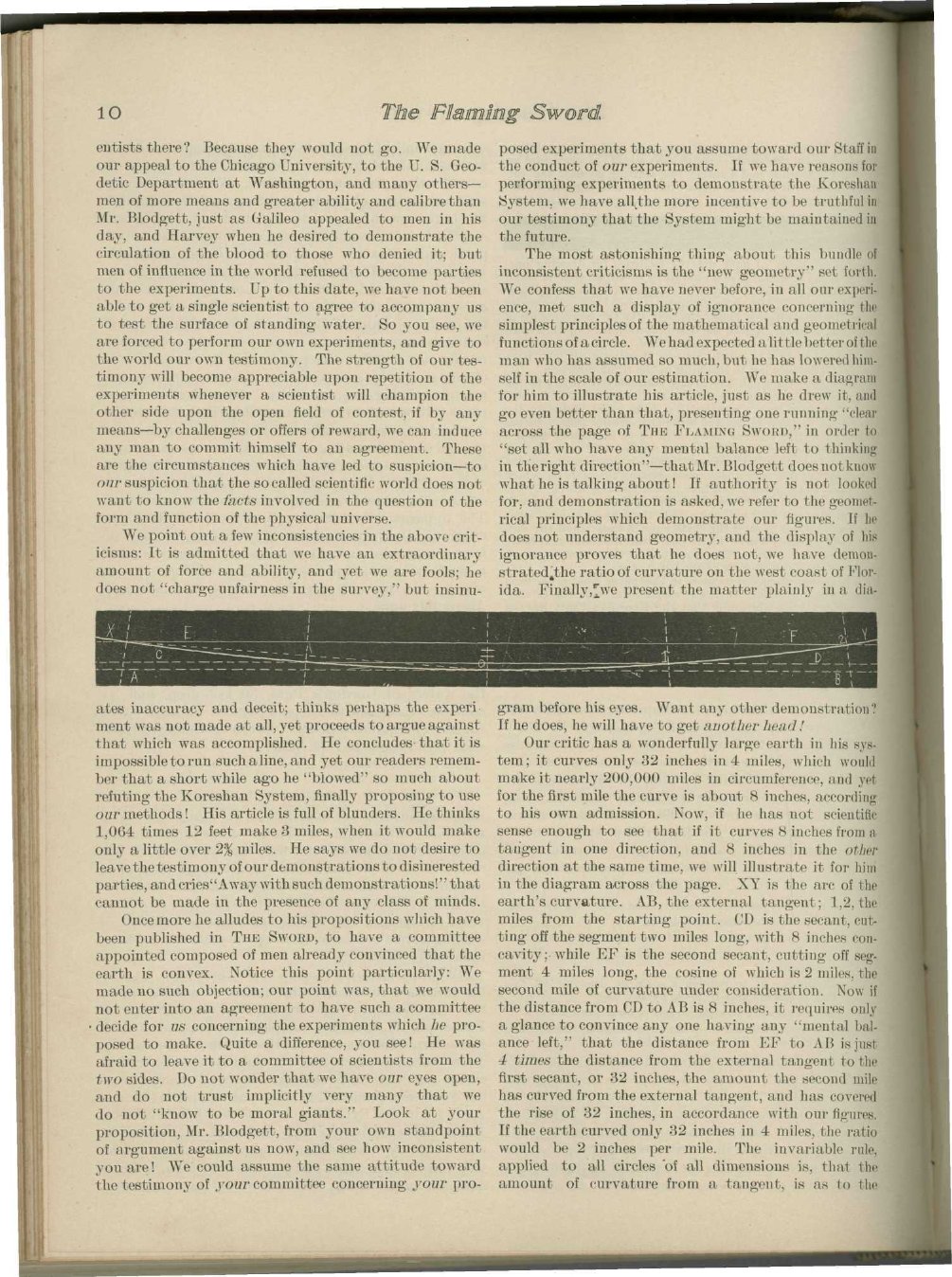
The most astonishing thing about this bundle of inconsistent criticisms is the "new geometry'' set forth. We confess that we have never before, in all our experience, met such a display of ignorance concerning the simplest principles of the mathematical and geometrical functions of a circle. We had expected a little better of the man who has assumed so much, but he has lowered himself in the scale of our estimation. We make a diagram for him to illustrate his article, just as he drew it, and go even better than that, presenting one running "clear across the page of THE FLAMING SWORD,"' in order to "set all who have any mental balance left to thinking in the right direction"—that Mr. Blodgett does not know what he is talking about! If authority is not looked for, and demonstration is asked, we refer to the geometrical principles which demonstrate our figures. If he does not understand geometry, and the display of his ignorance proves that he does not, we have demonstrated the ratio of curvature on the west coast of Florida. Finally,'[we present the matter plainly in a diagram before his eyes. Want any other demonstration? If he does, he will have to get another head!
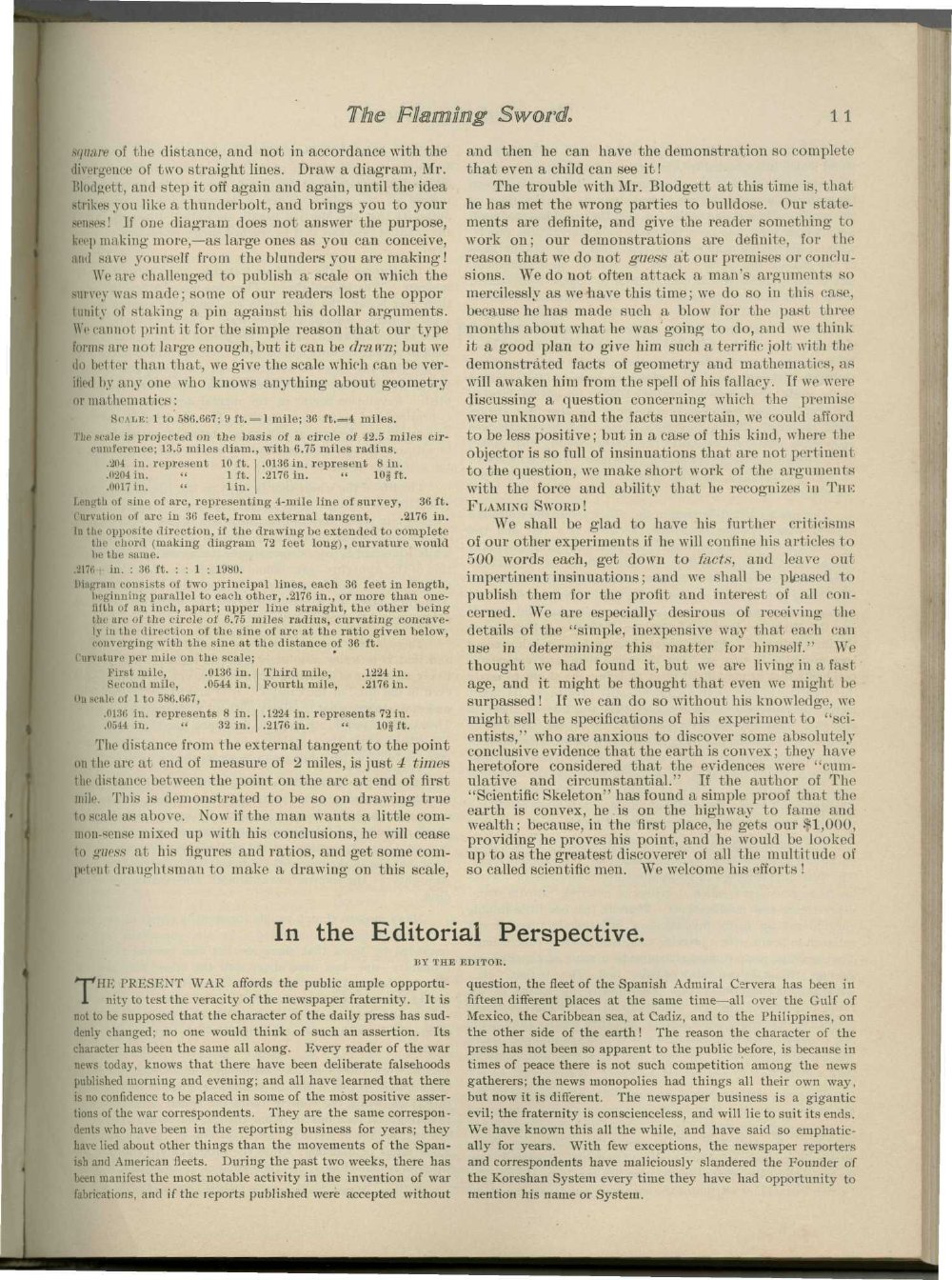
Our critic has a wonderfully large earth in his system; it curves only 32 inches in 4 miles, which would make it nearly 200,000 miles in circumference, and yet for the first mile the curve is about 8 inches, according to his own admission. Now, if he has not scientific sense enough to see that if it curves 8 inches from a tangent in one direction, and 8 inches in the other direction at the same time, we will illustrate it for him in the diagram across the page. XY is the arc of the earth's curvature. AB, the external tangent; 1,2, the miles from the starting point. CD is the secant, cutting off the segment two miles long, with 8 inches concavity; while EF is the second secant, cutting off segment 4 miles long, the cosine of which is 2 miles, the second mile of curvature under consideration. Now if the distance from CD to AB is 8 inches, it requires only a glance to convince any one having any "mental balance left," that the distance from EF to A15 is just 4 times the distance from the external tangent to the first secant, or 32 inches, the amount the second mile has curved from the external tangent, and has covered the rise of 32 inches, in accordance with our figures. If the earth curved only 32 inches in 4 miles, the ratio would be 2 inches per mile. The invariable rule, applied to all circles "of all dimensions is, that the amount of curvature from a tangent, is as to the square of the distance, and not in accordance with the divergence of two straight lines. Draw a diagram, Mr. Blodgett, and step it off again and again, until the idea strikes you like a thunderbolt, and brings you to your senses! If one diagram does not answer the purpose, keep making more,—as large ones as you can conceive, and save yourself from the blunders you are making! We are challenged to publish a scale on which the survey was made; some of our readers lost the opportunity of staking a pin against his dollar arguments. We cannot print it for the simple reason that our type forms are not large enough, but it can be drawn; but we do better than that, we give the scale which can be verified by any one who knows anything about geometry or mathematics:
SCALE: 1 to 586.667; 9 ft. = 1 mile; 36 ft.—4 miles. The scale is projected on the basis of a circle of 42.5 miles circumference; 13.5 miles diam., with 6.75 miles radius. .204 in. represent 10 ft. I .0136 in. represent Sin. .0204 in. " 1 ft. .2176 in. " 10½ ft. .0017 in. represents 1 in. I Length of sine of arc, representing 4-mile line of survey, 36 ft. Curvature of arc in 36 feet, from external tangent, .2176 in. In the opposite direction, if the drawing be extended to complete the chord (making diagram 72 feet long), curvature would be the same. ,2176 in. : 36 ft. : : 1 : 1980. Diagram consists of two principal lines, each 36 feet in length, beginning parallel to each other, .2176 in., or more than one-fifth of an inch, apart; upper line straight, the other being the line of the circle of 6.75 miles radius, curvating concavely in the direction of the sine of arc at the ratio given below, converging with the sine at the distance of 36 ft. Curvature per mile on the scale; First mile, .0136 in. I Third mile, .1224 in. Second mile, .0544 in. | Fourth mile, .2176 in. On scale of 1 to 586.667, .0136 in. represents 8 in. I .1224 in. represents 72 in. .0544 in. " 32 in. I .2176 in. " 10½ ft. The distance from the external tangent to the point on the arc at end of measure of 2 miles, is just 4 times the distance between the point on the arc at end of first mile. This is demonstrated to be so on drawing true to scale as above. Now if the man wants a little common-sense mixed up with his conclusions, he will cease to guess at his figures and ratios, and get some competent draughtsman to make a drawing on this scale, and then he can have the demonstration so complete that even a child can see it!
The trouble with Mr. Blodgett at this time is, that he has met the wrong parties to bulldoze. Our statements are definite, and give the reader something to work on; our demonstrations are definite, for the reason that we do not guess at our premises or conclusions. We do not often attack a man's arguments so mercilessly as we have this time; we do so in this case, because he has made such a blow for the past three months about what he was going to do, and we think a good plan to give him such a terrific jolt with the demonstrated facts of geometry and mathematics, as will awaken him from the spell of his fallacy. If we were discussing a question concerning which the premise were unknown and the facts uncertain, we could afford be less positive; but in a case of this kind, where the objector is so full of insinuations that are not pertinent to the question, we make short work of the arguments with the force and ability that he recognizes in THE FLAMING SWORD!
We shall be glad to have his further criticisms of our other experiments if he will confine his articles to 500 words each, get down to facts, and leave out impertinent insinuations; and we shall be pleased to publish them for the profit and interest of all concerned. We are especially desirous of receiving the details of the "simple, inexpensive way that each can use in determining this matter for himself." We thought we had found it, but we are living in a fast age, and it might be thought that even we might be surpassed! If we can do so without his knowledge, we might sell the specifications of his experiment to "scientists," who are anxious to discover some absolutely conclusive evidence that the earth is convex; they have heretofore considered that the evidences were "cumulative and circumstantial." If the author of The "Scientific Skeleton" has found a simple proof that the earth is convex, he is on the highway to fame and wealth; because, in the first place, he gets our $1,000, providing he proves his point, and he would be looked to as the greatest discoverer of all the multitude of called scientific men. We welcome his efforts!
Source boundary: Begins under “Blodgett’s Survey of the Air Line Demolished” and “THE FLORIDA GEODETIC SURVEY”; preserves Samuel Blodgett’s criticism followed by the Flaming Sword reply; ends before “In the Editorial Perspective.” on PDF p. 11.
Vol. 12, No. 29 · PDF pages 8, 9, 10, 11
- --
The source scans remain the record. This page preserves the periodical's argument and reported observations without presenting its conclusions as independently established results. The claims remain attributed to The Flaming Sword.
← Flaming Sword Archive
The Flaming Sword · Vol. 12, No. 29 · · PDF pp. 8–11