Extracted text
Editorial transcription, lightly normalized from the scan. Line-break hyphenation, spacing, capitalization, and unmistakable OCR errors have been repaired; the claims remain those of The Flaming Sword.
Editor Flaming Sword: — I am very much interested in the Cellular Cosmogony. I have difficulty on one point, and you can probably help me out in a few words. I understand that astronomers calculate the distances of the planets from the earth by triangulation. Suppose, by the Koreshan System, a planet or center of energy A [as in sketch not here reproduced] 1,000 miles from the surface and on a meridian with B at a certain instant; and at another station 1,000 miles from B, C takes an observation at the same instant; then B and C get the angle which is supposed to give the distance to A. I understand that the supposed diameter of the earth's orbit as a base line, gives a very small angle with some of the stars. You see my difficulty; kindly indicate the way out.—V. B., Minneapolis, Minn.
Editor Flaming Sword: — Two astronomers at A and B respectively, observe a certain fixed star at the same instant, by previous arrangement. By comparison, they compute the distance of the star from the earth to be billions of miles. Now, how can this be reconciled with the theory that we are on the inside of the earth, 8,000 miles in diameter—especially when the accuracy of astronomical calculations is substantiated by the precision with which eclipses are predicted? The accuracy of astronomical calculations is still further demonstrated by navigators.—C. L., Columbus, O.
The first of the above questions is asked by a student of Koreshan Astronomy, who desires to have the apparent difficulty removed; the other is propounded by one who is credulous enough to believe that the old astronomy is thoroughly demonstrated. But both questions show to what extent the public mind misapprehends the processes by which these supposed distances are determined. The first thing to be considered in astronomy is the shape of the earth; without a knowledge of the earth's form there can be no means of comparing the results of the various observations of the orbs above us; but upon a theory of the earth's shape a system of astronomy may be constructed, and any system may be tolerably consistent with itself from the basis of its first premise. Astronomers assume that the earth is a convex body, with divergent perpendiculars extending into exterior space. The earth is not a convex body, and therefore, as we shall show, the angles upon which the astronomers depend for determining the distances of the heavenly bodies are fictitious. The shape of the earth is the all-important thing to begin with; if the premise is wrong, all computations consistent with the first premise are erroneous. It makes all the difference in the world whether we consider perpendiculars as diverging into exterior space, or as converging in the zenith of any horizon.
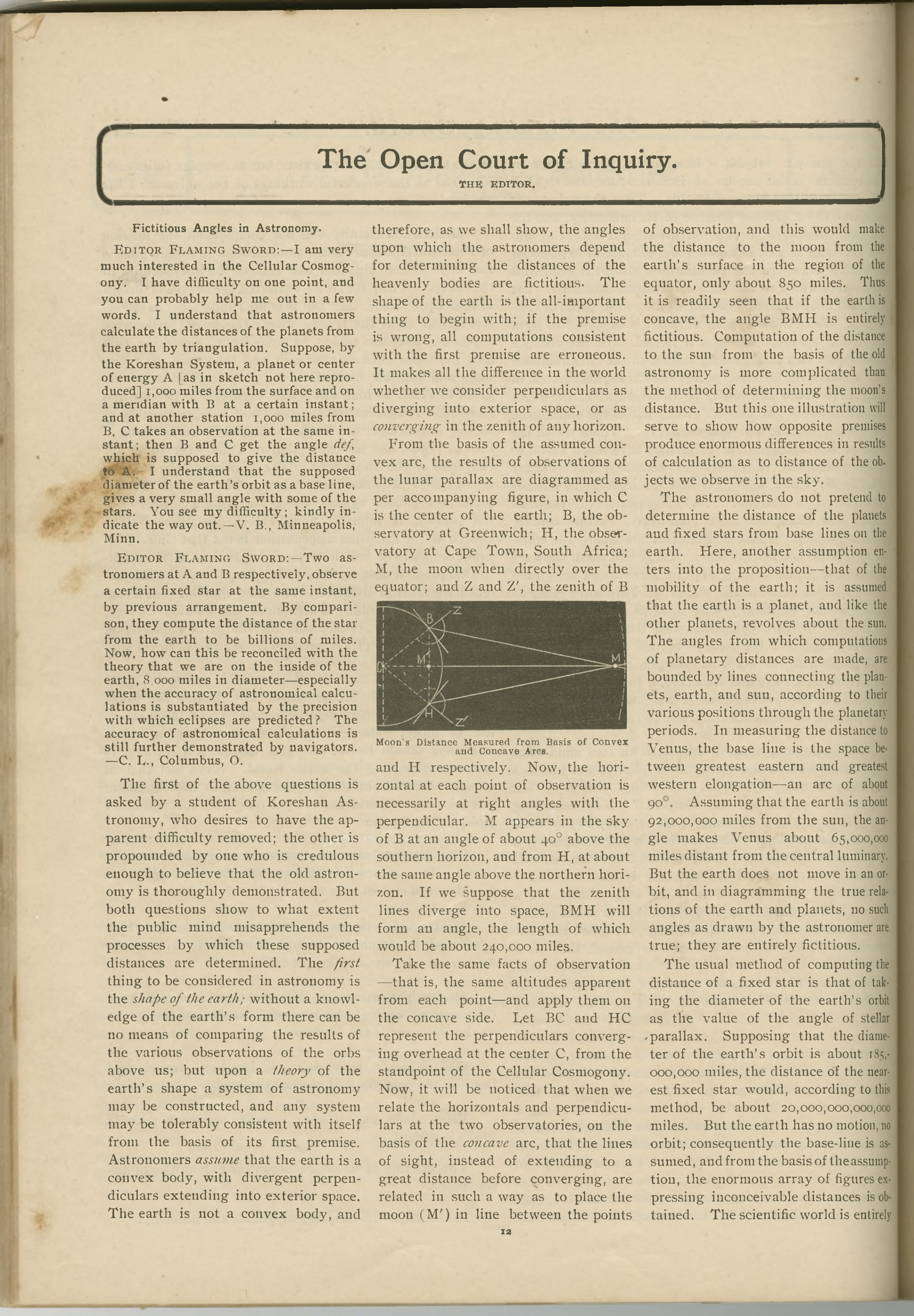
From the basis of the assumed convex arc, the results of observations of the lunar parallax are diagrammed as per accompanying figure, in which C is the center of the earth; B, the observatory at Greenwich; H, the observatory at Cape Town, South Africa; M, the moon when directly over the equator; and Z and Z', the zenith of B and H respectively. Now, the horizontal at each point of observation is necessarily at right angles with the perpendicular. M appears in the sky of B at an angle of about 40° above the southern horizon, and from H, at about the same angle above the northern horizon. If we suppose that the zenith lines diverge into space, BMH will form an angle, the length of which would be about 240,000 miles.
Take the same facts of observation—that is, the same altitudes apparent from each point—and apply them on the concave side. Let BC and HC represent the perpendiculars converging overhead at the center C, from the standpoint of the Cellular Cosmogony. Now, it will be noticed that when we relate the horizontals and perpendiculars at the two observatories, on the basis of the concave arc, that the lines of sight, instead of extending to a great distance before converging, are related in such a way as to place the moon (M′) in line between the points of observation, and this would make the distance to the moon from the earth's surface in the region of the equator, only about 850 miles. Thus it is readily seen that if the earth is concave, the angle BMH is entirely fictitious. Computation of the distance to the sun from the basis of the old astronomy is more complicated than the method of determining the moon's distance. But this one illustration will serve to show how opposite premises produce enormous differences in results of calculation as to distance of the objects we observe in the sky.
The astronomers do not pretend to determine the distance of the planets and fixed stars from base lines on the earth. Here, another assumption enters into the proposition—that of the mobility of the earth; it is assumed that the earth is a planet, and like the other planets, revolves about the sun. The angles from which computations of planetary distances are made, are bounded by lines connecting the planets, earth, and sun, according to their various positions through the planetary periods. In measuring the distance to Venus, the base line is the space between greatest eastern and greatest western elongation—an arc of about 90°. Assuming that the earth is about 92,000,000 miles from the sun, the angle makes Venus about 65,000,000 miles distant from the central luminary. But the earth does not move in an orbit, and in diagramming the true relations of the earth and planets, no such angles as drawn by the astronomer are true; they are entirely fictitious.
The usual method of computing the distance of a fixed star is that of taking the diameter of the earth's orbit as the value of the angle of stellar parallax. Supposing that the diameter of the earth's orbit is about 185,000,000 miles, the distance of the nearest fixed star would, according to this method, be about 20,000,000,000,000 miles. But the earth has no motion, no orbit; consequently the base-line is assumed, and from the basis of the assumption, the enormous array of figures expressing inconceivable distances is obtained. The scientific world is entirely ignorant of the cause of parallax.
Parallax is not the result of distance between two points of observation on the earth, nor from the earth at different points in space, but the mere result of difference of angles of reflection and degrees of curvature of light from different points of observation and different periods of the year. In Koreshan Astronomy we do not apply parallax in the same way as do the astronomers. Students of the Koreshan System gain nothing by endeavoring to make a test of our astronomy by applying angles which in reality are fictitious.
He who supposes that eclipse predictions and navigation prove the accuracy of modern astronomy, might well consider whether or not the Ptolemaic and other systems were proven true by the same processes. The man who asserts that eclipse predictions substantiate the Copernican system, perhaps does not know that eclipses were accurately predicted thousands of years before the Copernican system was founded. No theory of astronomy is considered in predicting eclipses. They occur as regularly as the seasons, and tables of eclipses for centuries past are applicable to eclipses for centuries to come. Navigators are not guided on the seas by the Copernican theory, but by the facts of practical astronomy, which theoretical astronomy endeavors to explain.
- --
Editorial transcription, lightly normalized from the scan. Line-break hyphenation, spacing, capitalization, and unmistakable OCR errors have been repaired; the claims remain those of The Flaming Sword.
The Flaming Sword · Vol. 16, No. 36 · 25 Jul. 1902 · PDF pp. 12-13