Extracted text
Editorial transcription, lightly normalized from the scan. Line-break hyphenation, spacing, capitalization, and unmistakable OCR errors have been repaired; the claims remain those of The Flaming Sword.
EDITOR FLAMING SWORD:—On a clear night we may look into the sky and see the different constellations, such as Orion, the Great Dipper, and others. These stars appear situated in a certain relation to and distance from each other. They maintain the same relative positions from rising to setting, the constellations not changing in size during the time of their passage from east to west.
Now, it appears to me that if the earth is a cell, with these stars revolving in the physical heavens which are convex to us, they would necessarily present very different positions, presenting their true relations while overhead, and appearing edgewise at rising and setting.—C. B., Salem, O.
If we take up a small star globe and revolve it, the constellations on the map will present different apparent relations in passing from side to side. This is because the globe is small, within the scope of visual adjustment and discrimination of distance; because the visual lines are practically straight; and because there are no vanishing points; the small globe appears convex.
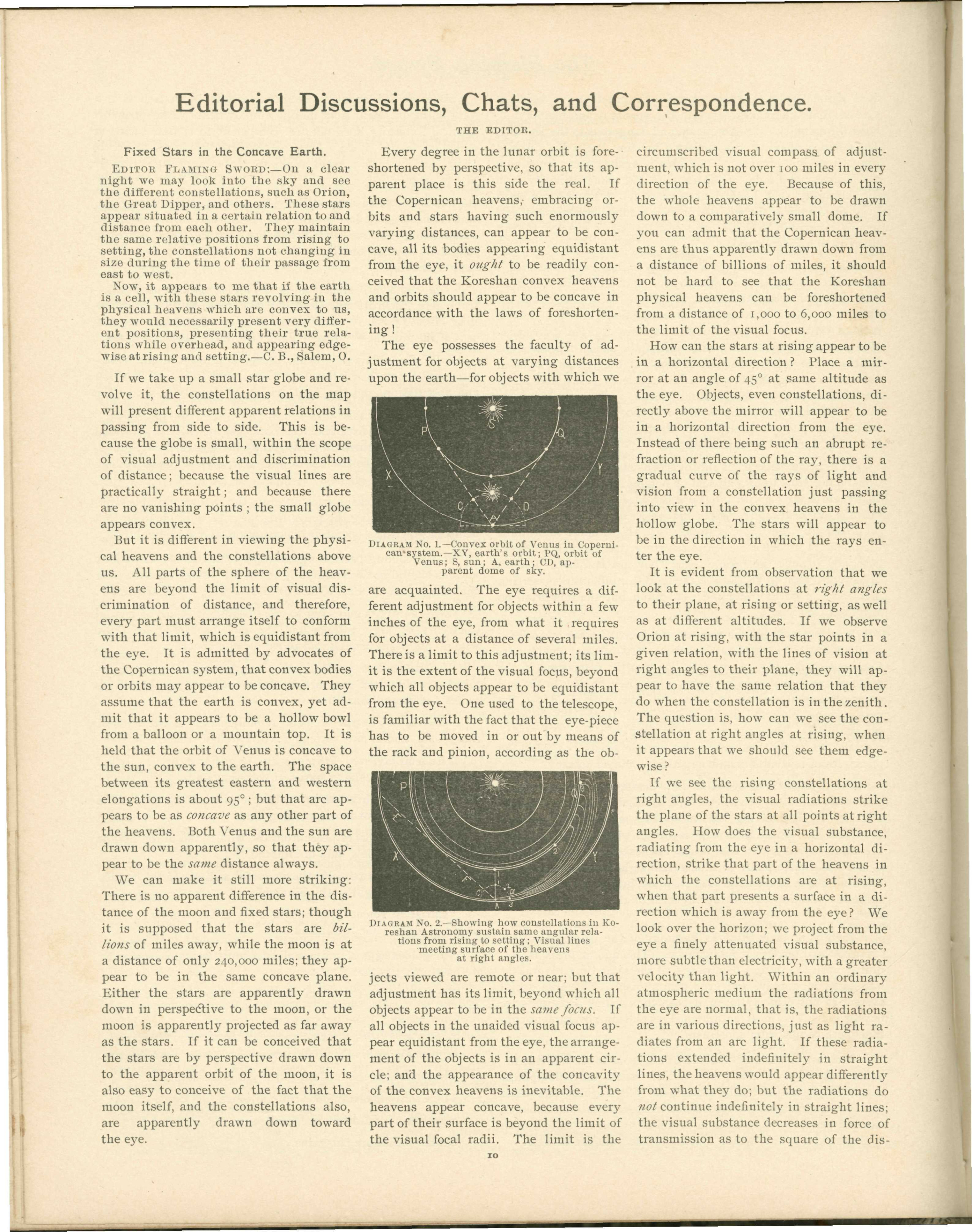
But it is different in viewing the physical heavens and the constellations above us. All parts of the sphere of the heavens are beyond the limit of visual discrimination of distance, and therefore, every part must arrange itself to conform with that limit, which is equidistant from the eye. It is admitted by advocates of the Copernican system, that convex bodies or orbits may appear to be concave. They assume that the earth is convex, yet admit that it appears to be a hollow bowl from a balloon or a mountain top. It is held that the orbit of Venus is concave to the sun, convex to the earth. The space between its greatest eastern and western elongations is about 95°; but that arc appears to be as concave as any other part of the heavens. Both Venus and the sun are drawn down apparently, so that they appear to be the same distance always.
We can make it still more striking: There is no apparent difference in the distance of the moon and fixed stars; though it is supposed that the stars are billions of miles away, while the moon is at a distance of only 240,000 miles; they appear to be in the same concave plane. Either the stars are apparently drawn down in perspective to the moon, or the moon is apparently projected as far away as the stars. If it can be conceived that the stars are by perspective drawn down to the apparent orbit of the moon, it is also easy to conceive of the fact that the moon itself, and the constellations also, are apparently drawn down toward the eye.
Every degree in the lunar orbit is foreshortened by perspective, so that its apparent place is this side the real. If the Copernican heavens, embracing orbits and stars having such enormously varying distances, can appear to be concave, all its bodies appearing equidistant from the eye, it ought to be readily conceived that the Koreshan convex heavens and orbits should appear to be concave in accordance with the laws of foreshortening!
DIAGRAM NO. 1.—Convex orbit of Venus in Copernican system.—XY, earth's orbit; PQ, orbit of Venus; S, sun; A, earth; CD, apparent dome of sky.
The eye possesses the faculty of adjustment for objects at varying distances upon the earth—for objects with which we are acquainted. The eye requires a different adjustment for objects within a few inches of the eye, from what it requires for objects at a distance of several miles. There is a limit to this adjustment; its limit is the extent of the visual focus, beyond which all objects appear to be equidistant from the eye. One used to the telescope, is familiar with the fact that the eye-piece has to be moved in or out by means of the rack and pinion, according as the objects viewed are remote or near; but that adjustment has its limit, beyond which all objects appear to be in the same focus. If all objects in the unaided visual focus appear equidistant from the eye, the arrangement of the objects is in an apparent circle; and the appearance of the concavity of the convex heavens is inevitable. The heavens appear concave, because every part of their surface is beyond the limit of the visual focal radii. The limit is the circumscribed visual compass of adjustment, which is not over 100 miles in every direction of the eye. Because of this, the whole heavens appear to be drawn down to a comparatively small dome. If you can admit that the Copernican heavens are thus apparently drawn down from a distance of billions of miles, it should not be hard to see that the Koreshan physical heavens can be foreshortened from a distance of 1,000 to 6,000 miles to the limit of the visual focus.
How can the stars at rising appear to be in a horizontal direction? Place a mirror at an angle of 45° at same altitude as the eye. Objects, even constellations, directly above the mirror will appear to be in a horizontal direction from the eye. Instead of there being such an abrupt refraction or reflection of the ray, there is a gradual curve of the rays of light and vision from a constellation just passing into view in the convex heavens in the hollow globe. The stars will appear to be in the direction in which the rays enter the eye.
It is evident from observation that we look at the constellations at right angles to their plane, at rising or setting, as well as at different altitudes. If we observe Orion at rising, with the star points in a given relation, with the lines of vision at right angles to their plane, they will appear to have the same relation that they do when the constellation is in the zenith. The question is, how can we see the constellation at right angles at rising, when it appears that we should see them edgewise?
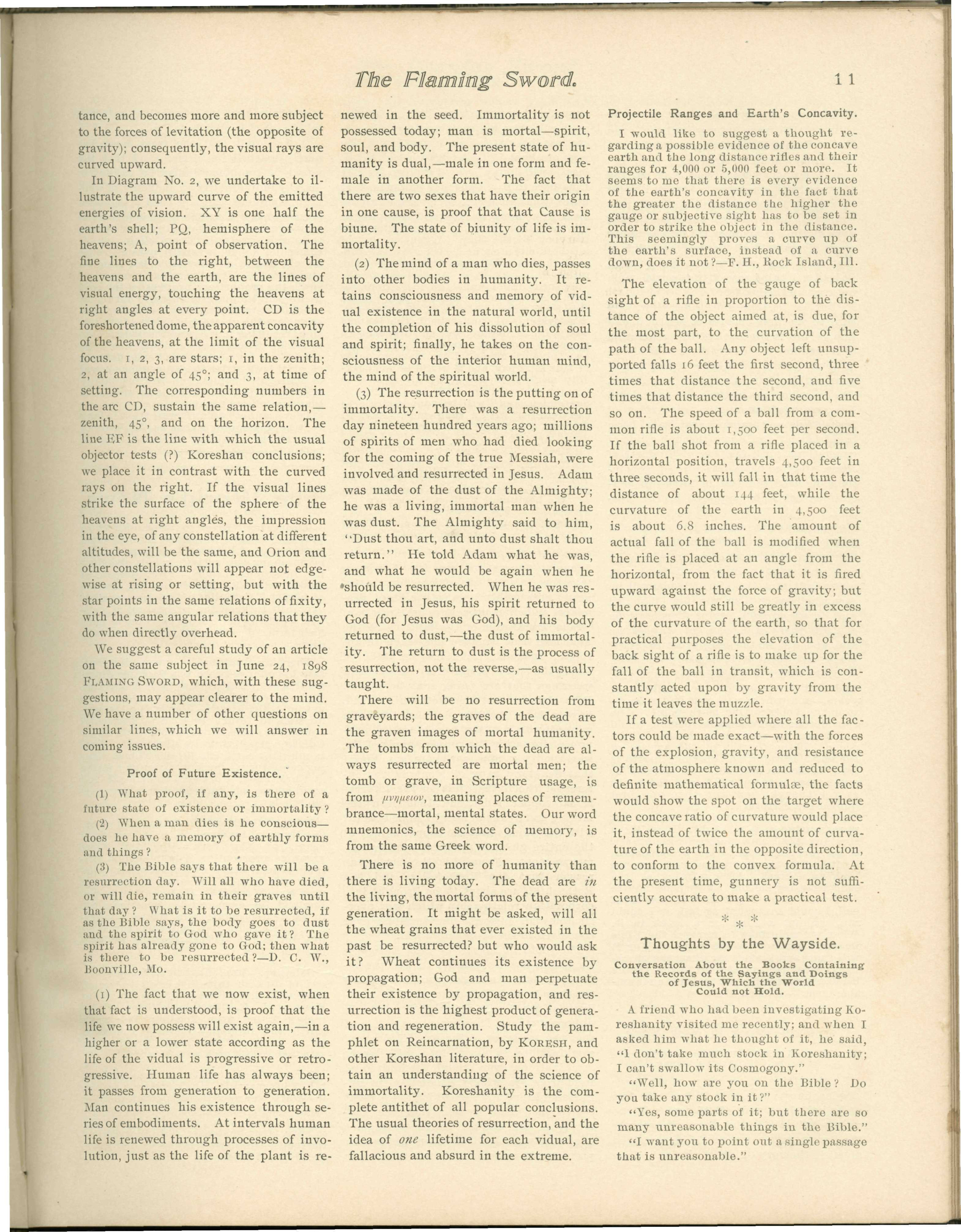
If we see the rising constellations at right angles, the visual radiations strike the plane of the stars at all points at right angles. How does the visual substance, radiating from the eye in a horizontal direction, strike that part of the heavens in which the constellations are at rising, when that part presents a surface in a direction which is away from the eye? We look over the horizon; we project from the eye a finely attenuated visual substance, more subtle than electricity, with a greater velocity than light. Within an ordinary atmospheric medium the radiations from the eye are normal, that is, the radiations are in various directions, just as light radiates from an arc light. If these radiations extended indefinitely in straight lines, the heavens would appear differently from what they do; but the radiations do not continue indefinitely in straight lines; the visual substance decreases in force of transmission as to the square of the distance, and becomes more and more subject to the forces of levitation (the opposite of gravity); consequently, the visual rays are curved upward.
DIAGRAM NO. 2.—Showing how constellations in Koreshan Astronomy sustain same angular relations from rising to setting: Visual lines meeting surface of the heavens at right angles.
In Diagram No. 2, we undertake to illustrate the upward curve of the emitted energies of vision. XY is one half the earth's shell; PQ, hemisphere of the heavens; A, point of observation. The fine lines to the right, between the heavens and the earth, are the lines of visual energy, touching the heavens at right angles at every point. CD is the foreshortened dome, the apparent concavity of the heavens, at the limit of the visual focus. 1, 2, 3, are stars; 1, in the zenith; 2, at an angle of 45°; and 3, at time of setting. The corresponding numbers in the arc CD, sustain the same relation,—zenith, 45°, and on the horizon. The line EF is the line with which the usual objector tests (?) Koreshan conclusions; we place it in contrast with the curved rays on the right. If the visual lines strike the surface of the sphere of the heavens at right angles, the impression in the eye, of any constellation at different altitudes, will be the same, and Orion and other constellations will appear not edgewise at rising or setting, but with the star points in the same relations of fixity, with the same angular relations that they do when directly overhead.
We suggest a careful study of an article on the same subject in June 24, 1898 FLAMING SWORD, which, with these suggestions, may appear clearer to the mind. We have a number of other questions on similar lines, which we will answer in coming issues.
- --
The source scans remain the record. This page preserves the periodical's argument and reported observations without presenting its conclusions as independently established results. The claims remain attributed to The Flaming Sword.
The Flaming Sword · Vol. 13, No. 26 · 19 May 1899 · PDF pp. 10-11