Extracted text
Editorial transcription, lightly normalized from the scan. Line-break hyphenation, spacing, capitalization, and unmistakable OCR errors have been repaired; the claims remain those of The Flaming Sword.
The Open Court of Inquiry.
THE EDITOR.
How Earth's Size is Determined.
Editor Flaming Sword:— Please answer the following questions: (1) How do the advocates of the globe theory get the fact (conceding that the earth be a globe,) that the earth is 25,000 miles in circumference? (2) Can the circumference of such a sphere be found from the curvature of the first mile? If so, please state how it is done.— F. T. J., Baltimore, Md.
The simplest method of determining the approximate dimensions of the earth, is that of measuring the length of degrees of longitude on the equator, or what amounts to the same thing, the length of degrees of latitude on any meridian. By the most accurate measurements yet made, a degree of longitude on the equator is determined to be 69.16 statute miles. From the basis of such measurement, the circumference is determined by merely multiplying the length of one degree by 360°, which gives 24,897 miles. One degree of the earth's circumference is equal to 4 minutes of solar time; the process of measuring the length of 1° is that of measuring the distance between two points on the equator, between which there is a difference of 4 minutes of time.
Degrees of latitude on the earth co-ordinate with the degrees of altitude of the astronomical poles. The latitude of any point north of the equator can be ascertained by determining the altitude of the astronomical center about which the north star revolves. The distance between two points on any meridian from which there is an observed difference of 1° of polar altitude, is the length of 1° of latitude which is about the same as the length of a degree of longitude on the equator. Longitude and time may be applied to any circle or parallel of latitude, and its circumference ascertained.
Geodetic surveys involve more complex methods. Long base-lines are surveyed, and from these base-lines, triangles and quadrilaterals are extended, and cross-lines surveyed. From the basis of the complex relation between the base and cross-lines, the approximate amount of curvature, but not the direction of curvature, is ascertained. It is known by actual measurements, by means of the cross-lines, that the area of a surveyed triangle or quadrilateral is greater than would obtain upon a flat surface; the angles are spherical angles. The excess of area applies with equal consistency upon a concave surface with same ratio of curvature. The ratio of the earth's curvature is found to be about the same in all directions; it is, approximately, 8 inches to the mile. In accordance with all the facts of geographical and geodetic measurements, there are only two shapes that the earth could possibly have; it must be either convex or concave. We maintain that the surface of the earth upon which we live is concave—a fact which we have demonstrated by the most direct and positive processes yet employed in the field of geodesy. All the facts fit a hollow globe about 7,925 miles in diameter, as measured from side to side of the interior space.
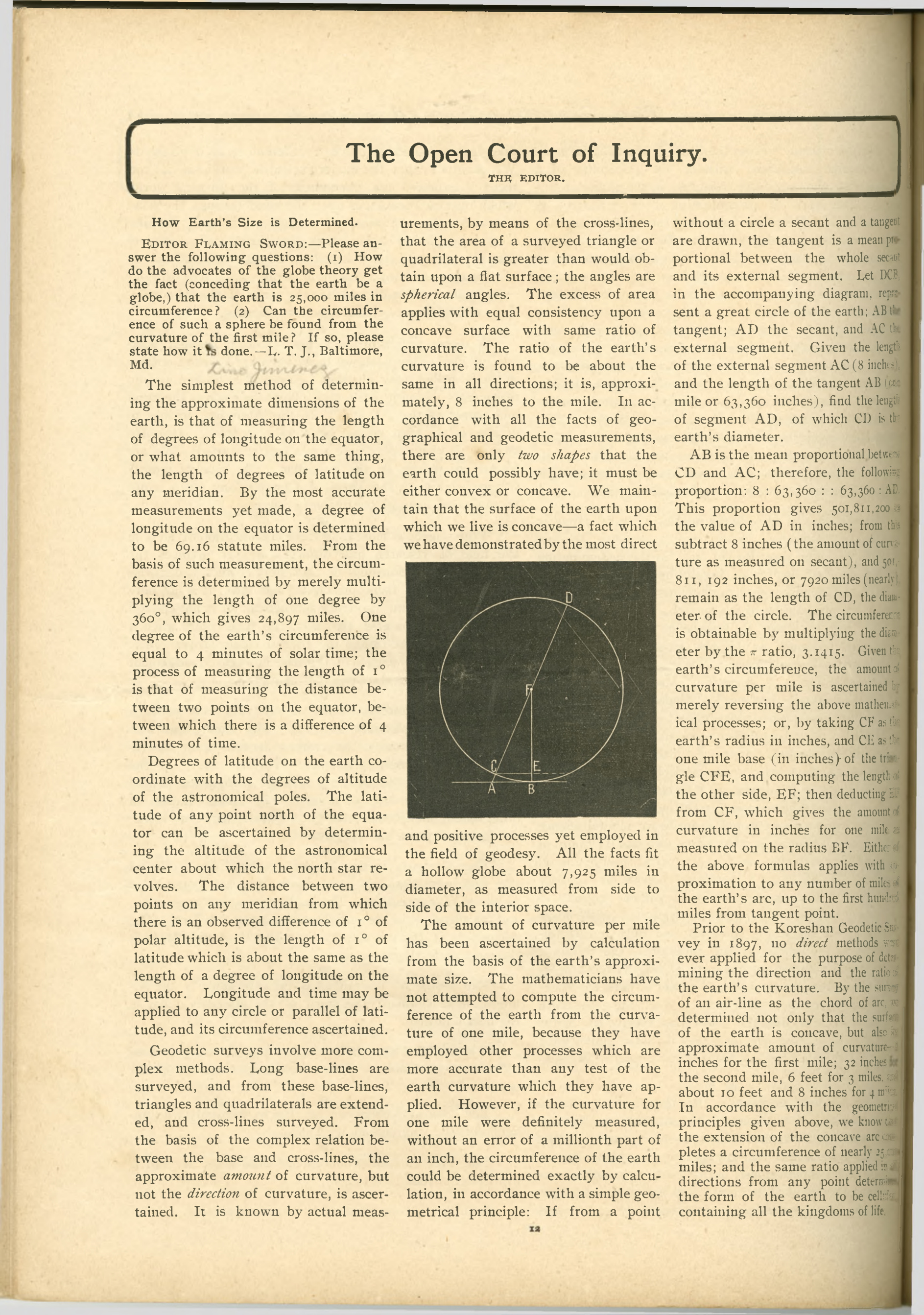
The amount of curvature per mile has been ascertained by calculation from the basis of the earth's approximate size. The mathematicians have not attempted to compute the circumference of the earth from the curvature of one mile, because they have employed other processes which are more accurate than any test of the earth curvature which they have applied. However, if the curvature for one mile were definitely measured, without an error of a millionth part of an inch, the circumference of the earth could be determined exactly by calculation, in accordance with a simple geometrical principle: If from a point without a circle a secant and a tangent are drawn, the tangent is a mean proportional between the whole secant and its external segment. Let DCB, in the accompanying diagram, represent a great circle of the earth; AB the tangent; AD the secant, and AC the external segment. Given the length of the external segment AC (8 inches), and the length of the tangent AB (one mile or 63,360 inches), find the length of segment AD, of which CD is the earth's diameter.
AB is the mean proportional between CD and AC; therefore, the following proportion: 8 : 63,360 :: 63,360 : AD. This proportion gives 501,811,200 as the value of AD in inches; from this subtract 8 inches (the amount of curvature as measured on secant), and 501,811,192 inches, or 7920 miles (nearly), remain as the length of CD, the diameter of the circle. The circumference is obtainable by multiplying the diameter by the π ratio, 3.1415. Given the earth's circumference, the amount of curvature per mile is ascertained by merely reversing the above mathematical processes; or, by taking CF as the earth's radius in inches, and CE as the one mile base (in inches) of the triangle CFE, and computing the length of the other side, EF; then deducting EF from CF, which gives the amount of curvature in inches for one mile as measured on the radius BF. Either of the above formulas applies with approximation to any number of miles of the earth's arc, up to the first hundred miles from tangent point.
Prior to the Koreshan Geodetic Survey in 1897, no direct methods were ever applied for the purpose of determining the direction and the ratio of the earth's curvature. By the survey of an air-line as the chord of arc, we determined not only that the surface of the earth is concave, but also its approximate amount of curvature—8 inches for the first mile; 32 inches the second mile, 6 feet for 3 miles, and about 10 feet and 8 inches for 4 miles. In accordance with the geometrical principles given above, we know that the extension of the concave arc completes a circumference of nearly 25,000 miles; and the same ratio applied in all directions from any point determines the form of the earth to be cellular, containing all the kingdoms of life.
- --
The source scans remain the record. This page preserves the periodical's text as an editorial transcription; its claims remain those of The Flaming Sword.
The Flaming Sword · Vol. 16, No. 21 · Apr 11, 1902 · PDF p. 12