Extracted text
Printed form: a correspondent’s letter followed by the editorial response. The response continues across PDF pp. 6–7.
Editorial transcription, lightly normalized from the cited scan pages. Historical claims remain those of The Flaming Sword.
EDITOR FLAMING SWORD:—As space will permit only the most condensed arguments of limited scope, there are many points that must be passed over; but for all that, I must dissent from the statement in your heading that I admit inability to "explain the difficulties urged against the Copernican system." That statement should have been postponed until such difficulties had been presented and I had failed to solve them. I was only referring to observed phenomena which had no bearing against the Copernican system. If there are observed phenomena that militate against it, I will be very glad to consider them, particularly if they make for your system, and can be best solved from that standpoint.
I will now, as above foreshadowed, pass over many minor points to reach the following statement near your conclusion: "There are long lines of conclusions connected with the primary supposition that the earth is convex. None of them will fit the Koreshan System." Now in this discussion I have endeavored, and I think with some success, to avoid all conclusions that were not amply warranted by observed and indisputable facts. From the fact that the dimensions of the sun, moon, and planets did not change during their passage over us, I conclude that their distance from us does not vary enough to cause perceptible change of size. If they were all in the "sphere of the heavens," as shown in your central diagram, their distance from the observer would be four or five-fold during passage, and your attempts to account for the constancy of their dimensions not being at all satisfactory, I still rest on the conclusion that the Copernican system furnishes the true explanation.
But another indisputable fact, patent to all, and which bears against your scheme with what appears to me to be overwhelming force, is the fixity of the stars, in their relative positions and distances. If the stars were all spread over the aforesaid "sphere of the heavens," all groups or constellations would be more or less perspectively distorted and foreshortened except when vertical over the observer. In fact, such foreshortening would reach entire obliteration of shape at the horizon, where they would be seen edgewise, if it were possible to separate their members from the maze of stars consequent on the tangential line of sight. I don't forget the assumed curvature of the line of sight; but that only apparently lowers the horizon. The laws of perspective would still hold.
Now, I hold that the fixity of the stars—called fixed because long observed to be so—cannot possibly be explained from your standpoint, but can be readily understood from that of the Copernican system. You speak vaguely of "demonstrations" of the earth's concavity, a hundred times repeated; but I defer comment on such demonstrations until I know how and with what instrumentality they are achieved.—Prof. J. W. T., Salem, O.
THE DIFFERENCES of interpretation of astronomical phenomena that exist between the Copernican and the Koreshan systems of astronomy, can never be settled in the mind of the investigator through consideration of the apparent movements of the sun, moon, and stars. Recourse must be had to some tangible evidence, where optical illusions are not factors of conclusion. Astronomical conclusions must be made referable to some basis; known and demonstrable premises must constitute the groundwork of all conclusions, in a correct system of interpretation of the phenomena of the heavens. We are here upon the earth's surface; it is tangible, and susceptible of measurement and test. We cannot scientifically consider what is in the heavens, until we know something definitely concerning the shape of the earth.
The Koreshan System of astronomy is revolutionary, and is the opposite of the Copernican system at every point; it is the absolute antithesis; consequently our methods are revolutionary. The two systems are differently constructed, founded upon premises that are exactly opposite in character. The old system is founded upon hypotheses, originated to explain a number of optical illusions; the so called proofs are appearances. The Koreshan System is not founded upon appearances, and consequently its conclusions seem out of harmony with apparent evidences in the sky. Now this is where our explanations are not satisfactory to the mind long educated to believe that the human eye is capable of seeing trillions of millions of miles in every direction into space. The endeavor to treat the Koreshan "sphere of the heavens" in the same way, leads to the discrepancy, which is usually urged as an objection to the Koreshan System.
It must be admitted that if the earth is concave, the phenomena that we observe do actually occur within the earth, and that the convex heavens appear concave above us, and that the stars do move from east to west in the apparent dome, without perspective distortion, about 15° per hour. As neither the heavens nor the earth change shape to suit the many theories about their form, they have always been the same! If we determine that the earth is concave, that eternally remains a fact, just as it has always been; and as no actual fact in the universe contradicts any other fact, the conclusion is inevitable that the correct interpretation of the phenomena of the heavens must be in harmony with the basic premise that the earth is concave. As to how such heavens would appear, there is no question; because that is patent to all, and visible nightly; for there cannot be two shaped universes in one! If it can be shown that the premise of the Koreshan System is absolutely true, then the conclusion is inevitable that all of the conceptions of the science of the day are fallacious, inclusive of optics and physics. It would be useless to undertake to interpret phenomena in the concave earth by fallacious conceptions of the propagation of light and theories of optics, which form a part of the astronomical system which has so far missed the mark as to teach the exact opposite to that which is true. The phenomena of the universe as a cell must be interpreted from our standpoint, in accordance with the system of optics which must be true if Koreshan Cosmography is sustained by facts. Our conclusions must be tested by our premises, not by the assumptions of a fallacious system. This is the only proper course to pursue. If our groundwork is false, there is nothing gained by considering any of our conclusions. We cannot fight our battles in the heavens; we parade our scientific facts on terra firma; then are we able to change the mind of the investigator concerning the heavens!
We cannot reproduce in this article the facts of observation which not only "bear against the Copernican system," but utterly overthrow it; that not only "make for our system," but actually demonstrate it. We refer specifically to the observations on the water's surface, made by our Geodetic Staff during the past two years; and the survey of an air line, not tangent to a convex arc, but convergent as the chord of the concave curvature. These facts we have published, and are now publishing in the CELLULAR COSMOGONY, our new work on the demonstrations of the earth's form. We place these facts over against all hypotheses in existence, and we challenge the world to test their truth by actual observation and measurements. We have made no vague references to our demonstrations; our evidences are specific. We refer our esteemed friend to these facts—not merely to our record of them on paper, but to the observations themselves, which can be repeated in his presence or in the presence of ten thousand witnesses, with the same results.
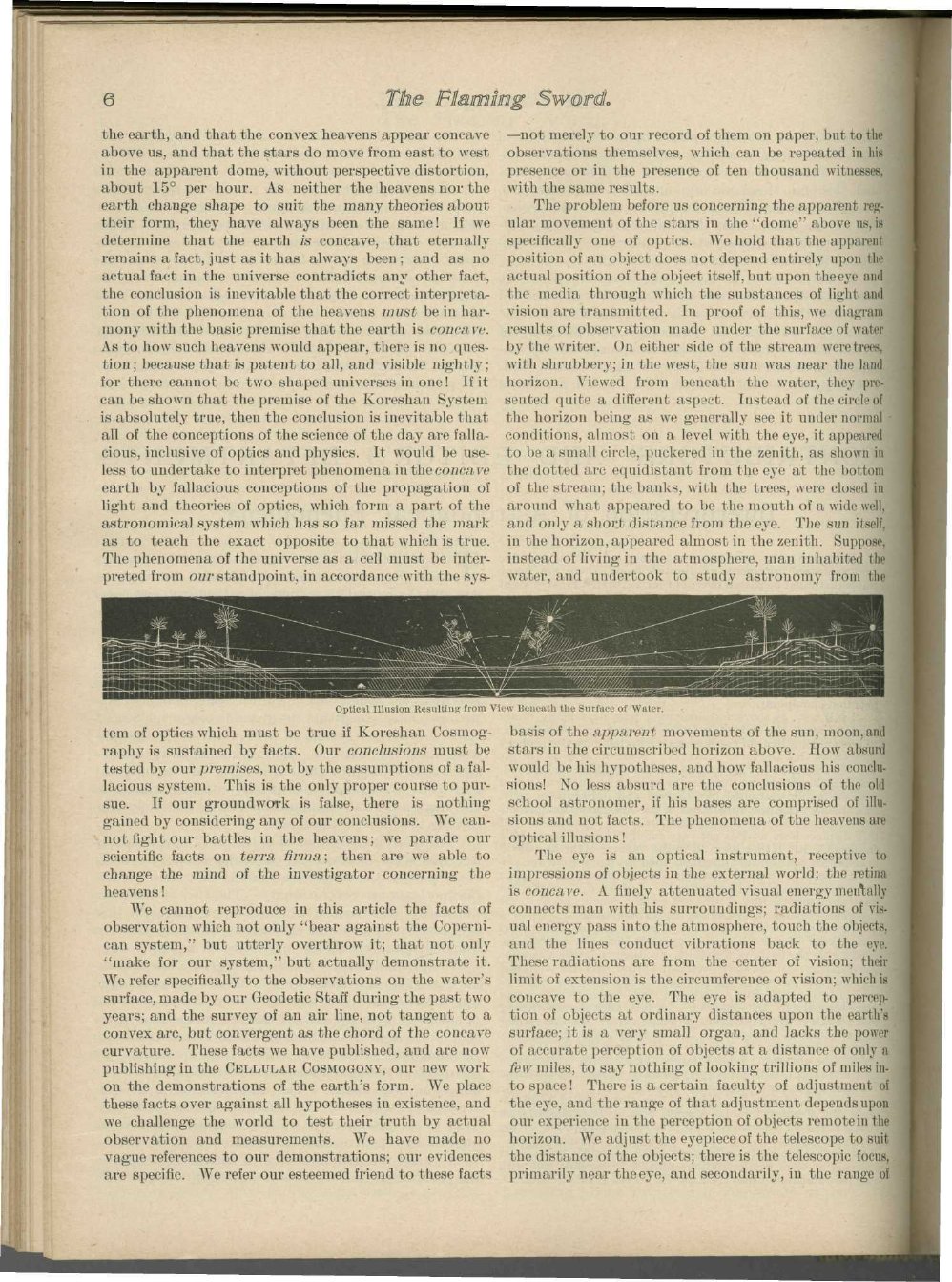
The problem before us concerning the apparent regular movement of the stars in the "dome" above us, is specifically one of optics. We hold that the apparent position of an object does not depend entirely upon the actual position of the object, itself, but upon the eye and the media through which the substances of light and vision are transmitted. In proof of this, we diagram results of observation made under the surface of water by the writer. On either side of the stream were trees, with shrubbery; in the west, the sun was near the land horizon. Viewed from beneath the water, they presented quite a different aspect. Instead of the circle of the horizon being as we generally see it under normal conditions, almost on a level with the eye, it appeared to be a small circle, puckered in the zenith, as shown in the dotted arc equidistant from the eye at the bottom of the stream; the banks, with the trees, were closed in around what appeared to be the mouth of a wide well, and only a short distance from the eye. The sun itself, in the horizon, appeared almost in the zenith. Suppose, instead of living in the atmosphere, man inhabited the water, and undertook to study astronomy from the basis of the apparent movements of the sun, moon, and stars in the circumscribed horizon above. How absurd would be his hypotheses, and how fallacious his conclusions! No less absurd are the conclusions of the old school astronomer, if his bases are comprised of illusions and not facts. The phenomena of the heavens are optical illusions!
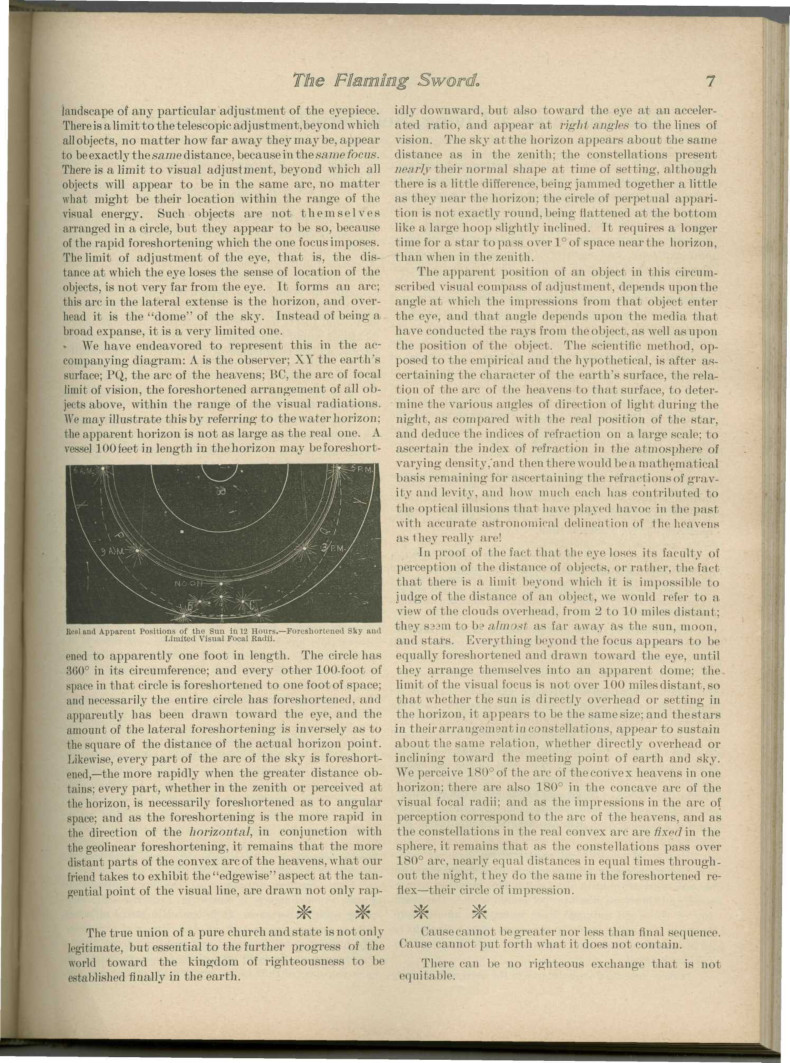
The eye is an optical instrument, receptive to impressions of objects in the external world; the retina is concave. A finely attenuated visual energy mentally connects man with his surroundings; radiations of visual energy pass into the atmosphere, touch the objects, and the lines conduct vibrations back to the eye. These radiations are from the center of vision; their limit of extension is the circumference of vision; which is concave to the eye. The eye is adapted to perception of objects at ordinary distances upon the earth's surface; it is a very small organ, and lacks the power of accurate perception of objects at a distance of only a few miles, to say nothing of looking trillions of miles into space! There is a certain faculty of adjustment of the eye, and the range of that adjustment depends upon our experience in the perception of objects remote in the horizon. We adjust the eyepiece of the telescope to suit the distance of the objects; there is the telescopic focus, primarily near the eye, and secondarily, in the range of landscape of any particular adjustment of the eyepiece. There is a limit to the telescopic adjustment, beyond which all objects, no matter how far away they may be, appear to be exactly the same distance, because in the same focus. There is a limit to visual adjustment, beyond which all objects will appear to be in the same arc, no matter what might be their location within the range of the visual energy. Such objects are not themselves arranged in a circle, but they appear to be so, because of the rapid foreshortening which the one focus imposes. The limit of adjustment of the eye, that is, the distance at which the eye loses the sense of location of the objects, is not very far from the eye. It forms an arc; this arc in the lateral extense is the horizon, and overhead it is the "dome" of the sky. Instead of being a broad expanse, it is a very limited one. We have endeavored to represent this in the accompanying diagram: A is the observer; XY the earth's surface; PQ, the arc of the heavens; BC, the arc of focal limit of vision, the foreshortened arrangement of all objects above, within the range of the visual radiations. We may illustrate this by referring to the water horizon; the apparent horizon is not as large as the real one. A vessel 100 feet in length in the horizon may be foreshort-ened to apparently one foot in length. The circle has 360° in its circumference; and every other 100-foot of space in that circle is foreshortened to one foot of space; and necessarily the entire circle has foreshortened, and apparently has been drawn toward the eye, and the amount of the lateral foreshortening is inversely as to the square of the distance of the actual horizon point. Likewise, every part of the arc of the sky is foreshortened,—the more rapidly when the greater distance obtains; every part, whether in the zenith or perceived at the horizon, is necessarily foreshortened as to angular space; and as the foreshortening is the more rapid in the direction of the horizontal, in conjunction with the geolinear foreshortening, it remains that the more distant parts of the convex arc of the heavens, what our friend takes to exhibit the "edgewise" aspect at the tangential point of the visual line, are drawn not only rap-idly downward, but also toward the eye at an accelerated ratio, and appear at right angles to the lines of vision. The sky at the horizon appears about the same distance as in the zenith; the constellations present nearly their normal shape at time of setting, although there is a little difference, being jammed together a little as they near the horizon; the circle of perpetual apparition is not exactly round, being flattened at the bottom like a large hoop slightly inclined. It requires a longer time for a star to pass over 1° of space near the horizon, than when in the zenith.
The apparent position of an object in this circumscribed visual compass of adjustment, depends upon the angle at which the impressions from that object enter the eye, and that angle depends upon the media that have conducted the rays from the object, as well as upon the position of the object. The scientific method, opposed to the empirical and the hypothetical, is, after ascertaining the character of the earth's surface, the relation of the arc of the heavens to that surface, to determine the various angles of direction of light during the night, as compared with the real position of the star, and deduce the indices of refraction on a large scale: to ascertain the index of refraction in the atmosphere of varying density,'and then there would be a mathematical basis remaining for ascertaining the refractions of gravity and levity, and how much each has contributed to the optical illusions that have played havoc in the past with accurate astronomical delineation of the heavens as they really are!
In proof of the fact that the eye loses its faculty of perception of the distance of objects, or rather, the fact that there is a limit beyond which it is impossible to judge of the distance of an object, we would refer to a view of the clouds overhead, from 2 to 10 miles distant; they seem to be almost as far away as the sun, moon, and stars. Everything beyond the focus appears to be equally foreshortened and drawn toward the eye, until they arrange themselves into an apparent dome; the limit of the visual focus is not over 100 miles distant, so that whether the sun is directly overhead or setting in the horizon, it appears to be the same size; and the stars in their arrangement in constellations, appear to sustain about the same relation, whether directly overhead or inclining toward the meeting point of earth and sky. We perceive 180° of the arc of the convex heavens in one horizon; there are also 180° in the concave arc of the visual focal radii; and as the impressions in the arc of perception correspond to the arc of the heavens, and as the constellations in the real convex arc are fixed in the sphere, it remains that as the constellations pass over 180° arc, nearly equal distances in equal times throughout the night, they do the same in the foreshortened reflex—their circle of impression.
Source boundary: Begins under “Interpretation of Astronomical Phenomena”; includes Prof. J. W. T.’s letter and the Koreshan editorial reply; continues through the optical/foreshortening conclusion on PDF p. 7 and ends before the following church-and-state article.
Vol. 12, No. 32 · PDF pages 5, 6, 7
- --
The source scans remain the record. This page preserves the periodical's argument and reported observations without presenting its conclusions as independently established results. The claims remain attributed to The Flaming Sword.
← Flaming Sword Archive
The Flaming Sword · Vol. 12, No. 32 · · PDF pp. 5–7