Extracted text
Editorial transcription lightly normalized from the cited scan; historical claims below are those of The Flaming Sword and are not independently verified.
Looking from Chicago to St. Louis.
(1) I cannot see why a good telescope should not enable one to see St. Louis from Chicago, if concavity be true. The geolineation of the first half would be counteracted exactly by the last half, and so rendered practically nil, and I think a good telescope would meet the vertical perspective. Could you, by half the distance, say from Springfield? At night, with electric lights burning, you could surely see it.
(2) Now I want to propose to you another scheme, which would settle the question of convexity, flatness, or concavity, beyond all dispute. Find a level piece of quiet water having a stretch of about 6 miles—a canal, if possible. Place stakes 10 or 12 feet in height, at the beginning, end, and middle of the six miles, with lights at the tops. Train a theodolite on the first and last. If the hair-line is above the middle light, it will prove concavity; if below, the convexity; if at the light on the middle stake, it will prove the earth flat. The difference between the convex and concave would be 10 or 12 feet, I suppose; at all events, there is plenty of space to settle the question.—J. A., Philadelphia.
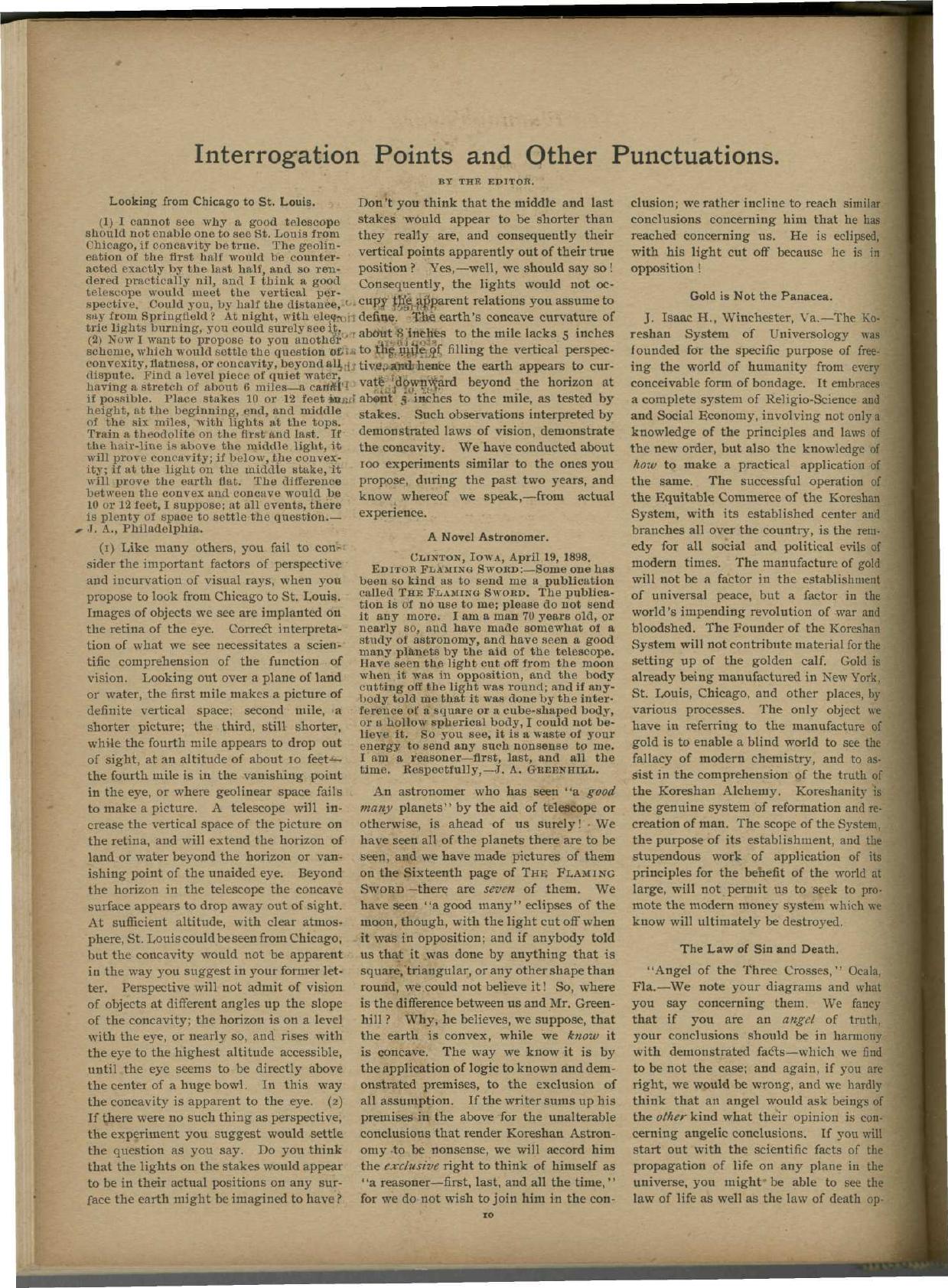
(1) Like many others, you fail to consider the important factors of perspective and incurvation of visual rays, when you propose to look from Chicago to St. Louis. Images of objects we see are implanted on the retina of the eye. Correct interpretation of what we see necessitates a scientific comprehension of the function of vision. Looking out over a plane of land or water, the first mile makes a picture of definite vertical space; the second mile, a shorter picture; the third, still shorter, while the fourth mile appears to drop out of sight, at an altitude of about 10 feet—the fourth mile is in the vanishing point in the eye, or where geolinear space fails to make a picture. A telescope will increase the vertical space of the picture on the retina, and will extend the horizon of land or water beyond the horizon or vanishing point of the unaided eye. Beyond the horizon in the telescope the concave surface appears to drop away out of sight. At sufficient altitude, with clear atmosphere, St. Louis could be seen from Chicago, but the concavity would not be apparent in the way you suggest in your former letter. Perspective will not admit of vision of objects at different angles up the slope of the concavity; the horizon is on a level with the eye, or nearly so, and rises with the eye to the highest altitude accessible, until the eye seems to be directly above the center of a huge bowl. In this way the concavity is apparent to the eye. (2) If there were no such thing as perspective, the experiment you suggest would settle the question as you say. Do you think that the lights on the stakes would appear to be in their actual positions on any surface the earth might be imagined to have?
Don’t you think that the middle and last stakes would appear to be shorter than they really are, and consequently their vertical points apparently out of their true position? Yes,—well, we should say so! Consequently, the lights would not occupy the apparent relations you assume to define. The earth’s concave curvature of about 8 inches to the mile lacks 5 inches to the mile of filling the vertical perspective, and hence the earth appears to curve downward beyond the horizon at about 5 inches to the mile, as tested by stakes. Such observations interpreted by demonstrated laws of vision, demonstrate the concavity. We have conducted about 100 experiments similar to the ones you propose, during the past two years, and know whereof we speak,—from actual experience.
- --
The source scans remain the record. This page preserves the periodical's argument and reported observations without presenting its conclusions as independently established results. The claims remain attributed to The Flaming Sword.
← Flaming Sword Archive
The Flaming Sword · Vol. 12, No. 24 · · PDF p. 10