Extracted text
Source-led transcription, lightly normalized from the page scans. Line-wrap hyphenation, mechanical spacing, and obvious scan whitespace have been repaired; historical claims remain attributed to The Flaming Sword.
KORESHAN ASTRONOMY (No. 1).
Consideration of Common Objections Urged by Investigators Against the Cellular Cosmogony.
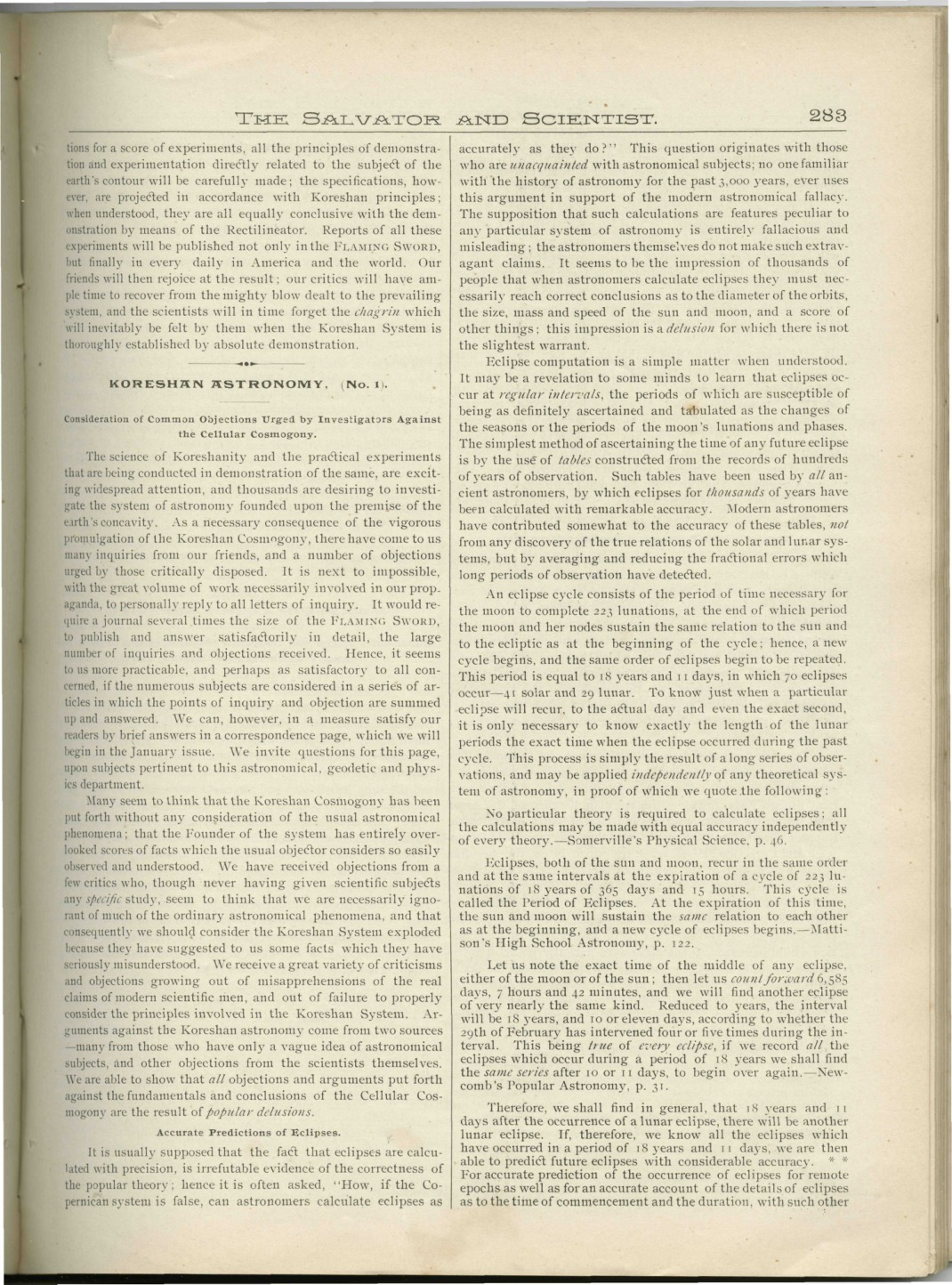
The science of Koreshanity and the practical experiments that are being conducted in demonstration of the same, are exciting widespread attention, and thousands are desiring to investigate the system of astronomy founded upon the premise of the earth's concavity. As a necessary consequence of the vigorous promulgation of the Koreshan Cosmogony, there have come to us many inquiries from our friends, and a number of objections urged by those critically disposed. It is next to impossible, with the great volume of work necessarily involved in our propaganda, to personally reply to all letters of inquiry. It would require a journal several times the size of the FLAMING SWORD, to publish and answer satisfactorily in detail, the large number of inquiries and objections received. Hence, it seems to us more practicable, and perhaps as satisfactory to all concerned, if the numerous subjects are considered in a series of articles in which the points of inquiry and objection are summed up and answered. We can, however, in a measure satisfy our readers by brief answers in a correspondence page, which we will begin in the January issue. We invite questions for this page, upon subjects pertinent to this astronomical, geodetic and physics department.
Many seem to think that the Koreshan Cosmogony has been put forth without any consideration of the usual astronomical phenomena; that the Founder of the system has entirely overlooked scores of facts which the usual objector considers so easily observed and understood. We have received objections from a few critics who, though never having given scientific subjects any specific study, seem to think that we are necessarily ignorant of much of the ordinary astronomical phenomena, and that consequently we should consider the Koreshan System exploded because they have suggested to us some facts which they have seriously misunderstood. We receive a great variety of criticisms and objections growing out of misapprehensions of the real claims of modern scientific men, and out of failure to properly consider the principles involved in the Koreshan System. Arguments against the Koreshan astronomy come from two sources many from those who have only a vague idea of astronomical subjects, and other objections from the scientists themselves. We are able to show that all objections and arguments put forth against the fundamentals and conclusions of the Cellular Cosmogony are the result of popular delusions.
Accurate Predictions of Eclipses. It is usually supposed that the fact that eclipses are calculated with precision, is irrefutable evidence of the correctness of the popular theory; hence it is often asked, "How, if the Copernican system is false, can astronomers calculate eclipses as accurately as they do?" This question originates with those who are unacquainted with astronomical subjects; no one familiar with "the history of astronomy for the past 3,000 years, ever uses this argument in support of the modern astronomical fallacy. The supposition that such calculations are features peculiar to any particular system of astronomy is entirely fallacious and misleading; the astronomers themselves do not make such extravagant claims. It seems to be the impression of thousands of people that when astronomers calculate eclipses they must necessarily reach correct conclusions as to the diameter of the orbits, the size, mass and speed of the sun and moon, and a score of other things; this impression is a delusion for which there is not the slightest warrant.
Eclipse computation is a simple matter when understood, it may be a revelation to some minds lo learn that eclipses occur at regular intervals, the periods of which are susceptible of being as definitely ascertained and tabulated as the changes of the seasons or the periods of the moon's lunations and phases. The simplest method of ascertaining the time of any future eclipse is by the use" of tables constructed from the records of hundreds of years of observation. Such tables have been used by all ancient astronomers, by which eclipses for thousands of years have been calculated with remarkable accuracy. Modern astronomers have contributed somewhat to the accuracy of these tables, not from any discovery of the true relations of the solar and lunar systems, but by averaging and reducing the fractional errors which long periods of observation have detected.
An eclipse cycle consists of the period of time necessary for the moon to complete 223 lunations, at the end of which period the moon and her nodes sustain the same relation to the sun and to the ecliptic as at the beginning of the cycle; hence, a new cycle begins, and the same order of eclipses begin to be repeated. This period is equal to 18 years and 11 days, in which 70 eclipses occur—41 solar and 29 lunar. To know just when a particular eclipse will recur, to the actual day and even the exact second, it is only necessary to know exactly the length of the lunar periods the exact time when the eclipse occurred during the past cycle. This process is simply the result of a long series of observations, and may be applied independently of any theoretical system of astronomy, in proof of which we quote the following:
No particular theory is required to calculate eclipses; all the calculations may be made with equal accuracy independently of every theory.—Somerville's Physical Science, p. 46.
Eclipses, both of the sun and moon, recur in the same order and at the same intervals at the expiration of a cycle of 223 lunations of 18 years of 365 days and 13 hours. This cycle is called the Period of Eclipses. At the expiration of this time, the sun and moon will sustain the same relation to each other as at the beginning, and a new cycle of eclipses begins.—Mattison's High School Astronomy, p. 122.
Let us note the exact time of the middle of any eclipse, either of the moon or of the sun; then let us count forward 6,585 days, 7 hours and 42 minutes, and we will find another eclipse of very nearly the same kind. Reduced to years, the interval will be 18 years, and 10 or eleven days, according to whether the 29th of February has intervened four or five times during the interval. This being true of every eclipse, if we record all the eclipses which occur during a period of 18 years we shall find the same series after 10 or n days, to begin over again.—Newcomb's Popular Astronomy, p. 31.
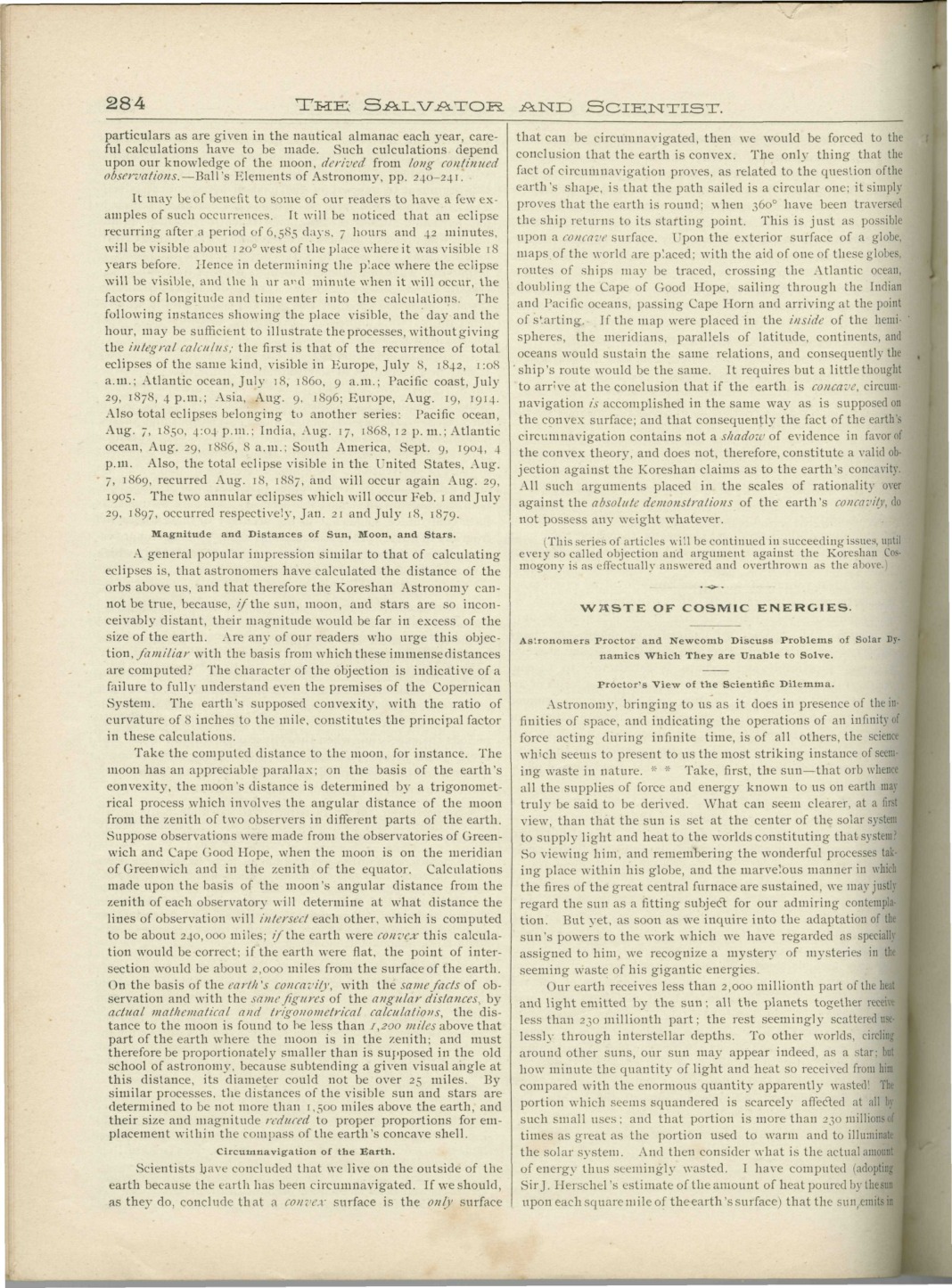
Therefore, we shall find in general, that 18 years and 11 days after the occurrence of a lunar eclipse, there will be another lunar eclipse. If, therefore, we know all the eclipses which have occurred in a period of 18 years and 11 days, we are then able to predict future eclipses with considerable accuracy. For accurate prediction of the occurrence of eclipses for remote epochs as well as for an accurate account of the details of eclipses as to the time of commencement and the duration, with such other particulars as are given in the nautical almanac each year, careful calculations have to be made. Such circulations depend upon our knowledge of the moon, derived from long continued observations.—Fall's Elements of Astronomy, pp. 240-241.
It may be of benefit to some of our readers to have a few examples of such occurrences. It will be noticed that an eclipse recurring after a period of 6,585 days, 7 hours and 42 minutes, will be visible about 1,200 west of the place where it was visible 18 years before. Hence in determining the place where the eclipse will be visible, and the hour and minute when it will occur, the factors of longitude and time enter into the calculations. The following instances showing the place visible, the day and the hour, may be sufficient to illustrate the processes, without giving the integral calculus; the first is that of the recurrence of total eclipses of the same kind, visible in Europe, July 8, 1842, 1:08 a.m.; Atlantic ocean, July 18, 1860, 9 a.m.; Pacific coast, July 29, 1878, 4 p.m.; Asia, Aug. 9, 1896; Europe, Aug. 19, 1914. Also total eclipses belonging to another series: Pacific ocean, Aug. 7, 1850, 4:04 p.m.: India, Aug. 17, 1868, 12 p. m.; Atlantic ocean, Aug. 29, 1886, 8 a.m.; South America, Sept. 9, 1904, 4 p.m. Also, the total eclipse visible in the United States, Aug. 7, 1869, recurred Aug. 18, 1887, and will occur again Aug. 29, 1905. The two annular eclipses which will occur Feb. 1 and July 29, 1897, occurred respectively, Jan. 21 and July 18, 1879.
Magnitude and Distances of Sun, Moon, and Stars.
A general popular impression similar to that of calculating eclipses is, that astronomers have calculated the distance of the orbs above us, and that therefore the Koreshan Astronomy cannot be true, because, "the sun, moon, and stars are so inconceivably distant, their magnitude would be far in excess of the size of the earth. Are any of our readers who urge this objection, familiar with the basis from which these immense distances are computed? The character of the objection is indicative of a failure to fully understand even the premises of the Copernican System. The earth's supposed convexity, with the ratio of curvature of 8 inches to the mile, constitutes the principal factor in these calculations.
Take the computed distance to the moon, for instance. The moon has an appreciable parallax; on the basis of the earth's convexity, the moon's distance is determined by a trigonometrical process which involves the angular distance of the moon from the zenith of two observers in different parts of the earth. Suppose observations were made from the observatories of Greenwich and Cape Good Hope, when the moon is on the meridian of Greenwich and in the zenith of the equator. Calculations made upon the basis of the moon's angular distance from the zenith of each observatory will determine at what distance the lines of observation will intersect each other, which is computed to be about 240,000 miles; //the earth were convex this calculation would be correct; if the earth were flat, the point of intersection would be about 2,000 miles from the surface of the earth. Gn the basis of the earth's concavity, with the same facts of observation and with the same figures of the angular distances, by actual mathematical and trigonometrical calculations, the distance to the moon is found to be less than 1,200 miles above that part of the earth where the moon is in the zenith; and must therefore be proportionately smaller than is supposed in the old school of astronomy, because subtending a given visual angle at this distance, its diameter could not be over 25 miles. By similar processes, the distances of the visible sun and stars are determined to be not more than 1,500 miles above the earth, and their size and magnitude reduced to proper proportions for emplacement within the compass of the earth's concave shell.
Circumnavigation of the Earth. Scientists have concluded that we live on the outside of the earth because the earth has been circumnavigated. If we should, as they do, conclude that a convex surface is the only surface that can be circumnavigated, then we would be forced to the conclusion that the earth is convex. The only thing that the fact of circumnavigation proves, as related to the question of the earth's shape, is that the path sailed is a circular one; it simply proves that the earth is round; when 5600 have been traversed the ship returns to its starting point. This is just as possible upon a concave surface. Upon the exterior surface of a globe, maps of the world are placed; with the aid of one of these globes, routes of ships may be traced, crossing the Atlantic ocean, doubling the Cape of Good Hope, sailing through the Indian and Pacific oceans, passing Cape Horn and arriving at the point of smarting. If the map were placed in the inside of the hemispheres, the meridians, parallels of latitude, continents, and oceans would sustain the same relations, and consequently the ship's route would be the same. It requires but a little thought to arr;ve at the conclusion that if the earth is concave, circumnavigation is accomplished in the same way as is supposed on the convex surface; and that consequently the fact of the earth's circumnavigation contains not a shadow of evidence in favor of the convex theory, and does not, therefore, constitute a valid objection against the Koreshan claims as to the earth's concavity. All such arguments placed in the scales of rationality over against the absolute demonstrations of the earth's concavity, to not possess any weight whatever.
(This series of articles will be continued in succeeding issues, until every so-called objection and argument against the Koreshan Cosmogony is as effectually answered and overthrown as the above. 1
Vol. 10, No. 12 · Dec. 1896 · PDF pp. 19–20
- --
The source scans remain the record. This page preserves the periodical's argument and reported observations without presenting its conclusions as independently established results. The claims remain attributed to The Flaming Sword.
← Flaming Sword Archive
The Flaming Sword · Vol. 10, No. 12 · Dec 1896 · PDF pp. 19–20