Extracted text
Source-led transcription, lightly normalized from the page scans. The printed article ends before the next heading, “The Florida Expedition,” on PDF p. 19; the periodical’s claims remain those of The Flaming Sword.
PDF p. 18
Limit of Vision in Concave Earth.
One of the most common objections used by those giving the Koreshan Cosmogony a casual glance is, that if the earth be concave, Why can we not see the actual rise of the earth beyond and upwards from the horizon, from the position of the observer? It appears to such that there should be no horizon at all in fact, but a continued slope upwards, outwards and onwards; that vessels could not disappear on a concave earth, and that Chicago should be visible from St. Louis. Of course, such objections are urged without consideration of the fundamental facts and laws of vision and principles of perspective, and moreover, without an investigation of the Koreshan System. We shall endeavor not to introduce abstruse illustrations in the removal of this objection, but to use some of the simplest illustrations, the force and clearness of the application of which we trust will be realized by those considering the facts and arguments.
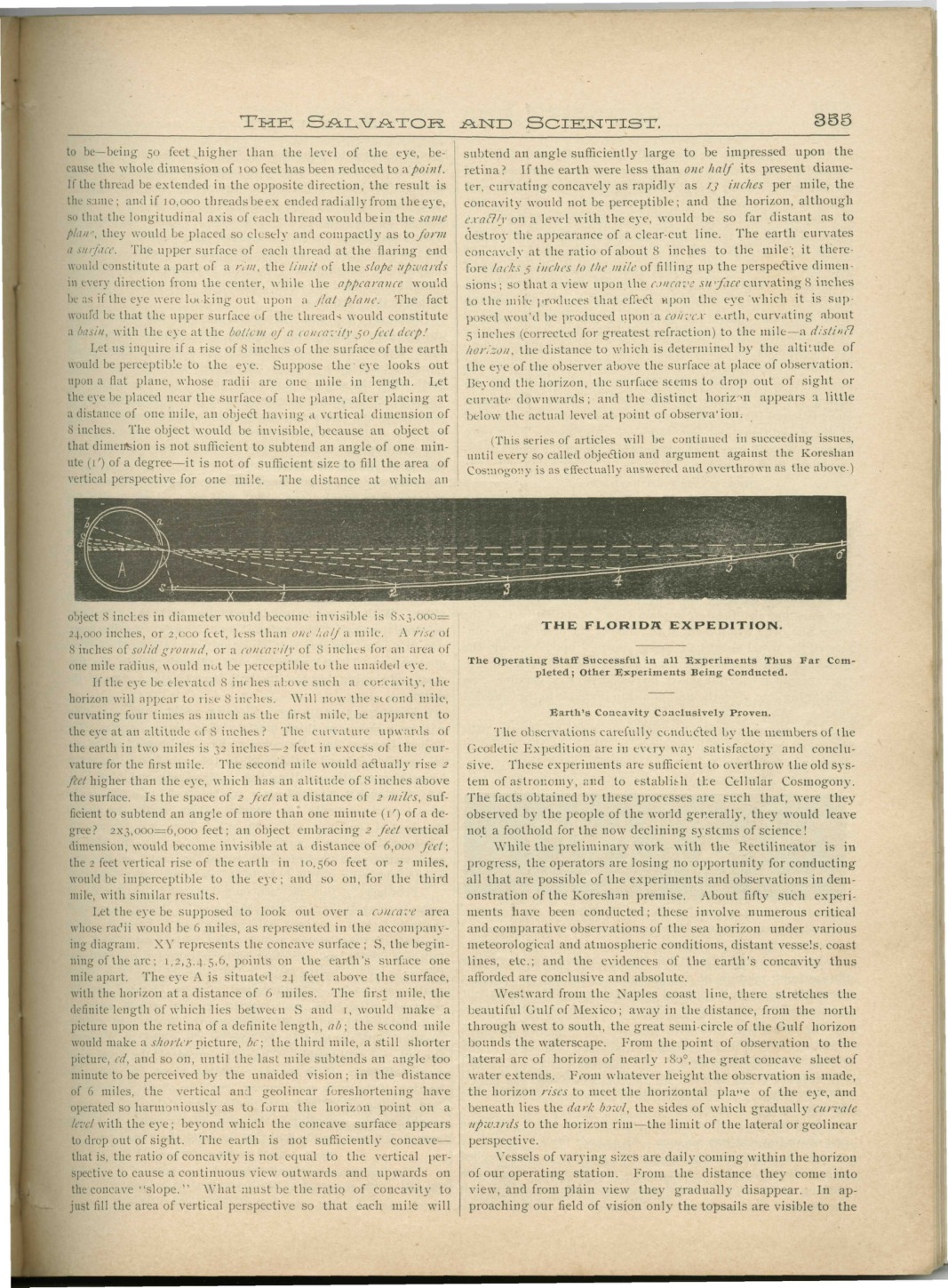
It is a fact patent to all, that objects of given size, receding in the distance, appear to grow smaller and smaller until they entirely disappear. They do not in fact diminish; the apparent diminution in size is due to the operation of certain visual laws in the implantation of the impression of the objects upon the retina of the eye. It is a fact well known to those who have had to do with parallel lines, or who have observed a straight reach of railway tracks, that there is an apparent convergence in the distance. When the mind perceives an object which appears to be small, it is either actually small in size, or it is distant; if large, it is either actually large or near. The apparent size of an object, therefore, depends upon the visual angle which the object subtends. We may illustrate this principle by the following diagram, A representing the eye; BC an arrow 12 inches in length, at a given distance from the eye; bc, its impression upon the retina of the eye; DE, the same arrow removed to twice the distance from the eye, and de, the length of the impression upon the retina; P is the pupil where the rays cross and focalize. Let it be noticed here that de is just one half the length of the image bc, and the corresponding visual angle is proportionably smaller. The same arrow could be removed so far from the eye as to be entirely invisible. The smallest angle under which an object can be seen is about one sixtieth part of one degree, or one minute (1') of space, so that when an object is removed to a distance which equals 3,000 times its diameter, it will subtend an angle no larger than one minute (1') of a degree, and therefore will be visible as a point; this is the vanishing point. For the sake of illustration, let us suppose that a balloon 100 feet in diameter recedes until it appears to be a mere point. We know that it has not actually been reduced to a point. The vanishing point of the balloon necessarily embraces a dimension of 100 feet. If we extend a thread to the balloon so that it shall have apparently the same diameter throughout the distance, its diameter will have to be increased proportionably to the distance, so that when the balloon is reached the thread would have to be 100 feet in diameter. When the eye is applied to the thread, its sides, although curvating outwards more and more like a trumpet, appear absolutely parallel and the sides straight. The upper or vertical point of the thread at the vanishing point of 100 feet, would really be higher than it appears—being 50 feet higher than the level of the eye, because the whole dimension of 100 feet has been reduced to a point.
PDF p. 19
If the thread be extended in the opposite direction, the result is the same; and if 10,000 threads be extended radially from the eye, so that the longitudinal axis of each thread would be in the same plane, they would be placed so closely and compactly as to form a surface. The upper surface of each thread at the flaring end would constitute a part of a rim, the limit of the slope upwards in every direction from the center, while the appearance would be as if the eye were looking out upon a flat plane. The fact would be that the upper surface of the threads would constitute a basin, with the eye at the bottom of a concavity 50 feet deep!
Let us inquire if a rise of 8 inches of the surface of the earth would be perceptible to the eye. Suppose the eye looks out upon a flat plane, whose radii are one mile in length. Let the eye be placed near the surface of the plane, after placing at a distance of one mile an object having a vertical dimension of 8 inches. The object would be invisible, because an object of that dimension is not sufficient to subtend an angle of one minute (1') of a degree—it is not of sufficient size to fill the area of vertical perspective for one mile. The distance at which an object 8 inches in diameter would become invisible is 8 × 3,000 = 24,000 inches, or 2,000 feet, less than one-half mile. A rise of 8 inches at solid ground, or a concavity of 8 inches for an area of one-mile radius, would not be perceptible to the unaided eye.
If the eye be elevated 8 inches above such a concavity, the horizon will appear to rise 8 inches. Will now the second mile, curvating four times as much as the first mile, be apparent to the eye at an altitude of 8 inches? The curvature upwards of the earth in two miles is 32 inches—2 feet in excess of the curvature for the first mile. The second mile would actually rise 2 feet higher than the eye, which has an altitude of 8 inches above the surface. Is the space of 2 feet at a distance of 2 miles sufficient to subtend an angle of more than one minute (1') of a degree? 2 × 3,000 = 6,000 feet; an object embracing 2 feet vertical dimension would become invisible at a distance of 6,000 feet; the 2 feet vertical rise of the earth in 10,560 feet, or 2 miles, would be imperceptible to the eye; and so on, for the third mile, with similar results.
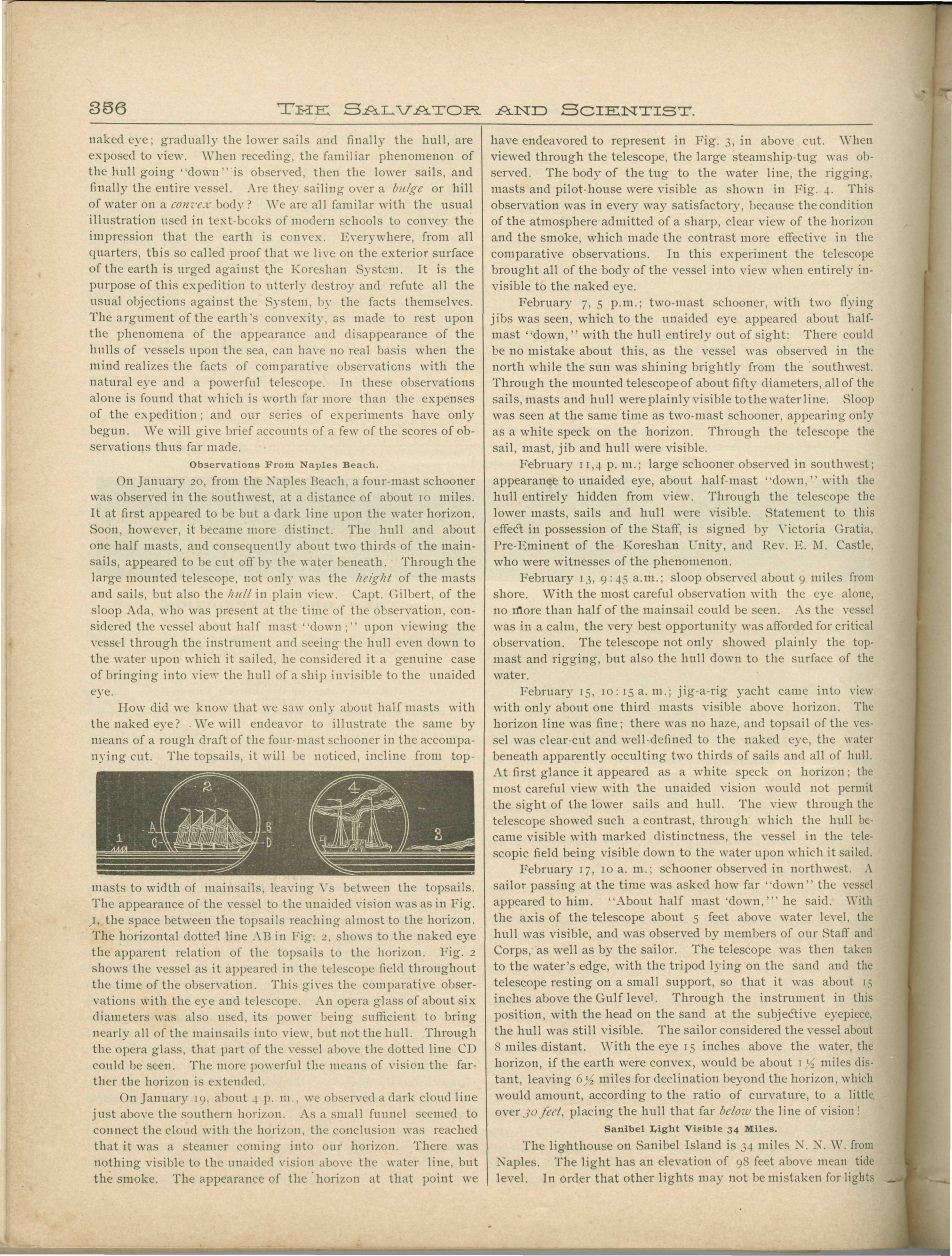
Let the eye be supposed to look out over a concave area whose radii would be 6 miles, as represented in the accompanying diagram. XY represents the concave surface; S, the beginning of the arc; 1, 2, 3, 4, 5, 6, points on the earth's surface one mile apart. The eye A is situated 24 feet above the surface, with the horizon at a distance of 6 miles. The first mile, the definite length of which lies between S and 1, would make a picture upon the retina of a definite length, ab; the second mile would make a shorter picture, bc; the third mile, a still shorter picture, cd; and so on, until the last mile subtends an angle too minute to be perceived by the unaided vision. In the distance of 6 miles, the vertical and geolinear foreshortening have operated so harmoniously as to form the horizon point on a level with the eye; beyond which the concave surface appears to drop out of sight. The earth is not sufficiently concave—that is, the ratio of concavity is not equal to the vertical perspective to cause a continuous view outwards and upwards on the concave “slope.” What must be the ratio of concavity to just fill the area of vertical perspective so that each mile will subtend an angle sufficiently large to be impressed upon the retina? If the earth were less than one half its present diameter, curvating concavely as rapidly as 13 inches per mile, the concavity would not be perceptible; and the horizon, although exactly on a level with the eye, would be so far distant as to destroy the appearance of a clear-cut line. The earth curvates concavely at the ratio of about 8 inches to the mile; it therefore lacks 5 inches to the mile of filling up the perspective dimensions; so that a view upon the concave surface curvating 8 inches to the mile produces that effect upon the eye which it is supposed would be produced upon a convex earth, curvating about 5 inches (corrected for greatest refraction) to the mile—a distinct horizon, the distance to which is determined by the altitude of the eye of the observer above the surface at place of observation. Beyond the horizon, the surface seems to drop out of sight or curve downwards; and the distinct horizon appears a little below the actual level at point of observation.
(This series of articles will be continued in succeeding issues, until every so-called objection and argument against the Koreshan Cosmogony is as effectually answered and overthrown as the above.)
Vol. 11, No. 3 · Mar. 1897 · PDF pp. 18–19
- --
The source scans remain the record. This page preserves the periodical's argument and reported observations without presenting its conclusions as independently established results. The claims remain attributed to The Flaming Sword.
← Flaming Sword Archive
The Flaming Sword · Vol. 11, No. 3 · Mar 1897 · PDF pp. 18–20