Extracted text
Source-led transcription, lightly normalized from the page scans. The printed article ends on PDF p. 19 before the separate “More Light From Chicago” heading; the periodical’s claims remain those of The Flaming Sword.
The Cause of Day and Night.
The vicissitudes of day and night force even the most casual observer to the conclusion that movements of some kind obtain in the universe to produce these changes. The cause of day and night, with all that follows in the train of conclusion, has been the battleground of astronomical theories of the past. It has been a question as to what moves to produce the alternations of light and darkness—the earth or the sun. The usual theory of the earth's daily rotation has seemed so plausible to the common people of the present time that they consider that it must be direct evidence that it is true—so true that the Koreshan Astronomy is treated as an absurdity. Let the investigator consider the fact that astronomers admit that so far as the phenomena of day and night are concerned, the Ptolemaic system, which was supplanted by the Copernican system for other reasons, accounted for the changes of morning, noon and night as accurately as the popular theory seems to do it; he will be forced to the conclusion that the phenomena under consideration do not constitute evidence in favor of the Copernican theory.
Connected with this subject, are questions which the modern scientist has never been able to solve. It is easy enough to say that the earth revolves on its axis in 24 hours, and quite another thing to prove it; the evolution of an hypothesis upon this basis is not difficult, but to give the cause of the earth's supposed diurnal rotation has been the vain and unsuccessful effort of astronomers for centuries. This at once stamps the theory as being the result of ignorance of the simplest principles and laws of the universe. If the earth rotates daily upon an axis, from whence is derived the energy of rotation? If the earth revolves about the sun in 365 days, in an orbit of 185,000,000 miles diameter, what is the source of its projectile energy? Are the conclusions of the modern scientist reasonable if he cannot show a proven premise, nor explain the causes which produce the results so commonly observed? The Copernican system is being weighted down with objections placed over against it, which its advocates cannot remove. The Koreshan System stands solidly upon its foundation fact—the demonstrated premise of the water's concavity; it answers all objections, accounts for all phenomena, and gives the causes, not only of universal phenomena and motion, but the science of their existence!
We do not deny any of the facts of astronomical observation or of geographical research; we find no necessity for doing so. In the consideration of the subject of day and night, we are not so ignorant as to undertake to set aside the many facts of investigation of solar time or of the periods of daylight and darkness; we use them all. It is a fact of the most common observation that every day at noon, the sun is directly in the south on our meridian; 12 hours later, the sun is on the opposite meridian, 180° to the westward, or just halfway round the earth. When the sun is on the equator, it rises at 6 a. m. and sets at 6 p. m., the world over, and the area of daylight stretches from pole to pole. From these facts it is evident that one half of the earth's surface is continually illumined by the sun, while in the other half there is night, bordered in the east, west, north and south by the deepening shades of twilight. Thus day and night succeed each other, and in the course of 24 hours the sun passes over 360°, bringing noon to every meridian.
During the period of 24 hours the heavens revolve, studded with the greater and lesser lights, and millions of stars, with here and there on the ecliptic, the brilliant gems of the planetary orbs. The diurnal rotation of the sphere of the heavens above us is derived from the reciprocal relation of the universal center and circumference, the principles of which are found in the well-known scientific apparatus, called the radiometer. The central solar sphere, the center of influx and efflux of universal energies, possesses a light and a dark side, the reflective and absorptive hemispheres, and rotates diurnally. The image of this central sun is focalized upon the upper stratum of our atmosphere, at a distance of about 1,000 miles above the earth's surface; the projected sun, the sun we see, has a daily motion, and is the direct cause of the changes of light and darkness which obtain at the earth's surface. Its light covers one half the area of the earth's concave surface; the hemisphere of light, when the sun is on the equator, reaches over 90° east, west, north and south.
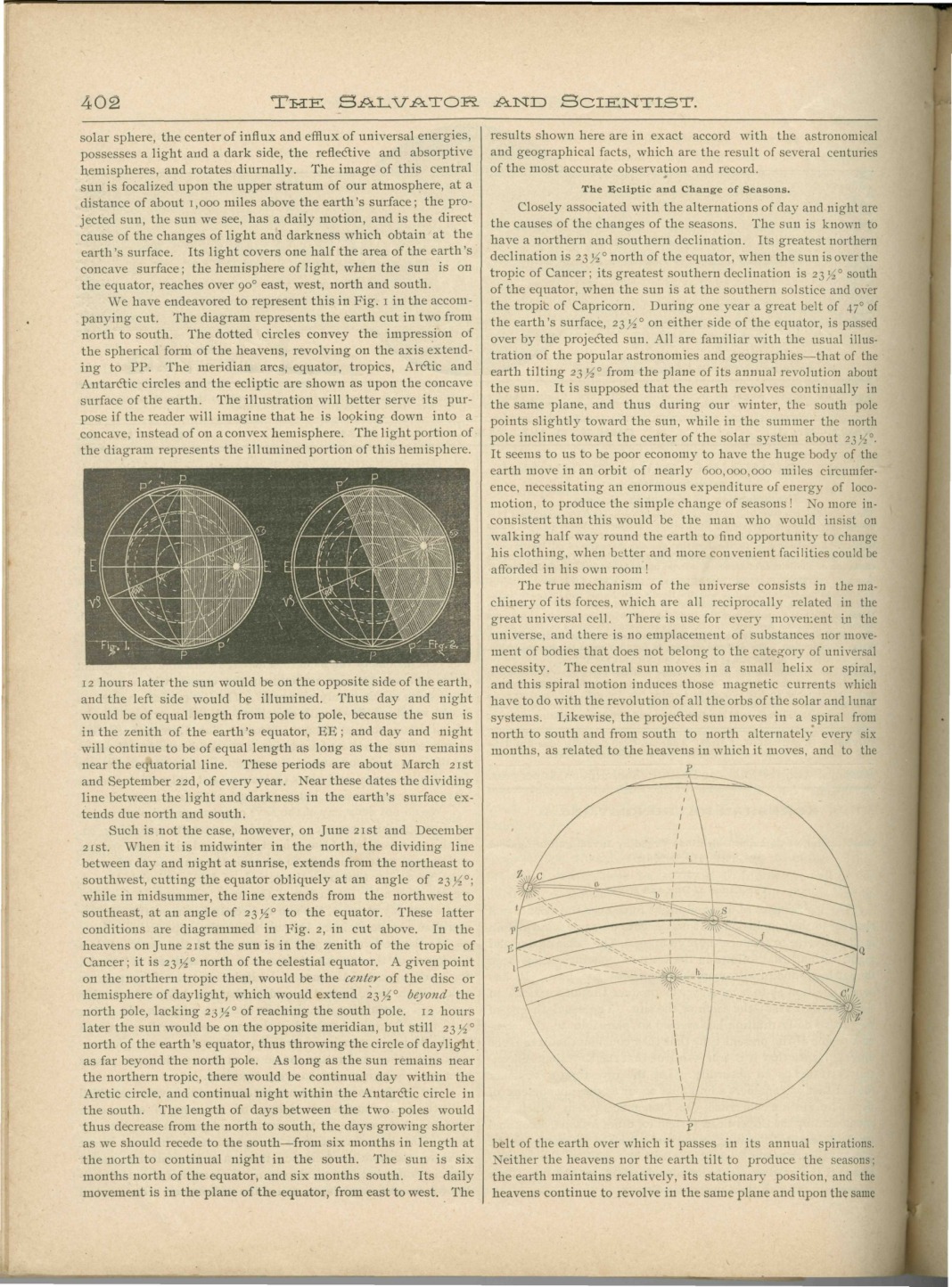
We have endeavored to represent this in Fig. 1 in the accompanying cut. The diagram represents the earth cut in two from north to south. The dotted circles convey the impression of the spherical form of the heavens, revolving on the axis extending to PP. The meridian arcs, equator, tropics, Arctic and Antarctic circles and the ecliptic are shown as upon the concave surface of the earth. The illustration will better serve its purpose if the reader will imagine that he is looking down into a concave, instead of on a convex hemisphere. The light portion of the diagram represents the illumined portion of this hemisphere.
12 hours later the sun would be on the opposite side of the earth, and the left side would be illumined. Thus day and night would be of equal length from pole to pole, because the sun is in the zenith of the earth's equator, EE; and day and night will continue to be of equal length as long as the sun remains near the equatorial line. These periods are about March 21st and September 22d, of every year. Near these dates the dividing line between the light and darkness in the earth's surface extends due north and south.
Such is not the case, however, on June 21st and December 21st. When it is midwinter in the north, the dividing line between day and night at sunrise, extends from the northeast to southwest, cutting the equator obliquely at an angle of 23½°; while in midsummer, the line extends from the northwest to southeast, at an angle of 23½° to the equator. These latter conditions are diagrammed in Fig. 2, in cut above. In the heavens on June 21st the sun is in the zenith of the tropic of Cancer; it is 23½° north of the celestial equator. A given point on the northern tropic then, would be the center of the disc or hemisphere of daylight, which would extend 23½° beyond the north pole, lacking 23½° of reaching the south pole. 12 hours later the sun would be on the opposite meridian, but still 23½° north of the earth's equator, thus throwing the circle of daylight as far beyond the north pole. As long as the sun remains near the northern tropic, there would be continual day within the Arctic circle, and continual night within the Antarctic circle in the south. The length of days between the two poles would thus decrease from the north to south, the days growing shorter as we should recede to the south—from six months in length at the north to continual night in the south. The sun is six months north of the equator, and six months south. Its daily movement is in the plane of the equator, from east to west. The results shown here are in exact accord with the astronomical and geographical facts, which are the result of several centuries of the most accurate observation and record.
The "Ecliptic and Change of Seasons. Closely associated with the alternations of day and night are the causes of the changes of the seasons. The sun is known to have a northern and southern declination. Its greatest northern declination is 23½° north of the equator, when the sun is over the tropic of Cancer; its greatest southern declination is 23½° south of the equator, when the sun is at the southern solstice and over the tropic of Capricorn. During one year a great belt of 47° of the earth's surface, 23½° on either side of the equator, is passed over by the projected sun. All are familiar with the usual illustration of the popular astronomies and geographies—that of the earth tilting 23½° from the plane of its annual revolution about the sun. It is supposed that the earth revolves continually in the same plane, and thus during our winter, the south pole points slightly toward the sun, while in the summer the north pole inclines toward the center of the solar system about 23½°. It seems to us to be poor economy to have the huge body of the earth move in an orbit of nearly 600,000,000 miles circumference, necessitating an enormous expenditure of energy of locomotion, to produce the simple change of seasons! No more inconsistent than this would be the man who would insist on walking half way round the earth to find opportunity to change his clothing, when better and more convenient facilities could be afforded in his own room!
The true mechanism of the universe consists in the machinery of its forces, which are all reciprocally related in the great universal cell. There is use for every movement in the universe, and there is no emplacement of substances nor movement of bodies that does not belong to the category of universal necessity. The central sun moves in a small helix or spiral, and this spiral motion induces those magnetic currents which have to do with the revolution of all the orbs of the solar and lunar systems. Likewise, the projected sun moves in a spiral from north to south and from south to north alternately every six months, as related to the heavens in which it moves, and to the belt of the earth over which it passes in its annual spirations. Neither the heavens nor the earth tilt to produce the seasons; the earth maintains relatively, its stationary position, and the heavens continue to revolve in the same plane and upon the same axes. The northern and southern declination of the projected sun is the direct result of the spiral movements and change of obliquity of the axis of the astral center; the projected sun's annual path is the ecliptic. The heavens rotate daily from east to west; in the heavens the sun's annual motion is from west to east; its movement in this direction is at the rate of about 1° of space, or 4 minutes of time, per day. It completes its revolution in the Zodiac in 365¼ days.
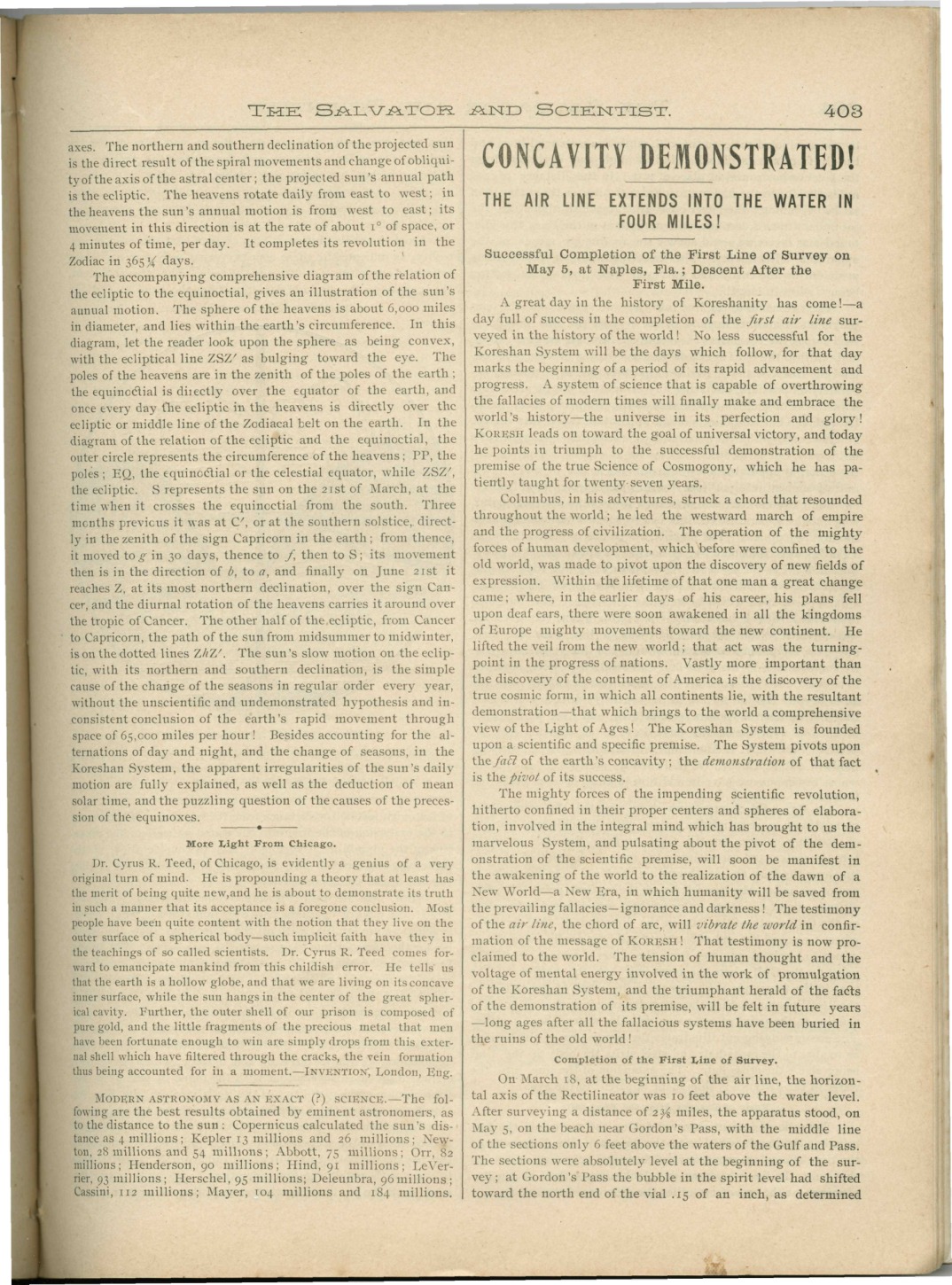
The accompanying comprehensive diagram of the relation of the ecliptic to the equinoctial, gives an illustration of the sun's annual motion. The sphere of the heavens is about 6,000 miles in diameter, and lies within the earth's circumference. In this diagram, let the reader look upon the sphere as being convex, with the ecliptical line ZSZ' as bulging toward the eye. The poles of the heavens are in the zenith of the poles of the earth; the equinoctial is directly over the equator of the earth, and once every day the ecliptic in the heavens is directly over the ecliptic or middle line of the Zodiacal belt on the earth. In the diagram of the relation of the ecliptic and the equinoctial, the outer circle represents the circumference of the heavens; PP, the poles; EQ, the equinoctial or the celestial equator, while ZSZ', the ecliptic. S represents the sun on the 21st of March, at the time when it crosses the equinoctial from the south. Three months previous it was at C', or at the southern solstice, directly in the zenith of the sign Capricorn in the earth; from thence, it moved to g in 30 days, thence to f, then to S; its movement then is in the direction of b, to a, and finally on June 21st it reaches Z, at its most northern declination, over the sign Cancer, and the diurnal rotation of the heavens carries it around over the tropic of Cancer. The other half of the ecliptic, from Cancer to Capricorn, the path of the sun from midsummer to midwinter, is on the dotted lines ZZ'. The sun's slow motion on the ecliptic, with its northern and southern declination, is the simple cause of the change of the seasons in regular order every year, without the unscientific and undemonstrated hypothesis and inconsistent conclusion of the earth's rapid movement through space of 65,000 miles per hour! Besides accounting for the alternations of day and night, and the change of seasons, in the Koreshan System, the apparent irregularities of the sun's daily motion are fully explained, as well as the deduction of mean solar time, and the puzzling question of the causes of the precession of the equinoxes.
Vol. 11, No. 5 · May 1897 · PDF pp. 17–19
- --
The source scans remain the record. This page preserves the periodical's argument and reported observations without presenting its conclusions as independently established results. The claims remain attributed to The Flaming Sword.
← Flaming Sword Archive
The Flaming Sword · Vol. 11, No. 5 · May 1897 · PDF pp. 17–19