Extracted text
Consideration of Common Objections Urged by Investigators Against the Cellular Cosmogony.
Usual Suppositions Concerning Perpendiculars.
By Prof. U. G. Morrow.
Editorial transcription, lightly normalized from the cited scan pages. Historical claims remain those of The Flaming Sword.
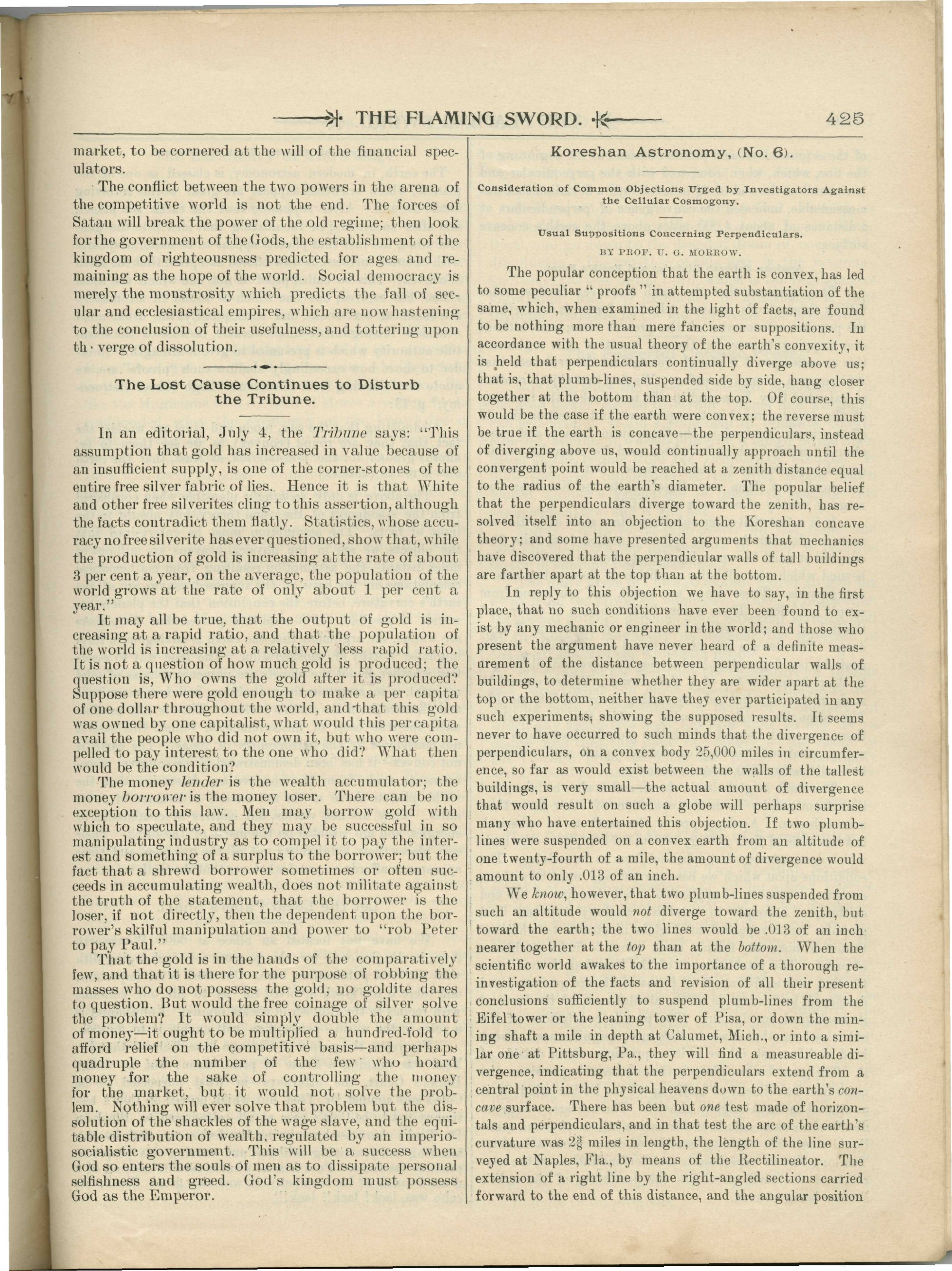
The popular conception that the earth is convex, has led to some peculiar " proofs " in attempted substantiation of the same, which, when examined in the light of facts, are found to be nothing more than mere fancies or suppositions. In accordance with the usual theory of the earth's convexity, it is held that perpendiculars continually diverge above us; that is, that plumb-lines, suspended side by side, hang closer together at the bottom than at the top. Of course, this would be the case if the earth were convex; the reverse must be true if the earth is concave—the perpendiculars, instead of diverging above us, would continually approach until the convergent point would be reached at a zenith distance equal to the radius of the earth's diameter. The popular belief that the perpendiculars diverge toward the zenith, has resolved itself into an objection to the Koreshan concave theory; and some have presented arguments that mechanics have discovered that the perpendicular walls of tall buildings are farther apart at the top than at the bottom.
In reply to this objection we have to say, in the first place, that no such conditions have ever been found to exist by any mechanic or engineer in the world; and those who present the argument have never heard of a definite measurement of the distance between perpendicular walls of buildings, to determine whether they are wider apart at the top or the bottom, neither have they ever participated in any such experiments showing the supposed results. It seems never to have occurred to such minds that the divergence of perpendiculars, on a convex body 25,000 miles in circumference, so far as would exist between the walls of the tallest buildings, is very small—the actual amount of divergence that would result on such a globe will perhaps surprise many who have entertained this objection. If two plumb-lines were suspended on a convex earth from an altitude of one twenty-fourth of a mile, the amount of divergence would amount to only.013 of an inch.
We know, however, that two plumb-lines suspended from such an altitude would not diverge toward the zenith, but toward the earth; the two lines would be.013 of an inch nearer together at the top than at the bottom. When the scientific world awakes to the importance of a thorough reinvestigation of the facts and revision of all their present conclusions sufficiently to suspend plumb-lines from the Eifel tower or the leaning tower of Pisa, or down the mining shaft a mile in depth at Calumet, Mich., or into a similar one at Pittsburg, Pa., they will find a measurable divergence, indicating that the perpendiculars extend from a central point in the physical heavens down to the earth's concave surface. There has been but one test made of horizontals and perpendiculars, and in that test the arc of the earth's curvature was 2½ miles in length, the length of the line surveyed at Naples, Fla., by means of the Rectilineator. The extension of a right line by the right-angled sections carried forward to the end of this distance, and the angular position of the original level and plumb obtained at the beginning of the line, which, when compared with the perpendicular and horizontal at the end of 2½ miles showed a deviation that was measurable, indicated the convergence of perpendiculars at a distance of about 4,000 miles above the earth's concave surface.
Analogy Between Globules and "Earth's Form.
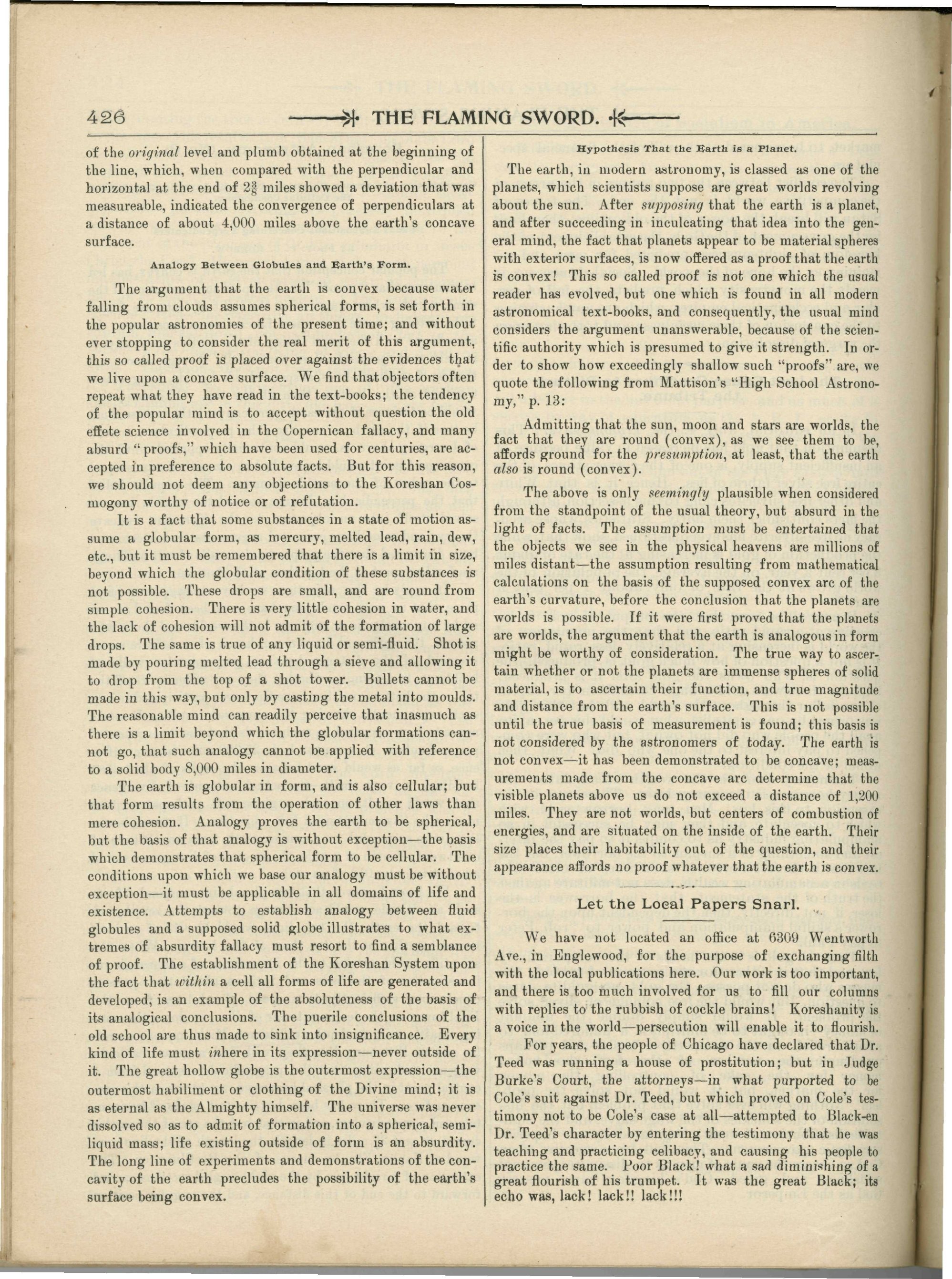
The argument that the earth is convex because water falling from clouds assumes spherical forms, is set forth in the popular astronomies of the present time; and without ever stopping to consider the real merit of this argument, this so called proof is placed over against the evidences that we live upon a concave surface. We find that objectors often repeat what they have read in the text-books; the tendency of the popular mind is to accept without question the old effete science involved in the Copernican fallacy, and many absurd " proofs," which have been used for centuries, are accepted in preference to absolute facts. But for this reason, we should not deem any objections to the Koreshan Cosmogony worthy of notice or of refutation.
It is a fact that some substances in a state of motion assume a globular form, as mercury, melted lead, rain, dew, etc., but it must be remembered that there is a limit in size, beyond which the globular condition of these substances is not possible. These drops are small, and are round from simple cohesion. There is very little cohesion in water, and the lack of cohesion will not admit of the formation of large drops. The same is true of any liquid or semi-fluid. Shot is made by pouring melted lead through a sieve and allowing it to drop from the top of a shot tower. Bullets cannot be made in this way, but only by casting the metal into moulds. The reasonable mind can readily perceive that inasmuch as there is a limit beyond which the globular formations cannot go, that such analogy cannot be applied with reference to a solid body 8,000 miles in diameter.
The earth is globular in form, and is also cellular; but that form results from the operation of other laws than mere cohesion. Analogy proves the earth to be spherical, but the basis of that analogy is without exception—the basis which demonstrates that spherical form to be cellular. The conditions upon which we base our analogy must be without exception—it must be applicable in all domains of life and existence. Attempts to establish analogy between fluid globules and a supposed solid globe illustrates to what extremes of absurdity fallacy must resort to find a semblance of proof. The establishment of the Koreshan System upon the fact that within a cell all forms of life are generated and developed, is an example of the absoluteness of the basis of its analogical conclusions. The puerile conclusions of the old school are thus made to sink into insignificance. Every kind of life must inhere in its expression—never outside of it. The great hollow globe is the outermost expression—the outermost habiliment or clothing of the Divine mind; it is as eternal as the Almighty himself. The universe was never dissolved so as to admit of formation into a spherical, semi-liquid mass; life existing outside of form is an absurdity. The long line of experiments and demonstrations of the concavity of the earth precludes the possibility of the earth's surface being convex.
Hypothesis That the Earth is a Planet.
The earth, in modern astronomy, is classed as one of the planets, which scientists suppose are great worlds revolving about the sun. After supposing that the earth is a planet, and after succeeding in inculcating that idea into the general mind, the fact that planets appear to be material spheres with exterior surfaces, is now offered as a proof that the earth is convex! This so called proof is not one which the usual reader has evolved, but one which is found in all modern astronomical text-books, and consequently, the usual mind considers the argument unanswerable, because of the scientific authority which is presumed to give it strength. In order to show how exceedingly shallow such "proofs" are, we quote the following from Mattison's "High School Astronomy," p. 13:
Admitting that the sun, moon and stars are worlds, the fact that they are round (convex), as we see them to be, affords ground for the presumption, at least, that the earth also is round (convex).
The above is only seemingly plausible when considered from the standpoint of the usual theory, but absurd in the light of facts. The assumption must be entertained that the objects we see in the physical heavens are millions of miles distant—the assumption resulting from mathematical calculations on the basis of the supposed convex arc of the earth's curvature, before the conclusion that the planets are worlds is possible. If it were first proved that the planets are worlds, the argument that the earth is analogous in form might be worthy of consideration. The true way to ascertain whether or not the planets are immense spheres of solid material, is to ascertain their function, and true magnitude and distance from the earth's surface. This is not possible until the true basis of measurement is found; this basis is not considered by the astronomers of today. The earth is not convex—it has been demonstrated to be concave; measurements made from the concave arc determine that the visible planets above us do not exceed a distance of 1,200 miles. They are not worlds, but centers of combustion of energies, and are situated on the inside of the earth. Their size places their habitability out of the question, and their appearance affords no proof whatever that the earth is convex.
Source boundary: Begins under Koreshan Astronomy (No. 6); ends before Let the Local Papers Snarl.
Vol. 11, No. 7 · July 1897 · PDF pp. 5, 6
- --
The source scans remain the record. This page preserves the periodical's argument and reported observations without presenting its conclusions as independently established results. The claims remain attributed to The Flaming Sword.
← Flaming Sword Archive
The Flaming Sword · Vol. 11, No. 7 · · PDF pp. 5-6