Extracted text
By Koresh — Part IV.
Editorial transcription, lightly normalized from the scan. Line-break hyphenation, spacing, capitalization, and unmistakable OCR errors have been repaired; the claims remain those of The Flaming Sword. The article's diagram (No. 1, "The Laws of Visual Impression") is not reproduced; its caption text is preserved in the body.
THE VERY overshadowing of the primary seven successive baptisms proceeds directly, not from an invisible "oversoul," but from the tangible personality. The Holy Spirit shed upon the world (the church in the beginning of the age) proceeded from the visible Lord in his conversion from matter to spirit. If the Lord had not been personal, there could not have obtained the dissolution of his body and its conversion to Holy Spirit; and therefore the afflatus (the "oversoul") could not have obtained.
But the vortical involution, the anthropostic, took place in alchemico-organic (physical) space; therefore it involved the material elements not included in the organo-vital structure, and the vibrations were communicated to the elements and essences of the alchemico-organic kosmos, converging toward and into the stellar nucleus of the alchemico-organic world, and radiating to its circumferences.
It is thus that the conscious mental nucleus of the anthropostic imparts momentum to the activities of what has been denominated the physical universe. The impulse ceases to be mental substance so soon as the influence of correlation has mutated the vibration of mental substance to the vibration of alchemico-organic (physical) substance, and what we call the physical universe is but the expressed thought of the voluntary and involuntary mental cause producing it, so a knowledge of this expressed and manifest language reveals the history of human origin and destiny.
Optical Factors and Illusions
It is assumed by those who profess to believe in and advocate the Copernican system of astronomy, that the earth is convex because it appears so from optical observation. A person standing upon a tower and looking out in every direction will see the vanishing point at an equal distance, and the horizon (the limit of geolinear vision) describes a circle around this center of observation. This fact in appearance is taken as an assumption of the earth's convexity, because it is claimed that nothing but a globe would thus respond to, and impress itself upon, the organs of vision.
We maintain that an assumption predicated upon an optical illusion is not sufficient ground for the establishment of a rational conviction. If the earth were a perfectly flat surface extended inimitably, an observation from a tower looking out in every direction would assume, to the eye, the appearance of a circular horizon, for the simple reason that geolinear foreshortening would provide for a vanishing point at a given distance from the observer, proportionate to the elevation of the point from which the observation is taken.
If a person will stand upon a railroad track equidistant between two rails, the rails will seem to approach each other in the distance, the apparent contact, or vanishing point, being proportioned to the space between the rails and the height of observation. If they are five feet apart, the vanishing point is less than if they were six or seven feet apart.
Suppose we take a geolinear extense on the surface of the earth as one rail, and an imaginary line through the air as the other, placing the eye two and one half feet from the earth's surface. Now, the same law obtains in looking parallel along this surface, as in looking parallel to the rail and along its side. Making our observation by the side of the rail, the vanishing point is reached and the rail disappears, although extended in a straight line far beyond the vanishing point. The line over which observation is taken along the surface of the earth is the geolinear extense; it corresponds to the rail, and disappears by the same law; namely, that of foreshortening.
The phenomenon of the disappearance of a ship, hull first, as it recedes from view, is caused by the same law of foreshortening as that which governs the disappearance of the rail, or causes the two rails to appear to approach each other. If we should make calculations on the basis of the appearance instead of on the basis of the fact that the rails do not approach, but only seem to, we necessarily draw false conclusions. This is precisely what the astronomers do. They conclude from appearances rather than from facts.
A balloon six or seven miles distant, appearing about the size of a pin head, if it be sixty feet in diameter, occupies as much space in the distance as when near the subjective point of observation. The law by which the balloon appears to diminish in size as it recedes from view, is the same as that which produces geolinear foreshortening, or which makes the surface of the earth diminish longitudinally as extending from the point of observation.
This phenomenon belongs to the organ of vision, and cannot be comprehended except we possess a correct knowledge of the laws and phenomena of optics. Owing to this fact, the student cannot comprehend the principles involved in the phenomena of optical appearances and illusion, without a thorough comprehension of the principles and laws of optics.
In another part of this volume, the reader will find a complete record of the mechanical apparatus and processes by which we have so absolutely demonstrated the concavity of the earth as to overshadow the fallacious conclusions of mountebanks — Copernicus, et al., and their deluded followers.
We place a brief study of optics before the reader, merely to show wherein the fallacious conclusions of modern, so-called science, while conflicting with the discovered and projected truth, are drawn not from facts but from appearances.
Conclusions of Modern Science not Drawn from Facts but from Appearances
It might appear, as we proclaim the fact that a thorough knowledge of the Koreshan Cosmogony demands a thorough knowledge of optics, that it is our purpose to set forth a complete optical treatise preparatory to an understanding of the Koreshan Cosmogony. A thorough knowledge of Koreshanity must necessarily be a question of growth. A slight knowledge of the laws of optics will enable the student to see the discrepancies of modern astronomy, as predicated upon a misinterpretation of appearances.
What we behold through the organs of vision depends entirely upon the imprint of objectivities upon the retina of the eye. What we see is merely a picture placed upon the lining coat of the eyeball, and thence carried through the optic nerve, optic commissure, and optic tract, to that cortical area upon which the final function of vision depends.
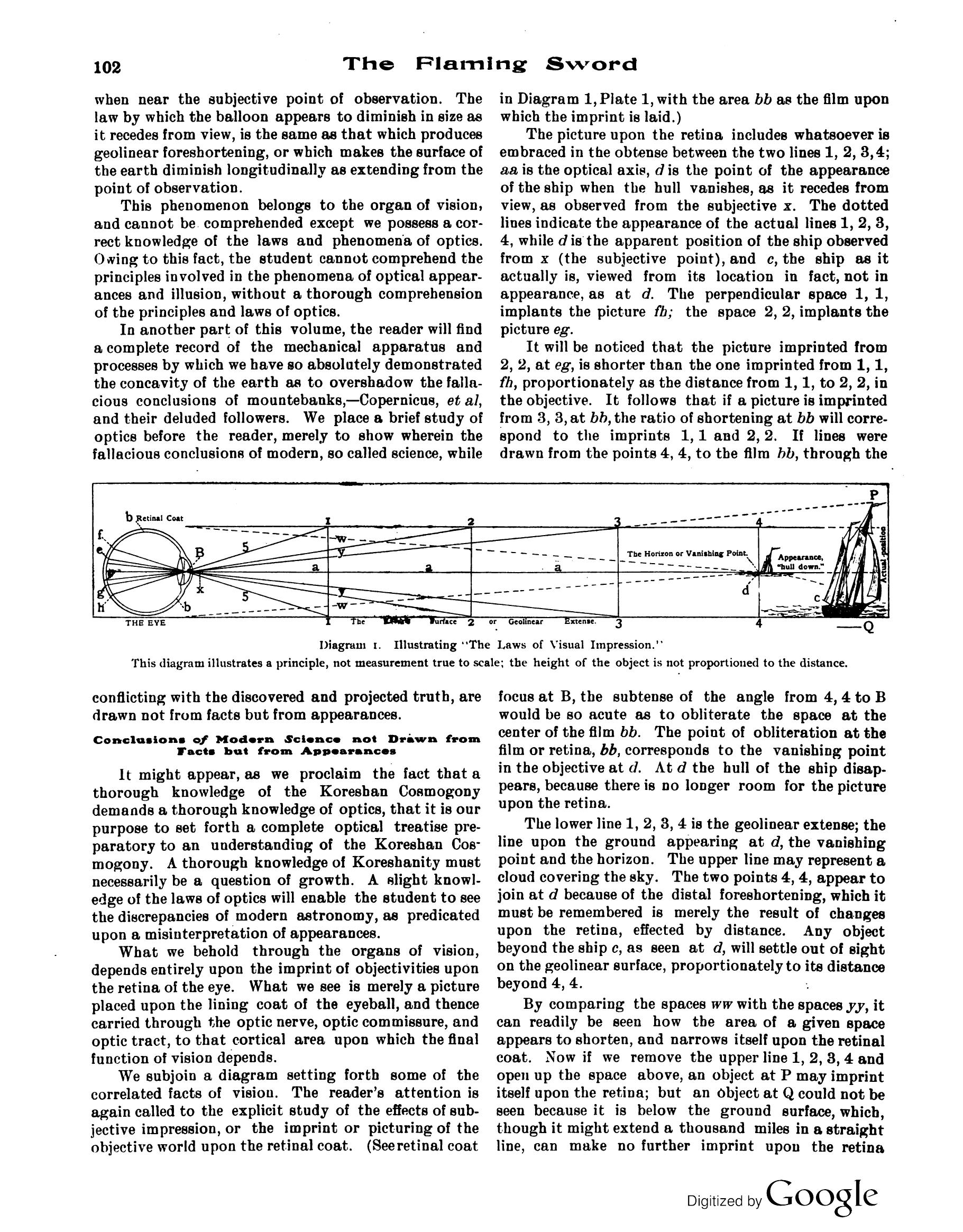
We subjoin a diagram setting forth some of the correlated facts of vision. The reader's attention is again called to the explicit study of the effects of subjective impression, or the imprint or picturing of the objective world upon the retinal coat. (See retinal coat in Diagram 1, Plate 1, with the area bb as the film upon which the imprint is laid.)
The picture upon the retina includes whatsoever is embraced in the obtense between the two lines 1, 2, 3, 4; aa is the optical axis, d is the point of the appearance of the ship when the hull vanishes, as it recedes from view, as observed from the subjective x. The dotted lines indicate the appearance of the actual lines 1, 2, 3, 4, while f is the apparent position of the ship observed from x (the subjective point), and c, the ship as it actually is, viewed from its location in fact, not in appearance, as at d.
The perpendicular space 1, 1, implants the picture fb; the space 2, 2, implants the picture eg. It will be noticed that the picture imprinted from 2, 2, at eg, is shorter than the one imprinted from 1, 1, fh, proportionately as the distance from 1, 1, to 2, 2, in the objective. It follows that if a picture is imprinted from 3, 3, at bb, the ratio of shortening at bb will correspond to the imprints 1, 1 and 2, 2. If lines were drawn from the points 4, 4, to the film bb, through the focus at B, the subtense of the angle from 4, 4 to B would be so acute as to obliterate the space at the center of the film bb. The point of obliteration at the film or retina, bb, corresponds to the vanishing point in the objective at d. At d the hull of the ship disappears, because there is no longer room for the picture upon the retina.
The lower line 1, 2, 3, 4 is the geolinear extense; the line upon the ground appearing at d, the vanishing point and the horizon. The upper line may represent a cloud covering the sky. The two points 4, 4, appear to join at d because of the distal foreshortening, which it must be remembered is merely the result of changes upon the retina, effected by distance. Any object beyond the ship c, as seen at d, will settle out of sight on the geolinear surface, proportionately to its distance beyond 4, 4.
By comparing the spaces ww with the spaces yy, it can readily be seen how the area of a given space appears to shorten, and narrows itself upon the retinal coat. Now if we remove the upper line 1, 2, 3, 4 and open up the space above, an object at P may imprint itself upon the retina; but an object at Q could not be seen because it is below the ground surface, which, though it might extend a thousand miles in a straight line, can make no further imprint upon the retina because the space between the lower line 4 and d is the obliterated space, as affecting the retinal film.
We have presented some optical facts upon which depend the appearances upon which rest the fallacies of the Copernican system; facts, a want of the understanding of which places the so-called scientists in the catalogue of the incompetents, which graces the contradictory systems of astronomy that arise spontaneously, subserve their purpose, and die the death of the fallacious in the various careers of mental transformation, as the human mind gropes its way in darkness.
Science and Revelation
It is the common dogma of orthodox theology, that physical science can by no possible means prove or demonstrate the existence and character of the Supreme Being, and that it is therefore left solely to the process and power of inspiration to reveal to man the existence of God and his purpose concerning him, involving human origin and destiny, and man's immortality. Revelation only, it is claimed, can prove the immortality of the soul.
Koreshanity affirms that the physical kosmos is the outward expression of thought, formulated through a succession of operations having their primary impetus in personal mental activity. The kosmos, therefore, is the outermost, or most literal and physical formulation from mental substance, and because expressed from supreme consciousness, and being the most physical, extreme, and limitable point of motion and form, does in itself, when correctly interpreted, reveal the character and purpose of God.
A Correct Knowledge of the Kosmos Scientifically Demonstrates Immortality
A correct knowledge of the form of the physical kosmos scientifically demonstrates the immortality of man. One of the cardinal doctrines of Koreshanity is, that man is not immortal, except through regeneration (reproduction) from the first begotten Son of God. Man is mortal from his head to his feet, from center to circumference, from spirit to matter, until the process of regeneration from the divine germ planted in him, reproduces the spirit and form of Godliness. From the mortal state man is regenerated to the immortal, and this state of immortality, when complete, reaches to the limitable form of his organic structure.
The body of man in its present degree or stage of involution is a corrupt and corruptible thing. Its corruptibility depends upon a non-conformity to the laws of life, which are violated both in the mental and physiological realms. Comprehension of and obedience to the laws of life — spiritual, moral, mental, and physiological — will insure man's perpetual existence. Nothing short of this will. The form and functions of life are portrayed in the construction and activities of the physical kosmos.
Every theorem, to be true, must be in agreement with the facts upon which the theorem is constructed. Koreshanity denies the modern so-called physical science, because not in agreement with the facts upon which they purport to be formulated.
Demonstration by Direct Observation
If a person would stand in mid-ocean, any number of feet from the surface of the water, say for instance, at an altitude of one hundred feet, and from such point of view extend his vision in any direction, he would see as the extreme limit of vision, on a horizontal line, the point where water and sky seem to meet. The physical scientist calls this point the horizon. It is so called because this limitable point of the horizontal line of vision is regarded as on a level with the eye.
Drive two poles or bars into the earth twenty rods (more or less) apart, leveling them by means of a spirit level, or other accurate means of fixing them at equal height, and sight over them. The verge (horizon) will be seen on a level with the tops of the two poles. If you sight either way the phenomenon is the same.
Determine and fix the perpendicular of the poles by a plummet, and set another pole twenty rods from one of these in a line with the others. You have now three poles, perpendicular, as determined by the plummet, and of equal height. Draw an absolute chord from the top of the center pole, in both directions, to the top of the other two poles. By an absolute chord is meant a line absolutely straight from pole to pole, or from point to point.
Now if a square be placed against the perpendicular and the chord, they will be found to form a right-angle. Sight from one extreme pole to the other one, and observe the horizon. It will be found on a level with the tops of the poles. If the line of this level be extended in both directions, it will touch the horizon point at the two extremes of the level. This line extended from verge to verge, or from horizon point to horizon point, is called a chord.
The arc of a chord would be the linear surface of the earth from the same two horizon points bowing down to the bottoms of the poles, the distance from the chord to the bottom of the arc being ten feet. The cavity thus represented would give the true contour of the earth, from the horizon points, which would be in the form of a basin, or concave surface.
Our proposition as founded upon these facts is as follows: The earth is a shell or concave sphere, the hollow surface of which is inhabited. The sun is at or near the center, being about 4,000 miles distant, this being one half the distance of the diameter of the shell.
(To be continued.)
- --
The source scans remain the record. This page preserves the installment's argument on mental causation, optical principles, the relation of science to revelation, and direct geometric demonstration without presenting them as independently established results. The claims remain attributed to The Flaming Sword.
← Flaming Sword Archive
The Flaming Sword · Vol. 27, No. 4 · Apr 1913 · PDF pp. 4-7