Extracted text
Part XVI
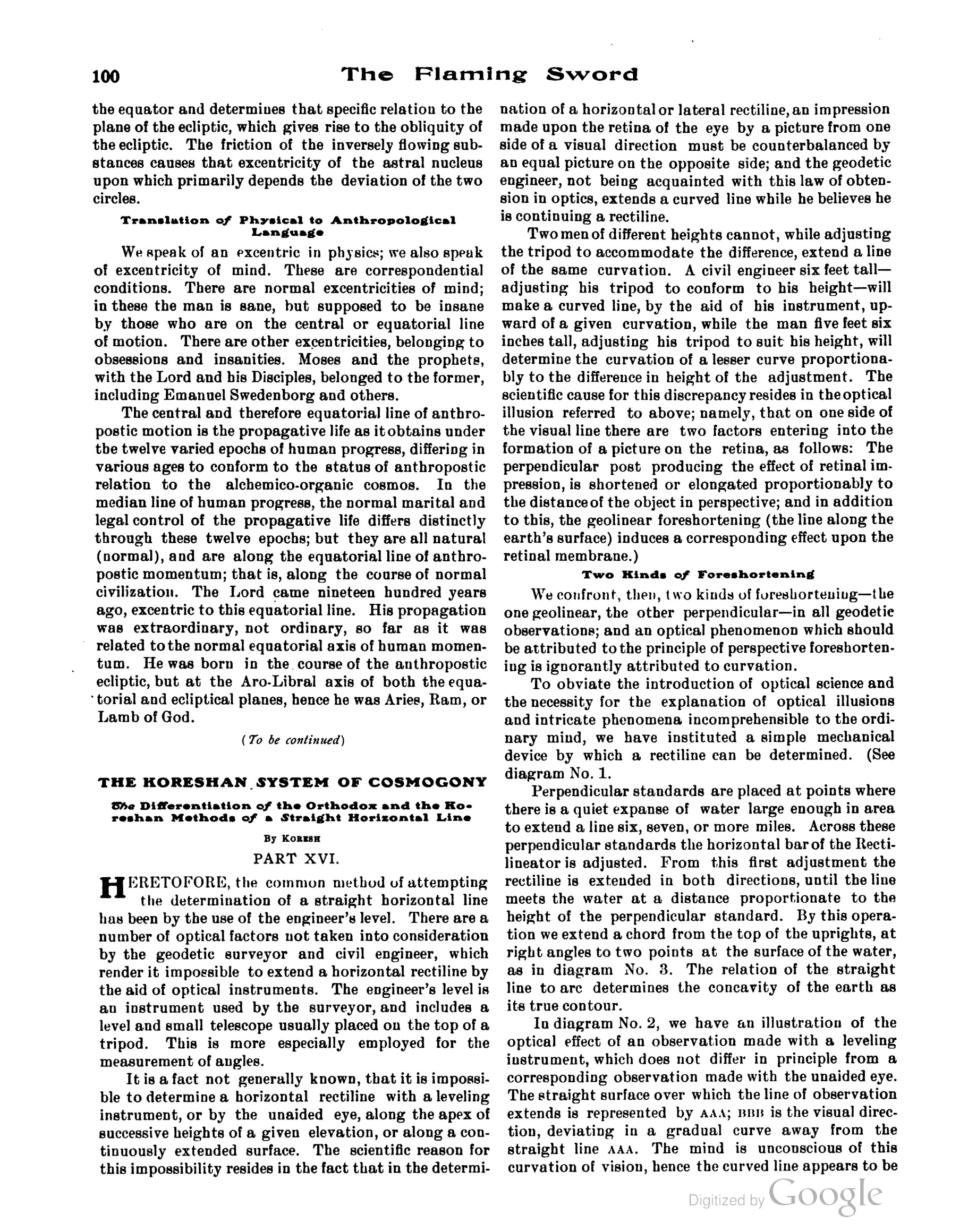
HERETOFORE, the common method of attempting the determination of a straight horizontal line has been by the use of the engineer’s level. There are a number of optical factors not taken into consideration by the geodetic surveyor and civil engineer, which render it impossible to extend a horizontal rectiline by the aid of optical instruments. The engineer’s level is an instrument used by the surveyor, and includes a level and small telescope usually placed on the top of a tripod. This is more especially employed for the measurement of angles.
It is a fact not generally known, that it is impossible to determine a horizontal rectiline with a leveling instrument, or by the unaided eye, along the apex of successive heights of a given elevation, or along a continuously extended surface. The scientific reason for this impossibility resides in the fact that in the determination of a horizontal or lateral rectiline, an impression made upon the retina of the eye by a picture from one side of a visual direction must be counterbalanced by an equal picture on the opposite side; and the geodetic engineer, not being acquainted with this law of obtension in optics, extends a curved line while he believes he is continuing a rectiline.
Two men of different heights cannot, while adjusting the tripod to accommodate the difference, extend a line of the same curvation. A civil engineer six feet tall— adjusting his tripod to conform to his height—will make a curved line, by the aid of his instrument, upward of a given curvation, while the man five feet six inches tall, adjusting his tripod to suit his height, will determine the curvation of a lesser curve proportionably to the difference in height of the adjustment. The scientific cause for this discrepancy resides in the optical illusion referred to above; namely, that on one side of the visual line there are two factors entering into the formation of a picture on the retina, as follows: The perpendicular post producing the effect of retinal impression, is shortened or elongated proportionably to the distance of the object in perspective; and in addition to this, the geolinear foreshortening (the line along the earth’s surface) induces a corresponding effect upon the retinal membrane.
Two Kinds of Foreshortening
We confront, then, two kinds of foreshortening—the one geolinear, the other perpendicular—in all geodetic observations; and an optical phenomenon which should be attributed to the principle of perspective foreshortening is ignorantly attributed to curvation.
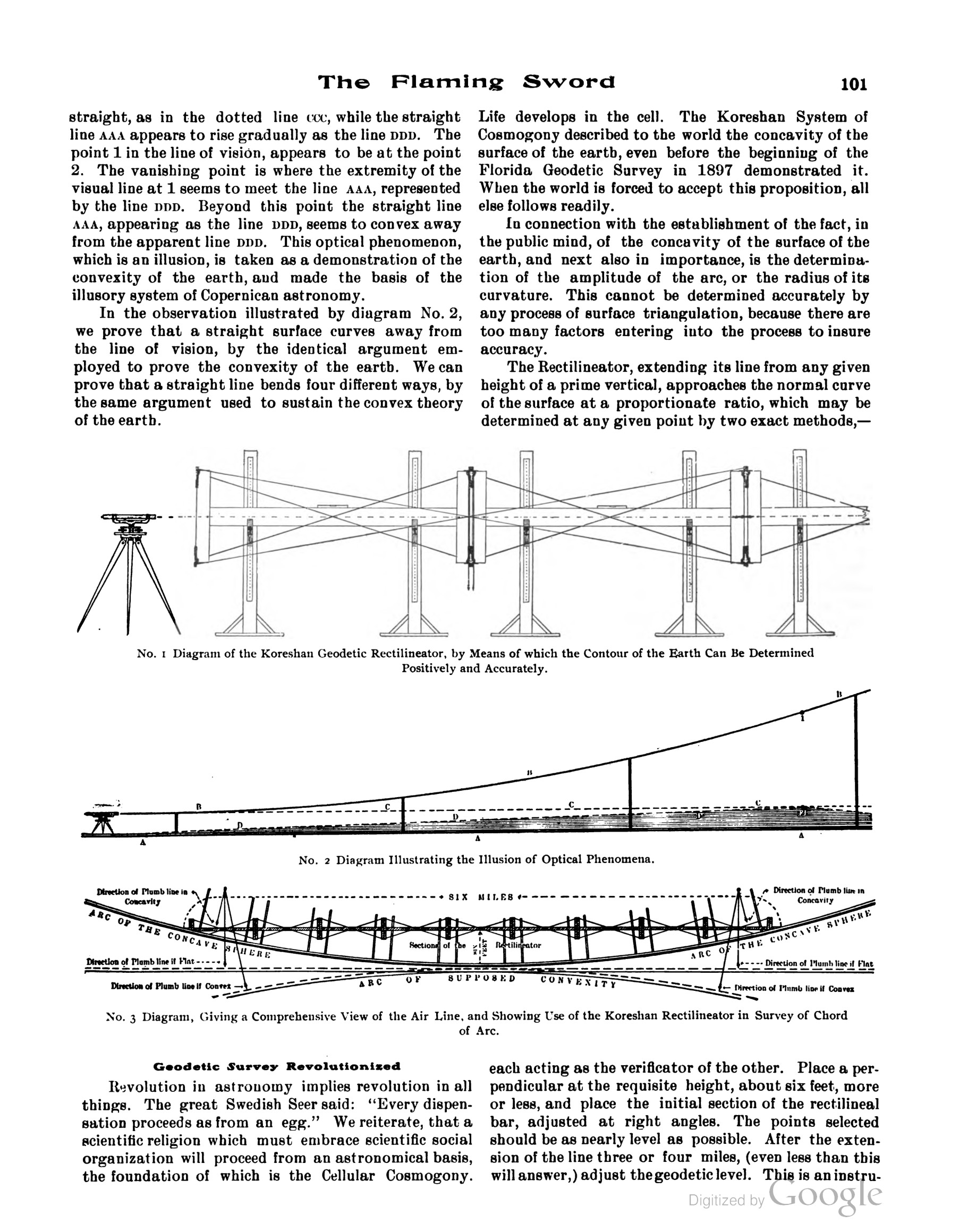
To obviate the introduction of optical science and the necessity for the explanation of optical illusions and intricate phenomena incomprehensible to the ordinary mind, we have instituted a simple mechanical device by which a rectiline can be determined. (See diagram No. 1.
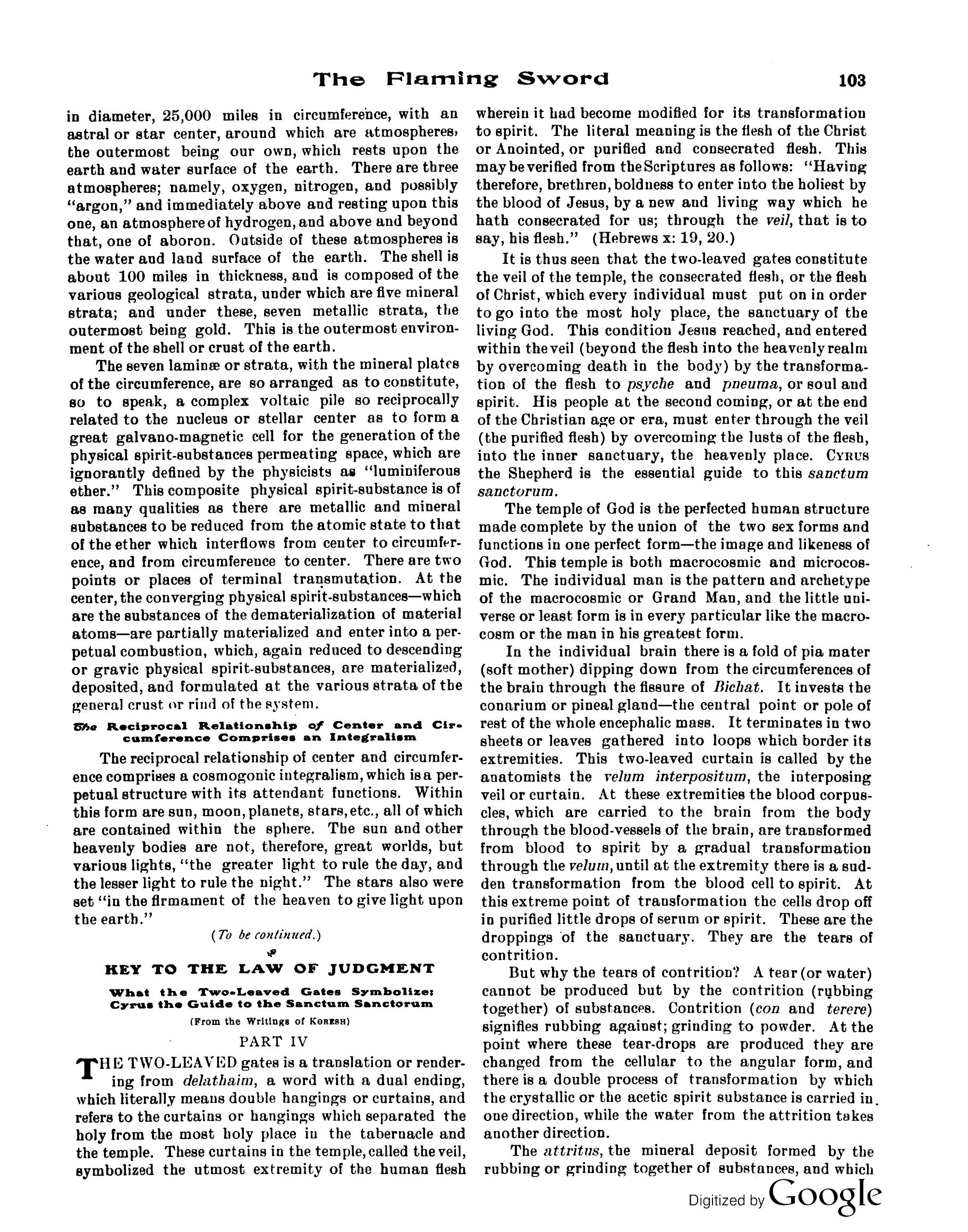
Perpendicular standards are placed at points where there is a quiet expanse of water large enough in area to extend a line six, seven, or more miles. Across these perpendicular standards the horizontal bar of the Rectilineator is adjusted. From this first adjustment the rectiline is extended in both directions, until the line meets the water at a distance proportionate to the height of the perpendicular standard. By this operation we extend a chord from the top of the uprights, at right angles to two points at the surface of the water, as in diagram No. 3. The relation of the straight line to arc determines the concavity of the earth as its true contour.
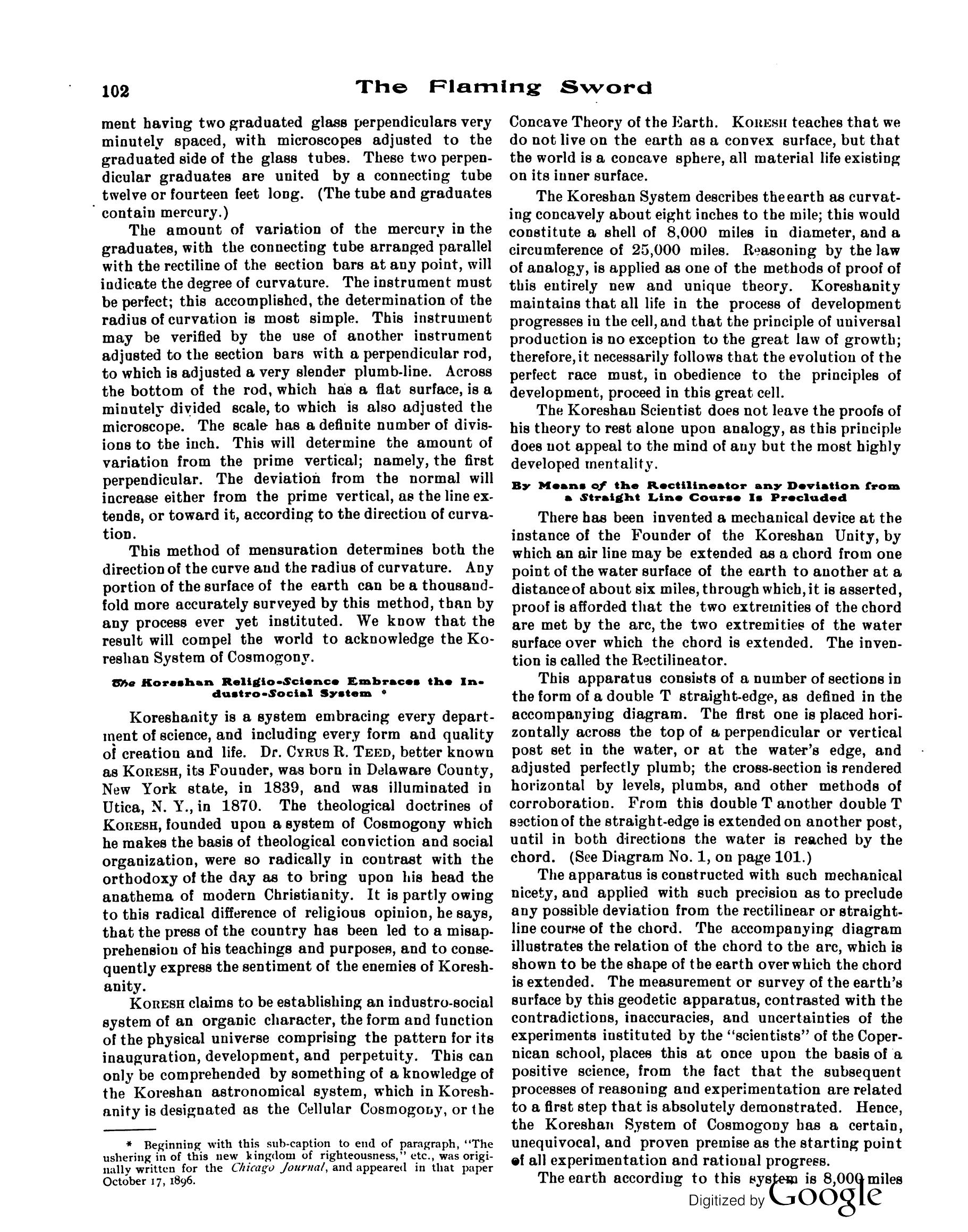
In diagram No. 2, we have an illustration of the optical effect of an observation made with a leveling instrument, which does not differ in principle from a corresponding observation made with the unaided eye. The straight surface over which the line of observation extends is represented by AAA; BBB is the visual direction, deviating in a gradual curve away from the straight line AAA. The mind is unconscious of this curvation of vision, hence the curved line appears to be straight, as in the dotted line CCC, while the straight line AAA appears to rise gradually as the line DDD. The point 1 in the line of vision, appears to be at the point 2. The vanishing point is where the extremity of the visual line at 1 seems to meet the line AAA, represented by the line DDD. Beyond this point the straight line AAA, appearing as the line DDD, seems to convex away from the apparent line DDD. This optical phenomenon, which is an illusion, is taken as a demonstration of the convexity of the earth, and made the basis of the illusory system of Copernican astronomy.
In the observation illustrated by diagram No. 2, we prove that a straight surface curves away from the line of vision, by the identical argument employed to prove the convexity of the earth. We can prove that a straight line bends four different ways, by the same argument used to sustain the convex theory of the earth.
Geodetic Survey Revolutionized
Revolution in astronomy implies revolution in all things. The great Swedish Seer said: ‘Every dispensation proceeds as from an egg.’ We reiterate, that a scientific religion which must embrace scientific social organization will proceed from an astronomical basis, the foundation of which is the Cellular Cosmogony.
Life develops in the cell. The Koreshan System of Cosmogony described to the world the concavity of the surface of the earth, even before the beginning of the Florida Geodetic Survey in 1897 demonstrated it. When the world is forced to accept this proposition, all else follows readily.
In connection with the establishment of the fact, in the public mind, of the concavity of the surface of the earth, and next also in importance, is the determination of the amplitude of the arc, or the radius of its curvature. This cannot be determined accurately by any process of surface triangulation, because there are too many factors entering into the process to insure accuracy.
The Rectilineator, extending its line from any given height of a prime vertical, approaches the normal curve of the surface at a proportionate ratio, which may be determined at any given point by two exact methods,— each acting as the verificator of the other. Place a perpendicular at the requisite height, about six feet, more or less, and place the initial section of the rectilineal bar, adjusted at right angles. The points selected should be as nearly level as possible. After the extension of the line three or four miles, (even less than this will answer,) adjust the geodetic level. This is an instrument having two graduated glass perpendiculars very minutely spaced, with microscopes adjusted to the graduated side of the glass tubes. These two perpendicular graduates are united by a connecting tube twelve or fourteen feet long. (The tube and graduates contain mercury.)
The amount of variation of the mercury in the graduates, with the connecting tube arranged parallel with the rectiline of the section bars at any point, will indicate the degree of curvature. The instrument must be perfect; this accomplished, the determination of the radius of curvation is most simple. This instrument may be verified by the use of another instrument adjusted to the section bars with a perpendicular rod, to which is adjusted a very slender plumb-line. Across the bottom of the rod, which has a flat surface, is a minutely divided scale, to which is also adjusted the microscope. The scale has a definite number of divisions to the inch. This will determine the amount of variation from the prime vertical; namely, the first perpendicular. The deviation from the normal will increase either from the prime vertical, as the line extends, or toward it, according to the direction of curvation.
This method of mensuration determines both the direction of the curve and the radius of curvature. Any portion of the surface of the earth can be a thousandfold more accurately surveyed by this method, than by any process ever yet instituted. We know that the result will compel the world to acknowledge the Koreshan System of Cosmogony.
The Koreshan Religio-Science Embraces the Industro-Social System *
Koreshanity is a system embracing every department of science, and including every form and quality of creation and life. Dr. Cyrus R. TEED, better known as Koresh, its Founder, was born in Delaware County, New York state, in 1839, and was illuminated in Utica, N. Y., in 1870. The theological doctrines of Koresh, founded upon a system of Cosmogony which he makes the basis of theological conviction and social organization, were so radically in contrast with the orthodoxy of the day as to bring upon his head the anathema of modern Christianity. It is partly owing to this radical difference of religious opinion, he says, that the press of the country has been led to a misapprehension of his teachings and purposes, and to consequently express the sentiment of the enemies of Koreshanity.
Koresh claims to be establishing an industro-social system of an organic character, the form and function of the physical universe comprising the pattern for its inauguration, development, and perpetuity. This can only be comprehended by something of a knowledge of the Koreshan astronomical system, which in Koreshanity is designated as the Cellular Cosmogony, or the Concave Theory of the Earth. Koresh teaches that we do not live on the earth as a convex surface, but that the world is a concave sphere, all material life existing on its inner surface.
The Koreshan System describes the earth as curvating concavely about eight inches to the mile; this would constitute a shell of 8,000 miles in diameter, and a circumference of 25,000 miles. Reasoning by the law of analogy, is applied as one of the methods of proof of this entirely new and unique theory. Koreshanity maintains that all life in the process of development progresses in the cell, and that the principle of universal production is no exception to the great law of growth; therefore, it necessarily follows that the evolution of the perfect race must, in obedience to the principles of development, proceed in this great cell.
The Koreshan Scientist does not leave the proofs of his theory to rest alone upon analogy, as this principle does not appeal to the mind of any but the most highly developed mentality.
By Means of the Rectilineator any Deviation from a Straight Line Course Is Precluded
There has been invented a mechanical device at the instance of the Founder of the Koreshan Unity, by which an air line may be extended as a chord from one point of the water surface of the earth to another at a distance of about six miles, through which, it is asserted, proof is afforded that the two extremities of the chord are met by the arc, the two extremities of the water surface over which the chord is extended. The invention is called the Rectilineator.
This apparatus consists of a number of sections in the form of a double T straight-edge, as defined in the accompanying diagram. The first one is placed horizontally across the top of a perpendicular or vertical post set in the water, or at the water’s edge, and adjusted perfectly plumb; the cross-section is rendered horizontal by levels, plumbs, and other methods of corroboration. From this double T another double T section of the straight-edge is extended on another post, until in both directions the water is reached by the chord. (See Diagram No. 1, on page 101.)
The apparatus is constructed with such mechanical nicety, and applied with such precision as to preclude any possible deviation from the rectilinear or straightline course of the chord. The accompanying diagram illustrates the relation of the chord to the arc, which is shown to be the shape of the earth over which the chord is extended. The measurement or survey of the earth’s surface by this geodetic apparatus, contrasted with the contradictions, inaccuracies, and uncertainties of the experiments instituted by the “scientists” of the Copernican school, places this at once upon the basis of a positive science, from the fact that the subsequent processes of reasoning and experimentation are related to a first step that is absolutely demonstrated. Hence, the Koreshan System of Cosmogony has a certain, unequivocal, and proven premise as the starting point of all experimentation and rational progress.
The earth according to this system is 8,000 miles in diameter, 25,000 miles in circumference, with an astral or star center, around which are atmospheres, the outermost being our own, which rests upon the earth and water surface of the earth. There are three atmospheres; namely, oxygen, nitrogen, and possibly “argon,” and immediately above and resting upon this one, an atmosphere of hydrogen, and above and beyond that, one of aboron. Outside of these atmospheres is the water and land surface of the earth. The shell is about 100 miles in thickness, and is composed of the various geological strata, under which are five mineral strata; and under these, seven metallic strata, the outermost being gold. This is the outermost environment of the shell or crust of the earth.
The seven laminæ or strata, with the mineral plates of the circumference, are so arranged as to constitute, so to speak, a complex voltaic pile so reciprocally related to the nucleus or stellar center as to form a great galvanomagnetic cell for the generation of the physical spirit-substances permeating space, which are ignorantly defined by the physicists as “luminiferous ether.” This composite physical spirit-substance is of as many qualities as there are metallic and mineral substances to be reduced from the atomic state to that of the ether which interflows from center to circumference, and from circumference to center. There are two points or places of terminal transmutation. At the center, the converging physical spirit-substances—which are the substances of the dematerialization of material atoms—are partially materialized and enter into a perpetual combustion, which, again reduced to descending or gravic physical spirit-substances, are materialized, deposited, and formulated at the various strata of the general crust or rind of the system.
The Reciprocal Relationship of Center and Circumference Comprises an Integralism
The reciprocal relationship of center and circumference comprises a cosmogonic integralism, which is a perpetual structure with its attendant functions. Within this form are sun, moon, planets, stars, etc., all of which are contained within the sphere. The sun and other heavenly bodies are not, therefore, great worlds, but various lights, ‘the greater light to rule the day, and the lesser light to rule the night.”” The stars also were set “in the firmament of the heaven to give light upon the earth.”
(To be continued.)
Printed notes
- Beginning with this subcaption to end of paragraph, “The ushering in of this new kingdom of righteousness,”’ etc., was originally written for the Chicago Journal, and appeared in that paper October 17, 1896.
Editorial transcription checked against the cited scans; historical claims remain those of The Flaming Sword.
The Flaming Sword · Vol. 28, No. 4 · Apr 1914 · PDF pp. 6–9