Extracted text
Source-led transcription, lightly normalized from the cited page scans; historical claims remain attributed to The Flaming Sword.
Principles and Purposes of the Movement; Its Striking Scientific Features; Headquarters at Estero, in Lee County.
THE WORLD seems on the verge of a period of great and rapid changes—changes so sweeping as to involve every department and branch of human thought and activity. There is an attitude of expectancy; something new is desired by numerous progressive classes, and human progress demands the unfolding of a new order, the application of new principles of human relations. History proves that when the desire for change becomes urgent enough to express itself in a climax of events, the issues of the hour are met by timely solution of their problems. From some source there must proceed the final solution of the great problems of the twentieth century.
Koreshanity, the new system and movement of religio-science having headquarters at Estero, Florida, claims to be the ultimate factor of great world-changes, and is endeavoring to fulfil and realize its high ideals. Its plans are unique, and the basis of its procedure is new to the modern world. The movement is not without force, for it is persistent, meeting seemingly insurmountable obstacles successfully. It is not without interest, for it is attracting attention almost everywhere. It is being investigated by many liberal minds; and already it has quite a following in various parts of the country. It has an earnest constituency, a faithful membership, a nucleus of which is at the headquarters of the system, the Colony and Town of Estero, in Lee County, where the effort is being made to apply the unique principles set forth in the literature of the system.
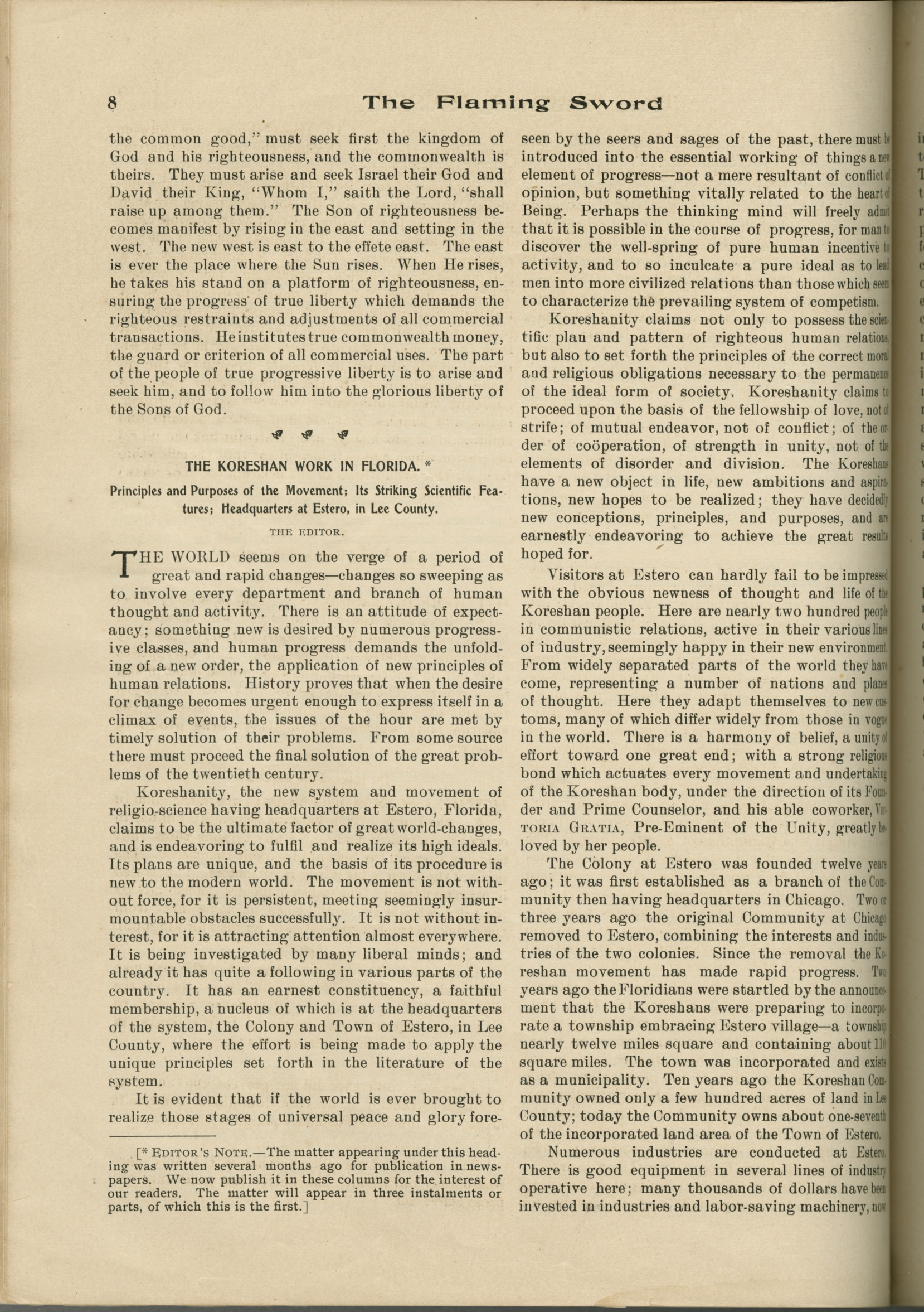
It is evident that if the world is ever brought to realize those stages of universal peace and glory foreseen by the seers and sages of the past, there must be introduced into the essential working of things a new element of progress—not a mere resultant of conflict of opinion, but something vitally related to the heart of Being. Perhaps the thinking mind will freely admit that it is possible in the course of progress, for man to discover the well-spring of pure human incentive to activity, and to so inculcate a pure ideal as to lead men into more civilized relations than those which seem to characterize the prevailing system of competism.
[* Editor’s Note.—The matter appearing under this heading was written several months ago for publication in newspapers. We now publish it in these columns for the interest of our readers. The matter will appear in three instalments or parts, of which this is the first.]
Koreshanity claims not only to possess the scientific plan and pattern of righteous human relations but also to set forth the principles of the correct moral and religious obligations necessary to the permanence of the ideal form of society. Koreshanity claims to proceed upon the basis of the fellowship of love, not of strife; of mutual endeavor, not of conflict; of the order of cooperation, of strength in unity, not of the elements of disorder and division. The Koreshans have a new object in life, new ambitions and aspirations, new hopes to be realized; they have decided new conceptions, principles, and purposes, and are earnestly endeavoring to achieve the great results hoped for.
Visitors at Estero can hardly fail to be impressed with the obvious newness of thought and life of the Koreshan people. Here are nearly two hundred people in communistic relations, active in their various lines of industry, seemingly happy in their new environment. From widely separated parts of the world they have come, representing a number of nations and planes of thought. Here they adapt themselves to new customs, many of which differ widely from those in vogue in the world. There is a harmony of belief, a unity of effort toward one great end; with a strong religious bond which actuates every movement and undertaking of the Koreshan body, under the direction of its Founder and Prime Counselor, and his able coworker, Victoria Gratia, Pre-Eminent of the Unity, greatly loved by her people.
The Colony at Estero was founded twelve years ago; it was first established as a branch of the Community then having headquarters in Chicago. Two or three years ago the original Community at Chicago removed to Estero, combining the interests and industries of the two colonies. Since the removal the Koreshan movement has made rapid progress. Two years ago the Floridians were startled by the announcement that the Koreshans were preparing to incorporate a township embracing Estero village—a township nearly twelve miles square and containing about 110 square miles. The town was incorporated and exists as a municipality. Ten years ago the Koreshan Com munity owned only a few hundred acres of land in Lee County; today the Community owns about one-seventh of the incorporated land area of the Town of Estero.
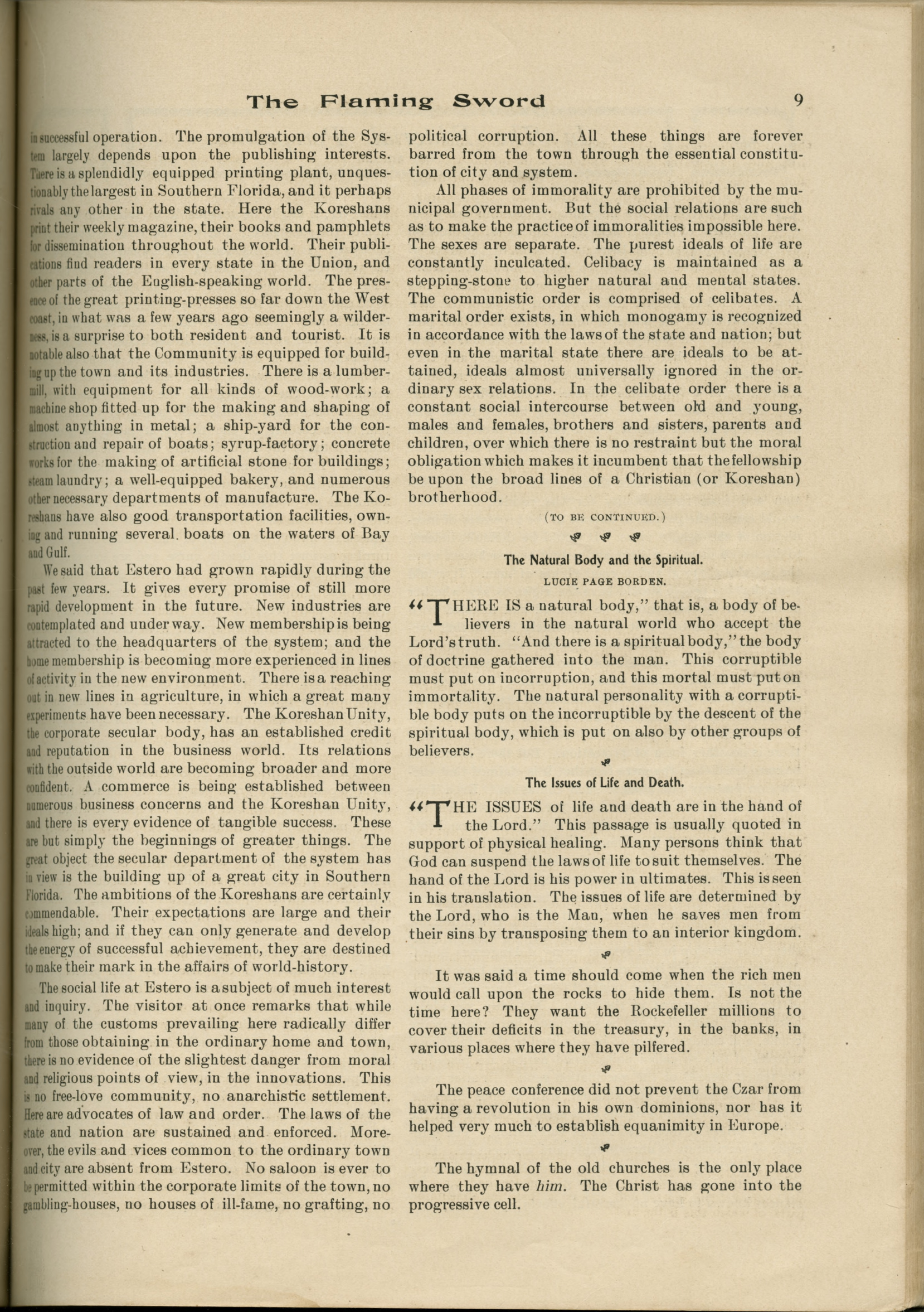
Numerous industries are conducted at Estero. There is good equipment in several lines of industry operative here; many thousands of dollars have been invested in industries and labor-saving machinery, now in successful operation. The promulgation of the System largely depends upon the publishing interests. There is a splendidly equipped printing plant, unquestionably the largest in Southern Florida, and it perhaps rivals any other in the state. Here the Koreshans print their weekly magazine, their books and pamphlets for dissemination throughout the world. Their publications find readers in every state in the Union, and other parts of the English-speaking world. The presence of the great printing-presses so far down the West coast, in what was a few years ago seemingly a wilderness, is a surprise to both resident and tourist. It is notable also that the Community is equipped for building up the town and its industries. There is a lumber-mill, with equipment for all kinds of wood-work; a machine shop fitted up for the making and shaping of almost anything in metal; a ship-yard for the conjunction and repair of boats; syrup-factory; concrete works for the making of artificial stone for buildings; steam laundry; a well-equipped bakery, and numerous other necessary departments of manufacture. The Koreshans have also good transportation facilities, owning and running several boats on the waters of Bay and Gulf.
We said that Estero had grown rapidly during the past few years. It gives every promise of still more rapid development in the future. New industries are contemplated and underway. New membership is being attracted to the headquarters of the system; and the home membership is becoming more experienced in lines of activity in the new environment. There is a reaching out in new lines in agriculture, in which a great many experiments have been necessary. The Koreshan Unity, the corporate secular body, has an established credit and reputation in the business world. Its relations with the outside world are becoming broader and more confident. A commerce is being established between numerous business concerns and the Koreshan Unity, and there is every evidence of tangible success. These are but simply the beginnings of greater things. The great object the secular department of the system has in view is the building up of a great city in Southern Florida. The ambitions of the Koreshans are certainly commendable. Their expectations are large and their ideals high; and if they can only generate and develop the energy of successful achievement, they are destined to make their mark in the affairs of world-history.
The social life at Estero is a subject of much interest and inquiry. The visitor at once remarks that while many of the customs prevailing here radically differ from those obtaining in the ordinary home and town, there is no evidence of the slightest danger from moral and religious points of view, in the innovations. This is no free-love community, no anarchistic settlement. Here are advocates of law and order. The laws of the state and nation are sustained and enforced. Moreover, the evils and vices common to the ordinary town and city are absent from Estero. No saloon is ever to be permitted within the corporate limits of the town, no gambling-houses, no houses of ill-fame, no grafting, no political corruption. All these things are forever barred from the town through the essential constitution of city and system.
All phases of immorality are prohibited by the municipal government. But the social relations are such as to make the practice of immoralities impossible here. The sexes are separate. The purest ideals of life are constantly inculcated. Celibacy is maintained as a stepping-stone to higher natural and mental states. The communistic order is comprised of celibates. A marital order exists, in which monogamy is recognized in accordance with the laws of the state and nation; but even in the marital state there are ideals to be attained, ideals almost universally ignored in the ordinary sex relations. In the celibate order there is a constant social intercourse between old and young, males and females, brothers and sisters, parents and children, over which there is no restraint but the moral obligation which makes it incumbent that the fellowship be upon the broad lines of a Christian (or Koreshan) brotherhood.
- --
Source: The Flaming Sword, Vol. 20, No. 12 (28 Aug 1906), PDF pp. 8–9.
The Flaming Sword · Vol. 20, No. 12 · 28 Aug 1906 · PDF pp. 8-9