Extracted text
Editorial transcription, lightly normalized from the scan. Line-break hyphenation and unmistakable OCR errors have been repaired; the claims remain those of The Flaming Sword.
[The editor responds to a critic from the Springfield (Mass.) Daily Republican who claimed atmospheric refraction could explain the Koreshan telescopic observation of a target 8 miles away from an 11-foot elevation on Lake Michigan.]
The critic affirms that the target was seen because atmospheric refraction was operative to produce a downward curve of the line of vision. If this were a factor, the target, the distant pier, and foundation of the lighthouse should have been visible to the naked eye, instead of being hidden by the apparent rise of the water to the horizon line midway between the eye and the objects 8 miles distant. It is obvious that refraction would be the same, no matter whether we made observations with the naked eye or employed the telescope. Refraction is not partial to aids to vision; neither can it go beyond its own bounds to assist the mind in sustaining a subterfuge.
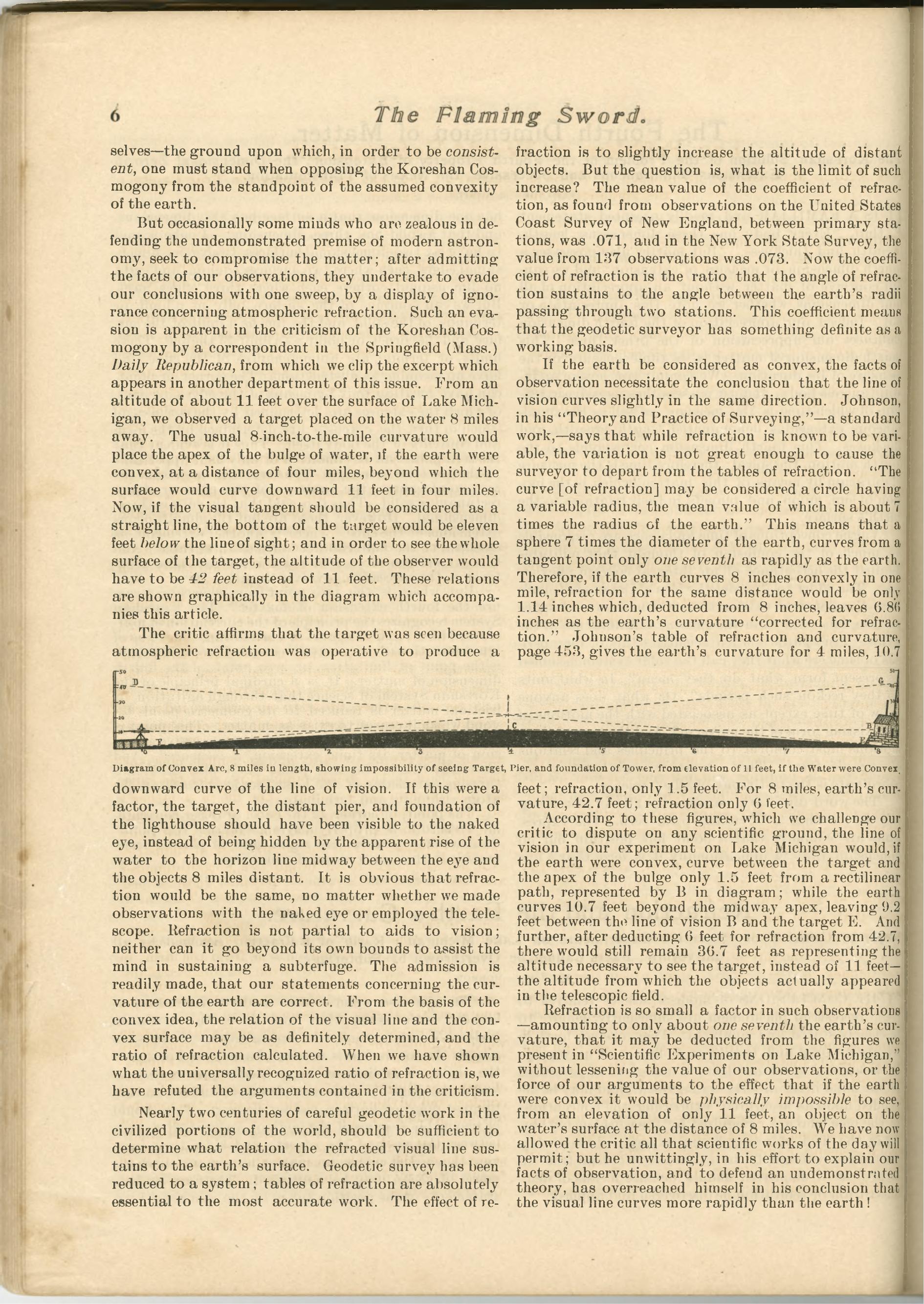
The admission is readily made, that our statements concerning the curvature of the earth are correct. From the basis of the convex idea, the relation of the visual line and the convex surface may be as definitely determined, and the ratio of refraction calculated. When we have shown what the universally recognized ratio of refraction is, we have refuted the arguments contained in the criticism.
Nearly two centuries of careful geodetic work in the civilized portions of the world, should be sufficient to determine what relation the refracted visual line sustains to the earth's surface. Geodetic survey has been reduced to a system; tables of refraction are absolutely essential to the most accurate work. The effect of refraction is to slightly increase the altitude of distant objects. But the question is, what is the limit of such increase? The mean value of the coefficient of refraction, as found from observations on the United States Coast Survey of New England, between primary stations, was .071, and in the New York State Survey, the value from 1,737 observations was .073. Now the coefficient of refraction is the ratio that the angle of refraction sustains to the angle between the earth's radii passing through two stations. This coefficient means that the geodetic surveyor has something definite as a working basis.
If the earth be considered as convex, the facts of observation necessitate the conclusion that the line of vision curves slightly in the same direction. Johnson, in his "Theory and Practice of Surveying,"—a standard work,—says that while refraction is known to be variable, the variation is not great enough to cause the surveyor to depart from the tables of refraction. "The curve [of refraction] may be considered a circle having a variable radius, the mean value of which is about 7 times the radius of the earth." This means that a sphere 7 times the diameter of the earth, curves from a tangent point only one seventh as rapidly as the earth. Therefore, if the earth curves 8 inches convexly in one mile, refraction for the same distance would be only 1.14 inches which, deducted from 8 inches, leaves 6.86 inches as the earth's curvature "corrected for refraction." Johnson's table of refraction and curvature, page 453, gives the earth's curvature for 4 miles, 10.7 feet; refraction, only 1.5 feet. For 8 miles, earth's curvature, 42.7 feet; refraction only 6 feet.
According to these figures, which we challenge our critic to dispute on any scientific ground, the line of vision in our experiment on Lake Michigan would, if the earth were convex, curve between the target and the apex of the bulge only 1.5 feet from a rectilinear path; while the earth curves 10.7 feet beyond the midway apex, leaving 9.2 feet between the line of vision and the target. And further, after deducting 6 feet for refraction from 42.7, there would still remain 36.7 feet as representing the altitude necessary to see the target, instead of 11 feet—the altitude from which the objects actually appeared in the telescopic field.
Refraction is so small a factor in such observations—amounting to only about one seventh the earth's curvature, that it may be deducted from the figures we present in "Scientific Experiments on Lake Michigan," without lessening the value of our observations, or the force of our arguments to the effect that if the earth were convex it would be physically impossible to see, from an elevation of only 11 feet, an object on the water's surface at the distance of 8 miles. We have now allowed the critic all that scientific works of the day will permit; but he unwittingly, in his effort to explain our facts of observation, and to defend an undemonstrated theory, has overreached himself in his conclusion that the visual line curves more rapidly than the earth!
- --
The source scans remain the record. This page preserves the periodical's claims without presenting its conclusions as independently established results.
Source: The Flaming Sword · Vol. 16, No. 32 · June 27, 1902 · Physical PDF p. 6
The Flaming Sword · Vol. 16, No. 32 · Jun 27, 1902 · PDF p. 6