Extracted text
The Hypothesis of the Earth's Convexity Remains Without Proof; the Famous Scientific Wager in 1870; Direct Tests of the Surface of Water; Koreshanity Demonstrated. By Prof. U. G. Morrow
MORE THAN ONE INSTANCE is on record where theories have failed to comport with the facts of demonstration. Sixteenth century scientists conceived that the heavier of two balls dropped from a point above the earth would reach the surface before the lighter one; but the experiments of Galileo at the leaning tower of Pisa demonstrated the conception to be not true. Anatomists of the seventeenth century stoutly maintained that the blood in the human system was not in circulation; but Dr. Harvey gave to the world the most satisfactory evidences that the anatomists were wrong in their conclusions. The hand of discovery has ruthlessly destroyed many a theoretical structure, but numerous illusions remain to be dispelled from the modern mind.
The idea that the earth is a convex body was conceived several centuries before the beginning of the Christian era. The conception had its origin in the illusions of the sense of vision; and a number of systems of astronomy have been evolved from the primary conception that we live on the exterior surface of the earth. Ptolemy endeavored to support the conclusion by a few illusive facts of observation—and it is stated by Professor Newcomb, the well-known American astronomer, that "Ptolemy's proofs that the earth is round [convex] are those still found in our school books at the end of seventeen hundred years." The Copernican system was founded in the sixteenth century—in the medieval period of the present dispensation. There was no proof whatever in support of the hypothesis of the Prussian astronomer, and none were offered; the founder of the system himself admits that the idea of the earth's motion was nothing but an hypothesis; and Professor Young, of Princeton, in his "General Astronomy," tacitly admits that "At the time of Copernicus the only argument in favor of the earth's rotation was that the hypothesis was more probable than that the heavens themselves revolved. All phenomena then known would be sensibly the same on either supposition." It should not be at all surprising to the world that such undemonstrated conclusions should be entirely overthrown by the overwhelming weight of the facts of observation and discovery.
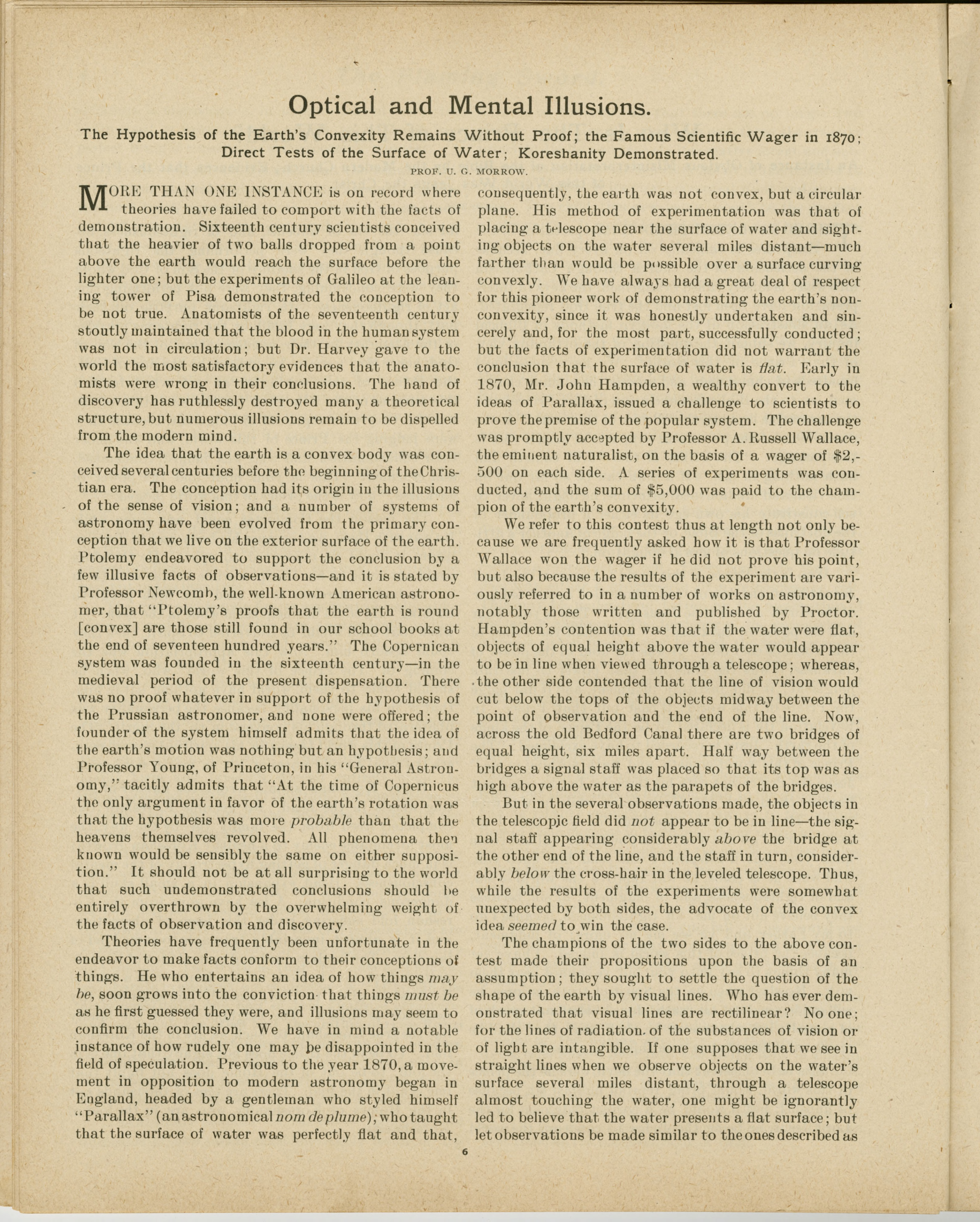
Theories have frequently been unfortunate in the endeavor to make facts conform to their conceptions of things. He who entertains an idea of how things may be, soon grows into the conviction that things must be as he first guessed they were, and illusions may seem to confirm the conclusion. We have in mind a notable instance of how rudely one may be disappointed in the field of speculation. Previous to the year 1870, a movement in opposition to modern astronomy began in England, headed by a gentleman who styled himself "Parallax" (an astronomical nom de plume), who taught that the surface of water was perfectly flat and that, consequently, the earth was not convex, but a circular plane. His method of experimentation was that of placing a telescope near the surface of water and sighting objects on the water several miles distant—much farther than would be possible over a surface curving convexly. We have always had a great deal of respect for this pioneer work of demonstrating the earth's non-convexity, since it was honestly undertaken and sincerely and, for the most part, successfully conducted; but the facts of experimentation did not warrant the conclusion that the surface of water is flat. Early in 1870, Mr. John Hampden, a wealthy convert to the ideas of Parallax, issued a challenge to scientists to prove the premise of the popular system. The challenge was promptly accepted by Professor A. Russell Wallace, the eminent naturalist, on the basis of a wager of $2,500 on each side. A series of experiments was conducted, and the sum of $5,000 was paid to the champion of the earth's convexity.
We refer to this contest thus at length not only because we are frequently asked how it is that Professor Wallace won the wager if he did not prove his point, but also because the results of the experiment are variously referred to in a number of works on astronomy, notably those written and published by Proctor. Hampden's contention was that if the water were flat, objects of equal height above the water would appear to be in line when viewed through a telescope; whereas, the other side contended that the line of vision would cut below the tops of the objects midway between the point of observation and the end of the line. Now, across the old Bedford Canal there are two bridges of equal height, six miles apart. Half way between the bridges a signal staff was placed so that its top was as high above the water as the parapets of the bridges.
But in the several observations made, the objects in the telescopic field did not appear to be in line—the signal staff appearing considerably above the bridge at the other end of the line, and the staff in turn, considerably below the cross-hair in the leveled telescope. Thus, while the results of the experiments were somewhat unexpected by both sides, the advocate of the convex idea seemed to win the case.
The champions of the two sides to the above contest made their propositions upon the basis of an assumption; they sought to settle the question of the shape of the earth by visual lines. Who has ever demonstrated that visual lines are rectilinear? No one; for the lines of radiation, of the substances of vision or of light are intangible. If one supposes that we see in straight lines when we observe objects on the water's surface several miles distant, through a telescope almost touching the water, one might be ignorantly led to believe that the water presents a flat surface; but let observations be made similar to the ones described as conducted at the time of the Hampden-Wallace wager, and the earth seems to be convex—but it is only an optical illusion. Is there then a conflict of the facts of observation? None at all. The Koreshan conception of the earth's concavity supplies the scientific basis of explanation of the apparently conflicting results obtained by two methods of sighting over the same body of water. If the contestants had possessed the slightest understanding of the principles of visual curvilineation, perspective and geolinear foreshortening, there would have been no excuse whatever for the pecuniary, legal, and other difficulties which finally proved to be the most pronounced results of the experiments.
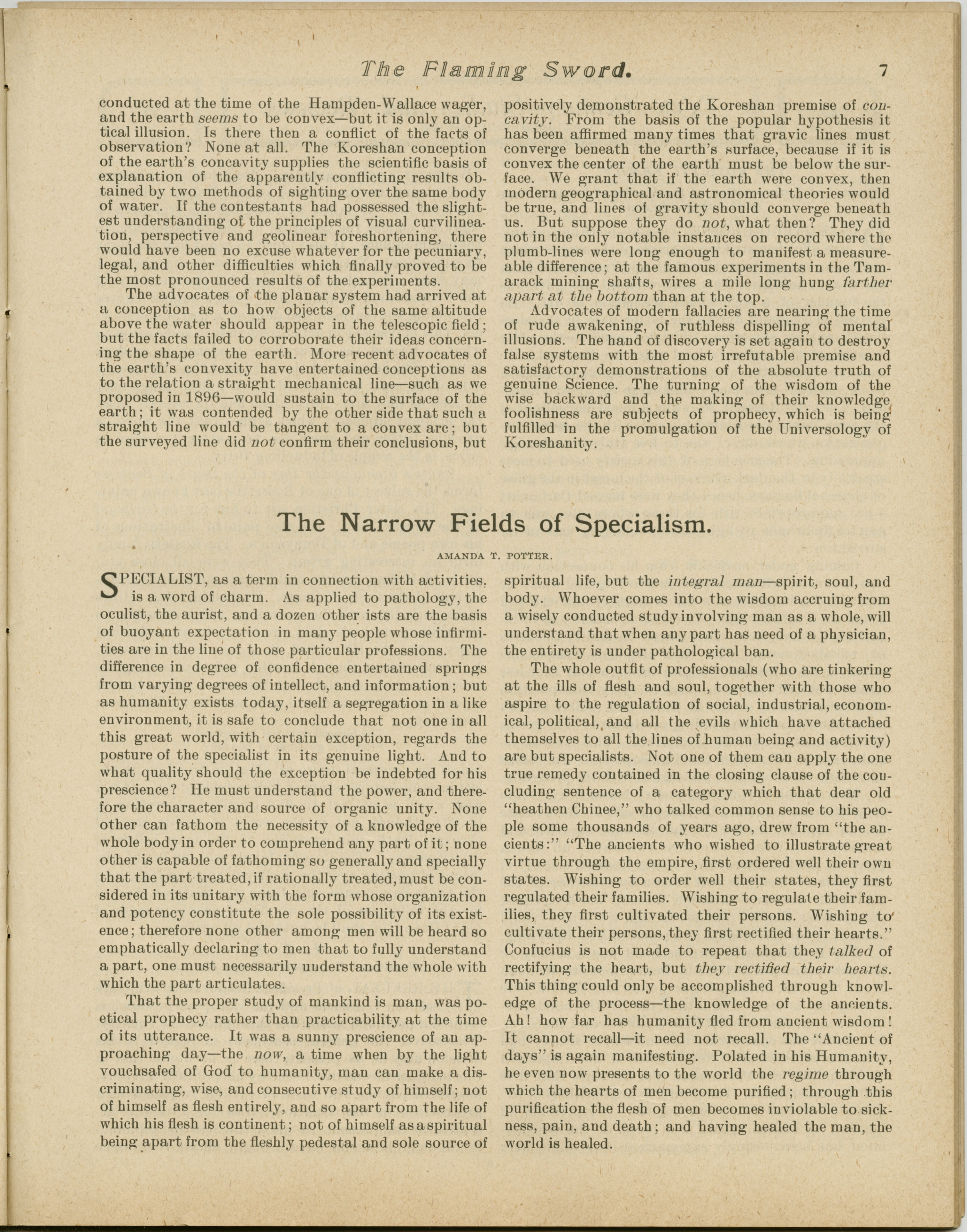
The advocates of the planar system had arrived at a conception as to how objects of the same altitude above the water should appear in the telescopic field; but the facts failed to corroborate their ideas concerning the shape of the earth. More recent advocates of the earth's convexity have entertained conceptions as to the relation a straight mechanical line—such as we proposed in 1896—would sustain to the surface of the earth; it was contended by the other side that such a straight line would be tangent to a convex arc; but the surveyed line did not confirm their conclusions, but positively demonstrated the Koreshan premise of concavity. From the basis of the popular hypothesis it has been affirmed many times that gravic lines must converge beneath the earth's surface, because if it is convex the center of the earth must be below the surface. We grant that if the earth were convex, then modern geographical and astronomical theories would be true, and lines of gravity should converge beneath us. But suppose they do not, what then? They did not in the only notable instances on record where the plumb-lines were long enough to manifest a measureable difference; at the famous experiments in the Tamarack mining shafts, wires a mile long hung farther apart at the bottom than at the top.
Advocates of modern fallacies are nearing the time of rude awakening, of ruthless dispelling of mental illusions. The hand of discovery is set again to destroy false systems with the most irrefutable premise and satisfactory demonstrations of the absolute truth of genuine Science. The turning of the wisdom of the wise backward and the making of their knowledge foolishness are subjects of prophecy, which is being fulfilled in the promulgation of the Universology of Koreshanity.
- --
[End of "Optical and Mental Illusions" as printed in The Flaming Sword, Volume 17, Number 8, January 9, 1903. Pages 4–5 of the periodical (PDF pp. 4–5). The printed heading and subheading appear on page 4; the article ends before the separate heading "The Narrow Fields of Specialism" on page 5.]
- --
The source scans remain the record. This page preserves the periodical's argument without presenting its conclusions as independently established results.
The Flaming Sword · Vol. 17, No. 8 · Jan 9, 1903 · PDF pp. 4–5