Extracted text
Editorial transcription, lightly normalized from the two page scans. Line-break hyphenation, spacing, capitalization, and unmistakable OCR errors have been repaired; the claims remain those of The Flaming Sword and of Koresh.
THE KORESHAN SYSTEM OF COSMOGONY
Application of the Principles of Optics to Geodetic Observation; the Law of Refraction; Assumption No Basis for Truth
By KORESH
PART XXIV.
The broader the space in perspective, the more rapidly it vanishes by distal extense, as shown in comparison with the middle rail; and the narrower the space, the less rapidly it vanishes by distal extense. This principle belongs more exclusively to the effect on the retina itself. A balloon in passing out of visual range appears to diminish rapidly for the first few miles, after which it remains in view for a long time as a mere speck. These facts will have their application during the course of this argument.
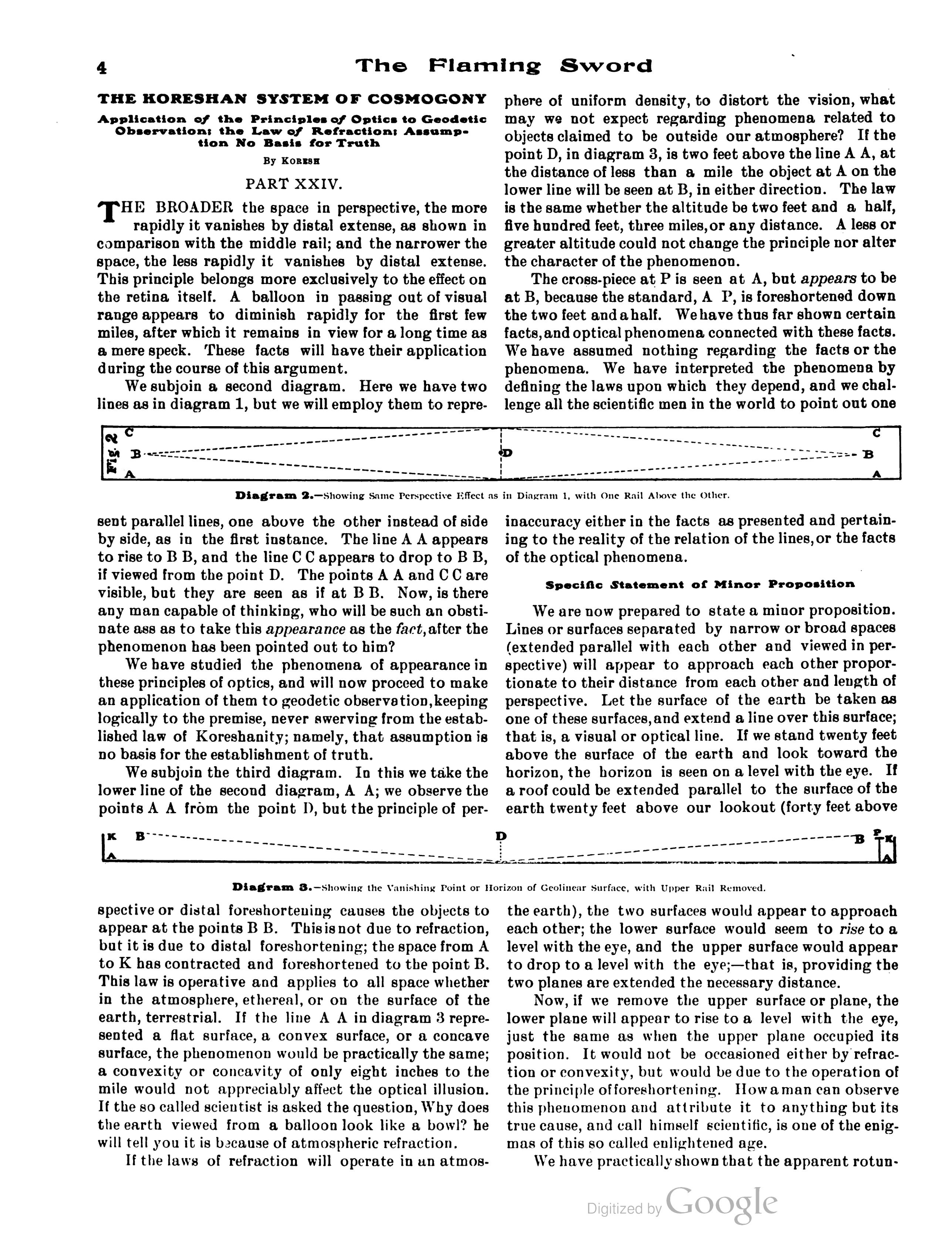
We subjoin a second diagram. Here we have two lines as in diagram 1, but we will employ them to represent parallel lines, one above the other instead of side by side, as in the first instance. The line A A appears to rise to B B, and the line C C appears to drop to B B, if viewed from the point D. The points A A and C C are visible, but they are seen as if at B B. Now, is there any man capable of thinking, who will be such an obstinate ass as to take this appearance as the fact, after the phenomenon has been pointed out to him?
We have studied the phenomena of appearance in these principles of optics, and will now proceed to make an application of them to geodetic observation, keeping logically to the premise, never swerving from the established law of Koreshanity; namely, that assumption is no basis for the establishment of truth.
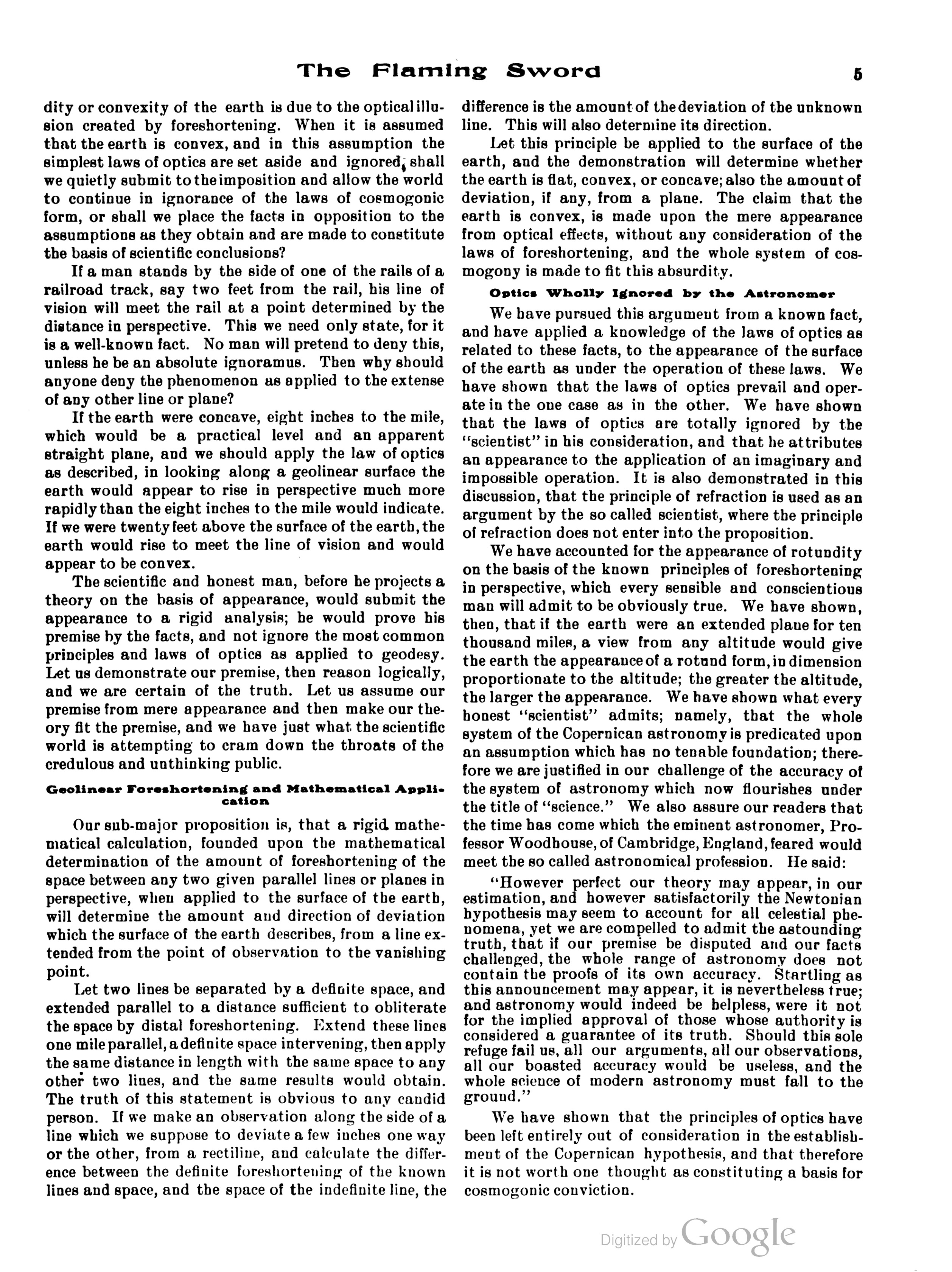
We subjoin the third diagram. In this we take the lower line of the second diagram, A A; we observe the points A A from the point D, but the principle of perspective or distal foreshortening causes the objects to appear at the points B B. This is not due to refraction, but it is due to distal foreshortening; the space from A to K has contracted and foreshortened to the point B. This law is operative and applies to all space whether in the atmosphere, ethereal, or on the surface of the earth, terrestrial. If the line A A in diagram 3 represented a flat surface, a convex surface, or a concave surface, the phenomenon would be practically the same; a convexity or concavity of only eight inches to the mile would not appreciably affect the optical illusion. If the so called scientist is asked the question, Why does the earth viewed from a balloon look like a bowl? he will tell you it is because of atmospheric refraction.
If the laws of refraction will operate in an atmosphere of uniform density, to distort the vision, what may we not expect regarding phenomena related to objects claimed to be outside our atmosphere? If the point D, in diagram 3, is two feet above the line A A, at the distance of less than a mile the object at A on the lower line will be seen at B, in either direction. The law is the same whether the altitude be two feet and a half, five hundred feet, three miles, or any distance. A less or greater altitude could not change the principle nor alter the character of the phenomenon.
The cross-piece at P is seen at A, but appears to be at B, because the standard, A P, is foreshortened down the two feet and a half. We have thus far shown certain facts, and optical phenomena connected with these facts. We have assumed nothing regarding the facts or the phenomena. We have interpreted the phenomena by defining the laws upon which they depend, and we challenge all the scientific men in the world to point out one inaccuracy either in the facts as presented and pertaining to the reality of the relation of the lines, or the facts of the optical phenomena.
Specific Statement of Minor Proposition
We are now prepared to state a minor proposition. Lines or surfaces separated by narrow or broad spaces (extended parallel with each other and viewed in perspective) will appear to approach each other proportionate to their distance from each other and length of perspective. Let the surface of the earth be taken as one of these surfaces, and extend a line over this surface; that is, a visual or optical line. If we stand twenty feet above the surface of the earth and look toward the horizon, the horizon is seen on a level with the eye. If a roof could be extended parallel to the surface of the earth twenty feet above our lookout (forty feet above the earth), the two surfaces would appear to approach each other; the lower surface would seem to rise to a level with the eye, and the upper surface would appear to drop to a level with the eye;—that is, providing the two planes are extended the necessary distance.
Now, if we remove the upper surface or plane, the lower plane will appear to rise to a level with the eye, just the same as when the upper plane occupied its position. It would not be occasioned either by refraction or convexity, but would be due to the operation of the principle of foreshortening. How a man can observe this phenomenon and attribute it to anything but its true cause, and call himself scientific, is one of the enigmas of this so called enlightened age.
We have practically shown that the apparent rotundity or convexity of the earth is due to the optical illusion created by foreshortening. When it is assumed that the earth is convex, and in this assumption the simplest laws of optics are set aside and ignored, shall we quietly submit to the imposition and allow the world to continue in ignorance of the laws of cosmogonic form, or shall we place the facts in opposition to the assumptions as they obtain and are made to constitute the basis of scientific conclusions?
If a man stands by the side of one of the rails of a railroad track, say two feet from the rail, his line of vision will meet the rail at a point determined by the distance in perspective. This we need only state, for it is a well-known fact. No man will pretend to deny this, unless he be an absolute ignoramus. Then why should anyone deny the phenomenon as applied to the extense of any other line or plane?
If the earth were concave, eight inches to the mile, which would be a practical level and an apparent straight plane, and we should apply the law of optics as described, in looking along a geolinear surface the earth would appear to rise in perspective much more rapidly than the eight inches to the mile would indicate. If we were twenty feet above the surface of the earth, the earth would rise to meet the line of vision and would appear to be convex.
The scientific and honest man, before he projects a theory on the basis of appearance, would submit the appearance to a rigid analysis; he would prove his premise by the facts, and not ignore the most common principles and laws of optics as applied to geodesy. Let us demonstrate our premise, then reason logically, and we are certain of the truth. Let us assume our premise from mere appearance and then make our theory fit the premise, and we have just what the scientific world is attempting to cram down the throats of the credulous and unthinking public.
Geolinear Foreshortening and Mathematical Application
Our sub-major proposition is, that a rigid mathematical calculation, founded upon the mathematical determination of the amount of foreshortening of the space between any two given parallel lines or planes in perspective, when applied to the surface of the earth, will determine the amount and direction of deviation which the surface of the earth describes, from a line extended from the point of observation to the vanishing point.
Let two lines be separated by a definite space, and extended parallel to a distance sufficient to obliterate the space by distal foreshortening. Extend these lines one mile parallel, a definite space intervening, then apply the same distance in length with the same space to any other two lines, and the same results would obtain. The truth of this statement is obvious to any candid person. If we make an observation along the side of a line which we suppose to deviate a few inches one way or the other, from a rectiline, and calculate the difference between the definite foreshortening of the known lines and space, and the space of the indefinite line, the difference is the amount of the deviation of the unknown line. This will also determine its direction.
Let this principle be applied to the surface of the earth, and the demonstration will determine whether the earth is flat, convex, or concave; also the amount of deviation, if any, from a plane. The claim that the earth is convex, is made upon the mere appearance from optical effects, without any consideration of the laws of foreshortening, and the whole system of cosmogony is made to fit this absurdity.
Optics Wholly Ignored by the Astronomer
We have pursued this argument from a known fact, and have applied a knowledge of the laws of optics as related to these facts, to the appearance of the surface of the earth as under the operation of these laws. We have shown that the laws of optics prevail and operate in the one case as in the other. We have shown that the laws of optics are totally ignored by the "scientist" in his consideration, and that he attributes an appearance to the application of an imaginary and impossible operation. It is also demonstrated in this discussion, that the principle of refraction is used as an argument by the so called scientist, where the principle of refraction does not enter into the proposition.
We have accounted for the appearance of rotundity on the basis of the known principles of foreshortening in perspective, which every sensible and conscientious man will admit to be obviously true. We have shown, then, that if the earth were an extended plane for ten thousand miles, a view from any altitude would give the earth the appearance of a rotund form, in dimension proportionate to the altitude; the greater the altitude, the larger the appearance. We have shown what every honest "scientist" admits; namely, that the whole system of the Copernican astronomy is predicated upon an assumption which has no tenable foundation; therefore we are justified in our challenge of the accuracy of the system of astronomy which now flourishes under the title of "science." We also assure our readers that the time has come which the eminent astronomer, Professor Woodhouse, of Cambridge, England, feared would meet the so called astronomical profession. He said:
"However perfect our theory may appear, in our estimation, and however satisfactorily the Newtonian hypothesis may seem to account for all celestial phenomena, yet we are compelled to admit the astounding truth, that if our premise be disputed and our facts challenged, the whole range of astronomy does not contain the proofs of its own accuracy. Startling as this announcement may appear, it is nevertheless true; and astronomy would indeed be helpless, were it not for the implied approval of those whose authority is considered a guarantee of its truth. Should this sole refuge fail us, all our arguments, all our observations, all our boasted accuracy would be useless, and the whole science of modern astronomy must fall to the ground."
We have shown that the principles of optics have been left entirely out of consideration in the establishment of the Copernican hypothesis, and that therefore it is not worth one thought as constituting a basis for cosmogonic conviction.
- --
The source scans remain the record. This page preserves the article's argument, measurements, and rhetorical structure without presenting its conclusion as an independently established result. The periodical's claims remain attributed to The Flaming Sword and to Koresh.
← Flaming Sword Archive
The Flaming Sword · Vol. 29 (1915 bound volume) · 1915 · PDF pp. 6-7