Extracted text
Source-led transcription, lightly normalized from PDF p. 2; the argument remains the periodical's own. The chord-of-arc diagram is a separate extracted image from the same page.
Our Scientific Premise
The Basis of the Koreshan System is the Cellular Cosmogony, Demonstrating the Earth's Concavity.
The first question to settle in the consideration of the subject, from the basis of argumentation, is the apparent depression of what is called, either truthfully or falsely, the horizontal line. Suspend a plumb-line twenty feet, and from the vertical point describe a horizontal line. This line is at right angles to the plumb-line or perpendicular, and its extremity touches the horizon. The ordinary picture or diagram, given in the school-room to impress upon the juvenile mind the idea of the convexity of the earth, is first a circle, designed to indicate its rotundity and convex surface; related to this is a horizontal line, at the extremities of which are a man and a ship mast; the man is at one end of the horizontal, (not at right angles to the horizontal but oblique to it), at the other end of the horizontal is the mast, also oblique to it.
Explanation of Apparent Depression of the Horizon
The position taken by Koreshanity is as follows:
First, the earth curves eight inches to the mile, concavely, not convexly.
Second, a line of vision extending from the visual point to the horizon is not a straight one, but one curvilineating slightly upwards and striking the point called the horizon a little above the exact horizontal direction.
Third, this curvilineation of vision is caused by the deviation of the visual substance (energy), deflected through the resistance of the gravic energy.
Fourth, there are two laws governing the visual deception of convexity; namely, visual curvilineation, and geolinear foreshortening. The horizontal line has the appearance of a slight depression in perspective.
Fifth, the depression is apparent, not real. Its cause is, first, perpendicular, and second, geolinear foreshortening.
Suppose a visual line from an altitude of five hundred feet to meet the horizon; we will urge this supposition from the conception of a concave instead of a convex surface, the horizon point being on a level with the altitude of the visual point, or point from which the ascension is taken. The natural apparent construction of the geolinear surface would drop the perspective of the horizontal, and give it the appearance of being slightly descending instead of horizontal, which it really is.
At this point we confront another objection, the result of a want of knowledge concerning practical optics. The horizontal line appears depressed, and the objection now to be considered is one raised by the ordinary civil engineer, or surveyor.
This apparent depression is taken for a reality, and the difficulty arises in this way. The surveyor employs an instrument called a theodolite. It is ten or twelve inches long, placed upon a tripod, and is used for ascertaining horizontal and perpendicular angles. Across the focus of the telescope, or across the objective extremity, are two transverse hair-lines connected with a spirit level. The telescope is leveled for observation and the transverse hair-line, ten or twelve inches from the eye, seems to describe a horizontal line across the sky in the distance. The real horizontal is slightly depressed from this apparent direction.
Principles of Foreshortening, Geolinear and Perpendicular
We will suppose we occupy a lookout or subjective visual point sufficiently high for the horizontal line to touch the horizon at a distance of ten miles. The line extends from this subjective point of vision to the horizon. The first mile appears to be a definite length, the second mile of a lesser length, the third is apparently still less; each mile apparently more contracted than the preceding one. This is called geolinear foreshortening. If the surface of the earth is apparently drawn back, (it should be remembered it is only apparent, not real,) the horizontal line is apparently depressed. This appearance, the surveyor takes to be a reality and is thus deceived, five inches to the mile.
Let a person stand ten feet from the ground and look out over a level surface. We will suppose the earth curves upward eight inches to the mile. This is practically a level surface. The first mile would make a long picture upon the retina of the eye; the second mile, a shorter one; the third mile, a still shorter one, and the fifth or sixth mile would make no picture at all. A large body standing upon the ground at the vanishing point of the last visible mile would appear to have sunken out of sight. This would be true if the earth were a dead level for ten or a thousand miles. The law of foreshortening accounts for the disappearance of an object a long distance from the point of vision.
Experiment Demonstrating Visual Curvilineation
Lay a rail like the single rail of a railroad, curving it eight inches to the mile. Upon its concave surface place a small telescope, the visual axis one foot from the rail, parallel to the concave. Place at the distance of ten feet from the focus of the instrument, a projection, the end of which is on a line with the visual axis of the instrument. The projection will be a little over one foot in length. At the distance of twenty feet from the first projection, place a second one projecting from the rail until the end can be seen on a line with the visual axis of the instrument. The second projection will be longer than the first. Continue the operation, and it will be found that each succeeding projection, to come into line with the visual axis of the instrument, or to be seen on a line with the focus of the instrument, must be increased in length beyond the next last one projected. It will be found that the increase of projection will average about five inches to the mile. The principle of foreshortening induces the necessity of elongating each successive projection.
Now as the projections are on a line with the visual line or axis of the glass, does it follow that the concave rail curves five inches to the mile in the opposite direction? Yet this is precisely the proposition of the pretended scientist, who claims that because of this visual appearance — due to foreshortening — the earth curves away from the visual line of the telescope, theodolite or transit instruments.
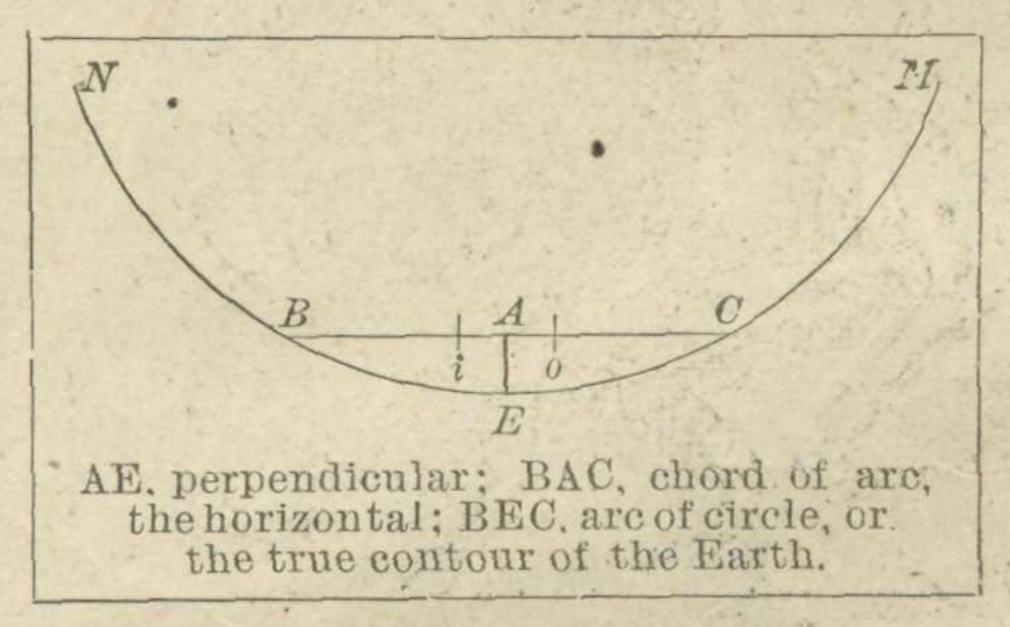
AE, perpendicular; BAC, chord of arc, the horizontal; BEC, arc of circle, or the true contour of the Earth.
- --
The source scans remain the record. This page preserves the periodical's argument and reported observations without presenting its conclusions as independently established results. The claims remain attributed to The Flaming Sword.
← Flaming Sword Archive
The Flaming Sword · Vol. 18, No. 23 · Nov 1904 · PDF p. 2