Extracted text
Editorial transcription, lightly normalized from the scan. Line-break hyphenation, spacing, capitalization, and unmistakable OCR errors have been repaired; the claims remain those of The Flaming Sword.
The Scientific Story of the Meteoric Showers; the Radiant Points of Systems of Shooting-Stars; Startling Evidence that the Constellations are Within Our Atmosphere.
PROF. U. G. MORROW.
THE GREAT FOUNDATION of Koreshan Universology is the Cellular Cosmogony, which demonstrates the concavity of the earth's surface. The visible concave arc which extends from horizon to horizon; the facts of Geodetic Survey; the results of specific experimentation; the principles of optics and physics; the phenomena of the heavens; the laws of comparative anatomy and correspondential analogy; the science of language and of life; the teachings of the ancients, and the testimony of the Bible—all these demonstrate, corroborate, and confirm the truth of the great discovery of KORESH, thirty years ago, that the universe is a great cell in which all life inheres—a gigantic electromagnetic battery which generates the forces of its own perpetuity. The premise of the new Cosmogony necessarily revolutionizes all prevailing astronomical conceptions. So invincible is its foundation; so irrefutable are its arguments; so impregnable is its position ; so logical are its conclusions; so authoritative is its science, and so aggressive is the work of its promulgation, that the old school astronomers are placed on the defensive with nothing but absurd hypotheses to support their conclusions!
The Copernican system does not explain the phenomena of the universe, not even the phenomena of the heavens. Show us one phenomenon that it seems to explain, and we will point to a hundred which it leaves within the veil of mystery; suggest a problem that it claims to solve, and we will name a thousand for which it has no solution ; find a single fact that seems to sustain the old system, and we will present ten thousand facts that are against it. In every plausible explanation of phenomena put forth by the modern astronomer, there is a conflict between the conclusions and the most patent and most easily observed facts relative to the phenomena explained. Its conclusions are inconsistent and contradictory; it leaves all cause of things hidden in mystery—it endeavors to explain only what is seen through illusion of the senses. It has come to the time of its bouleversement—its complete overthrow !
The criticisers of Koreshanity are not content to remain upon the solid basis of all astronomical observations— the earth's surface; they are wont to discuss the phenomena of the heavens, rather than the facts of the earth's true contour. It is as much within our province to discuss the phenomena of the heavens as the facts of the terrestrial base; for the facts of astronomical observation are as destructive to the conclusions of the old school of astronomy, as are the facts of actual tests of the inner surface of the walls of the great cell which encloses all that is observed above us. The coming of November 13 revives the discussion of the problem of the meteors; and we shall find here an unanswerable argument, an absolute demonstration of the fallacy of all prevailing astronomical conclusions. Koreshanity maintains that all of the visible heavenly bodies—the sun, moon, planets, and stars—are within our atmosphere, near the junction of the great seas of oxygen and hydrogen; and that none of the visible celestial orbs are over 1,000 miles from the earth's concave surface; and we propose to show, from the basis of astronomical observations of meteoric phenomena, that this conclusion is absolutely true.
Meteoric Systems and Their Radiants.
Of the hundred or more meteoric systems, the Leonids, Perseids, Andromedes, Geminids, and Lyrids, are the most common ; and of these, the Leonids are the most conspicuous. These are so named because the showers which belong to these systems proceed from radiant points or centers in the constellations Leo, Perseus, Andromeda, Gemini, and Lyra, respectively; and we will show that they have not been incorrectly named. That persistent cause which makes language has destined that the meteors should be called shooting stars; and it is not by any mere whim nor accident that the showers which fall from the constellation Leo are called Leonids. The very name indicates that they fall from the constellation, and that the radiant trains of light proceed from the star-sphere itself. It was not until recent years that the astronomers concluded that the meteors are in some way related to the comets. This conclusion, while it does not take the subject out of meteorology, places it distinctly in the field of astronomy proper—in the field where it belongs; and it is from an astronomical standpoint that we desire to examine it. The word meteor is from the Greek μετεωρα (meteoni), which means things high in the air—objects elevated, floating or soaring in the atmosphere. The verb μετεωριζω (meteorizo) means to raise into the air,to elevate; while μετεωρια (meteoria)means levity. The-word μετεωρα (meteora) was applied in a general way to all the astronomical bodies—to the atmosphere and all the phenomena which it presents. That the ancients knew that meteors, as well as the sun, moon, planets, and stars, were both meteorological and astronomical—that is, that all of the visible orbs are within the atmosphere—is evident from the fact that the word μετεωρολογια (meteorologia) means a discourse on the heavenly bodies, or atmospheric phenomena and conditions. The meaning of the word heavens is heaved-up things—substances heaved up or levitated from the solid shell of the earth, the firmamental environ of the universe. These substances, in their grosser elements, constitute the atmospheres of the great hollow world ; and the most external atmosphere contains all of the observed orbs, comets, and meteors. The etymology of the words used in the departments of astronomy and physics specifically corroborates the Koreshan conclusions. Neither the science of language nor the facts of Nature fit the popular fallacy. .
The Meteoric Radiant has no Parallax.
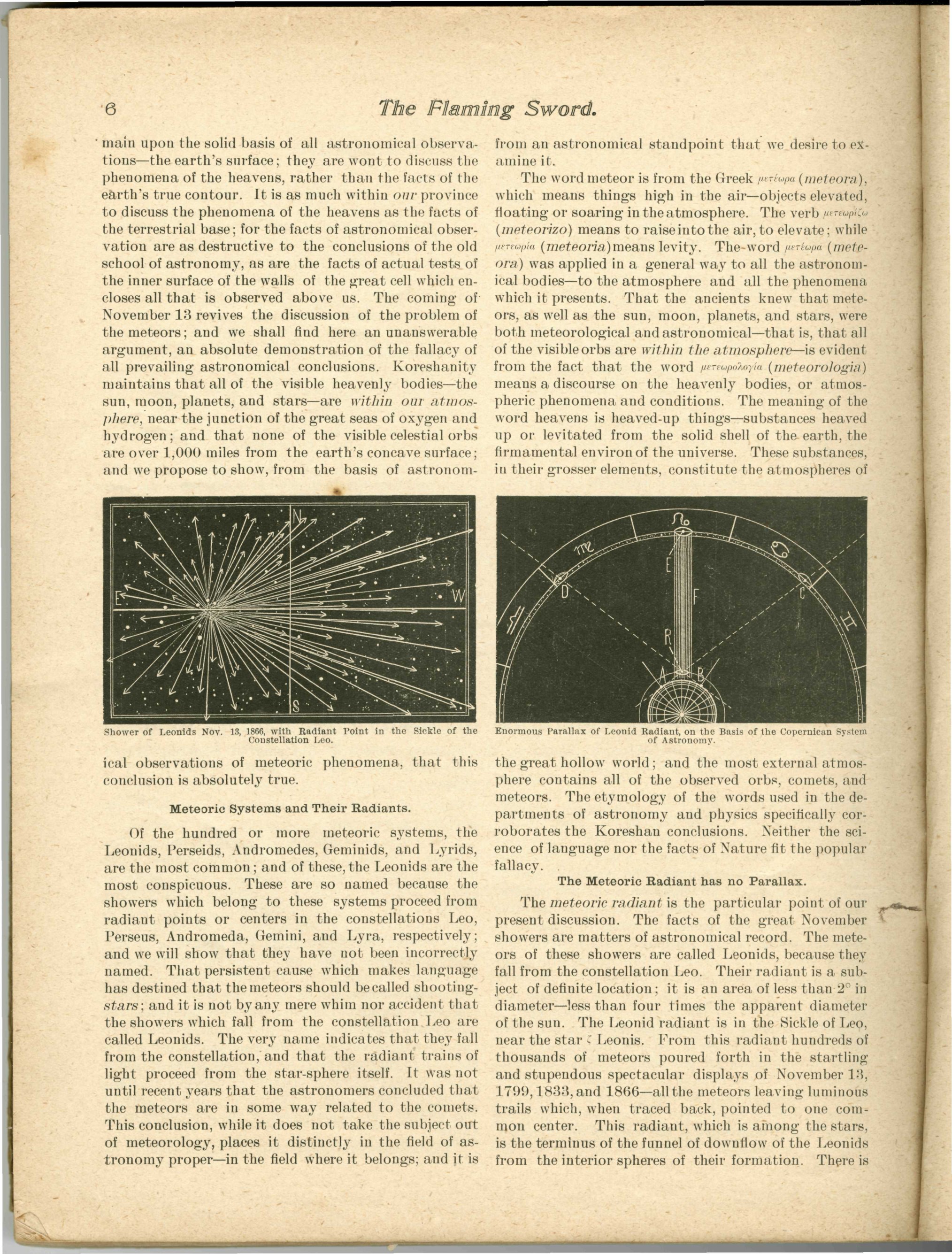
The meteoric radiant is the particular point of our present discussion. The facts of the great November showers are matters of astronomical record. The meteors of these showers are called Leonids, because they fall from the constellation Leo. Their radiant is a subject of definite location; it is an area of less than 2° in diameter—less than four times the apparent diameter of the sun. The Leonid radiant is in the Sickle of Leo, near the star ζ Leonis. From this radiant hundreds of thousands of meteors poured forth in the startling and stupendous spectacular displays of November 13, 1799,1833, and 1866—all the meteors leaving luminous trails which, when traced back, pointed to one common center. This radiant, which is among the stars, is the terminus of the funnel of downflow of the Leonids from the interior spheres of their formation. There is not a single star in the constellation Leo that is subject to the slightest parallax; and we will show that the meteoric radiant presents no parallax when viewed from widely separated stations of observation.
The radiant keeps its place among the stars unchanged, during the whole continuance of the shower, and the shower is named accordingly. Thus we have the meteor shower of the Leonids, whose radiant is in the constellation Leo.—Young's General Astronomy, p. 441.
If we mark, on a celestial globe, the apparent paths of the meteors which fall during a shower, or if we suppose them marked on the celestial sphere, and then continue backwards, we shall find them all to meet in the same point of the heavens. This is called the radiant point. It always appears in the same position, wherever the observer is situated, and does not partake of the diurnal motion of the earth ; that is, as the stars seem to move towards the west in their diurnal course, the radiant point moves with them.—Newcomb's Popular Astronomy, p. 403.
The radiant of the November meteors is in Leo, and remains unchanged from beginning to end of shower.—Peabody's Astronomy.
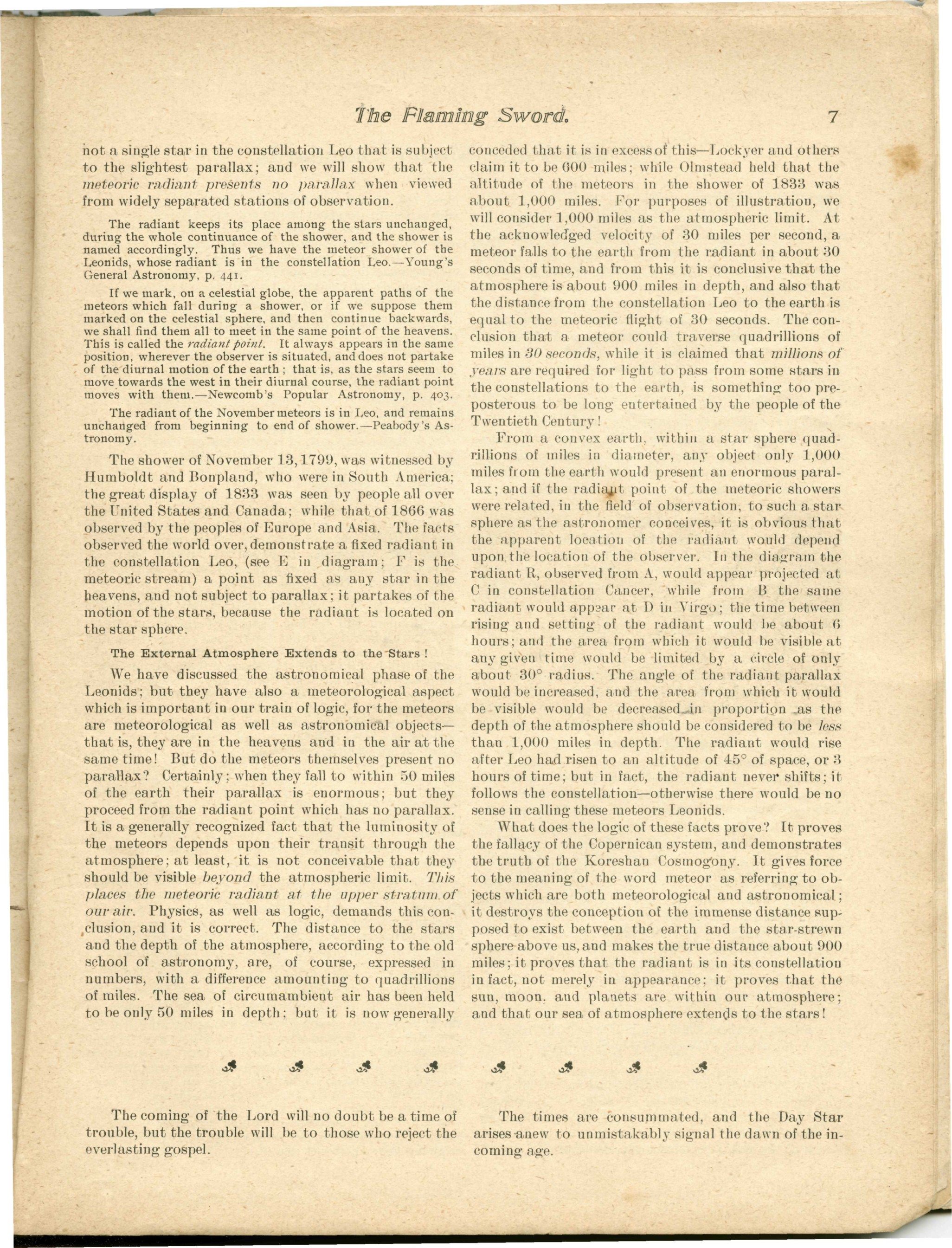
The shower of November 13,1799, was witnessed by Humboldt and Bonpland, who were in South America; the great display of 1833 was seen by people all over the United States and Canada; while that of 1866 was observed by the peoples of Europe and Asia. The facts observed the world over, demonstrate a fixed radiant in the constellation Leo, (see E iu diagram; F is the meteoric stream) a point as fixed as any star in the heavens, and not subject to parallax; it partakes of the motion of the stars, because the radiant is located on the star sphere.
The External Atmosphere Extends to the Stars!
We have discussed the astronomical phase of the Leonids; but they have also a meteorological aspect which is important in our train of logic, for the meteors are meteorological as well as astronomical objects— that is, they are in the heavens and in the air at the same time! But do the meteors themselves present no parallax? Certainly; when they fall to within 50 miles of the earth their parallax is enormous; but they proceed from the radiant point which has no parallax. It is a generally recognized fact that the luminosity of the meteors depends upon their transit through the atmosphere; at least, it is not conceivable that they should be visible beyond the atmospheric limit. This places the meteoric radiant at the upper stratum of our air. Physics, as well as logic, demands this conclusion, and it is correct. The distance to the stars and the depth of the atmosphere, according to the old school of astronomy, are, of course, expressed in numbers, with a difference amounting to quadrillions of miles. The sea of circumambient air has been held to be only 50 miles in depth; but it is now generally conceded that it is in excess of' this—Lockyer and others claim it to be 600 miles; while Olmstead held that the altitude of the meteors in the shower of 1833 was about 1,000 miles. For purposes of illustration, we will consider 1,000 miles as the atmospheric limit. At the acknowledged velocity of 30 miles per second, a meteor fails to the earth from the radiant in about 30 seconds of time, and from this it is conclusive that the atmosphere is about 900 miles in depth, and also that the distance from the constellation Leo to the earth is equal to the meteoric flight of 30 seconds. The conclusion that a meteor could traverse quadrillions of miles in 30 seconds, while it is claimed that millions of years are required for light to pass from some stars in the constellations to the earth, is something too preposterous to be long entertained by the people of the Twentieth Century!
From a convex earth, within a star sphere quadrillions of miles in diameter, any object only 1,000 miles from the earth would present an enormous parallax; and if the radiant point of the meteoric showers were related, in the field of observation, to such a star sphere as the astronomer conceives, it is obvious that the apparent location of the radiant would depend upon the location of the observer. In the diagram the radiant R, observed from A, would appear projected at C in constellation Cancer, while from H the same radiant would appear at I) in Virgo; the time between rising and setting of the radiant would be about 6 hours; and the area from which it would be visible at any given time would be limited by a circle of only about 30° radius. The angle of the radiant parallax would be increased, and the area from which it would be visible would be decreased in proportion .as the depth of the atmosphere should be considered to be less than 1,000 miles in depth. The radiant would rise after Leo had risen to an altitude of 45° of space, or 3 hours of time; but in fact, the radiant never shifts; it follows the constellation—otherwise there would be no sense in calling these meteors Leonids.
What does the logic of these facts prove? It proves the fallacy of the Copernican system, and demonstrates the truth of the Koreshan Cosmogony. It gives force to the meaning of the word meteor as referring to objects which are both meteorological and astronomical; it destroys the conception of the immense distance supposed to exist between the earth and the star-strewn sphere above us, and makes the true distance about 900 miles; it proves that the radiant is in its constellation in fact, not merely in appearance; it proves that the sun, moon, and planets are within our atmosphere; and that our sea of atmosphere extends to the stars!
- --
The source scans remain the record. This page preserves the periodical's argument, reported observations, and printed figures without presenting its conclusions as independently established results. The claims remain attributed to The Flaming Sword.
← Flaming Sword Archive
Printed figure captions
Shower of Leonids Nov. 13, 1866, with Radiant Point in the Sickle of the Constellation Leo.
Enormous Parallax of Leonid Radiant, on the Basis of the Copernican System of Astronomy.
The Flaming Sword · Vol. 14, No. 52 · Nov 1900 · PDF pp. 5–7