Extracted text
Editorial transcription, lightly normalized from the scan. Line-break hyphenation, spacing, capitalization, and unmistakable OCR errors have been repaired; the claims remain those of The Flaming Sword.
EDITOR FLAMING SWORD:—(1) I have this day seen a copy of your paper, in which you uphold the idea that the earth's surface is concave instead of convex, and that the diameter of this hollow globe is about 8,000 miles. I am a seeker after truth, and note the manner in which you reconcile apparent discrepancies cited you, with the Koreshan theory; and would like to ask that you explain through the columns of The Flaming Sword, why the distances to the sun, moon, and planets have been wrongfully calculated heretofore. I am a civil engineer, and am frequently forced to ascertain distance to inaccessible points, and know that they can be measured. If short distances can be accurately ascertained by instrumental observation, why cannot greater ones be calculated in exactly the same manner, using, of course, the necessary instruments and making the preparations sufficiently elaborate? (2) Also, you state that objects are held upon the earth's surface by centrifugal force. Can you give me an approximate calculation, showing the thickness the crust of the earth would have to be in order to stand the strain thrown upon it by the surface (concave) velocity of approximately 16¾ miles per minute? If you have gone over this ground in previous papers, will you refer me to them?—M. P. H., Marietta, O.
(1) There are three primary assumptions which constitute the basis of all modern astronomical conclusions, calculations of distances, and explanation of the phenomena of the "heavenly bodies." These assumptions are, that the earth is a convex body, that it rotates on its axis diurnally, and annually revolves about the sun. These assumptions have never been proven to have any foundation in fact. They are hypotheses, in accordance with which astronomical phenomena may be explained with a degree of harmony; but the apparent fitness of one part of the system with another does not constitute an evidence that it is true. If we begin with an assumption as a premise and reason logically from that premise, the resultant conclusions will be nothing but assumptions.
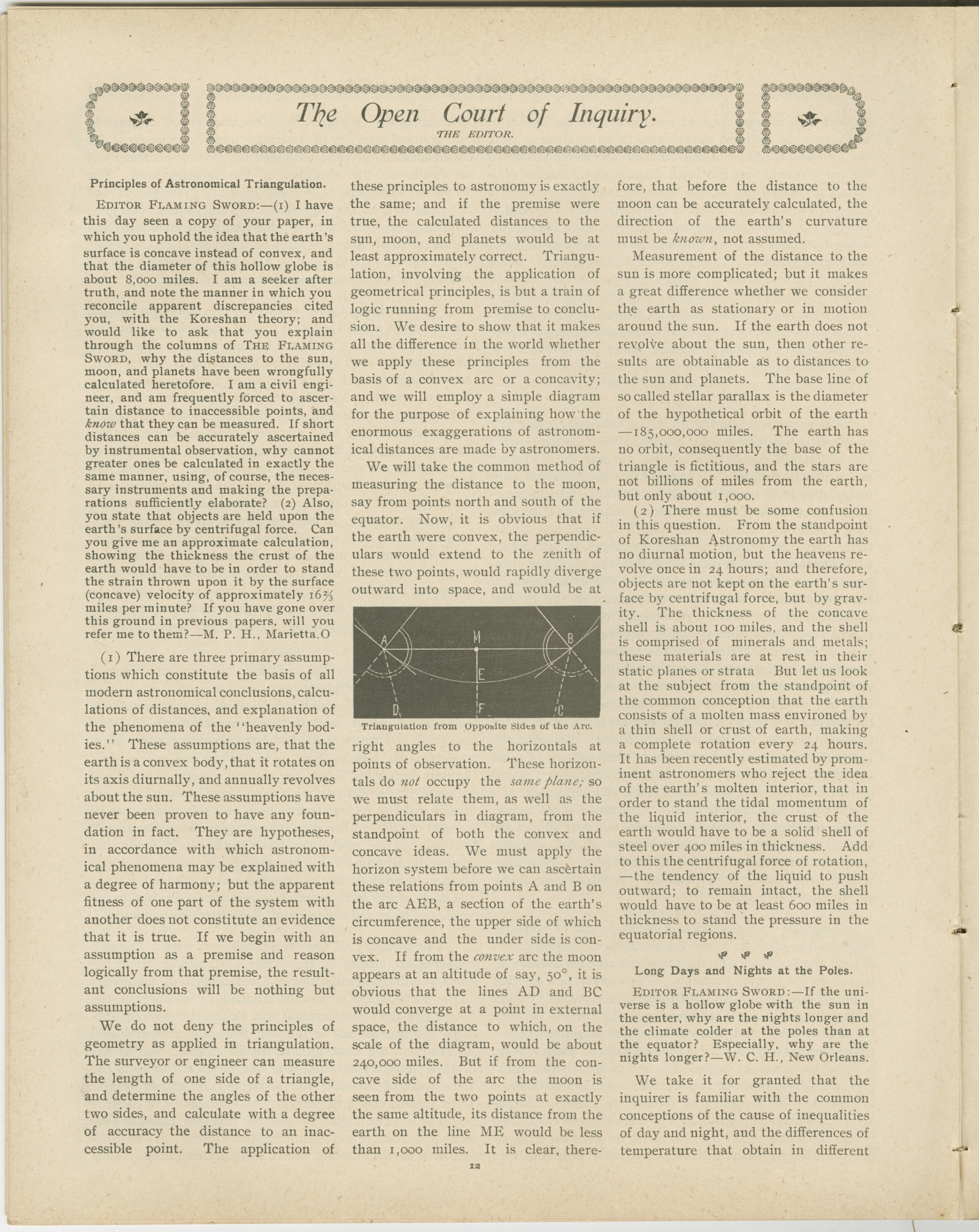
We do not deny the principles of geometry as applied in triangulation. The surveyor or engineer can measure the length of one side of a triangle, and determine the angles of the other two sides, and calculate with a degree of accuracy the distance to an inaccessible point. The application of these principles to astronomy is exactly the same; and if the premise were true, the calculated distances to the sun, moon, and planets would be at least approximately correct. Triangulation, involving the application of geometrical principles, is but a train of logic running from premise to conclusion. We desire to show that it makes all the difference in the world whether we apply these principles from the basis of a convex arc or a concavity; and we will employ a simple diagram for the purpose of explaining how the enormous exaggerations of astronomical distances are made by astronomers.
We will take the common method of measuring the distance to the moon, say from points north and south of the equator. Now, it is obvious that if the earth were convex, the perpendiculars would extend to the zenith of these two points, would rapidly diverge outward into space, and would be at right angles to the horizontals at points of observation. These horizontals do not occupy the same plane; so we must relate them, as well as the perpendiculars in diagram, from the standpoint of both the convex and concave ideas. We must apply the horizon system before we can ascertain these relations from points A and B on the arc AEB, a section of the earth's circumference, the upper side of which is concave and the under side is convex. If from the convex arc the moon appears at an altitude of say, 50°, it is obvious that the lines AD and BC would converge at a point in external space, the distance to which, on the scale of the diagram, would be about 240,000 miles. But if from the concave side of the arc the moon is seen from the two points at exactly the same altitude, its distance from the earth on the line ME would be less than 1,000 miles. It is clear, therefore, that before the distance to the moon can be accurately calculated, the direction of the earth's curvature must be known, not assumed.
Triangulation from Opposite Sides of the Arc.
Measurement of the distance to the sun is more complicated; but it makes a great difference whether we consider the earth as stationary or in motion around the sun. If the earth does not revolve about the sun, then other results are obtainable as to distances to the sun and planets. The base line of so called stellar parallax is the diameter of the hypothetical orbit of the earth—185,000,000 miles. The earth has no orbit, consequently the base of the triangle is fictitious, and the stars are not billions of miles from the earth, but only about 1,000.
(2) There must be some confusion in this question. From the standpoint of Koreshan Astronomy the earth has no diurnal motion, but the heavens revolve once in 24 hours; and therefore, objects are not kept on the earth's surface by centrifugal force, but by gravity. The thickness of the concave shell is about 100 miles, and the shell is comprised of minerals and metals; these materials are at rest in their static planes or strata. But let us look at the subject from the standpoint of the common conception that the earth consists of a molten mass environed by a thin shell or crust of earth, making a complete rotation every 24 hours. It has been recently estimated by prominent astronomers who reject the idea of the earth's molten interior, that in order to stand the tidal momentum of the liquid interior, the crust of the earth would have to be a solid shell of steel over 400 miles in thickness. Add to this the centrifugal force of rotation,—the tendency of the liquid to push outward; to remain intact, the shell would have to be at least 600 miles in thickness to stand the pressure in the equatorial regions.
- --
The source scans remain the record. This page preserves the periodical's argument and reported observations without presenting its conclusions as independently established results. The claims remain attributed to The Flaming Sword.
The Flaming Sword · Vol. 17, No. 3 · 5 Dec 1902 · PDF p. 10