Extracted text
Editorial transcription, lightly normalized from the cited scan pages; historical claims remain those of The Flaming Sword.
Opponents of Koreshanity Busy Searching for Loop-Holes; An Argument Against Koreshan Cosmogony Proves Fatal to Modern Astronomy. A DISCIPLE OF KORESHANITY has recently been confronted with the absurd argument against the Cellular Cosmogony, that the perpendicular of the plumb-line has not been determined; and that until this is demonstrated, the line projected at right angles from the vertical point of the plumb suspended from any given point and extended into the earth or water surface does not settle the question of the contour of the earth. The initial bar of the mechanical device is fixed by the application of a mercurial and spirit-level. The mercurial level is twelve feet long, extending the entire length of the twelve-foot initial section of the Geodetic Rectilineator.
It makes no difference whether the support of this bar is perpendicular, or a solid support deviating any number of degrees from the perpendicular; the fact remains, that the extense from the middle or center of the twelve-foot initial bar, to the surface over which the bar is placed, is perpendicular. The straight line of this bar is at right angles to this absolute perpendicular, as determined by the rectilineal bar and level. Now, the proposition to be discussed is merely this: A mechanical rectiline extended in any direction from the initial point,—the middle of the initial bar of the Rectilineator,—will project into the water or the surface of the earth at a distance proportionate to the height of the rectilineal bar from the ground surface. The earth curves eight inches to the mile. This is determined both by optical and mechanical means.
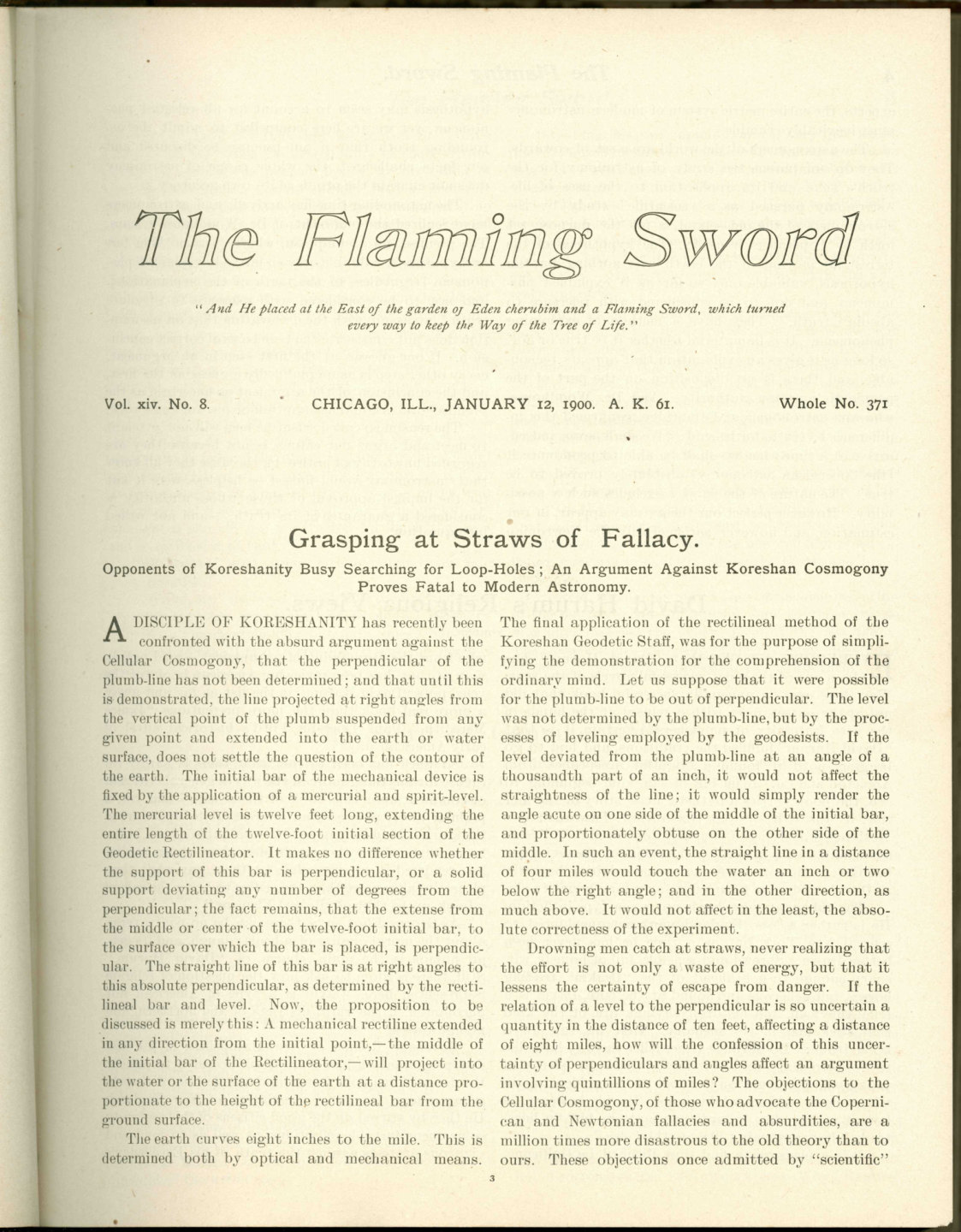
The final application of the rectilineal method of the Koreshan Geodetic Staff, was for the purpose of simplifying the demonstration for the comprehension of the ordinary mind. Let us suppose that it were possible for the plumb-line to be out of perpendicular. The level was not determined by the plumb-line, but by the processes of leveling employed by the geodesists. If the level deviated from the plumb-line at an angle of a thousandth part of an inch, it would not affect the straightness of the line; it would simply render the angle acute on one side of the middle of the initial bar, and proportionately obtuse on the other side of the middle. In such an event, the straight line in a distance of four miles would touch the water an inch or two below the right angle; and in the other direction, as much above. It would not affect in the least, the absolute correctness of the experiment.
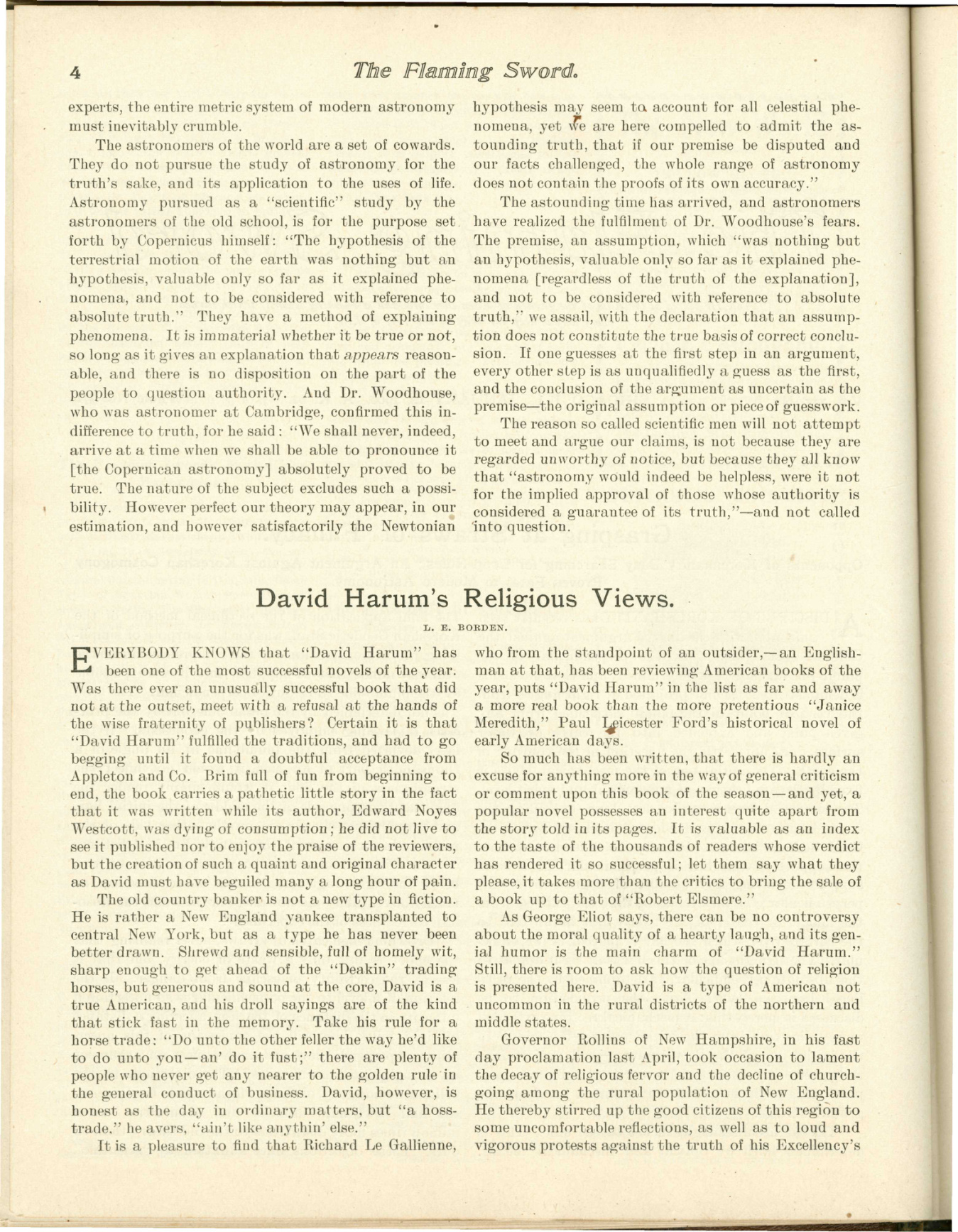
Drowning men catch at straws, never realizing that the effort is not only a waste of energy, but that it lessens the certainty of escape from danger. If the relation of a level to the perpendicular is so uncertain a quantity in the distance of ten feet, affecting a distance of eight miles, how will the confession of this uncertainty of perpendiculars and angles affect an argument involving quintillions of miles? The objections to the Cellular Cosmogony, of those who advocate the Copernican and Newtonian fallacies and absurdities, are a million times more disastrous to the old theory than to ours. These objections once admitted by "scientific" experts, the entire metric system of modern astronomy must inevitably crumble. The astronomers of the world are a set of cowards. They do not pursue the study of astronomy for the truth's sake, and its application to the uses of life. Astronomy pursued as a "scientific" study by the astronomers of the old school, is for the purpose set forth by Copernicus himself: "The hypothesis of the terrestrial motion of the earth was nothing but an hypothesis, valuable only so far as it explained phenomena, and not to be considered with reference to absolute truth." They have a method of explaining phenomena. It is immaterial whether it be true or not, so long as it gives an explanation that appears reasonable, and there is no disposition on the part of the people to question authority.
And Dr. Woodhouse, who was astronomer at Cambridge, confirmed this indifference to truth, for he said: "We shall never, indeed, arrive at a time when we shall be able to pronounce it [the Copernican astronomy] absolutely proved to be true. The nature of the subject excludes such a possibility. However perfect our theory may appear, in our estimation, and however satisfactorily the Newtonian hypothesis may seem to account for all celestial phenomena, yet we are here compelled to admit the astounding truth, that if our premise be disputed and our facts challenged, the whole range of astronomy does not contain the proofs of its own accuracy."
The astounding time has arrived, and astronomers have realized the fulfilment of Dr. Woodhouse's fears. The premise, an assumption, which "was nothing but an hypothesis, valuable only so far as it explained phenomena [regardless of the truth of the explanation], and not to be considered with reference to absolute truth," we assail, with the declaration that an assumption does not constitute the true basis of correct conclusion. If one guesses at the first step in an argument, every other step is as unqualifiedly a guess as the first, and the conclusion of the argument as uncertain as the premise—the original assumption or piece of guesswork. The reason so-called scientific men will not attempt to meet and argue our claims is not because they are regarded unworthy of notice, but because they all know that "astronomy would indeed be helpless, were it not for the implied approval of those whose authority is considered a guarantee of its truth,"—and not called into question.
- --
- --
The source scans remain the record. This page preserves the periodical's argument and reported observations without presenting its conclusions as independently established results. The claims remain attributed to The Flaming Sword.
The Flaming Sword · Vol. 14, No. 8 · 12 Jan. 1900 · PDF pp. 3–4
← Flaming Sword Archive
The Flaming Sword · Vol. 14, No. 8 · Jan. 12, 1900 · PDF pp. 3-4