Extracted text
Editorial transcription, lightly normalized from the scan. Line-break hyphenation, spacing, capitalization, and unmistakable OCR errors have been repaired; the claims remain those of The Flaming Sword.
QUESTIONS ANSWERED BY KORESH.
The theories regarding the character and velocity of light and other "energies," are founded entirely upon false principles. Light, heat, electricity, magnetism, etc., generally denominated energies, are not mere modes of motion, acting on luminous or attenuated ether.
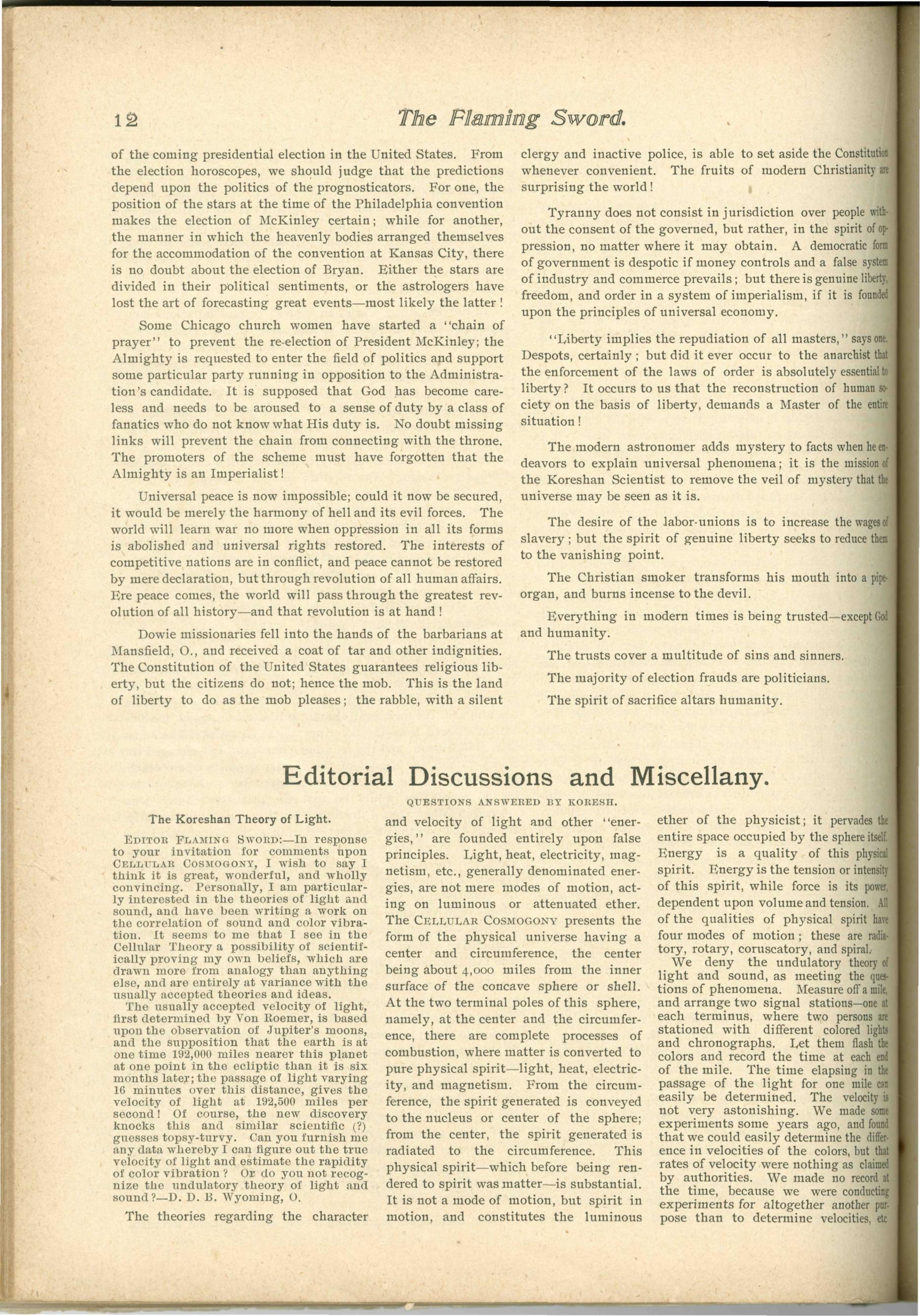
The CELLULAR COSMOGONY presents the form of the physical universe having a center and circumference, the center being about 4,000 miles from the inner surface of the concave sphere or shell.
At the two terminal poles of this sphere, namely, at the center and the circumference, there are complete processes of combustion, where matter is converted to pure physical spirit—light, heat, electricity, and magnetism. From the circumference, the spirit generated is conveyed to the nucleus or center of the sphere; from the center, the spirit generated is radiated to the circumference.
This physical spirit—which before being rendered to spirit was matter—is substantial. It is not a mode of motion, but spirit in motion, and constitutes the luminous ether of the physicist; it pervades the entire space occupied by the sphere itself.
Energy is a quality of this physical spirit. Energy is the tension or intensity of this spirit, while force is its power, dependent upon volume and tension. All of the qualities of physical spirit have four modes of motion; these are radiatory, rotary, coruscatory, and spiral.
We deny the undulatory theory of light and sound, as meeting the questions of phenomena.
Measure off a mile, and arrange two signal stations—one at each terminus, where two persons are stationed with different colored lights and chronographs. Let them flash the colors and record the time at each end of the mile. The time elapsing in the passage of the light for one mile can easily be determined. The velocity not very astonishing. We made some experiments some years ago, and found that we could easily determine the difference in velocities of the colors, but that rates of velocity were nothing as claimed by authorities. We made no record at the time, because we were conducting experiments for altogether another purpose than to determine velocities, etc.
- --
The source scans remain the record.
← Flaming Sword Archive
The Flaming Sword · Vol. 14, No. 44 · · PDF p. 12