Extracted text
Surface of Water Demonstrated by Ocular Evidence to be Not Convex; Specific Tests by Means of the Telescope.
Editorial transcription, lightly normalized from the scan. Line-break hyphenation, spacing, capitalization, and unmistakable OCR errors have been repaired; the claims remain those of The Flaming Sword.
The fundamental premise of the Copernican system of astronomy is the hypothesis that the surface of the earth on which we live is convex. The well-known phenomenon of the disappearance of a ship's hull beyond the horizon of the surface of the sea is one of the principal so called proofs offered in support of the popular theory; it is constantly being urged as an objection to the Koreshan conclusion that the earth is a hollow globe, with its habitable surface concave, instead of convex. If the usual theory were true, specific tests would verify it; if it is fallacious, ocular tests are sufficient to disprove it, and to overthrow the entire system.
In order to appreciate the value and force of such experiments of observation as have been conducted during the past three years by the Koreshan Scientific Staff, it is necessary to consider the ratio of the earth's curvature, and the claims of the advocates of the old school of astronomy. We desire to examine the subject just as it is presented by the astronomer, and subject the theory to the test of the facts of observation. The so called proof is an ocular one, used hundreds of years before the invention of the telescope; and it is but fair, in a scientific age, to submit it to ocular test, with the power of vision increased by telescopic aid.
If the surface of the sea were convex, the water line of the horizon would be the simple apex of the arc of the water's curvature. If the hull of a vessel disappeared on a rotund surface, it would do so because of the simple fact that it has passed to a point below the visual line extending from the eye over the apex or horizon. In other words, the hull would be rendered absolutely invisible by the intervening hill of water. We desire to state the question fairly, so that there can be no quibbling concerning the premise upon which the old system is made to rest.
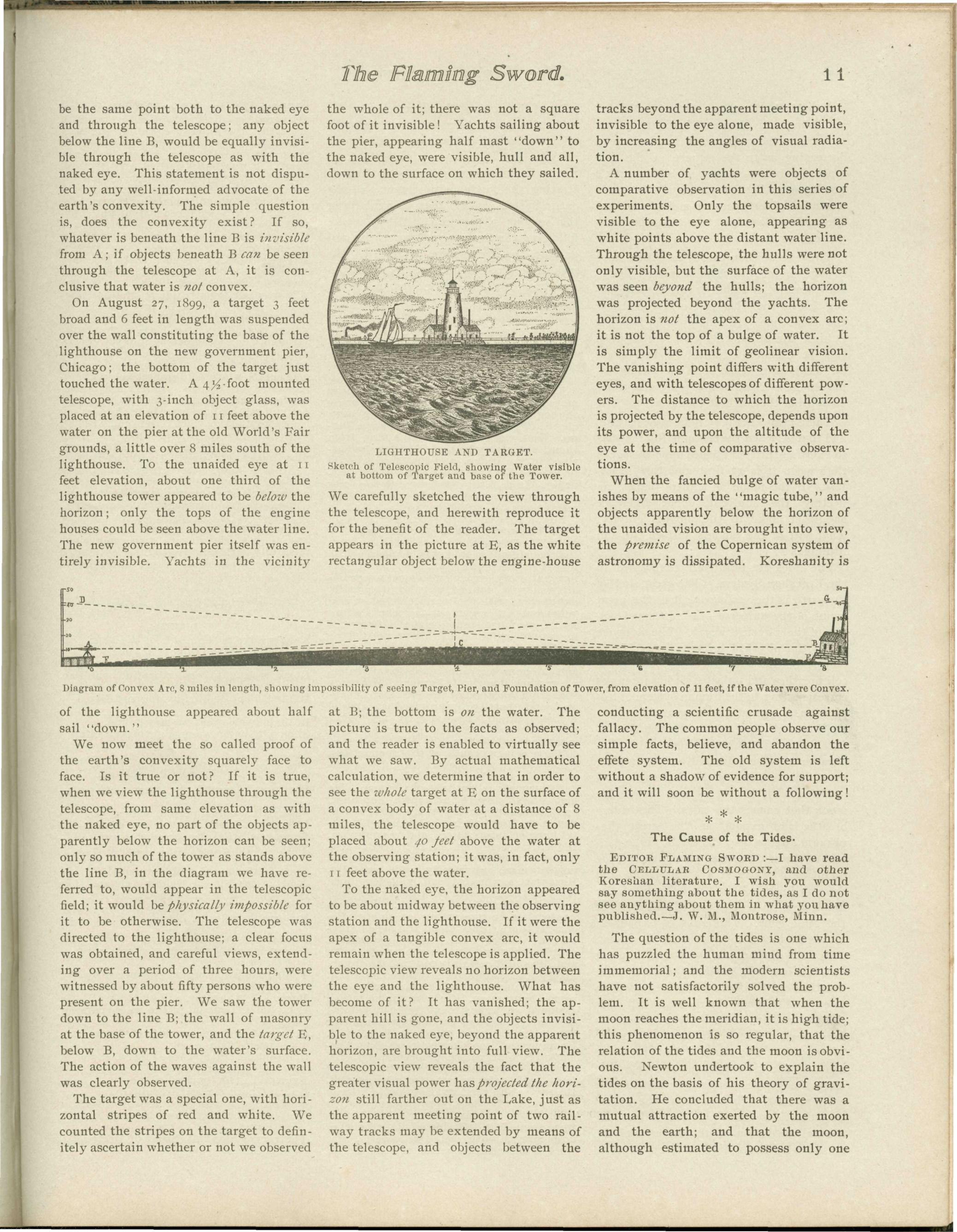
A convex earth 25,000 miles in circumference would manifest a curvation of 8 inches to the mile; or, according to the geometrical formula, the square of the distance in miles, multiplied by 8 inches, gives the declination in inches from the tangent line. In two miles the curvature downward from the tangent would be 32 inches; 3 miles, 6 feet; 4 miles, 10 feet and 8 inches; 8 miles, 42 feet and 8 inches. For the sake of illustration, we refer to the diagram accompanying this article. It represents an arc of convex curvature, 8 miles in length. The line AB is tangent to the apex of the arc at C. The curvature from C to A and B would be equal, because the arcs of declination are equal, amounting, at both A and B, to about 11 feet. From an elevation of 11 feet at A, view the horizon of the convex arc. It is 4 miles away—it is the apex of the hill of water. At B, at a distance of 4 miles beyond C, any object just 11 feet in height is invisible from A, because it is behind the hill. This is a fair and simple statement of the conditions which are affirmed by the astronomer to exist on the sea.
The horizon of such a surface is permanent for a given altitude; it would be the same point both to the naked eye and through the telescope; any object below the line B would be equally invisible through the telescope as with the naked eye. This statement is not disputed by any well-informed advocate of the earth's convexity. The simple question is, does the convexity exist? If so, whatever is beneath the line B is invisible from A; if objects beneath B can be seen through the telescope at A, it is conclusive that water is not convex.
On August 27, 1899, a target 3 feet broad and 6 feet in length was suspended over the wall constituting the base of the lighthouse on the new government pier, Chicago; the bottom of the target just touched the water. A 4½-foot mounted telescope, with 3-inch object glass, was placed at an elevation of 11 feet above the water on the pier at the old World's Fair grounds, a little over 8 miles south of the lighthouse.
To the unaided eye at 11 feet elevation, about one third of the lighthouse tower appeared to be below the horizon; only the tops of the engine houses could be seen above the water line. The new government pier itself was entirely invisible. Yachts in the vicinity of the lighthouse appeared about half sail "down." Through the telescope, the whole of it was visible; there was not a square foot of it invisible! Yachts sailing about the pier, appearing half mast "down" to the naked eye, were visible, hull and all, down to the surface on which they sailed.
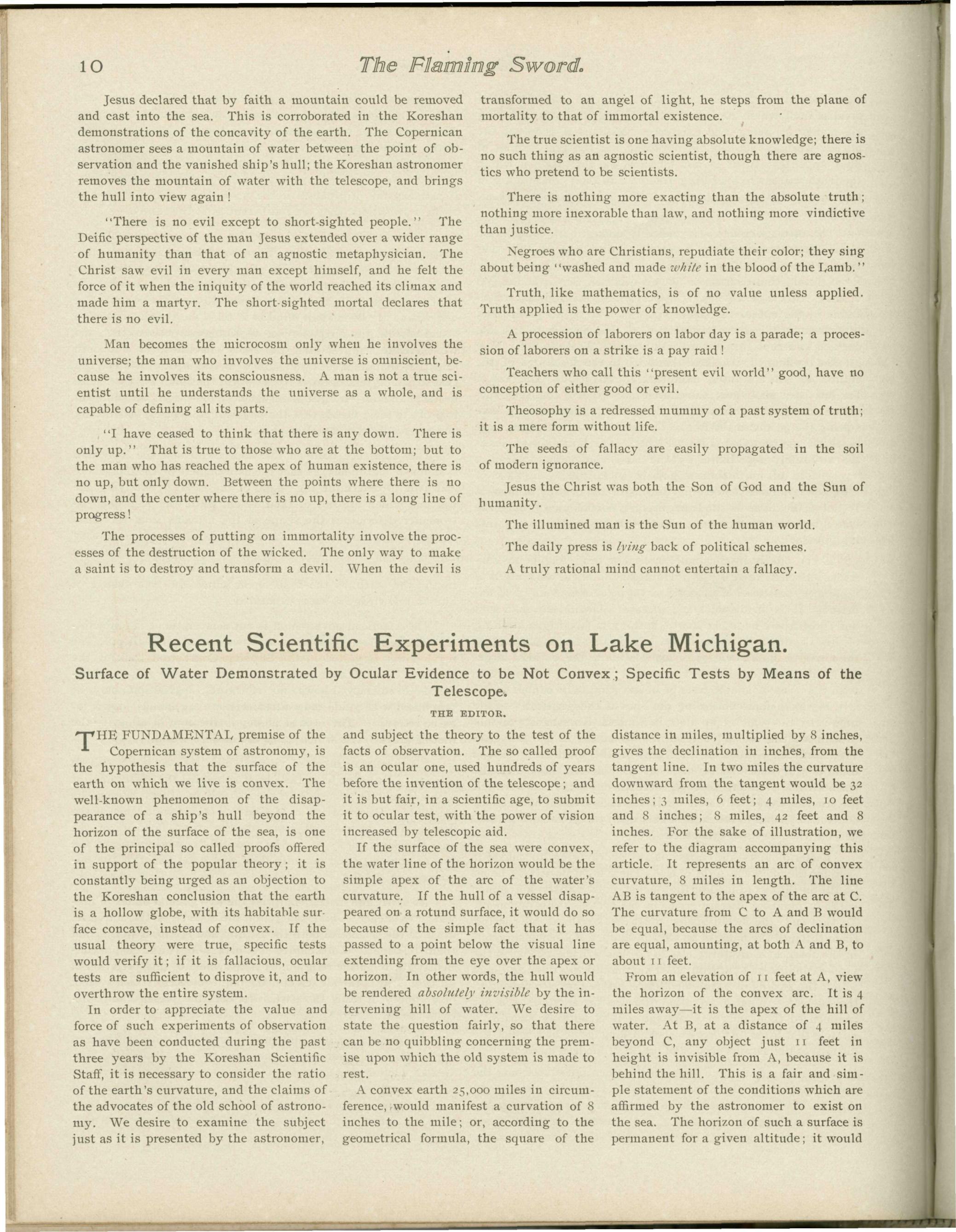
LIGHTHOUSE AND TARGET. Sketch of Telescopic Field, showing Water visible at bottom of Target and base of the Tower.
We carefully sketched the view through the telescope, and herewith reproduce it for the benefit of the reader. The target appears in the picture at E, as the white rectangular object below the engine-house tracks beyond the apparent meeting point, invisible to the eye alone, made visible by increasing the angles of visual radiation. A number of yachts were objects of comparative observation in this series of experiments. Only the topsails were visible to the eye alone, appearing as white points above the distant water line. Through the telescope, the hulls were not only visible, but the surface of the water was seen beyond the hulls; the horizon was projected beyond the yachts. The horizon is not the apex of a convex arc; it is not the top of a bulge of water. It is simply the limit of geolinear vision. The vanishing point differs with different eyes, and with telescopes of different powers. The distance to which the horizon is projected by the telescope depends upon its power, and upon the altitude of the eye at the time of comparative observations.
When the fancied bulge of water vanishes by means of the "magic tube," and objects apparently below the horizon of the unaided vision are brought into view, the premise of the Copernican system of astronomy is dissipated. Koreshanity is conducting a scientific crusade against fallacy.
[Diagram of Convex Arc, 8 miles in length, showing impossibility of seeing Target, Pier, and Foundation of Tower, from elevation of 11 feet, if the Water were Convex.]
We now meet the so called proof of the earth's convexity squarely face to face. Is it true or not? If it is true, when we view the lighthouse through the telescope, from same elevation as with the naked eye, no part of the objects apparently below the horizon can be seen; only so much of the tower as stands above the line B, in the diagram we have referred to, would appear in the telescopic field; it would be physically impossible for it to be otherwise.
The telescope was directed to the lighthouse; a clear focus was obtained, and careful views, extending over a period of three hours, were witnessed by about fifty persons who were present on the pier. We saw the tower down to the line B; the wall of masonry at the base of the tower, and the target E, below B, down to the water's surface. The action of the waves against the wall was clearly observed. The target was a special one, with horizontal stripes of red and white. We counted the stripes on the target to definitely ascertain whether or not we observed at B; the bottom is on the water. The picture is true to the facts as observed; and the reader is enabled to virtually see what we saw.
By actual mathematical calculation, we determine that in order to see the whole target at E on the surface of a convex body of water at a distance of 8 miles, the telescope would have to be placed about 40 feet above the water at the observing station; it was, in fact, only 11 feet above the water. To the naked eye, the horizon appeared to be about midway between the observing station and the lighthouse. If it were the apex of a tangible convex arc, it would remain when the telescope is applied. The telescopic view reveals no horizon between the eye and the lighthouse. What has become of it? It has vanished; the apparent hill is gone, and the objects invisible to the naked eye, beyond the apparent horizon, are brought into full view. The telescopic view reveals the fact that the greater visual power has projected the horizon still farther out on the Lake, just as the apparent meeting point of two railway tracks may be extended by means of the telescope, and objects between the two points brought into range.
The common people observe our simple facts, believe, and abandon the effete system. The old system is left without a shadow of evidence for support; and it will soon be without a following!
The source scans remain the record. This page preserves the periodical's argument and reported observations without presenting its conclusions as independently established results. The claims remain attributed to The Flaming Sword.
← Flaming Sword Archive
The Flaming Sword · Vol. 13, No. 42 · · PDF pp. 10-11